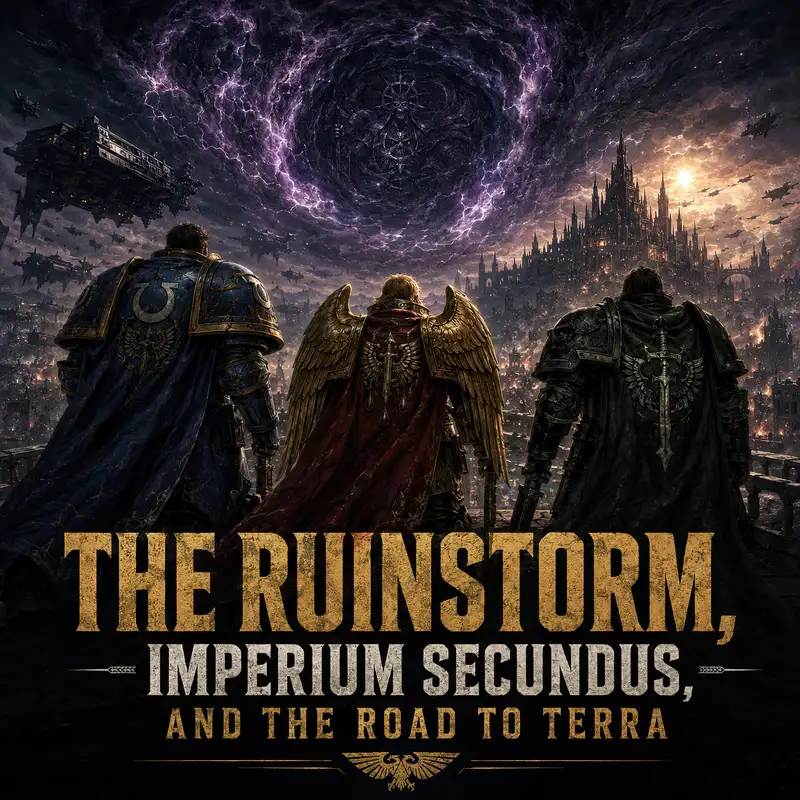
The Ruinstorm, Imperium Secundus, and the Road to Terra
Three loyalist primarchs commanded enough soldiers and ships to break Horus’s rebellion, yet while the Warmaster drove toward Terra, they were governing an empire their father had never ordered them to create. Roboute Guilliman, Sanguinius, and Lion El’Jonson were not cowards, and they had not secretly joined the traitors. They were trapped behind a weapon that attacked navigation, communication, judgment, and trust all at once. That weapon was the Ruinstorm. The uncomfortable question is not simply why these three brothers failed to reach Terra sooner. It is whether Imperium Secundus was a reasonable act of survival, or the moment loyal men came dangerously close to committing treason for all the right reasons?
Horus had understood that the Ultramarines were too powerful to ignore. Guilliman’s Legion was enormous, his realm of Ultramar was wealthy, and its worlds could replace losses that would cripple less organized forces. A direct assault might wound that strength, but it was unlikely to destroy it quickly enough. The attack on Calth therefore served more than one purpose. The Word Bearers shattered fleets, slaughtered warriors, and turned a trusted muster into a massacre. Beneath the military operation lay ritual intent. Erebus and the servants of Lorgar helped unleash a warp catastrophe, while the bloodshed of the Shadow Crusade fed it. Horus did not need every Ultramarine dead. He needed them absent.
The Ruinstorm was not weather in any ordinary sense. It was a vast upheaval in the warp, the hostile dimension through which Imperial ships crossed interstellar distances. Within it, routes twisted, time became unreliable, and the light of the Astronomican could no longer be trusted. Astropaths could not send clear warnings. Navigators stared into madness and found no road. Fleets translated into realspace far from their intended destinations, if they returned at all. Lorgar’s forces possessed knowledge of paths through the disturbance, but the loyalists did not. The eastern Imperium became a darkened house in which every room contained armed men, none of whom knew whether the others were still alive.
That uncertainty was the storm’s greatest achievement. A fleet can respond to an enemy it can locate. A government can endure defeat if it knows where authority remains. Guilliman knew neither. Terra had fallen silent. The Emperor could not be reached. Reports arrived late, broken, or not at all. Refugees brought accounts of betrayal, daemonic attack, and worlds collapsing into private wars. Some commanders continued old orders because no new ones could reach them. Others improvised. A few discovered that isolation provided a convenient opportunity to revise their loyalties. The Imperial response was therefore energetic, heavily armed, and occasionally directed at people who were still on the same side.
Guilliman returned to Macragge with the ruins of Calth behind him and the Five Hundred Worlds under attack. His instinct was to preserve what could still be governed. He gathered loyal forces, restored communications where possible, and prepared Ultramar to survive even if the wider Imperium had died. This was entirely in character. Some primarchs met disaster with fury, some with faith, and Guilliman met it with a contingency plan large enough to require its own throne. Yet he did not immediately proclaim himself Emperor. He understood both the moral danger and the appearance of ambition. A second Imperium led by Roboute Guilliman would look suspiciously like something Roboute Guilliman had wanted all along.
His alternative depended on the Pharos, an ancient alien device hidden beneath Mount Pharos on Sotha. The loyalist Iron Warrior Barabas Dantioch learned to operate it, though not to explain every principle behind it. The Pharos could act as a beacon through the Ruinstorm, drawing lost ships toward Ultramar when the Astronomican could not. Its light was not the Emperor’s light, and that distinction mattered, but it worked. Scattered Legionaries, battered vessels, refugees, and envoys began arriving. Each arrival proved that part of the Imperium still lived. None could prove that Terra did. Macragge became a harbor in a black sea, and Guilliman began building a state around the harbor.
Imperium Secundus was meant to preserve human unity if the original Imperium had been destroyed. Guilliman elevated Sanguinius as its sovereign, because the Angel possessed a moral authority that Guilliman knew he could not manufacture through efficient record keeping. Lion El’Jonson became its supreme military protector. Guilliman retained the work of government, logistics, and administration. On parchment, the arrangement was balanced. Sanguinius embodied legitimacy, the Lion defended the realm, and Guilliman made the realm function. Arrangements involving three primarchs often achieved their finest harmony on parchment.
The decision was not absurd. If Terra had fallen, refusing to organize the surviving loyal worlds would have been an act of paralysis. Humanity needed armies, food, law, shipyards, and a center of command. Guilliman was attempting continuity, not rebellion. He did not renounce the Emperor, bargain with Horus, or declare the Great Crusade a mistake. Yet the foundation remained poisonous. Terra’s fall had not been confirmed. Sanguinius accepted a crown while his father might still live. The Lion swore obedience to a new order whose limits he did not truly accept. Guilliman had created a constitutional answer before establishing whether the old constitution was dead.
Their differences soon became more dangerous than any title. Guilliman believed institutions could restrain power if responsibilities were clearly assigned. The Lion believed that survival sometimes required action before permission. Sanguinius stood between them, admired by both and fully trusted by neither. He also carried visions of his own death at Horus’s hands. These were not vague nightmares. They had pursued him since Signus, suggesting that he would face Horus at the end of the war and die. Konrad Curze suffered from similar prophetic visions, but drew the opposite conclusion. Sanguinius believed foreknowledge demanded courage. Curze believed it abolished responsibility.
The Night Haunter arrived at Macragge as an unintended passenger in the Lion’s war. Curze had hidden aboard the Dark Angels flagship after the Thramas campaign, then escaped into the new capital. He turned Macragge’s mountains, cities, and political resentments into hunting ground. Bombings and murders spread fear. Rebels and criminals became tools in a private war against his brothers. Curze did not need to conquer Imperium Secundus. He needed to demonstrate that its rulers could not protect their own capital without becoming what they claimed to oppose.
The Lion answered terror with methods designed for exterminating threats, not reassuring citizens. He imposed martial law and unleashed the Dreadwing in the hunt for Curze. Regions suspected of sheltering the Night Haunter suffered devastating attacks. Guilliman saw his authority ignored and his world treated as hostile territory. The Lion saw hesitation that allowed a monster to keep killing. Sanguinius issued commands that the Lion bent or defied when he judged them impractical. Imperium Secundus had acquired an Emperor, a protector, and a government, yet it could not settle the basic question of who gave the final order. Curze’s campaign succeeded even before he was captured.
The Pharos then drew another enemy. Night Lords attacked Sotha, seeking control of the beacon that held the isolated realm together. The defenders were badly outmatched. Dantioch, once condemned by his own Legion for refusing Perturabo’s path, chose to destroy himself rather than surrender the device. He overloaded the Pharos, crippling the attackers and enabling loyalist relief forces to arrive. He died with Alexis Polux of the Imperial Fists beside him, a former enemy mourning him as a brother. The beacon survived in damaged form, but its apparent promise had been exposed. Imperium Secundus rested on a machine no one fully understood, defended by men whose sacrifices could not be repeated indefinitely.
Curze’s capture did not restore unity. His public trial became an indictment of the judges. He admitted what he had done while denying moral responsibility, claiming that fate had made him what he was. He exposed the Lion’s secret violence and provoked another rupture between the brothers. More importantly, Curze’s certainty about his own future offered Sanguinius a terrible line of reasoning. Curze believed he would one day be killed by an assassin sent by the Emperor. Sanguinius still foresaw himself dying at Horus’s hands during the war’s final confrontation. If these visions held any truth, then the Emperor lived, Terra had not fallen, and the crown on Macragge was not a necessary inheritance. It was an error.
Imperium Secundus ended because its central assumption could no longer be defended. There was no comfortable way to dissolve it. Guilliman could explain the logic, and the logic was strong, but logic did not remove the oath he had risked breaking. Sanguinius could surrender the title, but he could not forget that he had accepted it. The Lion could return to military purpose, but the damage to trust remained. They had not become traitors, yet they understood how the act would look to Rogal Dorn, Malcador, and the Emperor. Their answer was not to debate the matter further. They would cross the Ruinstorm, reach Terra, and place themselves under their father’s judgment.
Vast portions of the Ultramarines, Blood Angels, and Dark Angels departed Ultramar. The fleet represented enough power to transform the war, which was precisely why the storm had been raised to contain it. Even the Lion’s secretive engines and devices could not provide a clean route. Warp jumps produced little progress. Ships vanished or emerged damaged. Navigators failed. The fleet was forced to fight for information as often as it fought for territory. At Anuari, the loyalists defeated traitor forces and captured corrupted Navigators who could perceive routes through the storm more clearly than their loyal counterparts. The road to Terra would be shown by servants of the enemy. No one involved considered this ideal.
The Ruinstorm also attacked the strengths of the three primarchs. Guilliman was tempted to believe that every hostile thing could be cataloged, studied, and turned into an asset. He preserved captured ritual blades for examination rather than destroying them. The decision was rational, which made it dangerous. The Lion was tempted by decisive destruction, the belief that any barrier could be removed if sufficient force were applied quickly enough. Sanguinius was tempted by sacrifice, because a man convinced that he must die can begin to treat death as the answer to every problem. Chaos did not offer them crude villainy. It offered each brother a corrupted version of his finest quality.
At Pyrrhan, the fleet confronted an obstacle that made conventional strategy almost meaningless. A daemonic fortress on the scale of a star system blocked their passage, its immense walls anchored to reality by infernal forges on the world below. The combined guns of three Legions could not batter through it. Sanguinius recognized that the structure was not truly built in the material universe. Destroying the anchor might collapse the impossible wall. The loyalists therefore attacked Pyrrhan, advancing through endless daemonic hosts while the fortress guns tore at the fleet above.
The battle required the three Legions to behave according to their deepest traditions. The Dark Angels formed unyielding lines and held ground against creatures that did not respect ordinary death. The Ultramarines attacked across several fronts, forcing structure upon a battlefield designed to reject it. The Blood Angels drove toward the heart of the forge with Sanguinius at their head. Inside, the Angel endured visions of his death and of alternate futures in which Horus fell by his hand. He struck through the illusion and destroyed the forge’s heart. Pyrrhan collapsed, the gate failed, and the fleet forced its way onward. They had breached the wall, but the storm’s center still waited.
That center was Davin, the world where Horus had first been turned from wounded Warmaster into willing rebel. The place had become more than a corrupted planet. It was an anchor for the Ruinstorm and a monument to the first successful temptation of a primarch. Sanguinius insisted on descending rather than destroying it from orbit. He even took Curze with him, seeking the insight of the one brother who treated prophecy as a prison. The Lion came close to ordering the world annihilated despite Sanguinius being on its surface. He stopped. That restraint mattered. The road forward would not be opened by each brother following his worst instinct.
In the temple where Horus had been corrupted, Sanguinius confronted the meaning of his visions. A portal drew him into a false future in which he had defeated the traitors, received the Emperor’s praise, and become ruler of a purified Imperium. It was everything Imperium Secundus had pretended not to be. Sanguinius recognized the deception. The figure wearing his father’s face was the daemon Madail, a herald of Chaos Undivided and one of the powers behind the storm. Madail offered the Angel more than a throne. It offered him victory over Horus and deliverance for his sons from the madness waiting in their blood, the curse later known as the Black Rage.
This was the temptation that could reach Sanguinius. Personal power alone was not enough. The promise that his sons might be spared gave surrender the appearance of love. Madail’s bargain also exploited prophecy. If Sanguinius believed his death was fixed, then accepting another path could be called freedom. If he believed the future could change, then perhaps service to Chaos could be justified as the price of saving the Blood Angels. The trap was shaped so that either interpretation led toward submission. Sanguinius refused it. He chose neither passive obedience to fate nor escape through corruption. He chose to continue toward the death he feared without allowing that fear to decide what he became.
While Sanguinius fought within the portal, Guilliman and the Lion battled together to reach him. Their rivalry did not vanish, but necessity forced them into genuine cooperation. Above Davin, the fleet faced ships that had been lost to the warp and returned as living engines of corruption. Destroyed vessels seemed to feed the enemy. Guilliman’s flagship was lost in the struggle. On the surface, daemons poured into reality as the primarchs fought toward their brother. Sanguinius’s Herald finally took the Angel’s place in the collapsing portal, sacrificing himself so that Sanguinius could escape. The act was not a convenient rescue. It was a reminder that destiny in this war was borne by more than primarchs.
The loyalists evacuated and subjected Davin to cyclonic bombardment. The world died. With its material anchor destroyed, the daemon fleet vanished and the Ruinstorm began to weaken. A breach opened toward Terra. Yet Horus had anticipated that possibility and placed forces across the route. The three primarchs could not simply sail together into the Sol System. Guilliman and the Lion turned their fleets against the blockade, creating the opening Sanguinius required. The Blood Angels broke away and raced for Terra, carrying the one primarch whose presence would become essential to the defense of the Imperial Palace.
Guilliman and the Lion did not arrive before the Siege. Their absence was not the result of indifference, nor was it proof that Imperium Secundus had been a hidden rebellion. They spent the remaining approach fighting through delaying positions, traitor strongholds, and routes prepared specifically to consume their time. Horus understood that Guilliman’s fleet could decide the war if it reached Terra intact. Every day of delay therefore mattered. The Ultramarines became the threat approaching from behind, while the Dark Angels carried their own war into traitor territory. The Warmaster’s campaign acquired a deadline. He had to take the Throneworld before the forces beyond the storm closed upon him.
Imperium Secundus remains disturbing because it cannot be dismissed as simple treachery. Guilliman acted from incomplete information and attempted to preserve the Emperor’s work. Sanguinius accepted authority he did not desire because his presence could hold the survivors together. The Lion defended the realm with the methods that had always made him effective, until those methods threatened the realm itself. Each remained loyal. Each also crossed a line that loyalty alone could not make harmless. Chaos had created a situation in which responsible action and disobedience could wear the same uniform.
That was the true purpose of the Ruinstorm. It did not merely keep three Legions away from Terra. It separated decision from certainty. It forced loyalists to choose without knowing whether the authority they served still existed, then ensured that every choice carried the scent of betrayal. Imperium Secundus was the political wound left by that isolation. The road to Terra opened only when its rulers admitted their error, trusted one another just enough, and passed through the place where Horus had first fallen.
Sanguinius emerged from the breach and flew toward the fate he had always seen. Behind him, Guilliman and the Lion turned toward the enemy guns to buy the necessary time. The second Imperium disappeared, its crown surrendered and its banners lowered, but the time spent building it could not be reclaimed. The Ruinstorm was broken. The hours it had stolen were already waiting at Terra.