The Rangdan: The Enemy History Tried to Erase
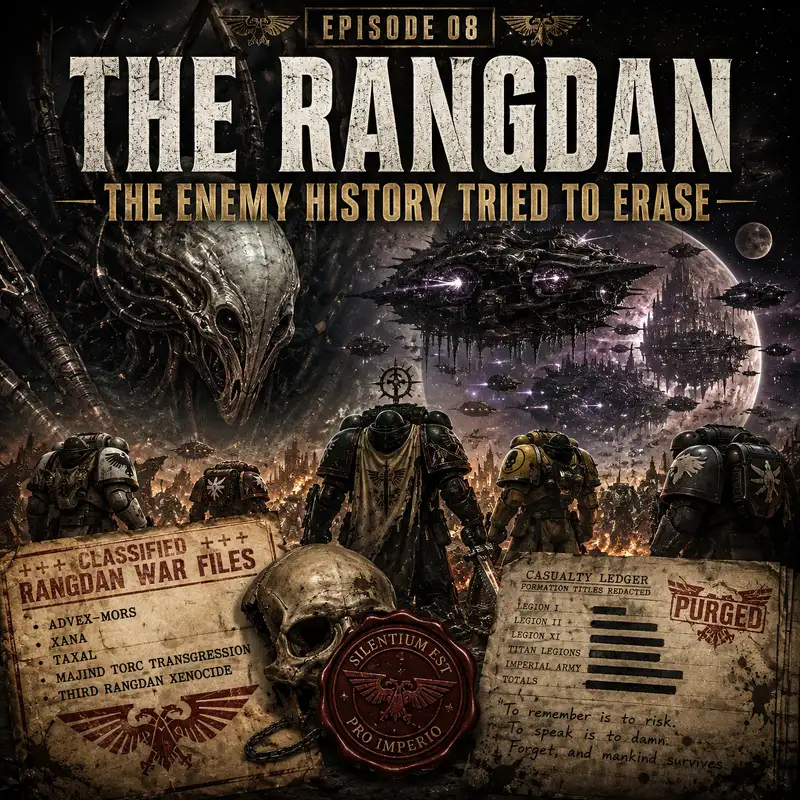
The archive does not begin with a battle. It begins with a missing page. A campaign seal survives, but its report has been cut away. A casualty ledger lists formations that no longer appear in any order of battle. Star charts preserve quarantine lines around nameless systems. Behind those absences stand the Rangdan, an enemy vast enough to threaten the Great Crusade, and dangerous enough that victory was followed by an attempt to destroy its memory.
The Rangdan were not forgotten because ten thousand years passed and clerks misplaced the paperwork. The surviving record points toward deliberate suppression. Veterans were sworn to silence. Tainted worlds were abandoned. Relics were hidden under guard. Later histories contradicted one another so sharply that contradiction became evidence. The mystery is not simply what the Rangdan were. The deeper question is why the Imperium feared an accurate account of defeating them almost as much as it feared the enemy itself.
This war unfolded during the Great Crusade, when the Imperium still presented itself as a rational project of human reunification. Its fleets moved outward with primarchs, Space Marine Legions, the Imperial Army, Titans, and the Mechanicum. Officially, this was inevitable unity. In practice, inevitability required extraordinary amounts of ammunition. Most opponents were overwhelmed or made examples of. The Rangdan did something much worse. They forced the Imperium to fight as though its survival was uncertain.
The earliest major clash is usually placed at Advex-Mors in the late eight hundred and thirties of the thirtieth millennium. A pioneer force found a Rangdan outpost, and the First Legion was sent to destroy it. The fighting lasted months. Some accounts record five thousand Space Marines lost, an appalling price for a forward position. The Imperium had not found the heart of an empire. It had kicked a door and discovered something looking back.
Even the enemy's name is unstable. Surviving texts call them the Rangda, the Rangdan Cerabvores, or the Rangdan Osseivores. Those terms may describe one species, several castes, or Imperial attempts at classification. Their appearance is only fragmentarily recorded. Some accounts describe grey, faceless forms. Others emphasize their capacity for imitation. None provides the clarity of a field manual, inconvenient when soldiers had to identify the enemy before it borrowed a familiar face.
Their vessels were more consistently remembered, perhaps because warships are difficult to mistake for anything friendly. Rangdan craft were described as brutal, organic-looking masses surrounded by spines, flails, and metallic tendrils, like predatory creatures drifting through the void. Their weapons included radioactive electromagnetic discharges called shadow blasters. The name came from the marks left behind when living bodies were caught in the blast. That detail survived. The names of many of the dead did not.
The Rangdan also fielded artificial war-moons crewed by populations measured in the millions. These were more than stations with large guns. They were mobile instruments of conquest, packed with slave cohorts controlled through neural devices and driven against enemy worlds. The Rangdan way of war appears to have depended upon turning conquered peoples into expendable mass. It was cruel and strategically useful. Every captured population became another layer of troops the Imperium had to kill before reaching their masters.
Behind those slave armies stood Rangdan elites who were reportedly capable of meeting a Space Marine in direct combat. Their shields and weapons may have exceeded Imperial equivalents. Their commanders did not throw bodies forward without thought. They used vast subordinate forces to exhaust defenders, reveal positions, and consume ammunition before committing their best troops at the chosen point. The method was coldly professional. The Imperium had encountered a rival power that understood attrition, operational depth, and the value of making someone else die first.
Some records attribute frightening mimetic abilities to the Rangdan. The limits are never settled. They may have copied forms, infiltrated populations, or created controlled servants difficult to distinguish from uncorrupted humans. Even the possibility changed the war. A conventional enemy can be pushed back across a border. An enemy able to hide inside refugees, auxiliaries, or recovered personnel turns every rescue into a security problem. Compassion becomes vulnerability, and suspicion becomes doctrine. The Imperium has rarely needed much encouragement in that direction.
Then there is the connection to the Slaugth. Imperial fragments associate Slaugth murder-minds with the Rangdan, while later tales place Slaugth in their wake, harvesting corpses and survivors. This does not prove that the Slaugth ruled the Rangdan, that the Rangdan ruled the Slaugth, or that they were the same species. They may have been masters, allies, parasites, or scavengers. The surviving evidence supports the relationship. It does not settle its nature.
Destroying the outpost at Advex-Mors appears to have delayed the greater threat. Then, around eight hundred and sixty-two, the Rangdan advanced from the galactic north and east in force. Thousands of vessels and multiple war-moons struck the frontier. Expeditionary fleets disappeared without survivors. Garrison systems fell before distant commands understood the attack. The Great Crusade had been designed to expand along many fronts. The Rangdan exploited that spread and turned Imperial momentum into dangerous overextension.
The collapse reached far beyond human infantry. Accounts speak of entire expeditionary fleets destroyed, dozens of Titan Legions ruined, and worlds rendered unusable. Some texts use the ominous claim that whole Space Marine Legions were lost to the Imperium. That wording is imprecise. It might mean annihilation, isolation, corruption, political disgrace, or something later historians were forbidden to define. Imperial archives are often most revealing when grammatically evasive.
The White Scars and Raven Guard slowed the advance while larger forces gathered. At the forge world of Xana, warriors of both Legions fought a holding action lasting eight months. Thousands of Space Marines and Mechanicum troops were spent buying time. Xana was not defended because anyone believed the position comfortable. It was defended because the alternative was to let the Rangdan break deeper into the growing Imperium, where richer, less prepared worlds waited.
The Dark Angels and Death Guard brought relief. The siege was broken, but this was not the end of the war. It was when the Imperium prevented immediate defeat. Victory proclamations tend to blur the difference. The conflict widened across systems and decades. Reinforcements arrived from multiple Legions. Army formations vanished into campaigns that left little beyond unit numbers and death notices. The front became a region rather than a line.
One reconstruction describes twenty years of war, nineteen systems devastated, nine Legions committed, and three primarchs at the assault on Taxal. It places more than three hundred thousand Astartes in that operation. Other records dispute the sequence and dates, but not the scale. The Rangdan wars consumed forces comparable to those later associated with the opening catastrophes of the Horus Heresy. The difference is that the enemy was not supposed to have existed afterward.
Casualty figures are difficult to trust, yet even conservative fragments are severe. Tens of thousands of Space Marines died across the campaigns. Millions of Imperial Army personnel were lost. Titan engines, treated elsewhere as walking relics, vanished by entire formations. The accounting becomes vague precisely where the totals become enormous. This may reflect damage. It may also reflect a bureaucracy discovering that numbers can be classified when they become politically embarrassing.
No Legion carried the wound more visibly than the Dark Angels. The First Legion had stood at the summit in size, prestige, and access to weapons from Old Night. The Rangdan campaigns reduced that strength drastically. One tradition claims that fifty thousand Dark Angels died in the later fighting alone. Whatever the number, the losses ended the First Legion's numerical supremacy and helped make the Ultramarines the largest.
For Lion El'Jonson, the wars established a reputation that never entirely left him. He was brilliant, relentless, and secretive. Against infiltration, slave control, and unsafe technologies, those qualities were useful. They also made the Lion difficult for his brothers to read. He emerged as a hunter of monsters, accustomed to sealed orders, forbidden weapons, and victories that could not be explained to those who paid for them.
At the darkest point, a surviving record attributes the turning of the war to the Emperor and the breaking of something called the Labyrinth of Night. The phrase is opaque. It has encouraged theories about ancient powers beneath Mars, but the text confirms none. What matters is that the intervention was extraordinary enough to be remembered, yet sensitive enough to remain undefined. The Imperium used something it did not want later generations to examine.
That silence creates a boundary. We can say the Emperor intervened. We can say the Labyrinth of Night appears in the account. We cannot say what was released, activated, opened, or sacrificed. The absence is tempting because Warhammer history trains us to suspect that every locked vault contains a worse decision. Sometimes it is correct. Sometimes the vault contains only another locked vault, because Imperial record keeping has a sense of humour and it is not a generous one.
The surviving chronology contains stranger fragments. During the Majind Torc Transgression, a vessel known as a Basemekanic barque broke the northeastern blockade and struck the world of Majind, activating a macrobeast within. The Death Guard suffered severe losses before Space Wolves intervention prevented wider disaster. No clear account explains the creature, the method used against it, or why the incident belonged to the Rangdan cordon. It survives like a scorched photograph, enough to prove something happened, not enough to make it safe.
By eight hundred and eighty-two, a battered Rangdan fleet was reportedly destroyed. Worlds judged too contaminated to recover were abandoned. Interdiction stations were established. Surviving veterans faced oaths of silence or elimination. That is not the behaviour of a government protecting tactical details. It suggests fear that knowledge itself carried risk, whether through enemy influence, forbidden Imperial methods, political scandal, or all three at once.
The Third Rangdan Xenocide is even harder to reconstruct. Most accounts place it in the eight hundred and nineties, led by the Dark Angels and Space Wolves under the Lion and Leman Russ. Beyond that, the stories separate. One version has the Rangdan again bring the northern Imperium close to ruin. Another describes the discovery of the Rangdan home systems followed by a rapid, carefully planned extermination. Both claim victory. They do not describe the same war.
In the cleaner account, White Scars scouts locate the remaining enemy worlds. The Dark Angels and Space Wolves then spend roughly a year crushing resistance and ruining the Rangdan heartland. It reads like history an empire prefers. The enemy is found, the correct forces are assigned, and extermination proceeds efficiently. Losses become proof of resolve rather than evidence of near failure. The file closes with the useful assurance that nothing remains.
The darker account describes years of purges, including worlds touched by Rangdan influence. Some of those worlds may have contained human populations. If infiltration and neural control were widespread, commanders may have judged liberation impossible. The distinction between occupied territory and contaminated territory then disappeared. A planet need not resist. It merely had to be considered unsafe. The solution was applied from orbit.
These versions may describe different parts of the same final process. The surviving Rangdan centres could have been destroyed quickly after a much longer period of containment, investigation, and systematic purging. The tidy one-year victory may be an official ending attached to a decade no one wished to name. Empires prefer anniversaries to aftermaths. A single date can be engraved on a monument. Twenty years of quarantines and executions are harder to fit beneath an eagle.
The word xenocide should not be softened. The Imperial aim was not a border, a new government, or the destruction of a fleet. It was the elimination of a species and everything judged irreversibly connected to it. The Rangdan were themselves conquerors who enslaved populations on a massive scale. That explains why the Imperium fought. It does not transform extermination into a clean act. In this setting, two monstrous systems can meet without either becoming morally improved by the collision.
The choice of the Dark Angels and Space Wolves for the final work is revealing. The Lion's Legion possessed secret orders, specialized formations, and weapons for threats others could not study. Russ and his sons carried the reputation of executioners, deserved or cultivated. Together they represented two forms of violence. One was cold, compartmented, and technically precise. The other was personal, punitive, and meant to leave no doubt that judgment had been carried out.
The lost Second and Eleventh Legions haunt every discussion of the Rangdan because fragments place them somewhere in the wider theatre. A field guide names both among Imperial forces. Other records speak loosely of Legions being lost. Later history erased their primarchs' names and fates. Readers understandably connect these absences. It is not responsible to pretend the connection has been proven.
No confirmed account shows a lost primarch joining the Rangdan, falling to them, dying there, or having his Legion absorbed. No reliable scene shows the Emperor ordering a brother erased because of Rangda. Those are theories built from adjacent silences. Some are elegant. Some are entertaining. None has crossed the line into established history. The mystery becomes less interesting when speculation loses its warning label.
Still, the lost Legions may help explain the scorched archive. Even if their disgrace was unrelated, campaign records could preserve names, commands, genetic data, and witnesses contradicting the official erasure. Deleting a primarch is difficult when logisticians recorded where his ammunition went. Deleting two during a war involving nine Legions requires a broader fire. The Rangdan files may have been burned partly because other secrets were stored beside them.
The Imperium also had an ideological reason to erase the scale of the defeat. The Great Crusade depended on human unity under the Emperor appearing necessary and unstoppable. The Rangdan demonstrated that the project could be outmatched, surprised, and driven backward. They forced the Emperor to intervene with an unnamed power. They destroyed formations the Imperium considered nearly invincible. Remembered accurately, the war was not simple proof of Imperial strength. It would be evidence that the new order had nearly died before it could declare itself eternal.
Practical security mattered as well. If Rangdan technology controlled populations, mimicry compromised identification, and Slaugth followed their advance, archives might contain more than history. They could include samples, command protocols, maps to sealed sites, or forbidden weapons. The Imperium secures dangerous knowledge by restricting it, surrounding it with ritual, and forgetting why. This is not ideal information management, but it does produce impressive doors.
The Dark Angels created a secret body known as the Order of Broken Claws to study the Rangdan and prepare for a possible return. It remained active after the supposed extermination, guarding relics at Advex-Mors. Its continued existence undermines the cleanest victory narrative. If the Rangdan were certainly extinct, specialists would not need to watch sealed artifacts. The guardians suggest that the people closest to the war did not trust the official ending.
Erasure was not the opposite of remembrance. It was a controlled form of remembrance. The public history was cut away, while selected institutions retained weapons, specimens, procedures, and warnings. Citizens were told nothing. Soldiers knew only their orders. A narrow circle preserved enough to act if the nightmare returned. This is how the Imperium handles truth. It does not destroy every fact. It turns facts into privileges, and privileges into secrets that can outlive the reasons for keeping them.
That system has consequences. When knowledge is buried, commanders cannot learn from it. When veterans are silenced, their experience dies with them. When war becomes a heroic sentence, costly mistakes become available for repetition. The Imperium gained security in the short term and ignorance in the long term. Ten thousand years later, it has fragments, relics, and warnings, but no complete account of the enemy that nearly broke its northern frontier.
The Rangdan remain frightening without a definitive portrait. Their menace is visible through negative space. We see vanished fleets, reduced Legions, erased Titans, quarantined worlds, and an Imperial intervention no chronicler explained. We see the Dark Angels transformed by the campaign and secret orders maintained after victory. The enemy's face is missing, but the wound remains.
History tried to erase the Rangdan because truth exposed too much. It would have shown that the Great Crusade was vulnerable. It might have preserved traces of the lost Legions. It would document weapons and decisions intolerable even by Imperial standards. It may also have provided a map back to surviving contamination. The suppression was military censorship, political surgery, and ritual burial of the same evidence.
The final irony is that the erasure only half succeeded. We cannot describe the Rangdan confidently, but the Imperium feared them enough to mutilate its own memory. In the sealed dark, an order watched relics from a species officially destroyed. Somewhere else, a ledger still carried the cost after every name had been removed. The Rangdan were erased from history, but the hole left behind is almost large enough to see them through.