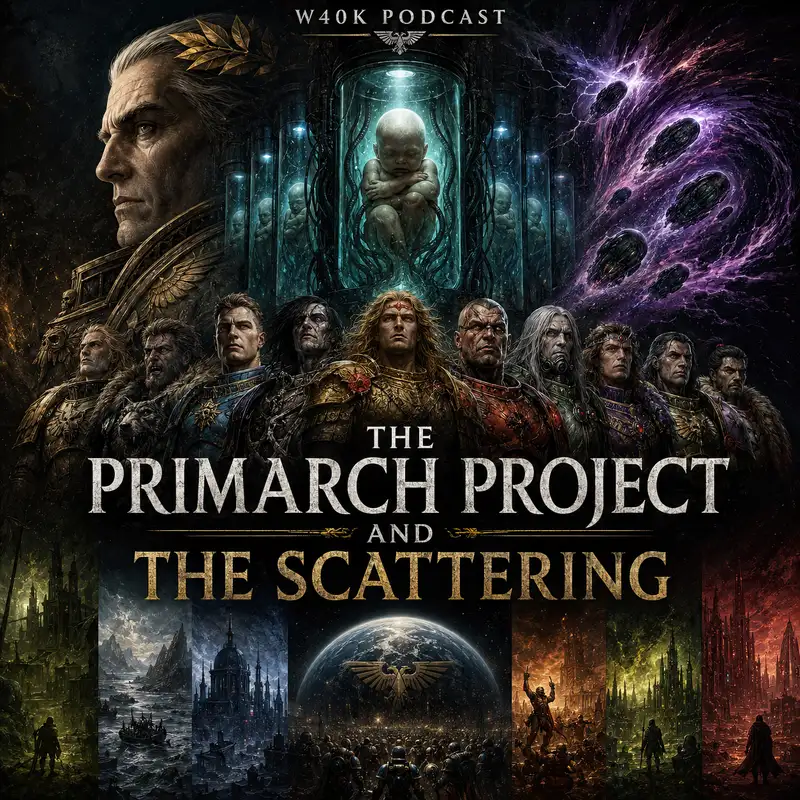
The Primarch Project and the Scattering
Twenty sealed chambers stood beneath Terra, each holding a child who had never seen a sky. They were not infants in any ordinary sense. They were gene-forged beings of immense physical and psychic potential, created to command armies that did not yet fully exist. Then the protections around the chambers failed. The laboratory filled with the pressure of the Warp, the capsules were torn from reality, and the Emperor’s sons vanished before he could raise them. The greatest military project in human history lost all of its commanders at once.
That disappearance is called the Scattering, a name almost gentle enough to hide what occurred. It was the moment the Emperor lost control of his creations. The Primarch Project had been intended to produce twenty leaders shaped by design, education, and purpose. Instead, the galaxy educated them. Some were raised by statesmen, some by warriors, some by tyrants, and some by no one. When the Emperor found them, they were no longer unfinished weapons waiting for orders. They were men with kingdoms, loyalties, injuries, and names.
The project grew from the brutal necessities of Terra’s Unification Wars. The Emperor had already created the Thunder Warriors, formidable transhuman soldiers who crushed the techno-barbarians of Old Earth. They were powerful, but unstable, short-lived, and poorly suited to a war that might continue for centuries across thousands of systems. Conquering Terra required shock troops. Reuniting humanity required armies that could cross the void, adapt to alien wars, and remain in the field for generations. It also required commanders able to think on a scale no ordinary human could sustain.
The primarchs were meant to answer that need. They were not simply larger Space Marines. Each primarch was a unique genetic source from which one of the Space Marine Legions would be developed. The Space Marines were diminished reflections of their gene-sires, carrying fragments of a primarch’s physical traits and aspects of his temperament. Each son was intended to command the Legion created from his line. A Legion could break a world. A primarch was expected to decide how and why it should be broken, then determine what ought to replace it.
Their abilities were deliberately varied. Some grasped siegecraft, logistics, fortification, or rapid manoeuvre. Others excelled at diplomacy, psychological warfare, covert action, craftsmanship, administration, or psychic inquiry. These were not neat specialties stamped onto identical bodies. Their talents overlapped and sometimes contradicted one another. The Emperor was building a command structure broad enough to conquer a galaxy, not ceremonial champions. Their range suggests that some were intended for work beyond the Crusade, although no reliable blueprint for that future survives.
Imperial myth prefers the Emperor creating his sons alone, a golden figure working in splendid isolation. The surviving accounts are less tidy. The project drew upon hidden laboratories, genetic savants, ancient knowledge, and close associates. Amar Astarte helped translate the primarch gene-lines into the warriors who would bear the name Astartes. Erda, an ancient human and geneticist of exceptional ability, later claimed that her genetic material had been combined with the Emperor’s. She therefore regarded herself as the primarchs’ mother. Whether the Emperor accepted that description is doubtful. He was often more comfortable with authorship than parenthood.
Genetics alone cannot explain what emerged from those chambers. The primarchs possessed a presence that exceeded biology. They survived wounds that should have destroyed them, inspired devotion in hardened soldiers, and imposed their personalities upon entire cultures. Several displayed overt psychic powers. Hostile accounts claim the Emperor obtained forbidden knowledge or power from the Warp to complete them, perhaps through what occurred on Molech. Such witnesses had reasons to deceive, but the broader conclusion is difficult to avoid. The primarchs were products of science, psychic art, and forces the secular Imperial Truth would later deny.
The project comprised twenty genetic lines and twenty incubation capsules. Two primarchs and their Legions were later erased from Imperial history, leaving gaps their brothers were forbidden to discuss. The twentieth line became associated with Alpharius and Omegon, twin primarchs sharing one place in the official order, which made even arithmetic classified. At the Scattering, however, the Emperor expected a complete brotherhood. Each son would have a place, and each Legion a master. None was supposed to grow up alone on a distant world.
The traditional account blames the Chaos Gods. A breach opened, the protections failed, and the capsules were swept through the Warp before being cast across the galaxy. Some versions suggest Chaos touched the infants during that passage. Others imply the destinations were chosen to cultivate particular strengths or weaknesses. This explanation has the clean simplicity preferred by later Imperial historians. The enemy reached into the Emperor’s fortress and stole his children. It may be true. It is not the only surviving account.
Erda later claimed that she caused the Scattering. She believed the Emperor intended to turn the primarchs into instruments of conquest and that their planned lives amounted to enslavement. According to her, she opened the way and sent them beyond his reach. A Chaos-guided vision shown to members of the Word Bearers appeared to place them inside the laboratory, disabling the fields around the capsules. Whether they witnessed the past, caused it, or saw a constructed lie remains uncertain. The Warp does not respect causality, and daemons are not known for transparent record keeping.
Then there is Alpharius. In an account attributed to him, his capsule never travelled far. He remained near Terra, was recovered quickly, and grew under the Emperor’s secret instruction. The tale may contain truth, an elaborate falsehood, or both. The contradictions need not cancel one another. Erda may have opened the breach and Chaos may have seized it. The Word Bearers may have participated in a loop created by the Warp. The sequence remains disputed because nearly every witness was secretive, compromised, supernatural, or Alpharius.
The destinations raise another question. In the standard account, the capsules came to human-settled worlds across the galaxy. Each colony had survived Old Night differently, preserving its own politics, technology, religion, and habits of violence. The primarchs grew with unnatural speed, but still learned from their surroundings. Their abilities gave them possibilities. Their worlds gave those abilities meaning. A talent for command could become public service, tribal kingship, revolution, or terror depending upon who found the child and what society taught him power was for.
Roboute Guilliman landed on Macragge, a harsh but functioning civilisation with law, education, industry, and a living tradition of government. Konor Guilliman adopted him as a son rather than a specimen. Roboute learned that victory depended upon roads, supply, institutions, and legitimacy. When rebellion killed Konor, he answered not merely by punishing the conspirators but by reforming the state they had corrupted. By the time the Emperor arrived, Guilliman was already building a realm. His genius for administration was part of his design. Macragge taught him what administration was for.
Konrad Curze also possessed an instinct for imposing order. He landed on Nostramo, a lightless world ruled by predatory elites, criminal syndicates, and fear. No parent found him. He grew alone, tormented by visions of possible futures and surrounded by violence that appeared to confirm the darkest of them. Curze learned that law without terror was a fiction. He brought order to Nostramo, but it was the stillness of a population afraid to breathe. Guilliman built institutions strong enough to outlive him. Curze made himself the institution, then discovered that terror has no successor except greater terror.
Lion El’Jonson fell upon Caliban, where monstrous beasts haunted forests and knightly orders guarded isolated settlements. For years, the Lion survived alone before being found and taught the Order’s customs. His upbringing reinforced secrecy and the belief that civilisation endured only because warriors stood between the firelight and the forest. Leman Russ fell upon Fenris, a world of lethal seas, migrating tribes, and legends with teeth. Raised first among wolves and later among humans, Russ learned loyalty through the pack and kingship through personal bonds. Both became hunters. One concealed himself behind silence. The other behind the performance of a barbarian.
The contrast between Sanguinius and Angron is more painful. Sanguinius came to the irradiated moons of Baal bearing wings that could have made him an object of fear. Instead, he was accepted by people struggling amid poisoned deserts and atomic ruins. He became their protector and learned compassion among those the Imperium might have dismissed as damaged stock. Angron landed on Nuceria and was captured by slavers. Accounts of his youth suggest he could feel and ease the suffering of others. The Butcher’s Nails driven into his brain mutilated that gift, replacing peace with pain and pain with rage.
Mortarion grew on Barbarus beneath toxic clouds, among humans preyed upon by unnatural overlords. He learned endurance, suspicion of psychic power, and hatred for rulers who claimed superiority through abilities ordinary people could not resist. Magnus grew on Prospero among scholars and psykers who treated the Warp as a field of knowledge to be mastered. Both were shaped by psychic danger. Mortarion concluded that such power was inherently tyrannical. Magnus concluded that ignorance was the greater danger. Their later conflict began when two worlds taught two sons opposite lessons from similar evidence.
Across the remaining worlds, the pattern continued. Fulgrim rebuilt exhausted Chemos and associated worth with perfection. Jaghatai Khan united Chogoris without surrendering his suspicion of fixed empires. Vulkan defended Nocturne’s people and learned to measure strength by whom it protected. Corvus Corax was raised among prisoners and became a liberator. Lorgar grew on religious Colchis and learned that truth must be worshipped. Perturabo mastered war on Olympia while absorbing its culture of rivalry and conditional praise. The Scattering did not give every primarch the same wound. It gave each a point of view.
The Emperor began the Great Crusade without them. Their genetic legacy survived, and the Space Marine Legions were raised on Terra and across the conquered Solar System. These early Legions already displayed tendencies associated with their absent sires, but lacked the living centre around which those tendencies would organise. As the Crusade pushed outward, it became both a war of reunification and a search. The Emperor recovered his sons one by one, although even the order is disputed. Horus was publicly remembered as the first and enjoyed years at his father’s side before most of his brothers were found. Alpharius, naturally, claimed otherwise.
Those reunions are often described as a father finding lost children. They were also acts of political absorption. The Emperor did not encounter helpless youths. He met kings, warlords, philosophers, rebels, prophets, and survivors who had already earned loyalty from entire populations. He offered them knowledge of their origin, command of vast armies, and a place in a project larger than any world. He also required obedience. Most accepted, but acceptance did not erase the lives they had lived. Genetic recognition could create an immediate bond. It could not provide a shared childhood after the fact.
For some, reunion expanded a purpose they already understood. Guilliman saw the Imperium as a larger version of the ordered realm he had built. Dorn brought the stern duty of Inwit and his interstellar domain into Imperial service. Vulkan found in the Crusade a chance to defend human communities on a galactic scale. Corax believed, at least for a time, that Imperial unity could end the oppression he had overthrown on Deliverance. Their worlds prepared them to find meaning in the Emperor’s cause, even when they did not approve every method.
Other reunions exposed a gulf the Emperor never repaired. Mortarion led his people against the last overlord of Barbarus but could not survive the poisonous heights where the tyrant waited. The Emperor killed the enemy, saving Mortarion while taking the victory he had defined his life around. Angron was found before a final battle beside the gladiators who had become his family. Rather than save them all or let him die with them, the Emperor removed Angron alone and left the rebels to destruction. Both decisions were efficient. Both made rescue feel like humiliation or betrayal.
Once reunited with a primarch, each Legion changed. The gene-sire brought fresh genetic material, often improving the stability or expansion of his line. More importantly, he brought a culture. Recruits came from his adopted world. Its language, rituals, rivalries, weapons, and myths entered the Legion. Terran veterans who had served before the reunion sometimes adapted. Sometimes they were pushed aside or sent into battles from which few returned. A world that had shaped one child now shaped tens of thousands of transhuman soldiers.
The transformation could be redemptive. Before Sanguinius, the Ninth Legion was feared as the Revenant Legion, marked by blood rituals and a reputation for consuming the dead. Sanguinius did not remove the darkness in their gene-line, but gave it discipline, art, and an ideal of nobility. They became the Blood Angels by aspiring to something better than their hunger. The opposite occurred with Angron’s Legion. The War Hounds valued brotherhood and controlled aggression. Under pressure to resemble their suffering father, they accepted versions of the Butcher’s Nails. Nuceria’s cruelty was reproduced on an industrial scale.
This was the Scattering’s greatest military consequence. The Emperor designed diverse commanders. The galaxy gave them tested doctrines. Fenris produced aggressive loyalty. Chogoris produced mobile warfare and decentralised command. Macragge produced logistics and governance. Deliverance produced infiltration and liberation warfare. Caliban produced knightly discipline and secretive orders. No academy on Terra could easily have created such variety. The Great Crusade gained leaders who had conquered worlds, survived revolutions, built states, and mastered lethal environments. Disaster had become experience.
The same process made the brotherhood unstable. The primarchs had no common upbringing, shared moral language, or memory of learning to trust one another. They met as adult rulers accustomed to being the most capable person in every room. Russ saw controlled ferocity where others saw savagery. Guilliman saw systems where Jaghatai saw chains. Dorn saw duty where Perturabo saw unrecognised sacrifice. Lorgar saw spiritual truth where the Emperor demanded secular obedience. The Imperium possessed fleets, gene-labs, and siege engines. It did not possess a reliable method for persuading twenty demigods that they were a family.
The order of rediscovery deepened the problem. Horus spent the longest period near the Emperor and became the model against which later sons were measured. He learned Imperial command directly, gained influence over newly recovered brothers, and eventually became Warmaster. Others arrived after their Legions had developed reputations, losses, and traditions. Some inherited forces that welcomed them. Some inherited forces they despised. Some suspected the Emperor valued them only for the military function they performed. The Scattering converted a planned hierarchy into a competition for recognition.
Childhood did not determine loyalty. Sanguinius and the Lion survived nightmare worlds without turning against the Imperium. Jaghatai remained loyal despite distrusting the Emperor’s empire. Guilliman’s stable upbringing did not make him unquestioning. Horus, who enjoyed the closest relationship with the Emperor, led the rebellion. Personal choice, Chaos manipulation, Imperial policy, rivalry, pride, and fear all mattered. The homeworlds created vulnerabilities and strengths. They did not issue verdicts.
Nor did the Scattering make the Horus Heresy inevitable. It made the Heresy possible in the form it took. Chaos did not corrupt blank weapons. It approached adult personalities carrying old grievances. Angron’s rage, Mortarion’s suspicion, Perturabo’s resentment, Fulgrim’s hunger for perfection, and Lorgar’s need for faith all had histories. The loyalists carried histories too. Sanguinius chose hope despite foreseeing doom. Dorn chose duty even when it consumed him. Guilliman chose institutions over wounded pride. The freedom that made betrayal possible also gave loyalty moral weight.
Was the Scattering a failure of the Primarch Project? As a controlled experiment, certainly. The Emperor lost the chance to raise his sons together, teach them a common purpose, and observe their development. He recovered them unevenly and often treated integration as a command problem rather than a relationship. Yet the Scattering also produced the leaders who drove the Great Crusade forward. Without Macragge, there may have been no Guilliman as history knows him. Without Chogoris, no Great Khan. Without Baal, Sanguinius might never have learned that nobility means most among the condemned.
Some primarchs later wondered whether the destinations had been arranged, perhaps even by the Emperor. All reaching human worlds is suggestive. Several landed in environments that sharpened a talent or confronted a weakness. The Emperor also adapted to the loss with remarkable speed, preserving the gene-lines, raising the Legions, and beginning the search. None of this proves he planned the Scattering. It may show only that he was exceptionally skilled at turning catastrophe into strategy. Competence after a disaster is not evidence of innocence before it.
Erda’s claimed motive gives the event its final irony. She sought to save the primarchs from becoming weapons. The Warp delivered many into societies that made weapons of children with less restraint than the Emperor might have shown. Yet her action, if true, also gave them identities he had not designed. They became capable of loving people he had never selected, defending cultures he had never approved, and judging the Imperium by standards learned beyond Terra. She may have endangered them. She may also have given them the independence that made them sons rather than extensions of their father’s will.
The Primarch Project created their bodies, gifts, and the genetic foundations of the Legions. The Scattering created their histories. That is why the events cannot be separated. The Emperor recovered nearly every capsule’s occupant, but he could not recover the childhoods lost to the Warp. He could place armour on them, give them fleets, and call them sons. He could not make them the men they would have been beneath Terra. The twenty chambers had contained possibilities. The galaxy returned rulers, liberators, monsters, and martyrs, each convinced that his own world had taught him what power was for.