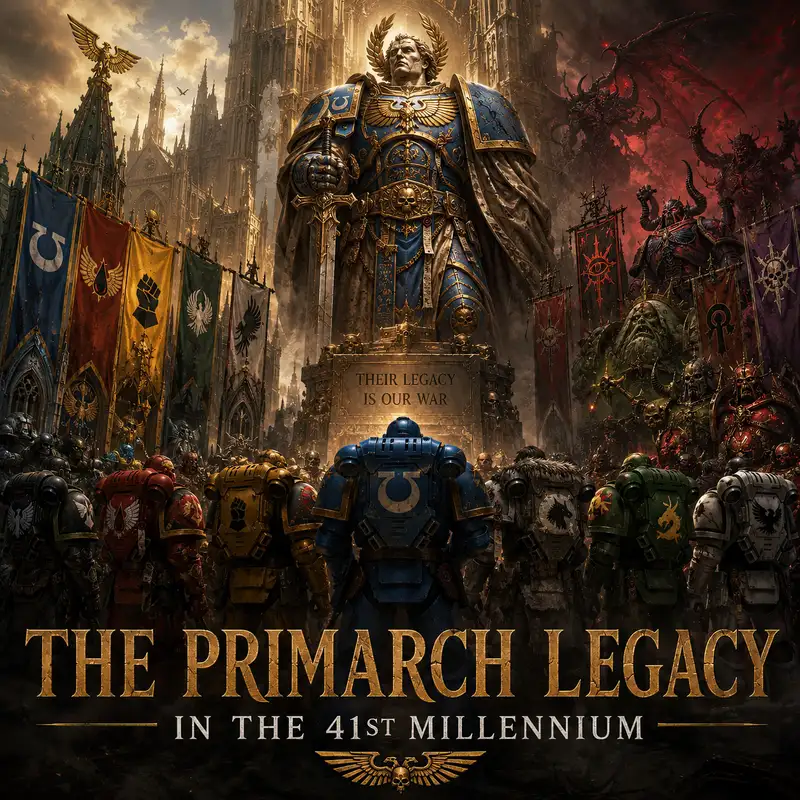
The Primarch Legacy in the 41st Millennium
Roboute Guilliman awakened from the edge of death and discovered that the empire he had helped save had turned him into a holy relic. His likeness stood above fortress gates and cathedral aisles. His name had become a prayer, a military doctrine, and, when convenient, a justification for whatever an Imperial official had already decided to do. He had been absent for nearly ten thousand years, yet the Imperium was crowded with versions of him. Most were flattering. Few were accurate. The son had returned, only to find that his legacy had grown old without him.
That is the strange fate of every primarch in the forty-first millennium. They were created as generals, governors, conquerors, and living symbols of the Emperor’s vision. They became fathers to the Space Marine Legions, architects of victory, authors of catastrophe, and eventually figures of myth. Some died. Some vanished. Some ascended into daemonic immortality. A handful have now stepped back into the wars of the present age. Yet their greatest influence does not depend upon whether they are alive. It survives in blood, doctrine, institutions, grudges, rituals, and inherited fears.
The Imperium of the forty-first millennium is not merely a realm once defended by the primarchs. It is a civilisation built inside the consequences of their choices.
The first and most literal legacy is genetic. Every Space Marine carries gene-seed derived from a primarch. The organs that transform a human recruit into an Adeptus Astartes are not simply pieces of advanced biotechnology. They are fragments of a bloodline, carefully harvested, tested, guarded, and passed forward. A Chapter may be separated from its founding Legion by thousands of years, yet its warriors still understand themselves as sons of a particular primarch.
That language is not decorative. It shapes identity. A Space Marine does not merely join an elite military organisation. He enters a family that remembers a father he never saw, follows traditions whose origins may be partly forgotten, and inherits expectations formed before his home world possessed recorded history. In the Imperium, bureaucracy can misplace a planet, a fleet, or occasionally an entire crusade. It rarely misplaces an ancestral grievance.
The genetic inheritance is also imperfect. The Blood Angels and their successors carry the Red Thirst and the Black Rage, curses bound to the line of Sanguinius. The Space Wolves carry the peculiarities of Leman Russ’s gene-seed and the risk of degeneration into the Wulfen. Other lineages possess their own instabilities, strengths, and suspected flaws. Some records are incomplete. Some Chapters do not know their true ancestry. Others know it very well and wish that fewer people did.
Gene-seed alone, however, cannot explain the differences among the sons of the primarchs. Culture matters just as much. Ten thousand years of isolation, recruitment, warfare, and local custom have produced successor Chapters very different from their parent Legion. They may share the same biological source while disagreeing on tactics, honour, government, mercy, and the proper number of chainswords required to settle a theological dispute.
This is why the primarch legacy is not a perfect copy. It is an inheritance interpreted by each generation.
Guilliman offers the clearest example. After the Horus Heresy, he helped reorganise the surviving Loyalist Legions into smaller Chapters. The Codex Astartes was intended to prevent any single commander from wielding the enormous military power once held by a Legion master. It also provided doctrine for organisation, command, and war. In the centuries that followed, Guilliman’s ideas became one of the foundations of Space Marine practice.
Yet even among his descendants, the Codex never produced complete uniformity. The Ultramarines treated it as living military wisdom, though outsiders often assumed they followed it with the enthusiasm of an auditor guarding the last clean form in the Administratum. Their successors adapted its principles in different ways. Some followed closely. Some treated it as guidance. Some treated it as the beginning of a useful argument. Guilliman’s legacy became influential precisely because it could be interpreted.
Sanguinius left something more emotional and more painful. He died defending the Emperor during the final confrontation with Horus, and his death became one of the central sacrifices in Imperial memory. To the Blood Angels, he is father, martyr, ideal, and wound. They strive toward his nobility while carrying the rage of his final moments inside their own minds. Their art, ritual, restraint, and beauty are not separate from their violence. They are methods of containing it.
The result is one of the defining contradictions of the primarch legacy. The Blood Angels are inspired by the best of Sanguinius because they fear the worst of what his death left within them. His memory raises them above savagery, even as his psychic echo can drag them into it. Ten thousand years later, the death of one primarch still kills his sons.
Lion El’Jonson left a different wound. The Dark Angels and many of their successors inherited the honour of the First Legion, but also the secret of Caliban and the shame of the Fallen. Their efforts to conceal that history shaped their command structure, their rituals, and at times their priorities on the battlefield. A failure at the end of the Heresy became an obsession lasting millennia. Entire generations of warriors lived and died preserving a secret whose original witnesses were long gone.
The Lion’s legacy therefore became larger than the event itself. Secrecy was no longer merely a response to danger. It became a culture. Suspicion became discipline. Guilt became mission. The descendants of the First Legion could be brilliant, loyal, and terrifyingly effective, yet their private war sometimes pulled them away from the wider needs of the Imperium. The official explanation was always duty. The hidden explanation tended to carry more robes.
The other Loyalist bloodlines show the same pattern. Rogal Dorn’s sons inherited endurance, siegecraft, and an uncompromising sense of duty, but not all expressed those qualities in the same way. The Imperial Fists became defenders and exemplars of control. The Black Templars transformed the same inheritance into an endless crusade driven by faith and aggression. One father produced both the fortress and the sword that refuses to remain inside it.
The sons of Jaghatai Khan preserved speed, independence, and a dislike of confinement, though many successors developed cultures far removed from Chogoris. The Raven Guard inherited Corvus Corax’s preference for precision, infiltration, and war against tyranny, even while serving an empire that can make tyranny look like a filing requirement. The Salamanders preserved Vulkan’s concern for ordinary human lives more strongly than most Space Marines, proving that compassion can survive in the Imperium, provided it is heavily armoured and carrying a flame weapon.
The Iron Hands inherited the trauma of Ferrus Manus’s death and turned it inward. Their contempt for weakness became contempt for the flesh, emotion, and often themselves. The primarch valued strength, but his sons built a culture around the belief that his death proved the danger of emotion and biological frailty. Whether Ferrus would have approved is uncertain. Legacy is often what followers construct from a leader’s absence, not what the leader intended to leave.
Across the Imperium, the primarchs became more than ancestral figures for Space Marines. They entered religion, art, political language, and popular myth. Sanguinius is mourned during Sanguinala. Statues of loyal sons stand beside images of the Emperor. Their deeds are retold by preachers who know little of the Great Crusade and less of its contradictions. To most Imperial citizens, the primarchs are not historical personalities with competing ambitions and serious failures. They are demigods from a sacred age.
This transformation serves the Imperium. A worker who cannot grasp galactic strategy can understand sacrifice. A soldier who will never meet a Space Marine can still be told that Dorn stood firm, that Russ punished treachery, or that Sanguinius gave his life. The stories create courage and obedience. They also remove complexity. The primarchs become symbols polished smooth enough to fit whatever lesson the authorities require.
The irony is that the Emperor designed the primarchs to help build a rational, unified human order. In the forty-first millennium, their images support a religious empire whose institutions often preserve ritual more faithfully than knowledge. Their legacy helps hold humanity together, but it also helps freeze the Imperium in place. A civilisation surrounded by relics becomes reluctant to admit that any solution might be new.
The Traitor Primarchs left legacies just as powerful, though less orderly. Their Legions fractured into warbands, cult armies, and rival hosts. Some still claim the ancient Legion name. Others follow a champion, a god, or an obsession. Yet the marks of their fathers remain. The World Eaters carry Angron’s rage and the brutal inheritance of the Butcher’s Nails. The Death Guard carry Mortarion’s endurance, bitterness, and surrender to decay. The Thousand Sons pursue knowledge and psychic power beneath the shadow of Magnus’s pride and catastrophe. The Emperor’s Children turned Fulgrim’s pursuit of perfection into a hunger that can never be satisfied.
The Word Bearers made Lorgar’s need for faith into a theology of the Dark Gods. The Iron Warriors inherited Perturabo’s resentment, technical brilliance, and conviction that every war is an equation solved with sufficient ammunition. The Night Lords preserved terror as both weapon and identity. The Alpha Legion inherited secrecy so completely that even its own motives became divided, concealed, or impossible to verify. In each case, the sons did not simply obey their primarch. They became trapped inside his defining conflict.
Horus left the greatest absence of all. He died aboard the Vengeful Spirit and his rebellion was defeated, but the war he began never truly ended. The Imperium still defines treason through his name. Chaos forces still fight beneath memories of the Heresy. Even those who reject him operate in the strategic world he created.
Abaddon the Despoiler is the clearest example. He was Horus’s son by gene-line and service, but he refused to become merely another copy of the Warmaster. He rejected the ruined Sons of Horus, formed the Black Legion, and united warriors from many Traitor bloodlines beneath a new purpose. His Black Crusades did not erase Horus’s legacy. They transformed it. Abaddon learned from the failure of a primarch and built power from the fragments left behind.
That may be the most insulting verdict the primarch age could receive. One of the galaxy’s most dangerous heirs is not a primarch at all. He is a Space Marine who understood that reverence for a father can become a chain.
The return of the primarchs has made these ancient legacies immediate again. Magnus, Mortarion, Angron, and Fulgrim have emerged as major powers in the wars of the present age. They are not preserved versions of their Great Crusade selves. Daemonhood has magnified their obsessions until each has become something close to a living doctrine.
Magnus embodies knowledge without humility, psychic power without restraint, and the enduring belief that superior understanding excuses disastrous choices. Mortarion embodies endurance corrupted into stagnation and resentment. Angron has become rage stripped of almost everything else, a victim whose suffering was turned into a weapon and then worshipped as purpose. Fulgrim embodies perfection transformed into endless appetite, where every triumph becomes dull the moment it is achieved.
Their presence gives the Traitor Legions something the Imperium long lacked: fathers who can still appear in person. Yet this does not restore unity. Daemon primarchs are bound to the Chaos Gods, to the Warp, and to their own compulsions. Their sons may worship, fear, resent, or seek approval from them. A returned father can be more destructive than an absent one, particularly when he arrives with wings and a personal weather system.
Guilliman’s return offered the Imperium a different possibility. Awakened after the fall of Cadia and the opening of the Great Rift, he found humanity divided, besieged, and governed by institutions that treated precedent as a substitute for thought. He assumed command, launched the Indomitus Crusade, and brought the Primaris Space Marines into the wider Imperium.
The Primaris project was itself a legacy reaching across millennia. Belisarius Cawl had worked for ages to create a new generation of Space Marines, following a task set in the aftermath of the Heresy. When Guilliman returned, these warriors reinforced old Chapters and founded others. The bloodlines of the primarchs were not merely preserved. They were expanded, reorganised, and sent into a galaxy split by darkness.
This looked like the restoration of the old order, but Guilliman soon discovered that a primarch cannot simply take possession of his own legend. The Ecclesiarchy had made worship of the Emperor central to Imperial life. Guilliman remembered an Emperor who rejected godhood. The distinction mattered to him. It mattered rather less to the millions who knelt when he entered a room.
He could not dismantle the religion without risking the collapse of the state it supported. He could not accept it without betraying much of what he remembered. He therefore governed through contradiction. He used institutions he distrusted, accepted reverence he did not want, and tried to reform an empire whose survival often depended upon the very habits that were killing it. The master of organisation had returned to discover that the Imperium was not a machine waiting for repair. It was an ecosystem of ten thousand years of fear.
The Lion returned to a different half of the disaster. Imperium Nihilus lay beyond the Great Rift, cut off from reliable travel, communication, and the light of the Astronomican. Where Guilliman confronted the machinery of government, the Lion emerged into darkness, isolation, and scattered war. He did not return as the same commander who had left the Great Crusade. The surviving accounts present an older figure, still dangerous, but more reflective and more willing to judge the Fallen as individuals rather than as one stain to erase.
That change strikes directly at the legacy inherited by the Dark Angels. The father returned not merely to lead his sons, but to challenge what they had made of his shame. Some Fallen who had not embraced Chaos could be gathered as the Risen. The secret war did not vanish, and trust did not suddenly become fashionable, but the meaning of loyalty became less simple.
The return of two Loyalist brothers also reveals how different their legacies have become. Guilliman is the organiser of Imperium Sanctus, the statesman attempting to make a broken empire function. The Lion is the hunter and protector moving through Imperium Nihilus, where central authority is often a distant memory. They are sons of the same Emperor, but they embody different answers to catastrophe. One builds systems. The other appears where the system has failed.
Neither can restore the Great Crusade. The galaxy they knew is gone. Their brothers are dead, missing, corrupted, or transformed. Their Legions have become Chapters with identities of their own. The Imperium venerates a past the returned primarchs remember as unfinished and deeply flawed. Even a demigod cannot command ten thousand years to reverse direction.
This is why the primarch legacy is both strength and danger. It gives Space Marines continuity across an almost impossible span of time. It provides models of courage, endurance, loyalty, sacrifice, and command. It lets scattered Chapters recognise a shared ancestry. In the darkest wars, a warrior can believe that he stands in a line reaching back to Terra, Macragge, Baal, Caliban, Nocturne, Chogoris, or the frozen halls of Fenris.
The same inheritance can become a prison. Chapters repeat ancient feuds because their founders fought them. They conceal failures because their fathers were ashamed. They pursue impossible ideals because a primarch once embodied them. Traitor warbands seek approval from beings who have become embodiments of the flaws that destroyed them. The dead continue to issue orders through memory, and the living often obey without asking whether the battlefield has changed.
Yet the sons are not merely copies. Some successor Chapters preserve qualities their primarchs might recognise. Others combine the old bloodline with new worlds, new cultures, and new duties. They can reject parts of their inheritance, misunderstand it, or turn it toward purposes no one intended. The Black Templars are not simply Rogal Dorn repeated. The Flesh Tearers are not merely Sanguinius with different heraldry. The many descendants of Guilliman are not interchangeable administrators carrying matching forms.
That capacity to change may be the only hopeful part of the legacy. The primarchs were created to be greater than humanity, but their sons often reveal something more human. They inherit wounds they did not cause. They struggle with expectations imposed before their birth. They decide which traditions to preserve or question. Sometimes they fail. Sometimes they become worse than the example they follow. Sometimes they exceed it.
The forty-first millennium is therefore not ruled by the primarchs, even when primarchs stand upon its battlefields. It is ruled by the accumulated interpretations of what they meant. Their genes create warriors. Their doctrines shape armies. Their failures sustain wars. Their virtues inspire resistance. Their myths support empires and rebellions alike.
Guilliman can amend the Codex, but he cannot erase ten thousand years of Chapters formed around it. The Lion can forgive some of the Fallen, but he cannot instantly remove the culture of secrecy built in his absence. A daemon primarch can summon his sons, but cannot guarantee their love or obedience. The fathers have returned to find that inheritance runs in both directions. The sons carry the primarchs, and the primarchs must now live with what their sons became.
That is their final legacy in the forty-first millennium. Not statues. Not blood alone. Not even the survival of a few impossible beings from a lost age. Their true legacy is a galaxy still organised around a family’s unresolved war. Every Chapter badge, every Black Crusade, every hidden shame, every inherited curse, and every act of impossible loyalty is another echo of the Emperor’s sons.
The primarchs were meant to lead humanity into the future. Instead, humanity built its future from their remains.