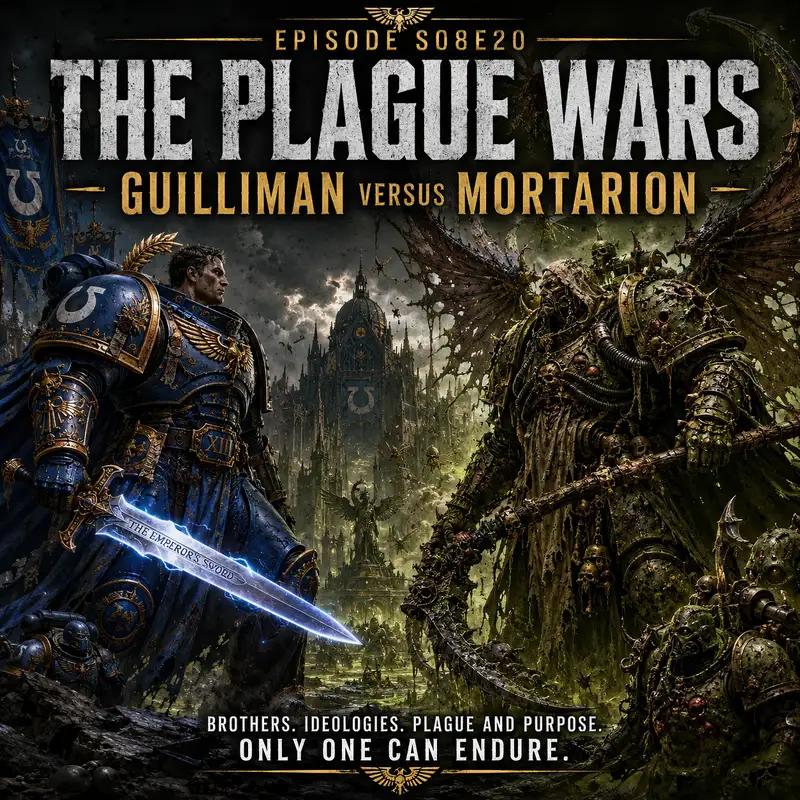
The Plague Wars: Guilliman Versus Mortarion
The first warning on Iax was not a fleet entering the system or a fortress sounding its guns. It was a patient. The garden world had become a hospital for the wounded of Ultramar, and its physicians believed they understood the enemy. They screened arrivals, isolated infection, burned contaminated equipment, and watched the void for plague ships. Then a hidden parasite passed through their precautions. Seven diseased hosts completed a ritual, reality tore open, and daemons poured into wards built to preserve life. By the time Roboute Guilliman reached Iax, forests had become swamps of corruption, hospitals had become charnel houses, and Mortarion was waiting. The Plague Wars would end there, but the war had never really been about one planet. It was a contest over whether order could survive a universe in which disease had a will, faith could become a weapon, and two brothers carried their father's unfinished judgment into battle.
Guilliman had returned to an Imperium that regarded him as both ruler and relic. Cadia had fallen. The Great Rift had split the galaxy, severing worlds and turning familiar routes into traps. Guilliman answered with the Indomitus Crusade, an immense attempt to restore communications, reinforce threatened systems, and impose direction upon a civilisation staggering in the dark. He brought new armies of Primaris Space Marines, revived command structures, and treated catastrophe as a problem that could still be mapped, supplied, and defeated. This was not gentle optimism. Guilliman knew what the Imperium had become. He simply believed surrendering to disorder would make the horror worse. In a galaxy run by prophecy, inherited dogma, and paperwork written by the long dead, competent administration had become almost revolutionary.
Ultramar mattered because it was more than Guilliman's birthplace. It was his proof that human worlds could be governed with some stability, education, planning, and mutual support. The realm remained part of the Imperium's brutal machinery, but it represented the closest thing Guilliman possessed to a working model. He intended to restore the ancient Five Hundred Worlds and use them as a foundation for wider reconstruction. Mortarion understood the value of that target. To corrupt Ultramar was not merely to raid his brother's home. It was to infect the argument Guilliman was trying to make. If the most organised realm in the Imperium could be reduced to plague pits and daemon worlds, then every governor watching elsewhere would receive Nurgle's preferred strategic memorandum. Resistance was exhausting, decay was patient, and eventually everyone joined the same garden.
Mortarion had once defined himself through resistance. Raised on the poison world of Barbarus beneath a cruel alien overlord, he grew to hate tyrants, sorcery, and masters who ruled through suffering. The Emperor's arrival ended his rebellion against that overlord, but also humiliated him. During the Horus Heresy, resentment and distrust helped carry Mortarion into treason. His fall did not end in freedom. Trapped in the warp while his Legion suffered from an impossible plague, he accepted Nurgle's power and became the sort of supernatural despot he had claimed to despise. Ten thousand years later, he still acted like the hard-eyed realist among fools. Mortarion hates slavery, yet serves a god. He condemns sorcery, yet exists through warp power. He despises the Emperor's domination, yet forces entire populations toward Nurgle. Chaos did not erase his grievances. It preserved them until grievance became identity.
From the Scourge Stars, Nurgle's forces moved against Ultramar while Guilliman's attention was divided by the wider crusade. Mortarion brought the Death Guard, warriors whose ancient endurance had become a diseased refusal to die. Typhus, the Legion's most infamous plague champion, commanded his own fleets and often showed greater loyalty to Nurgle than to his primarch. Ku'gath Plaguefather, a Great Unclean One, pursued diseases as another commander might pursue siege engines. Their alliance was powerful but unstable. Typhus wanted conquest for the Plague God. Ku'gath wanted his creations completed. Mortarion increasingly wanted Guilliman. They agreed on the invasion, but not on what victory meant. For a force devoted to entropy, the command arrangements were impressively on theme.
The Death Guard did not wage war by simply advancing from one trench to the next. Their campaigns attacked the distinction between battlefield and rear area. Crops failed and burst into clouds of flies. Water systems became vectors. Refugees carried infection into defensive zones. Corpses rose, hospitals collapsed, and fear did work artillery could not. Some plagues killed quickly. Others weakened discipline, distorted perception, or prepared a world for daemonic incursion. A commander could win a battle and discover that the returning wounded had carried defeat through his gates. Nurgle's power also offered a hideous bargain. Those who accepted decay could be freed from its fear and pain, at the cost of becoming part of what destroyed them. Mortarion's war attacked bodies, institutions, and hope together.
Guilliman responded as he always did. He reorganised territories, established command, mobilised successor Chapters, and directed immense flows of troops and supplies. Worlds were quarantined. Infected regions were isolated or destroyed. Fleet movements were coordinated across a realm whose routes had become unreliable. He also restored Ultramar's political structure, appointing tetrarchs and demanding that the Five Hundred Worlds function as a coherent strategic system. Against an ordinary invader, this combination of logistics and concentrated force would have been formidable. Against Nurgle, it was necessary but insufficient. A supply ledger could tell Guilliman where medicine was needed. It could not explain why a prayer sometimes halted a plague that medicine could not touch. The war forced the most rational man in the Imperium to account for evidence he deeply disliked.
The fighting spread across Greater Ultramar. Industrial systems, fortress worlds, and agricultural planets became parts of one campaign. In the Konor system, the invaders threatened a vital route toward Macragge and attempted to turn whole worlds into weapons. Elsewhere, defenders fought to keep ports, manufactoria, and food supplies functioning while disease undermined them from within. Guilliman's arrival with crusade forces arrested the invasion's momentum, but it restored nothing resembling normality. The lines stabilised only because both sides could replace losses on a scale that would have ended a more sensible war. Imperial counterattacks reclaimed ground, then medical teams followed to decide whether that ground remained safe to stand upon. The official maps continued to use neat colours. The people living inside those colours had a less tidy experience.
Parmenio became one of the war's decisive battlefields. It was an Ultramarine training world, a place of discipline and preparation, transformed into a diseased killing ground. Across the Plains of Hecatone, armoured formations and god-machines fought amid corruption on a scale that made infantry seem incidental. The star fort Galatan entered the war zone to support the Imperial effort and was itself assaulted by plague forces. On the surface, Guilliman drove into Ku'gath's host and destroyed the greater daemon's lieutenant, Septicus, with the Emperor's Sword. That weapon could do more than banish a daemon temporarily. It threatened true destruction. For creatures accustomed to returning from defeat, permanence was an alarming novelty.
Parmenio was also a trap. Mortarion, Typhus, and Ku'gath sought to isolate Guilliman and crush him beneath forces no single warrior, even a primarch, should face. The attempt nearly succeeded. What broke the trap was not a reserve armoured column arriving on schedule. It was a young girl whom many regarded as a living saint. Through her came a power the followers of Nurgle recognised as anathema, an expression of the Emperor's presence that drove back corruption and allowed Guilliman to survive. Surviving accounts present the event as a miracle, although its precise nature remains uncertain. Guilliman could not dismiss what he had witnessed. He also could not comfortably accept the religious explanation offered around him. Being rescued is rarely convenient. Being rescued by a theological problem is worse.
The conflict over faith followed Guilliman through the campaign in his Militant-Apostolic, Frater Mathieu. Mathieu preached the Emperor's divinity and increasingly treated Guilliman as a holy son whether Guilliman approved or not. The primarch had lived during the Great Crusade, when the Emperor publicly rejected worship and promoted the Imperial Truth. He remembered the man whom the Imperium now adored as a god. To Guilliman, the state religion was built upon distortion, fear, and ten thousand years of momentum. Yet priests could point to saints, exorcisms, and battlefield interventions with observable effects. Guilliman could punish disobedience and expose manipulation, but he could not make the evidence disappear. An empire cannot be governed by accepting every miracle claim. It also cannot survive by ignoring miracles that set daemons on fire.
Mortarion exploited that uncertainty because he understood his brother's need for systems. He wanted Guilliman to see that reason could not protect Ultramar and that the Emperor's promises had led only to suffering. Yet Mortarion's own position was hardly coherent. He claimed to expose the falsehood of freedom while insisting submission to Nurgle was liberation. He portrayed decay as honest because all things fail, then used supernatural power to hasten the failure. His argument was not that life had no value. It was that struggle against inevitable pain was the mistake. Guilliman's answer was embedded in everything he built. Mortality did not make medicine pointless. Collapse did not make construction foolish. The certainty of death did not excuse helping it arrive early. Between the brothers stood two responses to suffering: endure it while preserving improvement, or sanctify it until resistance feels absurd.
The invasion began to lose strategic coherence. Rival Chaos Gods attacked Nurgle's holdings in the Scourge Stars, opening another front in the War in the Rift. Nurgle called forces back to defend his domain. Typhus obeyed, placing the god's command above Mortarion's vendetta. Mortarion and Ku'gath did not. They continued preparing their final design against Guilliman, though withdrawal offered the sounder choice. This reveals more about Mortarion than another catalogue of victories. He accused Guilliman of being the Emperor's favoured tool, yet could not release his need to defeat that favoured brother. He sought freedom from paternal judgment, then organised an interstellar war around proving something to a family broken for ten millennia. Even Typhus could see the campaign had become less about Nurgle's realm and more about Mortarion's wound.
Iax offered the perfect instrument. Once celebrated as the Garden of Ultramar, it had become a hospital world as casualties mounted. Its beauty, medical infrastructure, and symbolic importance made it a place of healing. Ku'gath and Mortarion turned those qualities against it. Infection entered through the system designed to contain infection. Daemonic forces transformed the world toward a new identity, Pestiliax, and Mortarion intended to use it as a fulcrum for dragging Ultramar into the warp. The proposed conquest was geographical and metaphysical. He did not merely want flags on captured cities. He wanted Guilliman's ordered realm absorbed into Nurgle's Garden, where disease, emotion, symbolism, and landscape obeyed the same corrupted logic.
Guilliman knew Iax was bait. He understood that Mortarion wanted him personally and that the world had been shaped into a killing ground. A detached commander might have refused the invitation, preserved the crusade's leadership, and destroyed Iax from orbit. Guilliman went down anyway. Part of the decision was strategic. If Mortarion's ritual succeeded, the consequences could spread beyond one planet. Part was political. Abandoning a world of wounded soldiers without attempting rescue would damage the trust his reconstruction required. Part was personal, whatever he told himself. Mortarion had invaded his home, corrupted his people, and turned Guilliman's methods into instruments of infection. The lord of reason entered the trap because reason did not erase loyalty, anger, or responsibility. It merely gave them better briefings.
The final assault unfolded on several levels. Imperial forces fought through Iax while daemons and Death Guard defended the corrupted sites sustaining Mortarion's plan. A small band of Space Marines and soldiers pushed toward the portion of Nurgle's Cauldron used by Ku'gath. Mathieu accompanied them, no longer content to remain a ceremonial voice behind the lines. Around them, the boundary between material war and spiritual struggle weakened. Ku'gath's work was not simply a laboratory device that could be disabled with the correct explosive charge, although explosives remained welcome. The cauldron was part weapon, part ritual focus, and part intrusion of Nurgle's realm into reality. Destroying it required courage, sacrifice, and the faith Guilliman had spent much of the war trying to regulate.
At the centre of the battlefield, the brothers met. Guilliman carried the Emperor's Sword and fought with the speed, strength, and precision that made him one of humanity's greatest commanders. Mortarion came as a daemon primarch, swollen with warp power, bearing the scythe Silence and surrounded by his patron's poisons. Guilliman could wound him. He could not easily overcome what Mortarion had become. The duel was not balanced, and Mortarion had not arranged it to be. He used resilience, sorcery, and prepared ground to wear Guilliman down. For all the grand speeches that primarchs attract, the result was brutally simple. Mortarion defeated his brother in combat.
Then he administered the Godblight. Ku'gath had fashioned the disease through Nurgle's Cauldron to kill a son of the Emperor. It was not another infection with an impressive name. It attacked Guilliman at a level ordinary medicine could not reach. Mortarion offered him the logic that had trapped the Death Guard: submit to Nurgle and the agony could end. Guilliman refused. His resistance did not change the immediate result. The poison overcame him, and the Imperial Regent appeared dead. Mortarion had achieved the victory he wanted. He had beaten the favoured brother, broken the organiser, and shown that no armour of reason could seal a man away from despair.
Elsewhere, the assault upon Ku'gath's position reached its crisis. Imperial warriors died buying the chance to strike the cauldron. Mathieu became the focus of a power that shielded the attackers and burned against Nurgle's corruption. Whether one calls him a living saint, a conduit, or something less easily classified, his intervention had material consequences. Ku'gath was defeated, the cauldron was destroyed, and the structure supporting Mortarion's triumph began to fail. Mathieu did not emerge untouched. Faith in the Imperium is often praised most warmly by those arranging for someone else to die from it. Here, he paid the price himself.
Guilliman's death did not remain final. Between life and oblivion, he confronted the memory of his meeting with the Emperor after returning to Terra, an encounter so immense and fractured that even a primarch struggled to understand it. Then power moved through him. The safest statement is that the Emperor acted, or that something possessing the Emperor's authority and psychic signature did. Guilliman rose, not as a man who had solved divinity, but as the instrument of an answer delivered through fire. The power struck beyond Iax and wounded Nurgle's Garden itself. Mortarion, victorious seconds before, recoiled beneath the presence of the father he had defied. He was drawn back into the warp, where the consequences of his disobedience awaited.
This reversal did not make Iax a clean Imperial triumph. The world was too deeply corrupted to save. After survivors withdrew, Exterminatus destroyed the surface. The Garden of Ultramar, first transformed into a hospital and then a daemon-haunted ruin, ended beneath weapons intended to stop its infection spreading. Ultramar survived, but one of its jewels did not. Mortarion and Ku'gath had failed, lost favour, and squandered forces while Nurgle's rivals pressed the Scourge Stars. Typhus, who abandoned the vendetta to obey the god, appeared the more faithful servant. The Death Guard withdrew from their greatest gains, and Guilliman resumed reconstruction. As Imperial victories go, it was genuine, costly, and followed immediately by decontamination forms.
So who won the struggle between Guilliman and Mortarion? On the narrowest level, Mortarion won their duel. He planned the trap, overpowered his brother, and delivered a weapon capable of killing him. On the campaign level, Guilliman won. Ultramar was not dragged into the warp, the cauldron was destroyed, and the invading coalition lost purpose and momentum. On the level that mattered most to both men, neither received the certainty he wanted. Mortarion proved his strength and exposed his bondage. His obsession made him ignore his god's command, yet he ended the war pulled away by that god's displeasure. Guilliman preserved his realm but could no longer pretend faith was merely an administrative defect. He had been saved by manifestations he could not explain and restored by a power he had long refused to call divine.
The Plague Wars were more than a clash between a blue-armoured statesman and a winged reaper. They tested two philosophies of endurance. Mortarion offered surrender disguised as honesty: pain is inevitable, decay always wins, so accept the master who makes decay feel like love. Guilliman offered labour without assurance: build though it may fall, heal though death remains, organise though the universe resists order. His position is less comforting than simple heroism because it promises no permanent success. It demands that the work continue anyway. That is why Nurgle's assault on Ultramar was so precise. It targeted not merely Guilliman's territory, but his belief that effort still matters.
When the fires died on Iax, one brother returned to damaged worlds, impossible reports, and people who expected him to become a god despite his objections. The other returned to a garden where his patron's affection and punishment were aspects of the same possession. Guilliman had survived Mortarion, but not through reason alone. Mortarion had defeated Guilliman, but had not escaped the father or god whose judgment ruled him. The war ended with Ultramar still in realspace and Iax reduced to ash, a victory measured not by what had been saved intact, but by what had been denied to decay.