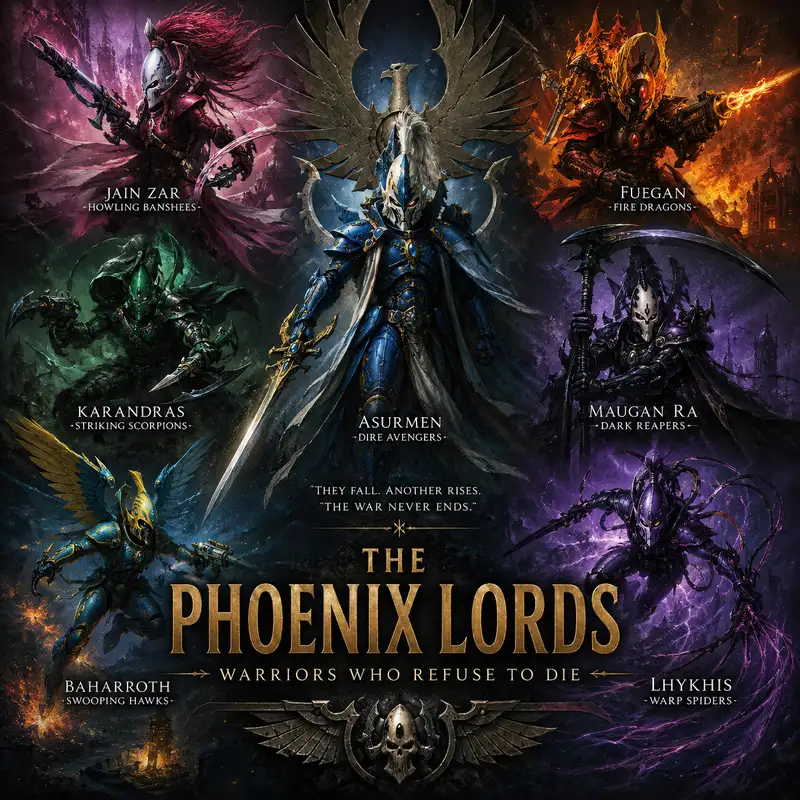
The Phoenix Lords: Warriors Who Refuse to Die
A Phoenix Lord can be shot from the sky, buried beneath a ruined city, or cut down by something that has killed far greater creatures than an Aeldari warrior. The armour falls silent. The battlefield moves on. Then, perhaps years later, an Exarch finds the abandoned suit and places a hand upon it. The new wearer does not inherit a title in the ordinary sense. Their soul is drawn into something older, deeper, and already awake. When the figure rises again, the voice, skill, purpose, and name of the Phoenix Lord have returned. The body has changed. The warrior has not. That is the secret behind the Aeldari heroes who refuse to die, and it is considerably less comforting than resurrection.
The Phoenix Lords are often described as immortal champions, but immortality is a poor word for what they endure. They do not preserve one untouched body across the ages. Nor do they return as copies, descendants, or ceremonial successors who merely adopt a famous name. Their ancient armour carries the accumulated souls and memories of those who have worn it, with the identity of the first and greatest bearer remaining dominant. A worthy warrior who dons the suit becomes part of that psychic inheritance. The Phoenix Lord is restored, strengthened by another life, while the new wearer is absorbed into the legend. From the outside, an undying hero has returned. From inside the armour, the distinction between survival and consumption has become very thin indeed.
To understand why the Aeldari created such beings, one must begin with the disaster that nearly ended their species. Before the rise of humanity's Imperium, the Aeldari ruled a vast and sophisticated civilisation. Their psychic power, technology, and freedom seemed without limit. Restraint slowly vanished. Sensation became obsession, obsession became cruelty, and the pressure of countless corrupted souls gave birth to Slaanesh. The resulting catastrophe, remembered simply as the Fall, destroyed the Aeldari empire and consumed almost all who remained within its heartlands. Survivors fled aboard immense craftworlds, through the Webway, or into harsh exile. They carried magnificent knowledge with them, but also the terrible understanding that an undisciplined Aeldari mind could destroy far more than its owner.
The craftworld survivors answered that danger with the Path. An Aeldari would devote themselves to one discipline at a time, learning it deeply but eventually setting it aside before devotion hardened into captivity. They might walk the Path of the Artisan, the Seer, the Mariner, or the Warrior. The system was not designed to make life narrow. It was designed to keep emotion from becoming a bottomless pit. War presented the greatest danger because Aeldari experience anger, fear, exhilaration, and grief with extraordinary intensity. A warrior therefore learned to create a battle identity, often called the war mask, that could be put on before combat and removed afterward. In theory, the violence remained contained. In practice, theory occasionally met an Aeldari who found killing far too clarifying.
An Aspect Warrior who can no longer leave the Path of the Warrior becomes an Exarch. This is not a promotion awarded for good service. It is a spiritual entrapment. The Exarch can no longer remove the war mask and return to ordinary life, so the shrine gives that warrior an ancient suit of armour associated with earlier Exarchs. Spirit stones within the suit preserve those previous souls, forming a small psychic community devoted entirely to war. The new Exarch joins them and assumes the shrine name carried by the armour. Every battle adds experience. Every death adds another voice. For a people terrified of losing souls to Slaanesh, preserving warriors inside a weapon is logical. It is also the sort of logic that becomes unsettling when followed with complete consistency.
The Phoenix Lords are this process raised to its oldest and most powerful form. They are the first masters of the great Aspect traditions, the founders or defining exemplars from whom later shrines learned how to express one face of Khaine, the shattered Aeldari god of war. Each Aspect does not represent a different profession so much as a different answer to the same question: how should controlled violence be used? One answer is disciplined defence. Another is speed, terror, fire, patience, distance, or sudden attack from a direction reality was not expecting. The Phoenix Lords embody those answers so completely that they have become less like commanders and more like living doctrines. An Autarch plans a campaign. A Phoenix Lord arrives as the perfected memory of one particular way to kill.
The first was Asurmen, once an Aeldari named Iliathin who survived the death throes of the old empire. Accounts of his earliest years describe a survivor moving through a civilisation that had already become monstrous before the Fall finished it. He eventually gathered followers, established the Path of the Warrior, and founded the Dire Avengers. His students became the Asurya, the first great disciples who carried martial discipline to the scattered craftworlds. Asurmen's genius was not simply that he fought well. He turned warfare from an intoxicating impulse into a system that could be taught, repeated, and survived. The Dire Avengers reflect that balance. They are neither the most savage nor the most specialised Aspect. They are adaptable guardians, trained to meet the enemy with controlled aggression rather than surrendering to it.
Jain Zar, the Storm of Silence, was the first of Asurmen's great students and the founder of the Howling Banshees. Her Aspect turns speed, shock, and psychological terror into a precise form of assault. The Banshee mask magnifies a psychic scream that can disorient, paralyse, or kill before the blade arrives. Jain Zar is therefore not merely a swordswoman moving very quickly. She is the moment an enemy formation loses control of its senses and discovers that the graceful figure already inside its lines is the cause. Her history also reveals that Phoenix Lords are not remote statues. She has argued with other Aeldari leaders, chosen allies, rejected them, and pursued her own reading of what survival requires. Millennia have not made the Phoenix Lords politically simple. Time rarely offers that courtesy.
Karandras, the Shadow Hunter, represents a different kind of continuity. The first master associated with the Striking Scorpions was Arhra, remembered in craftworld tradition as a fallen or treacherous figure. The precise truth is obscured by conflicting Aeldari accounts, but Arhra's legacy left a wound in the Aspect. Karandras became the Phoenix Lord who shaped the Striking Scorpions into patient hunters, warriors who stalk in silence before exploding into close violence. His existence proves that a Phoenix Lord's tradition can survive betrayal and even change its central bearer. Karandras is not simply Arhra returned under another name. He is a successor who inherited a damaged doctrine and spent ages correcting it. Among immortals, atonement can be measured in centuries, which is fortunate because the Aeldari seldom choose small mistakes.
Baharroth, the Cry of the Wind, embodies the opposite of the hidden Scorpion. He is the luminous master of the Swooping Hawks, descending from the sky in a blaze of wings, las-fire, and precisely timed violence. Aeldari legends present him as the brightest and most youthful of the Phoenix Lords, the sunlit counterpart to the sombre Maugan Ra. His warriors use altitude and mobility to harry enemies, scatter formations, and strike where ground-bound troops cannot easily answer. Baharroth's presence is often treated as an omen of victory, not because he makes war gentle, but because his Aspect makes it look effortless. That beauty is part of the danger. Aeldari warfare often wraps lethal purpose in elegance, and the Phoenix Lords are the purest expression of that habit.
Fuegan, the Burning Lance, took the image of the dragon and made it a doctrine of annihilation. His Fire Dragons specialise in destroying armoured vehicles, monsters, fortifications, and anything else whose designers felt reassured by thickness. Their fusion weapons do not gradually wear a target down. They turn concentrated heat into a direct argument against continued existence. Fuegan teaches anger focused so tightly that it becomes precision. He has wandered the Webway, hunted daemons, and emerged where the enemies of the Aeldari require sudden destruction. His methods are not subtle, but they are disciplined. The distinction matters. A berserker destroys because rage controls him. Fuegan destroys because he has controlled rage so completely that it points exactly where he intends.
Maugan Ra, the Harvester of Souls, chose distance, inevitability, and the symbolism of death. He founded the Dark Reapers and carries the Maugetar, a weapon combining a powerful shuriken cannon with the shape and function of a scythe. The design is theatrical, but Maugan Ra has had thousands of years to make theatricality practical. His history is tied to Craftworld Altansar, which was swallowed by the Warp while he escaped. He did not accept its loss. After ages of war and searching, he helped bring the craftworld back into realspace. Other Aeldari remained suspicious of survivors who had endured so long within the realm of Chaos. Maugan Ra appears to have answered those suspicions largely by continuing to save them while looking like death given armour. It discourages follow-up questions.
Lhykhis, the Whispering Web, makes that danger even clearer. She is the Phoenix Lord of the Warp Spiders, warriors who use personal jump generators to make short passages through the Warp. For most beings, entering the Immaterium without the protection of a ship is less a manoeuvre than an unusually ambitious form of suicide. Warp Spiders do it repeatedly, appearing without warning and cutting enemies apart with monofilament weapons before vanishing again. Lhykhis embodies Khaine's willingness to risk everything for the decisive strike. For long ages she was so rarely recorded that even some Aeldari treated her as lost or legendary. Her return demonstrates that absence means little to a Phoenix Lord. A missing suit may be a tomb, a trap, or merely an appointment delayed by several millennia.
When the armour is found, rebirth demands another Aeldari life. The candidate is usually an Exarch of the same Aspect, someone already lost to the warrior path and capable of resonating with the ancient presence. Donning the suit does not create a partnership of equals. The established identity of the Phoenix Lord rises to dominance, while the new soul joins the accumulated whole. Memories, instincts, and experience are not erased so much as incorporated. This helps explain how a Phoenix Lord returns with mastery intact rather than needing several decades to remember which end of the legendary weapon faces the enemy. Yet the process also means that every resurrection is built upon surrender. The Aeldari save an irreplaceable champion by offering another champion to the armour.
This is why the Phoenix Lords are more than unusually durable heroes. Their immortality reflects the central tragedy of craftworld society. The Aeldari survive by preserving themselves inside systems of discipline, memory, and ritual. Spirit stones protect the dead from Slaanesh. Infinity circuits hold generations within the craftworld. Paths keep the living from falling into destructive obsession. Aspect shrines turn rage into repeatable forms. Phoenix armour preserves military genius by making individual identity subordinate to continuity. Each solution works. Each solution also narrows the freedom of the person being saved. The Aeldari escaped extinction, but much of their civilisation now survives by carefully deciding what must be enclosed, contained, or surrendered before desire can destroy it.
That continuity makes the Phoenix Lords extraordinarily dangerous commanders even when they do not command in the conventional sense. They have fought species now extinct, crossed battlefields later buried under younger civilisations, and watched the same strategic errors return under new banners. Their reflexes are supported by accumulated lifetimes. Their weapons and armour are masterpieces from an age when Aeldari civilisation could achieve what later peoples mistake for sorcery. More importantly, each Lord understands one mode of warfare beyond ordinary expertise. They do not need to improvise their identity under fire. They have spent ten thousand years refining it. The enemy may surprise a Phoenix Lord with a new weapon. Surprising one with fear, pride, panic, or overconfidence is considerably more difficult, because those inventions are older than any empire.
Immortality has not made them omniscient. Phoenix Lords can be defeated, deceived, delayed, isolated, and drawn into conflicts shaped by prophecies they interpret imperfectly. They disagree with seers and with one another. Their dedication to a single martial Aspect grants unmatched clarity but can also narrow perspective. A master of annihilation sees problems that require annihilation. A master of ambush trusts patience. A master of the decisive airborne strike may consider waiting an error. This does not make them foolish. It makes them embodiments of doctrine, and doctrine always reveals some truths more clearly than others. The Aeldari revere them because they are perfected. They should also fear them for exactly the same reason.
Their relationship with ordinary Aspect Warriors is therefore both inspirational and unsettling. A shrine trains warriors to wear the mask temporarily, to become the scorpion, banshee, dragon, hawk, spider, avenger, or reaper for the duration of battle. The Phoenix Lord is what happens when the mask becomes permanent and then survives every face beneath it. To fight beside one is to see the ideal form of the shrine's teaching. Every movement confirms that the discipline works. Every victory proves that the founder's path remains potent. Yet the Lord also stands as a warning about where complete devotion ends. The Aspect Warrior hopes to return from war as themselves. The Exarch cannot. The Phoenix Lord has passed beyond even that distinction.
This gives their famous refusal to die a different meaning. They are not clinging to life out of fear. In many accounts, the Phoenix Lords enter battles where death is expected and sometimes necessary. Their confidence comes from continuity of purpose. A body can be spent if the armour survives. A defeat can become an interval if another disciple eventually arrives. Time itself becomes part of their strategy. Karandras can pursue an enemy across centuries. Maugan Ra can search for a lost craftworld through ages that would consume human history several times over. The Phoenix Lords do not always win the immediate battle. They endure long enough to make the war answer to a longer calendar.
The price is that they can never fully escape that war. Other Aeldari may change Paths, build families, create art, guide ships, or seek wisdom after a period of service. The Phoenix Lords carry only the next battle and the memory of all the previous ones. Even their moments of compassion are expressed through intervention, rescue, instruction, and violence directed at a necessary target. They protect a civilisation whose ordinary life they can no longer share. That separation may be why they wander rather than ruling craftworlds. A Phoenix Lord is too valuable to confine, too specialised to govern everything, and too saturated with ancient authority to fit comfortably into daily politics. They arrive at the hour of crisis, save what can be saved, and depart before anyone mistakes a weapon for a constitution.
Over all of them hangs the Rhana Dandra, the final battle of Aeldari prophecy. Traditions differ in detail, but the Phoenix Lords are expected to gather for a last war against Chaos. Their reunion will not be a victory parade. It marks the end of the long cycle in which fallen Lords can rise again. Fuegan is said to call the others together and to be the last among them to fall. Some accounts link their final sacrifice to the awakening of Ynnead, the Aeldari god of the dead. Others describe destruction on a scale that consumes both realspace and the Immaterium. Prophecy in Aeldari hands is rarely a clear instruction. It is more often a warning written in several possible futures, all of them expensive.
That final battle explains why every resurrection before it feels temporary. The Phoenix Lords are not escaping death forever. They are postponing a particular death until the one moment when their species believes it will matter most. Each return preserves skill for the last war. Each absorbed soul adds strength to an ancient identity expected to stand when the Aeldari story reaches its darkest page. Seen this way, their immortality is not a reward. It is mobilisation across millennia. They remain under arms because the final order has not yet been given. The galaxy may call them legends, demigods, or ghosts in armour. The Phoenix Lords themselves are closer to soldiers who have never been released from duty.
So the Phoenix Lords refuse to die because death, for them, is neither an ending nor a private event. It is a transfer of burden. The armour waits. A disciple arrives. One life joins the many, and the ancient warrior stands again with the same name and a slightly deeper silence behind the mask. The process preserves everything the Aeldari cannot afford to lose: knowledge, discipline, memory, and perfected violence. It also consumes exactly what the Aeldari can least afford to spend: another individual soul. Their immortality is therefore neither triumph nor curse alone. It is the Aeldari method of survival made into a person, beautiful in purpose, terrible in cost, and marching toward the one death from which none of them expects to return.