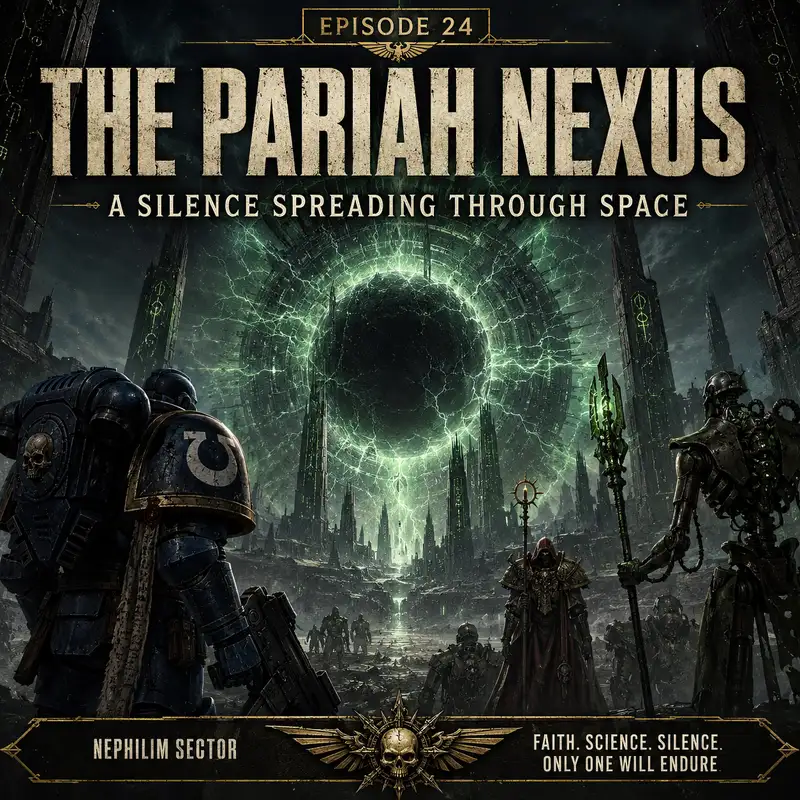
The Pariah Nexus: A Silence Spreading Through Space
At the edge of the Nephilim Sector, an Imperial fleet discovered that space could be quiet in the wrong way. The stars remained visible. Auspex screens still glowed. Reactor chambers still shook with the labour of imprisoned suns. Yet the voices carried through the warp had vanished. Astropaths reached outward and found no answering minds. Navigators looked for the light of the Astronomican and saw only a pale, depthless obstruction. Among the crews came a heaviness that sleep did not cure. Orders took longer to obey. Prayers lost their heat. Men and women who had crossed battlefields under artillery fire began to wonder why standing up was worth the effort. No great weapon had fired. No invading fleet had announced itself. Something had simply removed the part of the universe that made resistance feel possible.
That absence became known as the Pariah Nexus, or the Zone of Silence. It lay within the Nephilim Sector of the Ultima Segmentum, and it was first noticed because Imperial worlds stopped speaking. In another civilisation, a missing message might prompt concern. In the Imperium, messages disappear beneath storms, clerical errors, mutiny, famine, and the occasional planetary governor who assumes the tithe is more of a suggestion. What made the Nephilim silence disturbing was its scale and consistency. Distress calls did not arrive. Routine reports did not arrive. Astropathic choirs heard nothing. The worlds beyond the boundary were not merely late. They had become unreachable in a galaxy where distance can only be conquered by passing through a realm made from nightmare and emotion.
The Imperium depends on the warp even while fearing it. Starships enter it to cross interstellar distances. Navigators use the Astronomican as a beacon. Astropaths send thoughts across light-years. Psykers power weapons, interpret visions, and occasionally explode with consequences that require several departments to deny responsibility. Remove the warp, and the Imperium does not become safer in any simple sense. It becomes blind, slow, divided, and trapped. The Pariah Nexus therefore represented more than an anti-psychic field. It threatened the machinery of empire itself. A sector cut away from the warp could not be reinforced reliably, governed efficiently, or even understood from outside. Silence was not just the symptom. Silence was the method of conquest.
Roboute Guilliman sent Battle Group Kallides of the Indomitus Crusade to investigate. Its commanders entered the Nephilim Sector expecting an enemy that could be located, classified, and shot. At the edge of the anomaly, their Navigators described something like a shimmering veil across psychic sight. Beyond it, the familiar currents of the immaterium grew weak and strange. Task Force Three, supported by veteran Ultramarines and other Imperial forces, descended upon the mining world of Vertigus Two. The planet should have held millions. Its cities should have been crowded with labourers, overseers, servitors, priests, and officials explaining why production targets had been missed. Instead, the landing parties found emptiness. Streets remained. Buildings remained. The population did not.
Vertigus Two gave the Nexus its first human scale. A dead world normally advertises the cause. There are blast craters, plague pits, orbital scars, or the cheerful green handiwork of an Ork invasion. Here, the horror was restraint. The settlements looked abandoned by people who had not fled anywhere. The silence pressed against the Space Marines themselves, not enough to break their discipline, but enough to make even transhuman warriors feel that something was wrong beneath the level of thought. Then the Necrons attacked. The missing population and the rising metal legions were connected, but not in the familiar pattern of massacre followed by occupation. The enemy had altered the conditions under which life could continue to act like life.
The instrument was blackstone, known to the Necrons as noctilith. It is one of the most strategically important materials in the modern galaxy because it can influence the warp in opposite directions. Configured one way, it can intensify warp energies. Configured another, it can suppress them. The pylons of Cadia had demonstrated part of that potential long before the Imperium properly understood what it was looking at. In the Nephilim Sector, the Necrons employed blackstone with a precision humanity could barely describe. Colossal pylons rose from worlds and hidden complexes. Their placement followed patterns that Imperial savants interpreted as impossible geometries and vast circuits laid across star systems. Each structure was not merely a fortress or transmitter. It was a component in a machine whose circuitry was measured in planets.
The effect produced by that machine became known as the Stilling. Psykers felt it first and most violently. Their connection to the warp weakened, powers failed, and the inner pressure of psychic perception turned into pain, panic, or emptiness. Navigators and Astropaths were crippled by the same suppression. Ordinary humans suffered more slowly. Anxiety settled into exhaustion. Exhaustion became indifference. Duty, fear, loyalty, appetite, and hope all began to recede. Some victims killed themselves. Others simply stopped moving and waited for their bodies to fail. The Stilling did not command them to surrender. It drained away the reasons they might refuse. For Necrons, whose minds exist within bodies of living metal and whose civilisation long ago paid the price of losing its souls, the field carried no comparable burden.
This made the Nexus a nearly perfect Necron battlespace. Imperial fleets could not communicate normally with distant commands. Reinforcements struggled to find safe routes. Psykers lost the abilities upon which their units depended. Soldiers reached the battlefield already tired, frightened, and spiritually numb. The Necrons, by contrast, fought within an environment built for them. Their command networks did not require Astropaths. Their warriors did not need food, sleep, or morale. Their damaged bodies could phase away for repair. Even when Imperial forces won a local engagement, the Nexus continued working around them. Every hour spent holding a position was another hour in which the defenders became less capable of caring whether the position was held.
The principal architect of this design was Illuminor Szeras, one of the most brilliant and morally untroubled Crypteks in Necron history. Szeras had spent ages studying the relationship between matter, energy, consciousness, and the remnants of the soul. The populations caught inside the Nexus were therefore not merely obstacles. They were specimens. The Stilling offered him whole worlds on which to observe what happened when living minds were separated from the psychic dimension that had always touched them. Imperial suffering became experimental data. Szeras regarded resistance, especially resistance that contradicted his predictions, not as proof that his work was wrong but as evidence that further dissection might be useful. It is an admirably consistent scientific method, provided one overlooks the mountains of bodies and the complete absence of an ethics committee.
Behind Szeras stood the larger ambition of the Silent King, Szarekh. His return had shaken Necron politics because he was the last ruler of their ancient unified civilisation, the monarch who had led them through biotransference and then destroyed the command protocols that had made obedience absolute. Szarekh faced a galaxy threatened by Chaos, the Great Rift, and the Tyranids. Suppressing the warp could deny daemons entry to realspace and close the wounds through which Chaos poured. It could also secure the material galaxy for the Necrons. His motives are more complicated than simple extermination. Some accounts suggest he still seeks a way to reverse biotransference and may therefore value organic life as more than vermin. Yet the distinction offers little comfort to those being stilled. Preservation as raw material is not liberation.
The Pariah Nexus exposes one of the Imperium's deepest contradictions. Imperial doctrine teaches that the warp is corrupting, dangerous, and filled with predators. This is correct. Imperial civilisation also requires the warp for travel, communication, prophecy, and much of its military power. This is also correct. The Nexus appears to grant the first wish by destroying the second necessity. Daemonic intrusion becomes harder where the warp is becalmed, but so does nearly everything that allows humanity to remain a single civilisation. The result is not peace. It is a galaxy reduced to isolated islands, each unable to hear the others being conquered. The cure is so complete that the patient loses the ability to call it a cure.
Battle Group Kallides learned this through attrition rather than theory. Discipline frayed. Soldiers abandoned posts or spoke openly of inevitable defeat. Commissars answered with executions, because the Imperial Guard has a traditional solution for collapsing morale and is reluctant to abandon a classic merely because it is making matters worse. Ships consumed resources while accomplishing less. Units became separated by failing communications. Commanders could not tell whether silence meant destroyed transmitters, psychic interference, disobedience, or the death of everyone expected to reply. The Necrons exploited that uncertainty with sudden attacks, dimensional movement, and assaults timed against isolated formations. Kallides had entered to investigate a mystery. It found itself fighting a campaign in which the enemy could steadily erase the willingness to investigate anything.
Faith produced the first serious complication in the Necron design. The Adepta Sororitas proved unusually resistant to the Stilling, and intense religious conviction could strengthen those fighting near them. Ephrael Stern, the warrior known as the Daemonifuge, became especially important. Her powers had never fitted comfortably within Imperial categories, and they continued to manifest where conventional psychic abilities faltered. Alongside the outcast Aeldari Kyganil, Stern helped lead resistance that the Necrons had not expected. Victories associated with her and the Battle Sisters suggested that belief could still produce real effects inside the Nexus. The Imperial response was to distribute Sisters, preachers, Black Templars, and other sources of militant devotion among threatened formations. Faith had become a countermeasure, and the Imperium began issuing it with roughly the same subtlety as ammunition.
This did not mean prayer simply switched the Nexus off. Many faithful soldiers still suffered, and the precise relationship between belief, the warp, and miracles remains deliberately uncertain. The Sisters' resistance may reflect the unusual way collective faith manifests in the age of the Great Rift. Stern is herself an exceptional being, not a convenient template for every pilgrim with a hymn book. Szeras refused to accept that faith offered a true answer, which is understandable from his perspective. A Necron scientist confronted with a miracle is likely to assume that the specimen has developed an interesting defect. His desire to capture and study those who resisted only made the fighting more vicious.
The pylons themselves were difficult targets. Many were vast, deeply rooted, and protected by tomb complexes extending beneath inhabited worlds. Orbital bombardment and long-range artillery often achieved little against structures built by a civilisation that had once fought gods. Imperial kill teams were forced into narrow passages and impossible chambers to find power sources from within. There they faced Necron guardians, Canoptek constructs, and Flayed Ones moving through darkness that seemed designed to punish human senses. Destroying one installation might weaken a local field, but the Nexus was a network. A victory on one world did not answer the greater problem. The enemy had created strategic depth not with trenches or reserve armies, but with overlapping pieces of cosmic infrastructure.
As the war continued, the Necrons revealed that they were not politically united. Dynasties loyal to the Silent King fought beside those persuaded by reward, fear, or the promise of future territories. Other rulers rejected Szarekh's authority. The greatest challenger was Imotekh the Stormlord of the Sautekh Dynasty, a conqueror whose empire and reputation had grown while the Silent King remained in exile. Imotekh denounced the returning monarch and gathered supporters of his own. Their rivalry became open civil war within the wider Nephilim conflict. For the Imperium, this division created opportunities. It also placed more Necron armies in motion, each equipped with weapons that treated physical law as an administrative inconvenience.
The arrival of Belisarius Cawl and Battle Group Hephaestus raised the scale again. Cawl came as a rescuer in the broad Imperial sense of the word, meaning he intended to save the situation after examining everything valuable and possibly taking it apart. His priority was blackstone. He believed he could process enough noctilith to build devices called liminal abraisers, machines capable of precisely modulating warp energies and grinding away at the field dominating the Nexus. Cawl's fleet brought radical Tech-Priests, forbidden prototypes, and superweapons whose operators regarded caution as a problem suffered by lesser intellects. Against the Necrons' stellar engineering, the Adeptus Mechanicus prepared its own reality-altering experiments. The contest was no longer simply army against army. It was competing theories of how much damage could be done to the universe before the universe objected.
Cawl's plan contained genuine promise. Blackstone had helped restrain the warp before, and a controlled understanding of it might offer humanity a way to weaken the Great Rift as well as the Nexus. That possibility made the Nephilim War important far beyond its borders. It also made every fragment of noctilith a strategic prize. Imperial forces, Necron dynasties, opportunists, and raiders fought over deposits, ruined pylons, and functioning nodes. The material could be used to suppress psychic power, intensify it, defend a position, or destroy one. In careless hands, it could do several of those things in an unfortunate order. Cawl was attempting to learn in months what the Necrons had refined across geological ages. Confidence was not the missing component.
Then Chaos found a way into a region designed to exclude it. Vashtorr the Arkifane, master of the Forge of Souls and patron of corrupted invention, entered the struggle with forces of his own. Through manipulation and treachery, his agents helped open a route that allowed the powers of the warp to intrude upon the Silent Zone. The irony was severe even by Imperial standards. A Necron project built to becalm the immaterium had become the destination of a daemon lord whose entire existence was bound to malignant technology. Vashtorr did not need to share the Imperium's goals to oppose Necron control. He needed only to recognise that a machine capable of reshaping the boundary between reality and the warp was too valuable to leave in someone else's hands.
This is why the silence is spreading rather than merely lingering. The Pariah Nexus is not a single storm or one ancient relic. It is an expanding engineered system. New pylons can strengthen existing zones. Nodes can overlap. Worlds can become anchors in a design whose full dimensions remain beyond Imperial comprehension. Each extension makes the next response harder. Astropathic warnings fail sooner. Navigators lose their bearings farther from the centre. Garrisons become listless before they understand that an attack has begun. By the time the Imperium recognises a new boundary, the people inside it may already lack the will to explain what happened. The network advances with the patience of a machine and the political protection of armies that do not age.
Stopping it requires more than defeating Necron troops in open battle. An attacker must enter a region where strategic communication fails, identify structures concealed beneath worlds, resist the Stilling long enough to reach them, and destroy technology that can survive conventional bombardment. Every assault must then be coordinated with other assaults that may be unable to communicate. The Necrons need only delay, repair, and let the field continue its work. Even their civil war does not guarantee relief, because both loyalists and rebels understand the value of blackstone. Cawl may disrupt parts of the system, faith may protect selected forces, and rival dynasties may tear at one another, but none of these has yet turned the Nexus into a solved problem.
The Great Rift and the Pariah Nexus are opposite disasters. The Rift is the warp in excess, reality torn open by emotion, daemons, and impossible storms. The Nexus is the warp denied, reality sealed until minds become dim and souls seem remote. Humanity cannot survive either extreme. It requires a dangerous middle ground in which the immaterium is close enough to cross and communicate through, but not so close that its predators can step directly into the room. The Necrons are trying to end that compromise. Their answer to Chaos is order without freedom, silence without peace, and survival defined so narrowly that living beings may no longer qualify.
The Pariah Nexus is therefore frightening not because it is empty, but because it makes emptiness contagious. Its pylons do not merely silence messages. They silence courage, appetite, faith, rage, and the small private reasons a person chooses to rise from the floor. Armies can fight it. Saints can resist it. Scientists can attempt to retune it, and rival kings can spill immortal legions across its worlds. Yet every struggle occurs inside the enemy's machine. Beyond the battle lines, more stars wait behind the veil, still shining, still present, and increasingly unable to answer. The silence spreading through space is not the absence of a voice. It is the deliberate removal of anyone who might wish to speak.