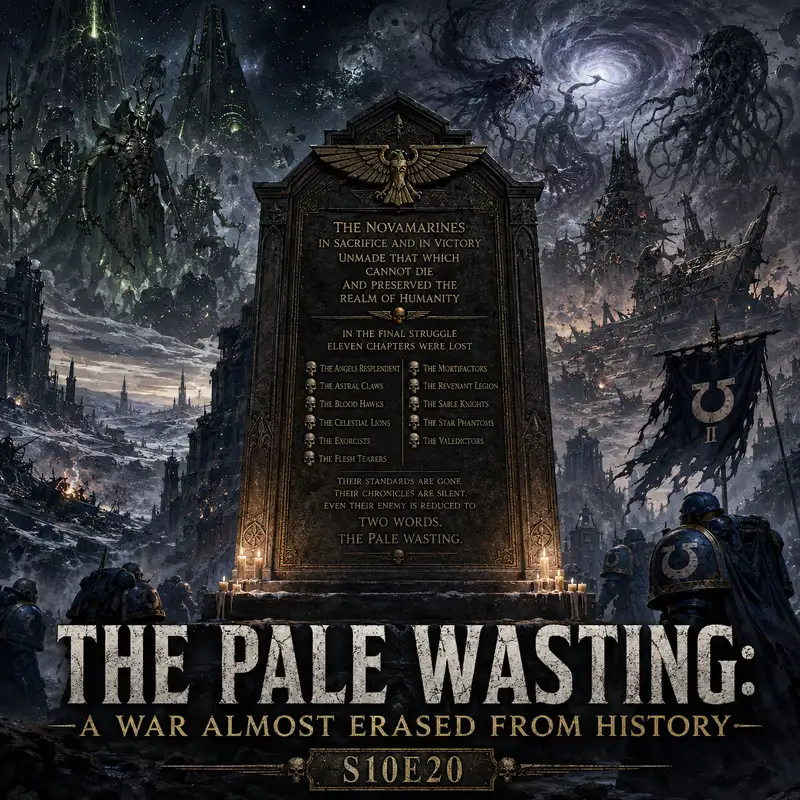
The Pale Wasting: A War Almost Erased From History
There is a monument inside the Imperial Palace that remembers a war almost no other record will admit happened. It praises the Novamarines for a victory won through mortal sacrifice, then claims they unmade something that could not die. Eleven other Space Marine Chapters are named among the lost. Their standards are gone, their chronicles are silent, and even the enemy that destroyed them has been reduced to two words. The Pale Wasting.
That is the first disturbing fact. The second is that the monument may be the only surviving witness with the authority to contradict the silence. The Novamarines themselves preserve no clear account of the campaign. Inquisitorial searches found that evidence had been censored or deliberately destroyed. What remains is scattered, contradictory, and written in the language institutions use when ordinary descriptions have failed. A plague born among the stars. Nightmare engines. Entire sectors slaughtered.
The Pale Wasting emerged from the Ghoul Stars, a region at the extreme north-eastern edge of the galaxy where Imperial maps become less confident and the light itself seems unwell. Its worlds turn beneath old, cold suns. Many were once inhabited by humanity. Many are now dead. Imperial expeditions have entered the deeper reaches and failed to return, leaving behind the useful administrative conclusion that further expeditions should be larger, more heavily armed, and equally unlikely to return.
The Ghoul Stars are not empty. They contain xenos realms, predatory species, ancient ruins, renegade human powers, and things described in Imperial reports as supernatural because no better category survived contact with them. The Necron Bone Kingdom of Drazak lies within the region. So do creatures remembered less as biological species than as nightmares given claws. None of this proves what caused the Pale Wasting. It establishes only that the disaster came from a frontier where several different kinds of impossible were already competing for territory.
The surviving account places the crisis around the late thirty-fourth millennium, in the shadow of the Nova Terra Interregnum. This was the age of the twin Imperiums, when the Ur-Council of Nova Terra rejected the authority of the High Lords and claimed dominion over much of the Imperium's western reaches. The resulting division lasted for centuries and spread into religious, political, and Mechanicus conflict. Humanity was arguing over which government possessed legitimate authority when something from beyond the Ghoul Stars began erasing worlds.
That context matters because empires rarely meet external disaster at a convenient moment. Fleets were divided by loyalty. Commands were disputed. Astropathic messages crossed jurisdictions that might no longer recognise the sender. Military forces needed against the unknown were also needed against other humans. The Imperium had endured civil war before, and apparently decided to revisit the experience while a star-spawned horror advanced from the edge of the map. Strategic timing, like mercy, is not one of the setting's abundant resources.
Even the basic description of the threat refuses to settle into one form. Some fragments call it a star-spawned plague that swept away scores of worlds. Others describe nightmare engines slaughtering whole sectors. Those statements may contradict one another, but they may also describe different faces of the same phenomenon. A plague need not be a fever carried in blood. It can be a contaminating technology, a self-replicating weapon, a change imposed on living matter, or an invasion that spreads faster than any army can contain it.
The word Wasting may describe the process rather than the enemy. It suggests worlds emptied, bodies diminished, populations consumed, and landscapes left pale beneath dying suns. It does not tell us whether the victims became corpses, fuel, components, or something worse. The name may have been coined by survivors who saw the aftermath but never understood the cause. They knew what the disaster did. They did not know what it was.
One later chronicle gives us a glimpse of the war before the final battles. As the Pale Wasting advanced, refugees and interstellar debris fled before what the account calls its miasmic grasp. The Mechanicus demanded a quarantine cordon around the forge world of Grammachus Beta. Several Iron Hands clan companies answered, including Raukaan, Kaargul, and Haarmek. Their strike cruisers became silent sentinels, not facing the Wasting directly, but watching everyone trying to escape it.
For months, the Iron Hands intercepted ships approaching the cordon. Ork raiders and Aeldari pirates were boarded and cleared deck by deck. Bodies were catalogued, heaped together, and burned. The empty vessels were then scuttled and directed into the nearest star. This was containment in its most Imperial form. Nothing crossed the line, nothing left evidence, and nothing required a second opinion.
The same treatment was given to the Yormethi Twenty-Sixth, an Imperial Guard formation assigned to hold the Phorox Corridor. Their ships were caught as they emerged from the warp and bracketed by efficient fire. Thousands died without knowing who had killed them. The record does not present this as treachery. It presents it as quarantine. The distinction was probably very important to the officers issuing the order and of limited comfort to everyone receiving it.
That episode tells us more than any theory about the enemy's identity. Imperial commanders believed escape from the affected region posed an unacceptable danger. They were willing to destroy xenos, pirates, refugees, and their own troops rather than risk contamination reaching a forge world. This does not prove the Pale Wasting was a biological disease. It proves that whatever followed the fleeing ships was feared as something movement itself could spread.
It also suggests that the Pale Wasting was not a single battle fought on a single world. There were retreating populations, blocked corridors, quarantine zones, and sectors already being lost. The war had depth. It consumed space behind the front and created secondary disasters ahead of it. Every refugee fleet became a possible carrier. Every rescue operation became a breach. Every commander had to decide whether the people approaching his guns were survivors or the next stage of the attack.
At some point, containment gave way to direct war. Twelve Space Marine Chapters entered the struggle, the Novamarines and eleven others. The surviving account gives us no order of battle, no campaign map, no names for the principal commanders, and no reliable sequence of engagements. It says only that the final battles were apocalyptic and that the eleven other Chapters were lost. Not mauled. Not withdrawn. Lost.
A Space Marine Chapter is more than a thousand warriors in armour. It is a fleet, a fortress, gene-seed, relics, armouries, serfs, recruiting traditions, and a chain of memory extending across centuries. Destroying one is difficult. Destroying eleven in the same conflict is an institutional extinction event. The Pale Wasting did not merely kill elite soldiers. It severed eleven military cultures from the future of the Imperium.
The sole surviving Chapter named in the account was well suited to a distant emergency. The Novamarines were a Second Founding successor of the Ultramarines, based on Honourum near the outer reaches of Imperial space. They had sworn to defend the wider Ultima Segmentum and often operated in dispersed forces, responding quickly to calls for aid. Their history presents them as guardians who crossed great distances when other Imperial forces were in danger. The Pale Wasting may have been the greatest such call they ever answered.
Yet the evidence for their role does not come from Honourum. It comes from the ancient stone in the Imperial Palace. The monument praises their sacrifice and declares that they unmade that which cannot die, preserving the realm of humanity. Then it records the eleven Chapters destroyed in the final struggle. The Novamarines' own chronicles contain no corresponding triumph. For a Chapter that reveres continuity, inherited duty, and the preservation of ancient war relics, that absence is not casual.
The phrase unmade that which cannot die is the hinge on which most theories turn. It may be poetic language for defeating an enemy that seemed immortal. It may refer to machines that repaired themselves, entities that returned after destruction, or a central intelligence that could not be killed by ordinary means. It may also be ceremonial exaggeration. Imperial monuments are not famous for modesty, although this one had enough names of the dead to discourage entirely cheerful boasting.
The most common theory points toward the Necrons. The Ghoul Stars contain Drazak, the Bone Kingdom of the Flayed Ones. Necron bodies can rise after damage, vanish into repair systems, and return to battle. Their war machines would easily earn the name nightmare engines from human witnesses who had no established language for them. In the thirty-fourth millennium, the Imperium would not have possessed the later body of knowledge used to identify Necron dynasties and technologies.
The theory becomes more tempting when the words star-spawned and cannot die are placed beside the C'tan. These ancient beings fed upon stars and survived in shattered forms within Necron prisons. To unmake such a thing might mean breaking a manifestation, dispersing a shard, or destroying the machinery that allowed it to act. The language fits. The geography permits it. None of the surviving sources confirms it.
The plague description also encourages comparison with the Flayer curse that haunts Necron-kind, especially because Drazak is ruled by Flayed Ones. Yet resemblance is not identification. The surviving record does not mention metal bodies, green fire, tomb worlds, dynasties, or skin-draped warriors. Those omissions do not disprove the theory, but they prevent it from becoming history. A good mystery can tolerate a plausible answer without surrendering to it.
Chaos offers another possibility. A spreading miasma, apparently deathless entities, supernatural inhabitants, and engines built from nightmare all sound comfortably at home in the warp's vocabulary. Daemon engines can slaughter sectors. Warp-born corruption can travel through minds, objects, and belief. A force that cannot die might have to be banished rather than killed. Still, the fragments do not name daemons, the Ruinous Powers, possession, or a warp storm. For once, Chaos cannot simply be blamed because the lighting is ominous.
A wholly unknown xenos civilisation may fit the evidence better precisely because it explains less. Imagine an enemy whose technology reproduces like infection, whose machines alter the worlds they conquer, and whose armies are not separate from the plague that precedes them. Such a force could be remembered as both contagion and engine. It could drive other species before it, turning the Ghoul Stars into a tide of refugees and predators. This is possible, but possibility is not canon wearing a respectable coat.
There is also a more unsettling option. The Pale Wasting may not have been one species at all. The name could describe a chain of connected disasters, an awakening, a contagion, and the mass flight of everything caught ahead of it. The nightmare engines might have belonged to the Wasting, to infected victims, or to desperate powers trying to survive it. Later archivists may have compressed several wars into one forbidden label because the distinction no longer mattered to anyone outside the quarantine line.
The records cannot resolve these theories because the records were not merely lost. They were attacked. Inquisitorial investigation concluded that evidence had been censored or deliberately destroyed. The Novamarines' silence points in the same direction, although it does not reveal whether their archives were purged by outside authority, sealed by the Chapter, or erased because the survivors themselves could not be trusted with what they knew.
Several motives are possible. Knowledge of the enemy might have been dangerous. Its technology may have tempted the Mechanicus. Its plague may have spread through information, memory, or recovered artefacts. The campaign may have required bargains or weapons the Imperium could not publicly acknowledge. The truth may have exposed failures during the Nova Terra Interregnum, when rival authorities were already contesting legitimacy. Every explanation fits some part of the silence. None has been confirmed.
The chronology is damaged as well. One account places the Pale Wasting around the late thirty-fourth millennium. Another records the quarantine action around Grammachus Beta earlier in that same millennium. The difference might reflect a campaign lasting generations, the reuse of one name for several phases, or simple corruption in Imperial dating. In a history with eleven missing Chapters, an uncertain calendar is almost reassuringly ordinary.
What survived was not a military archive but a monument. That distinction is revealing. A monument tells people whom to honour. An archive tells them what happened. The Imperium preserved the first function and removed the second. It could remember that the Novamarines saved humanity without preserving the enemy, the method, the failures, or even the names of the dead where later readers could easily find them. Bureaucracy had achieved a rare form of elegance. The conclusion remained, while the dangerous working was deleted.
The physical landscape may be the larger record. The Ghoul Stars contain an unusual number of dead worlds once inhabited by humans, and the Pale Wasting has been offered as a possible explanation. We cannot assign every ruin to the same catastrophe. The region endured the Horus Heresy, xenos predation, isolation, and later wars. Even so, a belt of extinguished colonies is exactly the sort of scar a world-killing advance would leave behind.
The Imperium's later posture toward the Ghoul Stars also looks like the memory of trauma. The Death Spectres stand watch beyond the ordinary boundaries of Imperial space, charged with ensuring that the region's supernatural inhabitants never again threaten the galaxy. The wording does not explicitly identify the Pale Wasting, and the Chapter's own origins remain wrapped in secrets. Even so, never again is a phrase with history inside it.
On Occludus, each master of the Death Spectres eventually takes his place upon the Shariax, the Throne of Glass. The artefact grants power essential to the Chapter's vigil while slowly consuming the life of the one enthroned. Later lore does not state that the Shariax contains the Pale Wasting or seals its source. It does show how seriously the watch is taken. A Space Marine Chapter has built its command structure around a leader dying by degrees so that something in the Ghoul Stars can be observed.
That does not tell us what the Novamarines did in the final battle, but the language of the monument offers a narrow clue. They did not merely slay the enemy. They unmade it. One interpretation is that the final objective was not an army but a mechanism, a source, or a condition that kept recreating the army. Eleven Chapters may have been consumed holding the front while the Novamarines reached whatever made the Wasting possible. It is an inference, but it fits the strange precision of the verb.
If that interpretation is close, victory would not have looked like conquest. There may have been no capital to occupy and no surviving population to surrender. The end could have been a machine silenced, a gate closed, a network broken, or an entity forced into a state from which it could no longer return. The Imperial Palace celebrates the outcome because the alternative was continued expansion toward the heart of the Imperium.
The human cost is easy to lose behind the destruction of eleven Chapters. The surviving fragments speak of scores of worlds, refugee fleets, whole sectors, and an Imperial Guard formation annihilated by its own allies. The dead were not limited to Space Marines. The Chapters are remembered because Imperial history is built around institutions that possess heraldry, archives, and stone monuments. Most of the people who vanished in the Pale Wasting left none of those things.
This is why the mystery should not be solved by choosing the most familiar monster. Naming the Necrons, a C'tan, Chaos, or some lost xenos empire would make the event easier to catalogue, but the surviving lore does not permit certainty. The Pale Wasting is defined by effects rather than identity. It came from the Ghoul Stars. It spread across worlds. It appeared as plague and engine. It forced lethal quarantine. It destroyed eleven Chapters. The Novamarines stopped it, and someone then dismantled the memory of how.
The erasure may have been the final act of containment. That remains an interpretation, but it explains the peculiar completeness of the silence. If the enemy could return through recovered technology, infected survivors, forbidden knowledge, or imitation, then burning the archive would be part of winning the war. The Imperium may have concluded that history itself was another road out of the Ghoul Stars and closed it with the same mercy shown at Grammachus Beta.
What, then, was the Pale Wasting? The honest answer is not a species name. It was an expanding, world-killing phenomenon from the Ghoul Stars, one that combined or inspired contagion and machinery, drove populations before it, and required a campaign so destructive that eleven Space Marine Chapters disappeared in its final battles. Everything beyond that belongs to theory. The uncertainty is not a gap around the story. It is the story.
The war was almost erased because the Imperium chose to preserve the fact of salvation while destroying the knowledge surrounding the threat. Political collapse may have helped. Fear almost certainly did. Deliberate censorship is the one part the records support. The result is a victory without a campaign, heroes without testimony, and eleven dead Chapters whose last enemy has no face.
Somewhere beneath the endless stone of the Imperial Palace, the ancient monument still carries the official memory. Far away, under the cold light of the Ghoul Stars, the Death Spectres continue their vigil over a frontier where dead worlds outnumber explanations. Between them lies a corridor of silence built from burned ships, empty archives, and names cut into stone. The Pale Wasting ended when the Novamarines unmade what could not die. Its history ended when someone decided that remembering it was another form of danger.