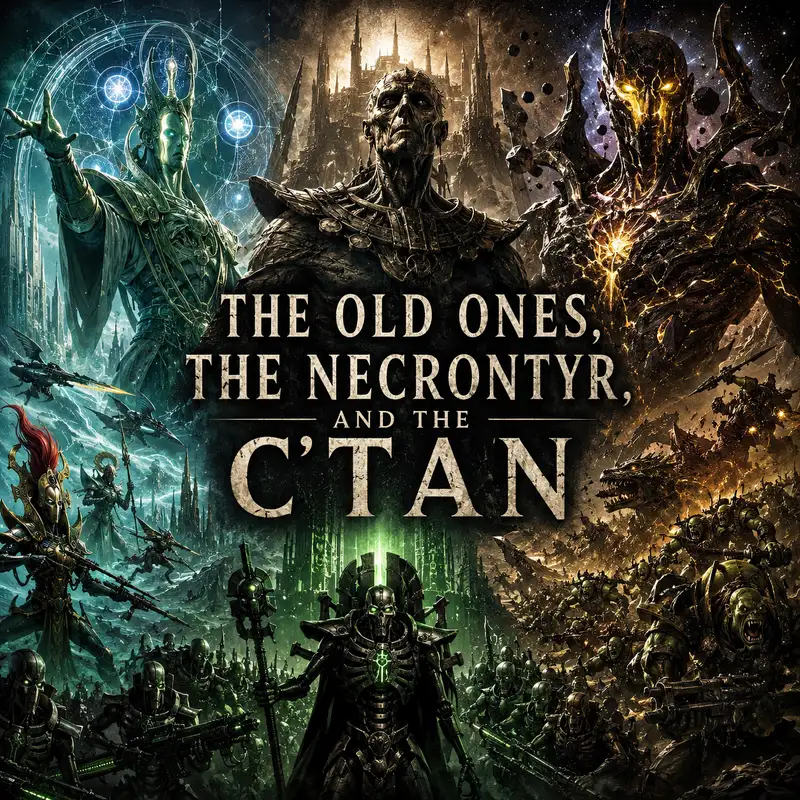
The Old Ones, the Necrontyr, and the C’tan
The doors of the biotransference furnaces closed upon a living civilisation. When they opened, an army marched out. The bodies were metal. The eyes burned with cold green light. The soldiers obeyed without hesitation, because most of them no longer possessed enough of themselves to refuse. What entered those furnaces had been the Necrontyr. What emerged would be called the Necrons. They had escaped disease, age, and death. They had also lost almost everything that made survival worth the effort.
That transformation was the turning point in a conflict so ancient that even its survivors remember it imperfectly. The Old Ones, the Necrontyr, and the C’tan did not merely fight over territory. Their struggle changed the nature of life, death, and war across the galaxy. It filled the stars with engineered warrior species, scarred the realm of souls, and left weapons buried beneath worlds that had not yet formed when the first battles were fought. The central question is not simply who won the War in Heaven. It is how a people’s fear of death became the instrument by which gods devoured them.
The surviving accounts come from legends, damaged memory engrams, alien myth, and the testimony of beings with excellent recall and very poor reasons to be honest. Precise sequences differ. Motives are disputed. Even the Necrons, who were present, spent roughly sixty million years asleep and did not all wake with their memories intact. Some remember themselves as liberators. Others remember servitude. A few remember flesh. That is the difficulty with ancient history when several of the witnesses are immortal, insane, and still arguing over ownership of the evidence.
Long before humanity existed, the Old Ones moved through the galaxy. They were immensely long-lived beings with a mastery of psychic power, biological design, and the hidden pathways later known as the webway. They could cross vast distances without relying upon ordinary travel through realspace. They shaped environments and are credited with creating, guiding, or uplifting many forms of life. To younger species, they must have appeared less like rulers than natural forces with opinions.
Yet the Old Ones were not necessarily kindly gardeners spreading life for its own sake. Their exact purposes remain obscure. They cultivated species, but cultivation can serve many ends. A farmer values the crop, though not always for reasons the crop would appreciate. The Old Ones possessed knowledge that other civilisations desperately wanted, and they decided who would receive it. Their power rested not only on what they could do, but on what they would not share.
The Necrontyr arose beneath a far less generous sky. Their home star saturated their world with lethal radiation. Illness came early. Lives were short and often painful. Even after the Necrontyr spread to other systems, the damage seemed to follow them, written into their bodies across generations. Their science became extraordinary, but their flesh remained fragile. They could command energies beyond the understanding of later empires and still die before they had enough time to enjoy the achievement.
Mortality shaped Necrontyr civilisation from its foundations. Their cities stood in the shadow of tombs. Dynasties measured prestige through monuments to the dead. Political power belonged to nobles who ruled brief lives with the urgency of men trying to finish an argument before their organs failed. Rival dynasties fought bitter wars, united by culture but divided by ambition, grievance, and the ancient conviction that someone else’s ancestors had received a better burial plot.
The Necrontyr carried this urgency into the stars. Their dynasties established far-flung domains, each ruled by nobles who guarded honour as fiercely as territory. Scientific achievement did not soften their politics. It gave old rivalries better engines. Their empire could cross interstellar distances, build weapons of astonishing power, and preserve the dead in splendour, yet it could not solve the one problem every citizen understood personally. Progress became another reminder that mastery of the universe meant very little when the universe had placed a timer inside your blood.
Their resentment of the Old Ones was therefore more than envy. The Old Ones possessed immense lifespans and biological knowledge. The Necrontyr asked for the secret of immortality, or at least relief from the curse carried in their flesh. The Old Ones refused. The surviving record does not establish why. Perhaps they could not safely repair what generations of radiation had done. Perhaps they feared what the Necrontyr would become with endless time. Perhaps immortality was not a gift the Old Ones believed should be given at all.
The refusal also carried an ideological insult. The Necrontyr had built a civilisation through discipline, calculation, and endurance. The Old Ones appeared to possess by nature what the Necrontyr could not obtain through genius. To accept that difference as permanent would have meant accepting that effort had limits and that some peoples were simply born closer to eternity. Proud dynasties found that conclusion intolerable.
The distinction meant little to those who were dying. To the Necrontyr, refusal looked like contempt. Here stood beings who crossed the galaxy through private roads, altered living species, and endured for ages. They had what the Necrontyr lacked, and they would not share it. A grievance born in hospitals and tomb complexes became a political weapon. The Old Ones were transformed from remote rivals into the authors of every Necrontyr funeral.
The rulers of the Necrontyr also faced a more immediate problem. Their dynasties were turning upon one another. The authority of the Triarch and the Silent King could not permanently restrain wars of secession. A common enemy offered a solution. War against the Old Ones could unite the dynasties, redirect their anger, and restore central control. It was an ancient political technique, though the Necrontyr applied it on a galactic scale. Administrative efficiency was never their problem.
The first great assault failed. Necrontyr weapons were formidable, but the Old Ones controlled the webway and could move forces where they were needed with impossible speed. They understood psychic warfare in ways the Necrontyr did not. The Necrontyr were driven back, their territorial gains broken, and their internal divisions returned with renewed force. They had gone to war partly to escape disunity and discovered that defeat is not generally considered a unifying long-term programme.
Then they found the beings within the stars.
The C’tan were not gods in the manner of the later powers of the Warp. They belonged to the material universe. They were vast entities of energy that fed upon stars, perhaps as old as the cosmos itself. The Necrontyr learned to perceive them and constructed bodies of necrodermis, living metal capable of containing their immense power. By giving the C’tan physical form, the Necrontyr made the incomprehensible visible. They also gave hunger hands.
Embodied, the C’tan discovered new sensations and richer forms of nourishment. Individual beings took identities that later ages would remember with terror. The Nightbringer became death given shape. The Void Dragon possessed a unique affinity with machines. Most consequential of all was Mephet’ran, the Deceiver, whose preferred weapon was not raw force but the carefully selected truth. The Deceiver did not need to invent Necrontyr despair. He only needed to tell them that despair could be cured.
The offer was immortality. The C’tan promised bodies that would not decay, strength sufficient to defeat the Old Ones, and freedom from the weak flesh that had humiliated the Necrontyr since their beginning. The Silent King, Szarekh, accepted. Whether he acted from compassion, ambition, desperation, or some mixture of all three remains uncertain. Later accounts describe terrible regret, but regret is not proof of innocence. A ruler may sincerely mourn the consequences of a decision he had no right to make.
Illuminor Szeras and the Crypteks turned the promise into machinery. Across the Necrontyr realm, vast furnaces received the population. Some may have gone willingly, convinced that the final enemy had been conquered. Others were forced. Ghost Arks are remembered as gathering the unwilling and carrying them toward the fires. The process destroyed the body and transferred patterns of memory and personality into forms of living metal. It was called biotransference, a bloodless word for an event involving a remarkable amount of screaming.
The C’tan had concealed the price. The souls of the Necrontyr were consumed. Their rulers received sophisticated bodies capable of preserving personality, intellect, and pride. Even then, something essential was missing. Lesser nobles and professional warriors retained only limited independence. The mass of common citizens became Necron Warriors, stripped of almost all identity and reduced to obedient mechanisms. Children, labourers, artisans, and entire family lines disappeared into ranks of identical metal infantry.
Even among the ruling class, preservation was uneven. Some Necron nobles retained sharp intellects and recognisable personalities. Others woke with gaps, compulsions, or memories that had become more ceremonial than real. A copied pattern could claim continuity, but the soul that once animated it was gone. Necron arguments about identity are therefore not abstract philosophy. They are family disputes conducted by armed monarchs who may no longer agree on whether the person standing before them is the same person who entered the furnace.
This was not the survival of a people in any ordinary sense. It was the preservation of hierarchy after the population had been spiritually harvested. The nobles remained nobles. The soldiers remained soldiers. The poor became property with gauss weapons. Necrontyr social order had achieved perfect stability by removing nearly everyone’s capacity to object.
The Silent King retained command protocols that bound the new Necron race to his will. Through him, and through the C’tan behind him, the dynasties became a single war machine. The Wars of Secession ended because the subjects who had fought them could no longer disobey. Unity had been achieved. It merely resembled enslavement from every practical angle.
The renewed War in Heaven began with a different balance of power. The Old Ones faced tireless legions that did not age, did not fear, and could repair bodies ruined by weapons fire. Necron technology manipulated matter and energy with terrifying precision. Their C’tan masters brought the laws of realspace to heel, extinguishing life and breaking armies with powers that later civilisations could describe only as divine.
The battles exceeded the categories used by later military history. Worlds were not merely invaded. Their environments, orbits, and physical laws could be altered. Fleets fought across ordinary space and through hidden dimensions. Entire species entered the conflict as strategic resources. The front was not a line on a map. It was the galaxy itself, divided between masters of matter and masters of the immaterium.
The Old Ones answered by drawing upon their own strengths. They created or developed psychic warrior races to fight the Necrons and the C’tan. Among the peoples linked to this struggle were the ancestors of the Aeldari and the Krork, the formidable forebears of the Orks. These were not simply auxiliary troops. They were living weapons, able to channel the immaterium against enemies whose power was rooted in the physical universe.
The strategic logic was sound. The consequences were less cooperative. Psychic warfare on such a scale disturbed the Warp, which had once been calmer than the nightmare known to later ages. Emotion, violence, and mass death churned the realm of souls. Predatory entities emerged or multiplied within it. Some accounts connect the collapse of the Old Ones to incursions by creatures such as the Enslavers. Other traditions place greater weight on direct defeat by the Necrons and C’tan. The precise ending remains uncertain, but the result does not. The Old Ones vanished as a ruling power.
Their disappearance did not mean their work disappeared with them. The webway endured. The Aeldari survived and eventually rose to dominance. The Krork declined into forms that would become the Orks, though decline is a relative term when the result can still remove a man’s head with farming equipment. The galaxy had been seeded with peoples shaped for war, and war proved an inheritance they could maintain without further instruction.
For the Necrons, victory brought no peace. The C’tan had fed upon their souls and treated their legions as servants. The star gods also turned upon one another. The Deceiver encouraged rivalries, and C’tan consumed their own kind to increase their power. Gods who had helped break the Old Ones began breaking each other. Their appetites, once useful to the Necron cause, became vulnerabilities.
Szarekh waited until the C’tan were weakened by war and infighting. Then the Necrons rebelled. The weapons they used were powerful enough to wound the structure of reality itself. Most of the C’tan could not be safely destroyed, so the Necrons shattered them into fragments. These shards retained portions of their original power and personality, but they could be imprisoned, controlled, and carried to war. The former masters became batteries and weapons for the people they had deceived.
Shattering rather than destroying the C’tan also created a lasting irony. The Necrons had rebelled against gods, then kept pieces of those gods in cages because the power was too useful to discard. A C’tan shard could be compelled into battle, but containment was never the same as safety. The masters had become munitions, and the Necrons had become wardens of the beings that once ate their souls. No dynasty appears to regard this arrangement as emotionally complicated, which may be one of the advantages of biotransference.
The revenge was immense, but not clean. Necron tradition claims that one C’tan, Llandu’gor the Flayer, was destroyed outright. Its death may have cursed the Necrons with the affliction that produces Flayed Ones, metal creatures driven to cover themselves in flesh and imitate appetites their bodies can no longer satisfy. Whether this was truly a dying god’s vengeance or the expression of damage already buried within Necron minds is unresolved. Either explanation is unpleasant, which is often how Necron history indicates authenticity.
The Silent King had defeated the Old Ones and shattered the star gods, yet his empire was exhausted. The Aeldari and other surviving creations of the Old Ones were ascending. The Necrons had won their wars but lacked the strength to hold the galaxy against the next age. Szarekh ordered the dynasties into the Great Sleep. Tomb worlds sealed themselves beneath dead planets and living ones alike, waiting for their enemies to weaken.
Before departing into exile, the Silent King is said to have destroyed the command protocols that gave him absolute control over his people. It was an act of remorse, liberation, or perhaps both. It could not restore the souls consumed by the C’tan. It could not return minds erased during biotransference. It could not give a Necron Warrior the childhood, name, or face that had been burned away. Freedom offered after the destruction of the self is a limited settlement.
The Old Ones are often cast as the wise power in this story, but wisdom did not prevent catastrophe. Their refusal to aid the Necrontyr may have been justified, yet they appear to have underestimated the depth of Necrontyr rage and the danger of leaving that rage unanswered. When war came, they answered by shaping other species into weapons and escalating conflict through the Warp. They fought for survival, but the galaxy paid the bill.
The Necrontyr were victims of biology and of the C’tan’s deceit, but victimhood did not make their choices harmless. Their leaders converted suffering into entitlement, then converted entitlement into conquest. They attacked the Old Ones to unify an unstable empire. They accepted an irreversible bargain on behalf of an entire species. Their fear of death was understandable. The decision to make everyone else bear its cost was not.
The C’tan were the clearest predators. They offered exactly what the Necrontyr desired and removed the meaning from the gift. Immortality was granted without life. Unity was granted without freedom. Victory was granted without a future worth inhabiting. The bargain worked because it was not wholly false. The Necrons truly did become deathless. They truly did defeat the Old Ones. The Deceiver’s finest lies were built from accurate promises arranged around an omitted price.
That is why the War in Heaven still matters in the forty-first millennium. The Necrons awakening beneath Imperial worlds are not newcomers. They are the remnants of the galaxy’s first great imperial catastrophe. The Aeldari carry the legacy of the Old Ones. The Orks carry an older purpose within a culture that no longer remembers its maker. Shards of the C’tan remain imprisoned in Necron vaults, still hungry, still powerful, and still waiting for an error in procedure. After sixty million years, the paperwork has become rather brittle.
No single moment created the disaster. It grew from the meeting of three failures. The Old Ones possessed power without enough humility. The Necrontyr possessed suffering without restraint. The C’tan possessed appetite without conscience. Each saw the others as instruments or obstacles. None treated the lives caught between them as having a claim of their own.
The deepest tragedy belongs to the Necrontyr. They began with a reasonable desire. They wanted enough life to become more than caretakers of their own tombs. They wanted children who would not inherit poisoned blood. They wanted time. What they received was endless duration inside bodies that could not heal the loss of being alive.
Across the galaxy, tomb doors are opening again. Metal hands rise from dust. Ancient kings reclaim titles that outlived the stars over which they once ruled. Some seek restored bodies. Some seek empire. Some simply continue commands issued before humanity’s ancestors existed. Behind every green-lit gaze stands the shadow of the furnaces and a civilisation that conquered death by allowing death to consume it.
The Old Ones are gone. The C’tan are broken. The Necrontyr endure, but only as the Necrons. They won the right never to die, and paid for it with the people who had wanted to live.