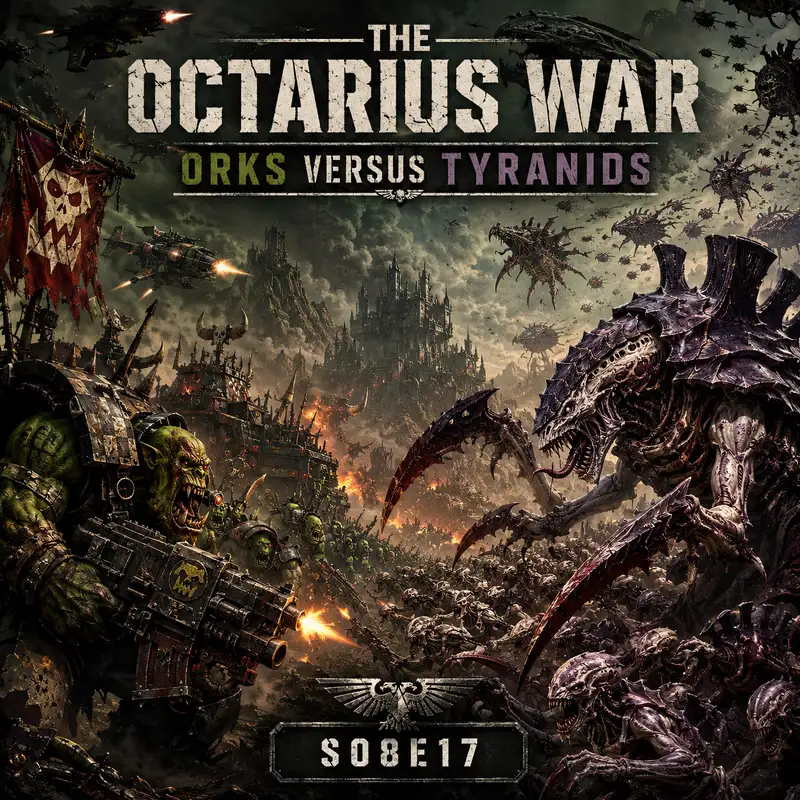
The Octarius War: Orks Versus Tyranids
The first mistake was believing that two nightmares, pointed at one another, would somehow become less dangerous. On the capital world of Octaria, the sky darkened beneath living spores, and the Orks waiting below did not flee. They cheered. Gun crews opened fire until burning Tyranid bodies fell with the rain. Aircraft, winged beasts, and wreckage tangled above the mountains while green-skinned warriors scrambled uphill, hoping the battle might come close enough to join. To an Imperial observer, it looked like the desired result. Hive Fleet Leviathan had found an enemy willing to fight without retreat, negotiation, or concern for casualties. Yet the longer the war continued, the more obvious the flaw became. Neither side was merely spending strength. Both were learning how to create more of it.
The Octarius War was born from a desperate question. Could the Imperium redirect one existential threat into another and let them destroy each other? The man who attempted it was Inquisitor Fidus Kryptman, one of the Imperium's foremost authorities on the Tyranids. He understood the Great Devourer better than most humans alive, which meant he understood enough to be terrified and not quite enough to remain cautious. Hive Fleet Leviathan was advancing across the southern reaches of the galaxy, consuming worlds and converting every living thing into fresh organisms. Conventional victories slowed individual tendrils, but the greater mass kept moving. Kryptman needed something vast, violent, and conveniently nonhuman to place in its path. The Ork empire of Octarius seemed almost designed for the role.
Kryptman had already embraced measures that even the Inquisition considered extreme, an impressive achievement in a profession where planetary annihilation can appear in the paperwork as a regrettable necessity. He ordered worlds in Leviathan's path evacuated when possible and destroyed when not, denying their biomass to the hive fleet. Billions died. The strategy slowed the Tyranids, but it did not stop them, and Kryptman was stripped of his authority and condemned by his peers. Exile did not persuade him that his reasoning was wrong. It persuaded him that lesser minds lacked the will to follow it through. Octarius became his second answer, less direct than burning planets and, at least at first glance, more economical. Instead of starving Leviathan, he would feed it an enemy capable of biting back.
The Ork Empire of Octarius occupied a broad region of the Ultima Segmentum and was ruled by a warlord bearing the title of Overfiend. It was not an empire in the human sense. There were no orderly ministries, tax offices, or carefully maintained borders. There were worlds held by rival bosses, fleets assembled from stolen hulls and impossible machinery, and a rough hierarchy enforced by size, violence, and the immediate availability of witnesses. Yet the empire possessed enormous military depth. Its worlds teemed with Orks, their lesser kin, war machines, shipyards, and fungal ecosystems capable of replenishing losses. If any force could absorb a Tyranid invasion without collapsing at once, it was Octarius. Kryptman saw a shield. He did not fully account for the fact that the shield enjoyed being struck.
To guide Leviathan toward its new enemy, Kryptman led Deathwatch warriors in the capture of living Genestealers and sealed the brood in stasis. The creatures were planted aboard a drifting space hulk called Perdition's Flame, then sent toward Ork-held space. When Ork scavengers boarded the hulk in search of useful wreckage, they found the Genestealers instead. The infection spread through the sector, creating the psychic signal that would draw the hive fleet. It was a remarkable act of strategic manipulation, precise in method and monstrous in consequence. Kryptman had taken one of the Tyranids' own invasion mechanisms and used it as a beacon. The operation worked. A tendril of Leviathan turned toward Octarius. In the narrowest possible sense, the plan was a success.
The deeper problem lay in the nature of the opponents. Tyranids wage war as an ecosystem under unified direction. They consume bodies, vegetation, oceans, and atmosphere, then reprocess that material into whatever organisms the next battle requires. Orks spread through spores, thrive amid violence, and grow larger and more dominant as they survive repeated combat. A major war also draws more Orks from surrounding space, because a truly enormous fight exerts a cultural pull they find difficult to resist. The Tyranids gained biomass and battlefield data. The Orks gained experience, momentum, and ever greater numbers. Kryptman had not placed two armies inside a sealed arena. He had connected two military growth engines and supplied them with a sector.
The first worlds showed how quickly the theory could turn into nightmare. On Orrok, millions of spore pods descended through a darkened sky. Gaunts struck the fortifications, Ork mobs countercharged, and the battle spread across every scale. Squigs fought Ripper organisms underfoot. Warbosses and Nobz met Tyranid Warriors and Carnifexes. Squiggoths crashed into bio-titans. Even the microscopic struggle mattered, as Tyranid phage cells attacked the Orkoid spores settling across the ground. The Orks fought with the directness expected of them and killed astonishing numbers. It was not enough. By nightfall the defenders had been surrounded, slain, and fed into the Tyranid reclamation cycle. The hive fleet did not simply defeat Orrok. It converted the planet's resistance into supplies for the next invasion.
Ghorala appeared to offer a different result. Pirate-Warboss Skarfang and his fleet met the approaching bio-ships among dense asteroid fields and hidden mines. Ork vessels tore into the swarm before it could deploy, and the Tyranid fleet was nearly destroyed. One wounded bio-ship broke through and hurled itself toward the planet, releasing a comparatively small ground force. The Orks followed, confident that the surviving creatures could be hunted down. They had won the void battle and possessed overwhelming numbers on the surface. Most commanders in the galaxy would have accepted the position gladly. The Hive Mind did not treat the situation as a failed invasion. It treated it as a problem to be studied.
The Tyranids on Ghorala avoided the massed Ork mobs and attacked isolated groups. When the Orks adapted by travelling in larger formations, the swarm changed again. It fought only long enough to create piles of dead, withdrew into caves, and returned after dark to consume Ork and Tyranid corpses alike. Hidden digestion pools turned those remains into new creatures. The invaders became stronger while the defenders slowly spent themselves. When Skarfang entered the ground war, the Hive Mind identified him as the point around which Ork resistance cohered. Feint attacks drew him into a reckless pursuit. Toxic organisms blinded and scattered his convoy. Lictors isolated him and killed his followers one by one. Once Skarfang fell, his tribes turned on each other, and Ghorala was consumed. The victory came through patience, deception, and a clear understanding of Ork command.
That lesson mattered when Leviathan reached the capital world, Octaria. The Overfiend gathered the tribes among mountain fortresses and scrap-built cities. Ork anti-aircraft guns filled the sky with so much fire that fragments of Tyranid organisms fell like hail. Gargoyle swarms collided with fighta-bommers, Deffkoptas, and Stormboyz. Genestealers erupted from tunnels beneath the defenders, while Lictors climbed the mountains to silence heavy weapons. Every destroyed gun opened another path for the falling spores. Every Tyranid landing produced another Ork counterattack. The planet did not fall quickly. It became the centre of a conflict so intense that nearby systems began feeding it with reinforcements, refugees, scavengers, and fresh enemies. The Octarius war zone was no longer a trap. It was a beacon for war.
The fighting escalated because neither faction interpreted losses as the Imperium did. A human army can be destroyed by casualties even when it holds the field. Its trained personnel, supply structure, and political will are finite. Orks can lose millions and still spread spores across the ground where they died. Survivors become harder, larger, and more influential. Tyranids can expend entire broods if the hive fleet controls the battlefield afterward and recovers the biological material. The two sides did not gain from every engagement, and both suffered losses that could not always be reclaimed, especially in void warfare. Even so, the general pattern was grim. The longer the war continued, the more specialised the Tyranids became and the more formidable the surviving Orks grew.
Ghazghkull Thraka eventually came to Octarius, drawn by the scale of the conflict and by his own vision of a greater Ork war. His arrival rallied scattered forces and restored direction to the greenskin campaign. He killed a massive Mawloc, imposed order through the traditional Ork method of being larger and more convincing than anyone who disagreed, and showed the Octarian bosses what the war might become. Yet Ghazghkull did not remain to rule the sector. He departed to gather a still greater Waaagh, leaving behind renewed momentum but no lasting unity equal to his presence. Octarius had become important to the wider Ork awakening, not because it offered peace or territory, but because it demonstrated the scale of battle the galaxy could provide.
The Imperium watched the struggle expand and gradually understood that Kryptman's gambit had not produced a closed conflict. Ork fleets raided outward. Tyranid tendrils tested neighbouring systems. Genestealer cults rose on threatened worlds, while other forces entered the region for their own reasons. Imperial authorities established the Cordon Impenetra, a fortified ring intended to contain whatever emerged. Worlds inside the boundary were effectively written off. Worlds outside it were ordered to build defences, raise armies, and prepare for a disaster whose final direction no one could predict. The Imperial response was to draw a line around the catastrophe and give the line a formal name, which is often how panic becomes policy.
Containment proved brutally difficult. The Orks and Tyranids did not remain politely engaged with one another. They attacked Imperial worlds, collided with local defenders, and sometimes ignored humanity until it became inconvenient. Imperial commanders occasionally allowed the two xenos forces to weaken each other before striking the survivor, essentially repeating Kryptman's logic on a smaller scale. Sometimes it worked. Sometimes the survivor was merely angry, well fed, and standing closer. Forge worlds, mining systems, refugee routes, and naval stations were pulled into the fighting. The Octarius War had become less like a duel and more like a spreading fire front. The Imperium could preserve selected positions, but it could not restore the sector to anything resembling order.
For years, the central contest remained unresolved. That uncertainty encouraged a comforting interpretation. Perhaps the plan was still working. Perhaps every dead Ork and every destroyed Tyranid organism represented strength removed from the galaxy. Yet attrition only helps when the enemy cannot replace what is lost, and both factions were unusually capable of doing exactly that. Tyranid adaptation produced organisms suited to Ork tactics and environments. Ork Meks answered with stranger weapons, larger engines, and fortresses that behaved like industrial accidents with defensive budgets. Each side forced the other to improve. Octarius was not consuming two threats at equal speed. It was selecting the most dangerous survivors.
The balance shifted when the Swarmlord took direct control of the final campaign. The Swarmlord is not simply a larger Hive Tyrant. It is a recurring strategic intelligence, recreated by the Hive Mind when a war requires exceptional coordination. On Octaria, it did not rush toward the largest concentration of enemies in search of a glorious confrontation. That would have been an Ork solution. Instead, it isolated systems, divided reinforcements, and attacked the empire's structure. Outlying worlds were assaulted to draw away fleets and supplies. Strongholds were surrounded rather than merely charged. Vanguard organisms disrupted communications and logistics. The Hive Mind had learned that the Orks were most dangerous when gathered around a successful warlord. It therefore began dismantling the conditions that allowed such unity.
Across the Octarius system, the Tyranids turned Ork habits against them. On one world, an enormous bio-titan was used as bait for ambitious hunters, drawing a warboss and his followers into an encirclement. In asteroid fortresses, hidden Genestealers waited until the main assault began, then severed life support and opened sections to the void. Subterranean Ork speed mobs treated Tyranid tunnels as racing courses, so the swarm changed the battlefield with cave-ins and aerial organisms that burned broad corridors from above. At orbital shipyards, burrowing creatures emerged inside production areas and slaughtered the crews, leaving the defenders unable to replace lost vessels. None of these actions won the war alone. Together, they stripped Octaria of help.
The defenders remained terrifying. Ork engineering is often described as crude because it is loud, asymmetrical, and hazardous to stand near. On Octaria, it was also devastatingly effective. Mountain fortresses opened like mechanical jaws and swallowed advancing swarms into fields of blades. Scrap cities shifted their streets and walls to create new kill zones. Vast magnets lifted Tyranid organisms from the ground and dropped them into furnaces the size of settlements. Guns erased whole broods. Gargants crushed living monsters underfoot. The Tyranids paid for every advance in bodies. The Hive Mind's advantage was not that its creatures were invulnerable. It was that it was willing to spend them according to a plan the Orks could not see.
The Swarmlord first sealed Octaria from reinforcement. Bio-ships fought Ork blockade runners in orbit while winged organisms contested the skies. Once air superiority was established, spore waves delivered billions of fresh creatures to prepared landing zones. Captured regions were stripped and recycled, allowing new swarms to be produced close to the front. The Orks destroyed uncounted attackers, but ammunition ran low, machines failed, and isolated bosses disappeared. The Overfiend remained at the centre of resistance, a living symbol powerful enough to keep rival tribes fighting in the same direction. That made him the decisive target. The Swarmlord did not seek him until the surrounding system had been weakened and his lieutenants had been separated or killed.
At the scrap-city of Megascrap, the Hive Mind closed its trap. One vast swarm encircled the Overfiend's army and attacked from every direction. A second ring formed beyond it to stop escape and prevent reinforcement. Bio-titans pressed forward in such numbers that Ork war engines became bogged down among heaps of Tyranid dead. Elite organisms were expended as freely as common gaunts. The Overfiend fought at the centre, cutting down creature after creature while his remaining bodyguard was stripped away. This was not wasteful frenzy. The bodies were buying isolation, exhaustion, and a single moment of weakness. When the Overfiend suffered a deep wound, the Swarmlord finally entered the battle.
The duel was the last movement of a strategy already decided. The Overfiend attacked with the ferocity expected of the greatest warboss in the sector. His surviving warriors destroyed Tyrant Guard and Carnifexes around him, and his power claw remained capable of tearing apart almost anything it reached. The Swarmlord defended, parried, and allowed the Ork to spend his remaining strength. Then it severed the power feeds to the claw, turning the weapon into dead weight. Its bone blades smashed through the Overfiend's skull, and the Tyranid commander consumed his brain. The act was more than physical victory. It destroyed the authority holding the Ork empire together and announced that the long stalemate had ended.
Octaria fell, but the war did not end cleanly. The death of the Overfiend shattered the remaining Orks into rival followings. Multiple warlords claimed the vacant title and began gathering armies, fighting Tyranids, Imperial forces, and one another. Hive Fleet Leviathan held the upper hand and consumed the capital world, yet scattered battles continued throughout the sector. The Imperial cordon stabilised in places, though stability in Octarius meant that the defenders could identify which direction the next catastrophe was coming from. Tyranid organisms pushed outward. Ork survivors carried the experience of the war with them. What had been intended as a killing ground became a source of hardened armies and new invasions.
Was Kryptman simply wrong? The answer is less comfortable than that. His plan did divert Leviathan and bought the Imperium precious time. In a civilisation that survives by postponing extinction from one century to the next, time is not a trivial achievement. Octarius also inflicted enormous losses on both factions. Yet Kryptman treated war as subtraction, assuming that two enemy strengths committed against each other would steadily diminish. In Octarius, war was also reproduction, selection, and communication. It summoned Orks, refined Tyranid tactics, and taught both sides about an opponent unlike any they had faced. The gambit solved an immediate operational problem while creating a wider strategic danger. That is not uncommon in Imperial history. It is merely more visible when the consequences have teeth.
The Octarius War was therefore not important because Orks and Tyranids finally proved which species was stronger in some permanent sense. The Tyranids won the decisive campaign by turning adaptation into strategy, isolating the Ork empire and killing the warlord who held it together. The Orks proved that they could make even the Great Devourer pay an appalling price, and that defeat would scatter rather than erase them. Around the ruins, the Imperium inherited the result it had tried to avoid: a victorious hive fleet, rival Ork warlords, and a frontier trained to expect invasion. On Octaria, the last great cheer of the defenders was swallowed by the feeding swarms, but the war they loved had already escaped the world.