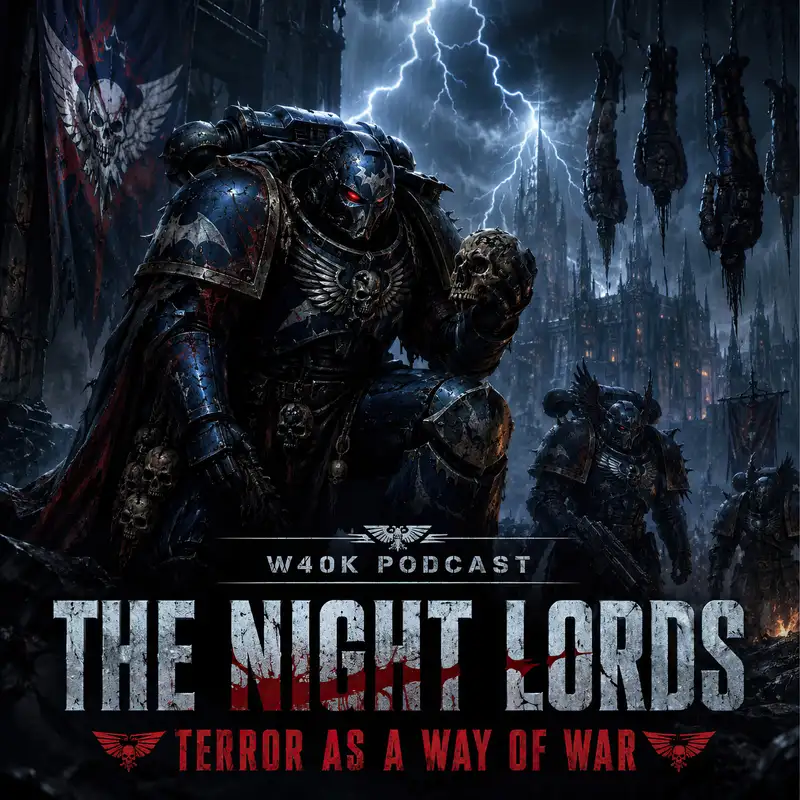
The Night Lords: Terror as a Way of War
For a world marked by the Night Lords, the first warning might not be a fleet entering orbit. It might be a voice on an emergency channel, calmly naming officials who had vanished during the night. It might be a transmission from a neighbouring city, repeating long after everyone there was dead. Lights would fail district by district. Patrols would find bodies arranged where they could not be ignored. By the time midnight-blue warriors appeared beneath artificial lightning, the battle had already begun inside the defenders’ minds. That was the point. The Night Lords did not regard fear as decoration added to violence. They regarded violence as a means of manufacturing fear, and fear as the force that made whole populations defeat themselves.
Every Space Marine Legion used shock, speed, and overwhelming power. The Night Lords built an entire theory of war around what happened before the first exchange of fire. Their ideal victory began with information. They studied an enemy’s command structure, habits, communications, and sources of confidence. Then they isolated units, removed leaders, corrupted signals, and made every unexplained sound feel like evidence of something worse. They preferred darkness, sudden attacks, and targets selected for the effect their deaths would have on survivors. A commander killed in battle was merely a casualty. A commander taken from a sealed bunker and displayed above the headquarters became a message. The distinction was strategically useful, though probably academic to the commander.
This doctrine did not begin on Nostramo, although Nostramo gave it its final shape. The earliest warriors of the Eighth Legion were drawn from bleak Terran populations, including the children of prisoners raised in places where darkness, violence, and confinement were normal facts of life. The Legion was used to punish resistance and make examples of those who defied the new Imperium. It developed a reputation for operations in which the destruction of a few was deliberately made visible to many. The Emperor’s Great Crusade was not a humanitarian tour of the galaxy. Compliance was compulsory, and every Legion carried its own form of coercion. The Eighth simply became unusually honest about the coercion, then unusually enthusiastic about it.
Konrad Curze arrived on Nostramo alone. The planet was rich in valuable minerals and poor in nearly everything that makes civilisation tolerable. Its cities existed beneath permanent night, their streets wet with chemical rain and their towers divided between predatory elites and desperate masses. Crime was not an interruption of society. It was one of the ways society functioned. Curze had no family, teacher, or stable community. He learned by observing, hunting, and surviving. He was also afflicted by visions of possible futures, usually the darkest ones. Those visions gave him knowledge without wisdom and certainty without peace. He could see consequences, but he increasingly struggled to believe that anyone, including himself, could choose another path.
Curze began by killing criminals. Then he killed officials who protected criminals, nobles who profited from them, and anyone he judged responsible for Nostramo’s misery. He did not hide what he had done. The mutilated dead were warnings placed where the living would find them. Fear spread faster than any police force could have moved. Crime fell. Corrupt institutions became obedient. Parents frightened children with stories of the Night Haunter, while rulers discovered a sudden and deeply sincere interest in public order. Curze had created peace, after a fashion. It was not trust, consent, or justice administered through law. It was the silence that follows when everyone believes a predator may be watching.
That result became the foundation of Curze’s philosophy. He believed punishment worked only when it was certain, memorable, and terrible enough to deter others. One victim could therefore stand in for thousands. In his own reasoning, cruelty was not indulgence. It was economy. A city terrorised into surrender might avoid a siege. A rebellious world shown the fate of one province might submit before orbital bombardment began. During the Great Crusade, the arrival of the Night Lords could end resistance before a campaign properly started. Systems corrected unpaid tithes, exposed dissidents, and offered compliance because the alternative had been made vivid. By the arithmetic of conquest, terror sometimes did save lives. It merely required that certain lives be ended with exceptional care.
When the Emperor found Curze, he found a son who had independently turned fear into government. The Eighth Legion found a father whose methods resembled its own darkest habits. The union appeared almost logical. Curze renamed his warriors the Night Lords and refined their appearance into part of their arsenal. Midnight armour carried images of death, winged skulls, and flickering patterns of lightning. Trophies transformed individual killings into public warnings. Assault troops descended from above like creatures from a nightmare, while vox systems carried screams, threats, and evidence that supposedly secure positions were not secure at all. Their armour did not simply protect them. It announced that the stories were true.
Terror warfare worked best when the Night Lords controlled the story surrounding a battle. They cultivated a reputation larger than the force actually present. Survivors were sometimes more useful than corpses because survivors travelled, spoke, and exaggerated without needing orders. Refugees could spread panic ahead of an advancing fleet. A single atrocity, carefully revealed, might convince several worlds that resistance was hopeless. This allowed the Legion to conserve strength, strike where it held an advantage, and let imagination multiply its numbers. Other Legions broke fortresses or annihilated armies. The Night Lords wanted the next fortress to open its gates because it had heard what happened to the last one.
The weakness was present from the beginning. Fear could compel behaviour, but it could not create loyalty. Nostramo became orderly because Curze was there, or because people believed he might appear. Once he left to join the Great Crusade, the old systems of power returned. Criminal families regained influence. Officials learned to imitate obedience while resuming familiar arrangements beneath it. A society that had never developed legitimate institutions had no reason to remain just when the punishment disappeared. Curze interpreted this relapse as proof that people were naturally corrupt and deserved harsher control. The same evidence could support a different conclusion. His peace had depended entirely on one immortal executioner remaining in every alley forever.
Nostramo’s corruption reached directly into the Legion. Curze had wanted worthy recruits, warriors who might embody the severe justice he imagined himself to represent. Instead, the planet’s elites manipulated the recruitment tithe. They kept useful fighters for their own struggles and emptied prisons into the Imperial system. Murderers, predators, and gang enforcers were transformed into Space Marines. The older Legionaries had already been trained to use cruelty as a tool. Many of the new Nostraman recruits enjoyed cruelty as an end in itself. The difference could be difficult to detect from outside, especially after the screaming started, but it mattered. Discipline became appetite. Exemplary punishment became entertainment. The doctrine had supplied sadists with a moral vocabulary.
Curze recognised the corruption in his sons, yet his response only deepened it. He despised them for enjoying the acts he claimed to perform from necessity. They saw the contradiction. Their Primarch taught that terror was the only reliable instrument of order, then condemned them for becoming expert practitioners. Sevatar, the Legion’s formidable First Captain, eventually challenged the heart of Curze’s argument. Had other methods truly failed, or had Curze simply never attempted them? The question exposed the weakness beneath the prophecy, philosophy, and blood. Curze had treated brutality as inevitable because inevitability freed him from responsibility. If another path had been possible, then every atrocity became a choice.
His visions made that choice harder to confront. Curze often saw futures ending in betrayal, madness, and death. Some accounts suggest he could perceive more than one possible outcome, yet he repeatedly fixed upon the worst. He acted as though the future were settled, and his actions helped settle it. He expected his brothers to reject him, so he concealed his deterioration until violence made rejection unavoidable. He expected the Imperium to condemn him, so he gave it crimes impossible to overlook. He expected death at an assassin’s hands, then shaped his final years around ensuring that death would occur. Prophecy became less a warning than a set of instructions he resented while following with remarkable diligence.
The Imperium’s role cannot be removed from this story. Curze did not invent terror in a peaceful civilisation. He served an expanding empire that rewarded rapid compliance and tolerated dreadful methods while they remained useful. Worlds surrendered to the Night Lords, and the Crusade moved on. Objections became serious only when Curze’s actions threatened Imperial citizens, embarrassed other Primarchs, or could no longer be contained inside the language of necessity. The Imperium had discovered a weapon too effective to discard and too shameful to admit was working as designed. Curze saw that hypocrisy clearly. His error was believing that Imperial hypocrisy proved his own innocence.
The breaking point came with Nostramo. Curze returned to find the planet again ruled by crime and exploitation. Rather than rebuild it, replace its institutions, or accept that terror had failed, he destroyed it. The Night Lords’ fleet shattered the world from orbit. Curze presented the act as judgment upon a corrupt population. It was also the destruction of the evidence against his philosophy. Nostramo had obeyed him and then relapsed when he departed. Its survival would always testify that fear had produced submission without reform. Its death allowed him to call the failure a sentence carried out. The lesson he drew was not that terror could not sustain a society. It was that the society had not been terrified enough.
By the time Horus openly rebelled, the Night Lords were already estranged from Imperial authority. At Isstvan Five, they joined the second wave sent against the apparent traitors, then turned their weapons upon the loyalist Salamanders, Raven Guard, and Iron Hands. The Drop Site Massacre gave them what their methods required: confusion, betrayal, isolated victims, and an enemy whose assumptions had collapsed. Rebellion also removed the remaining limits upon their conduct. Some Traitor Legions followed Horus from loyalty, grievance, ambition, or devotion to the powers of the Warp. Many Night Lords followed because the new war permitted them to become what they had already been practising to be.
Their largest independent campaign during the Heresy unfolded across the Eastern Fringe. Horus needed the region disrupted and its industrial resources denied to Terra. The Night Lords descended upon the Thramas territories, turning strategic warfare into a spreading climate of panic. They destroyed populations, poisoned productive worlds, drove refugees ahead of their fleets, and used each conquered system to frighten the next. The campaign was not random violence. It targeted routes, recruiting grounds, forge worlds, and the confidence of Imperial defenders. Yet the boundary between calculated terror and massacre for its own sake eroded rapidly. Curze was deteriorating, commanders pursued private cruelties, and worlds that resisted were punished on a scale that served vengeance as much as strategy.
The Dark Angels eventually entered the war under Lion El’Jonson, and the Night Lords met an opponent poorly suited to being frightened into collapse. The First Legion could be secretive, severe, and ruthless in its own fashion, but it retained discipline and a deep capacity for organised war. The Lion denied Curze the easy contest. He pursued fleets, forced engagements, adapted to ambush, and treated terror as a military problem rather than a supernatural verdict. When the Night Lords lost control of the narrative, their weaknesses became visible. They were dangerous Space Marines, not phantoms. They could bleed, their ships could be trapped, and their commanders could be outmanoeuvred. Fear was a force multiplier, not a substitute for force.
The Thramas Crusade badly mauled the Legion and broke its cohesion. Curze was injured, isolated, and eventually captured during the wider struggle with the Dark Angels. Sevatar divided the surviving fleet so that separate formations could escape destruction. That decision preserved warriors but accelerated the future warband culture of the Night Lords. Units became loyal to captains, companies, and immediate comrades rather than to a functioning Legion. Some elements continued toward the Siege of Terra. Others raided, settled private scores, or pursued their Primarch’s shadow across the galaxy. A force built upon dominance discovered that no one possessed enough dominance to hold it together.
Curze’s final act was perfectly consistent with the world he had made. On Tsagualsa, after years of slaughter and flight, he waited for an Imperial assassin he had long foreseen. He ordered that she be allowed to reach him. By accepting death rather than preventing it, Curze intended to prove that the Emperor was no different from him. The master of mankind had condemned murder and terror, then sent a killer through the dark to remove an inconvenient son. Curze treated the blade as vindication. Yet his death proved less than he believed. An assassin’s mission demonstrated Imperial ruthlessness. It did not demonstrate that every earlier cruelty had been necessary, or that no other future had ever existed.
After Curze died, the Legion’s remaining unity collapsed. Its leaders contested authority, the Night Lords were eventually driven from Tsagualsa, and the old formation splintered into warbands. Ten thousand years later, those warbands remain diverse. Some retain fragments of Legion discipline and contempt for open worship of the Chaos Gods. Others employ sorcerers, make daemonic bargains, or surrender fully to corruption. Some claim to preserve Curze’s vision of punishment. Others are pirates wearing inherited colours while hunting slaves, supplies, and amusement. They share no single command and little brotherhood. What binds them is method, memory, and the conviction that fear reveals the truth beneath every oath.
In battle, modern Night Lords still prefer advantage before honour. They sabotage communications, stalk isolated forces, attack at night, and descend upon weakened positions with jump packs and close-range weapons. They choose prey carefully because a fair fight wastes the principal benefit of terror. They use mutilation, trophies, recorded suffering, and sudden disappearance to make enemies imagine threats beyond what is physically present. Withdrawal is not shameful if it preserves the warband for a better opportunity. This separates them from warriors who seek glorious contests or sacrificial devotion. A Night Lord may be vicious, theatrical, and proud, but he is rarely obliged to die merely to prove that he can.
This pragmatism helps explain their survival. A scattered warband cannot replace losses easily, hold extensive territory securely, or win prolonged wars of attrition against the full machinery of the Imperium. Terror allows a small force to create effects out of proportion to its numbers. A frightened garrison may abandon a position. A panicked governor may overreact and exhaust his own troops. Refugees may clog roads and ports. Rumours may force several systems to prepare for attacks that never come. In the darkness beyond the Great Rift, where Imperial worlds are isolated and reliable information is scarce, the old Night Lords method becomes even more potent. Uncertainty does much of the work.
Their cruelty is therefore neither meaningless nor fully rational. It produces real military advantages, which is why the Legion used it before the Heresy and why its descendants still use it. It also creates appetites, habits, and identities that escape strategic control. Once warriors define themselves through terror, they must keep escalating to preserve their reputation and satisfy their own expectations. Violence intended to shorten war becomes the reason for war. Punishment meant to create order leaves populations too broken to govern. A reputation designed to make enemies surrender also ensures that many enemies believe surrender offers no safety. The weapon begins to select the strategy, then the targets, then the kind of warrior willing to carry it.
The Night Lords call fear honest because courage, loyalty, faith, and law can all fail when pain becomes immediate. They believe the terrified person reveals what civilisation normally conceals. There is insight in that belief, and also a convenient excuse. Fear exposes weakness, but it can manufacture weakness as well. It can compel betrayal without proving that loyalty was false. It can reduce people to survival and then claim survival was all they ever valued. Curze looked upon populations crushed beneath an impossible threat and regarded their collapse as evidence about human nature. He rarely considered what their resistance might have revealed under a different kind of leader.
Terror became the Night Lords’ way of war because it matched their origins, served the Imperium’s conquests, amplified their strength, and justified the instincts of men shaped by Nostramo. It became their ruin because they confused enforced silence with lasting order. They could frighten worlds into obedience, but not build institutions that survived their departure. They could expose hypocrisy, but not escape their own. They could foresee disaster, but treated foresight as permission to cause it. The midnight armour, the lightning, and the trophies remain effective because the stories still travel ahead of them. Behind those stories stands no empire, no shared faith, and no future they are trying to create. The Night Lords can make a world obey in a single night, but they have never learned how to make it remain theirs when morning comes.