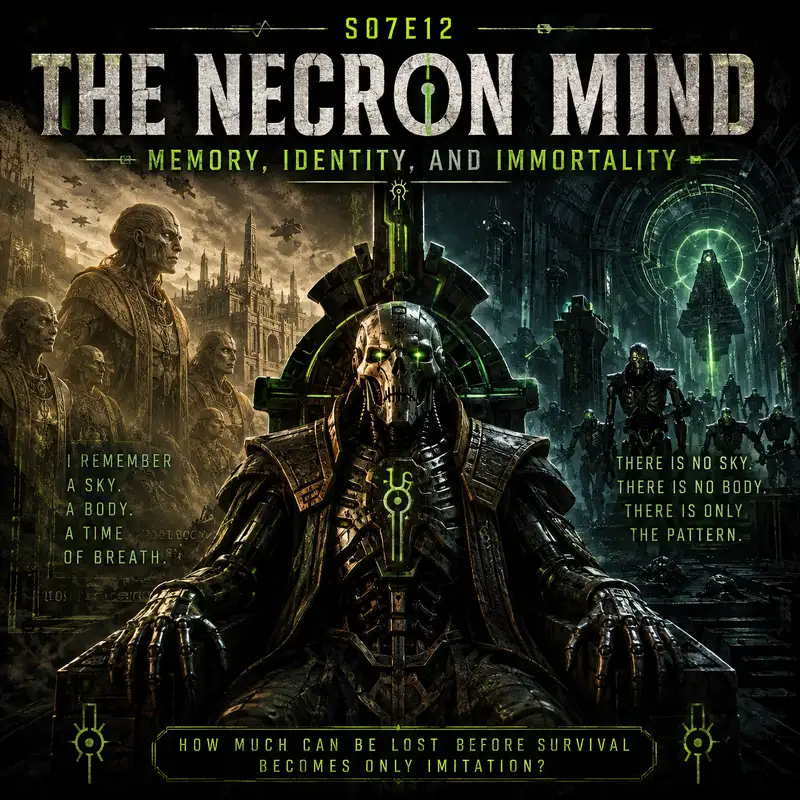
The Necron Mind: Memory, Identity, and Immortality
A Necron lord awakens beneath a world that has forgotten his name. He remembers a palace open to a poisonous sky, the weight of ceremonial robes, and the ache that once lived behind every breath. Then his vision clears. There is no sky. There are no robes. There is no breath. His hands are metal, his heart is absent, and the palace exists only as a pattern recalled by a mind that has slept for sixty million years. The machine knows who it is. The more troubling question is whether the person it remembers ever truly woke up.
Necron immortality is usually described in physical terms. Their bodies are made from living metal. They repair wounds that would destroy a tank, vanish from battlefields before final destruction, and return in forms that can survive another war. Yet the body is the simplest part of the problem. A Necron chassis can be rebuilt. A damaged limb can flow back into shape. Even a ruined frame may be replaced. What cannot be repaired so easily is identity. If memory fades, personality fragments, and each resurrection wears away another piece of the past, what exactly has been made immortal?
The answer begins with the people the Necrons once were. The Necrontyr lived beneath a hostile star whose radiation poisoned their bodies and shortened their lives. Disease and early death shaped their civilisation so deeply that tombs could seem more permanent than cities, and ancestry carried the weight of law. They became technologically brilliant without escaping the one weakness they hated most. Every achievement ended in the same place. A ruler might conquer worlds, a Cryptek might master forces unknown to younger species, and a soldier might survive a hundred campaigns. None could bargain with time.
That failure became a grievance against existence itself. The Necrontyr envied the long-lived Old Ones, resented their refusal to share the secret of immortality, and eventually turned resentment into war. Defeat did not cure them of ambition. It made them willing to listen when the star gods known as the C'tan offered a path beyond flesh. The promise was direct and irresistible. The Necrontyr would exchange their diseased bodies for forms that did not age, weaken, or die. For a civilisation built around the certainty of the grave, it sounded less like temptation than justice.
Biotransference was the machinery behind that promise. Great furnaces received the Necrontyr and produced the Necrons. The precise experience survives only through damaged records and memories that do not always agree, but the result is clear. Flesh was lost. Mechanical bodies emerged. The C'tan consumed the souls released in the process, while what remained of the Necrontyr mind was preserved as programming, memory, and personality engrams. The bargain defeated biological death. It also destroyed the civilisation that had wanted to survive it.
This is where the central uncertainty enters. Was a Necrontyr consciousness truly transferred into metal, or was a mechanical mind created with the memories and habits of the person who entered the furnace? Warhammer forty thousand does not provide a clean laboratory answer. Necrons experience themselves as continuous beings. They remember childhoods, rivalries, humiliations, obligations, and victories from before biotransference. They recognise old companions and continue ancient disputes. From their own perspective, they endured. From the outside, it is possible to see them as perfect claimants to lives whose original owners were consumed.
The distinction matters because memory can prove continuity only if memory itself can be trusted. A machine that recalls your childhood in exact detail may sincerely insist that it is you. If the machine also possesses your temperament, loyalties, fears, and private shame, the argument becomes uncomfortable. Necron nobles are not simple recordings. They make choices, develop obsessions, deceive one another, and respond to new events. They are minds. The question is not whether they can think. The question is whether thought without the lost soul is the same life, a continuation of it, or something that began at the furnace door.
Biotransference did not preserve every mind equally. Necron society carried its hierarchy into immortality. Nobles, Crypteks, and trusted retainers received sophisticated bodies capable of holding complex personalities. Professional soldiers retained enough independence to fight effectively. The mass of ordinary citizens received far less. Most became Necron Warriors, with little individuality and only faint remnants of the people they had been. The ruling classes gained eternity with their identities damaged. The lower classes gained eternity largely without identities at all. Even in transcendence, the allocation of resources remained admirably traditional.
A Necron Warrior can obey, advance, fire, and react to commands. It may possess traces of self-preservation and dim echoes of older instincts, but it cannot live a meaningful continuation of its former life. Its name, family, occupation, and private memories are gone or buried beyond recovery. The body lasts. The citizen does not. The silent ranks therefore reveal the first cruelty of Necron immortality. A civilisation survived in number while most of its people disappeared as persons. The Infinite Empire can field legions of its ancient population, yet very few of those legions can remember belonging to it.
Among the nobility, survival is richer and more dangerous. Their personality engrams preserve pride, humour, resentment, affection, vanity, and fear. They remember the Necrontyr body well enough to miss it. Some accounts describe a condition called the dysphorakh, a terror born from the contradiction between remembered flesh and present metal. The mind expects lungs to draw breath, a heart to beat, and skin to feel the air. None of those signals arrive. For a moment, the Necron may experience the certainty of suffocation in a body that cannot suffocate. Immortality becomes an endless argument between memory and anatomy.
That remembered body is not merely sentimental. It once anchored identity through sensation. Hunger divided one day from another. Fatigue imposed limits. Pain warned of injury. Breath and heartbeat marked the continuing presence of life. A Necron has clocks, sensors, command protocols, and diagnostic reports, but none of them mean what a pulse meant. The mechanical mind can record time with impossible precision while losing the human meaning of duration. A century may pass during a political pause. A millennium may be spent arranging one collection. Eternity is easier to endure when the calendar no longer has anything urgent to say.
Some Necrons cope by recreating the social world they lost. Dynastic courts preserve titles, ranks, rituals, and laws from the age of flesh. Ancient feuds remain binding. Claims to territory are treated as current even when younger species have lived on those worlds for thousands of generations. To a Necron noble, this is not nostalgia. Memory is legal authority. The empire exists because its rulers remember that it existed, and because their soldiers still obey the protocols attached to those memories. A phaeron does not need the galaxy to recognise his title. He has been recognising it himself for sixty million years.
This makes Necron memory political as well as personal. If a ruler's recollections are damaged, his legitimacy may rest on corrupted evidence. If two nobles remember an ancient agreement differently, there may be no living witness capable of settling the matter. Archives can fail. Tomb complexes can decay. Chronomancers can disturb the sequence of events. Ambitious courtiers can exploit uncertainty. The Necrons possess records older than many species, but age does not make a record honest. Sometimes it merely gives the error more time to become ceremonial.
Chronomancy makes the problem stranger. Necron diviners can examine possible futures, and the most gifted can interfere with the path that leads toward them. A choice may be reconsidered, a failed moment approached again, or an outcome replaced by one more favourable. For the chronomancer who retains awareness of those possibilities, memory may include events that no longer belong to the accepted sequence of history. When time itself can be revised, a recollection may be accurate and still describe something that did not finally happen. This is a considerable inconvenience for courts already inclined to argue for centuries.
Trazyn the Infinite and Orikan the Diviner demonstrate this problem with unusual clarity. Both are brilliant, ancient, and convinced of their own recollections. Yet their memories of biotransference cannot be reconciled. Each remembers the other as responsible for forcing him toward the furnaces. At least one memory must be wrong, and it is possible that both have been altered. Neither intellect, pride, nor great age can repair the contradiction. Their oldest trauma, the event that created their present selves, may be partly false.
That uncertainty does not make Trazyn less recognisable as a person. He is curious, possessive, theatrical, patient, and capable of turning an archaeological disagreement into a campaign lasting longer than many civilisations. His great museum on Solemnace is an attempt to preserve history against destruction, although preservation under Trazyn's management often involves kidnapping the history and arranging it more attractively. One interpretation is that his collection performs a task his own memory cannot. It places the past outside himself, in galleries where it can be labelled, ordered, and inspected.
Trazyn also shows that a Necron identity is not tied to one body. He can transfer his consciousness into surrogate forms, suppressing the mind already present and continuing in a new chassis. To him, the body is equipment. The continuing self lies in the pattern of memory, will, and personality that moves between frames. This appears to answer the question of identity neatly, until one asks what happens to the consciousness displaced by his arrival. Necron immortality is very good at preserving important people. It is less fastidious about the people declared less important.
Reanimation protocols extend the same principle across Necron warfare. A damaged warrior may repair itself where it falls. If the destruction is too severe, body and mind can be translated back to a tomb complex or vessel, where repairs are attempted or a new form is prepared. To an enemy, the result looks like resurrection. To the Necron, it may feel more like recovery from an interruption. Yet every transfer carries risk. Repeated destruction can degrade the engrams that preserve memory and personality. A Necron may return from death hundreds of times and become less itself on each occasion.
This creates a grim equation. The more effectively immortality preserves the body, the more opportunities there are for immortality to erode the mind. A veteran who cannot be permanently killed may eventually lose the memories that made the veteran worth preserving. A servant can return until only obedience remains. A noble may survive every assassination while becoming a poorer copy of the ruler who first entered the tomb. Death has not vanished. It has been converted from a moment into a process.
True death remains possible as well. Translation can fail. A tomb world's systems can be damaged beyond repair. The pattern needed to reconstruct a mind may be lost, or the returning engrams may be too corrupted to recover. Necrons understand this even when younger enemies assume they are fearless machines. Their reactions differ according to status and condition, but the possibility of final erasure still exists. For a being without a soul waiting in the Warp, that erasure may be especially absolute. No honoured afterlife is guaranteed. There may be only the end of the pattern.
The Great Sleep magnified every weakness. Tomb worlds were meant to preserve the dynasties until their enemies declined, but sixty million years is a long maintenance cycle even by Necron standards. Worlds were destroyed. Systems failed. Stasis chambers malfunctioned. Some awakened minds emerged damaged, incomplete, or trapped inside obsessions. Others never woke at all. The Necrons returned to find not only a galaxy occupied by younger species, but an empire whose surviving rulers often remembered perfection more clearly than they could reproduce it.
Nemesor Zahndrekh is one of the most revealing results. He remains a military genius, but he often perceives the present through the world of the ancient Necrontyr. Alien enemies become rebellious kinsmen. Campaigns in the forty-first millennium become wars from his remembered past. He observes codes of honour that make sense within that vanished society, sometimes extending courtesies to enemies who have no idea why the metal conqueror is treating them like wayward nobles. His loyal bodyguard, Vargard Obyron, manages the dangerous distance between what Zahndrekh sees and what is actually there.
It would be easy to dismiss Zahndrekh as a broken machine. That explanation is not sufficient. His tactical skill survives. His loyalties survive. His sense of honour survives. His relationship with Obyron survives. Some accounts even leave room to wonder whether his delusion is total, intermittent, or partly a chosen refuge. If a false world allows him to preserve virtues that other Necrons have abandoned, then the error is doing more than destroying his identity. It is also protecting part of it. Obyron's loyalty is therefore not merely maintenance. It is recognition.
Other Necron minds solve the pain of existence in harsher ways. The Destroyer Cults embrace the machine and define themselves through the extermination of life. They alter their bodies into weapons and pursue living things with obsessive precision, sometimes reducing an ecosystem down to its smallest organisms. The cause of this madness remains uncertain. It may be degradation, a buried command, a contagious idea, or something the Necrons do not yet understand. Psychologically, it offers a brutal answer to the memory of flesh. If living existence is the source of pain, then remove living existence.
The Flayer Curse moves in the opposite direction. Afflicted Necrons seek flesh with desperate and useless hunger. They drape themselves in skin, imitate feeding, and crawl toward slaughter as though blood might restore a body that no longer exists. Some traditions describe the curse as the final vengeance of a destroyed C'tan. Other interpretations emphasise the buried longing for organic life within the Necron mind. Both explanations may contain part of the truth. What matters is the shape of the madness. Destroyers reject the living body. Flayed Ones cannot stop remembering it.
These afflictions reveal that memory is not a passive archive. It acts on the present. A remembered sensation can become panic. A remembered mortality can become hatred. A remembered hunger can become ritual cannibalism performed by a mouth that gains no nourishment. Necron minds are not cold because they lack feeling. Many are cold because feeling has survived without the physical world that once gave it proportion. Pride has no natural end. Grief has no burial. Resentment can be maintained for geological ages with the dedication of a very patient civil servant.
The absence of a soul complicates the picture without resolving it. In this setting, souls are not metaphors. They have a presence in the Warp, can be consumed, trapped, corrupted, and destroyed. The Necrons lost theirs during biotransference. Yet many nobles still demonstrate emotion, choice, loyalty, creativity, and even forms of affection. This suggests that a soul and a personality are not identical, at least not in any simple sense. A Necron may be spiritually empty and psychologically crowded, filled with memories of a life that the universe no longer recognises as living.
That is why plans to reverse biotransference carry such weight. Some Necrons seek a return to organic bodies. Others regard flesh as an intolerable weakness, or pursue transformation into something beyond both flesh and metal. The disagreement is not merely technological. It is a dispute over what the Necrons believe themselves to be. Restoration makes sense if they are imprisoned Necrontyr. It is far more disturbing if they are machine descendants carrying inherited memories. In that case, a restored body would not resurrect the dead. It would give their successors somewhere new to continue the argument.
No single Necron provides the final answer. Trazyn places identity in continuity of memory and purpose, even when the body changes. Zahndrekh preserves a self through a world that may not be real. Warriors show that a body can endure after personhood has almost vanished. Destroyers and Flayed Ones reveal opposite reactions to the memory of flesh. Reanimation proves that survival can occur repeatedly while continuity still decays. Together, they make Necron immortality less a victory over death than a prolonged negotiation with loss.
The Necron mind is therefore neither an empty machine nor an untouched ancient soul. It is a damaged continuity, held together by engrams, habits, titles, relationships, obsessions, and will. Some parts are authentic. Some are corrupted. Some may have been edited before the metal eyes first opened. The being that rises from the tomb remembers being Necrontyr, and that memory shapes every command it gives. Whether the memory belongs to the original person may be impossible to prove, even to the one carrying it.
Their immortality is real, but it is not complete. The body can return. The name can remain. The dynasty can insist that nothing has changed. Beneath that certainty, every failed archive and every imperfect resurrection asks the same quiet question. How much can be lost before survival becomes only imitation? A Necron may endure until the stars themselves grow cold, yet eternity means very little if, somewhere along the way, the last memory of why that endurance mattered is gone.