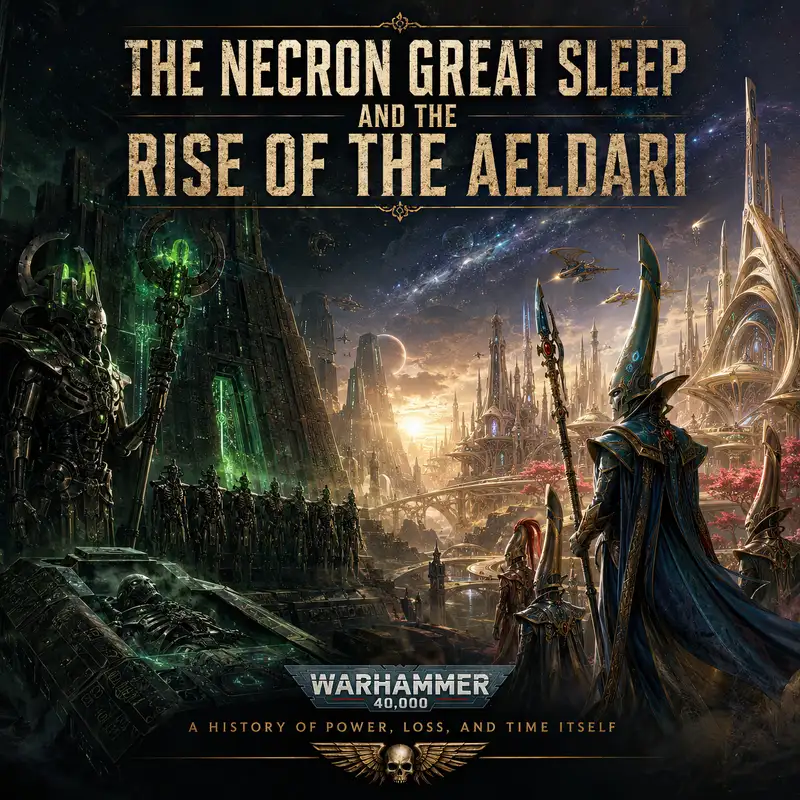
The Necron Great Sleep and the Rise of the Aeldari
The victors of the first great war did not build monuments to their triumph. They sealed themselves beneath dead worlds, extinguished their cities, and left the galaxy to species they had spent ages trying to destroy.
It was an extraordinary decision. The Necrons had survived the War in Heaven. The Old Ones were broken. The star gods who had deceived the Necrontyr had been shattered and chained. Across countless systems, armies of living metal still stood beneath rulers who could measure their lives in geological time. By any ordinary standard, this was the moment to consolidate power.
Instead, the Silent King ordered his people to sleep.
That choice created one of the defining transfers of power in galactic history. The Necrons did not vanish because the Aeldari defeated them in one final, decisive campaign. The Aeldari rose because the Necrons looked at the ruined galaxy, calculated the cost of continuing the war, and decided that time would kill their enemies more efficiently than another army could.
The Great Sleep was therefore not merely hibernation. It was strategy on a scale almost no mortal civilisation could contemplate. It was also a confession. The Necrons had won, but their victory had left them too damaged to enjoy it.
The Necrontyr had entered the War in Heaven as a bitter, short-lived species trapped beneath hostile stars. They emerged from biotransference as the Necrons, their minds sealed inside bodies of living metal. The process gave them the immortality they had desired, but it stripped away far more than flesh. The ordinary population lost most of its personality. Warriors became obedient ranks of nearly silent machines. Nobles retained more of themselves, though memory, sanity, and identity survived unevenly.
Most terrible of all, the souls of the Necrontyr had not been transferred into metal. They had been consumed.
The C'tan, the star gods who offered biotransference, had treated an entire civilisation as a feast. The Silent King, Szarekh, understood the betrayal only when it could no longer be reversed. He had united the Necrontyr under his authority and led them into the furnaces. He had gained obedient legions and lost the people he meant to save.
The war continued because stopping would not restore what had been taken. The Necrons fought the Old Ones and their servant races across a galaxy already being torn apart by weapons, psychic upheaval, and predatory forces from the Warp. The Aeldari were among the most important of those younger species. Accounts from this age are fragmentary and mythic, but they consistently present the Aeldari as a people shaped for conflict by powers older than themselves.
They were not yet the languid aristocrats of the empire that would come later. They were survivors of an age when gods walked near the battlefield, when the Webway carried armies between stars, and when psychic force could be used with a freedom that would become unthinkable after the birth of Slaanesh.
The Old Ones eventually disappeared from the struggle. Whether they were destroyed outright, consumed by the disasters they had helped unleash, or reduced to scattered remnants is not entirely settled. What matters is that their organised power ended. The Necrons had removed their greatest enemy, but the galaxy around them had become a ruin filled with armed successor species.
Then the Silent King turned against the C'tan.
This rebellion was the final act of Necron vengeance. The star gods had once seemed beyond resistance, but the long war had weakened them, and Necron science had advanced under the pressure of survival. The Necrons deployed weapons capable of breaking entities that had fed upon stars. They could not truly kill the C'tan without risking consequences they may not have understood, so they shattered them into fragments.
Those fragments became C'tan shards, pieces of former gods imprisoned within Necron devices and forced to serve the civilisation they had betrayed. It was a punishment of elegant cruelty. The Necrons had been made into weapons, so they made weapons of their makers.
The victory was real, but it was not clean. Necron dynasties had been devastated. Tomb complexes had been damaged. Entire lines of command had vanished. Many nobles were unstable, and the great weapons used in the final stages of the war had exacted costs that even an immortal species could not simply ignore.
The Aeldari, by contrast, were still growing.
They possessed powerful psychic abilities, access to much of the Webway, and a culture built from the surviving legacy of the Old Ones. They had suffered in the War in Heaven, but they had not been reduced to the same condition as the Necrons. Their bodies still lived. Their souls still moved through the Warp. Their society could reproduce, adapt, and create in ways the Necrons could no longer easily imitate.
A renewed war between the Necrons and the Aeldari might have lasted ages. The Necrons may have possessed the greater mastery of physical science, but that did not make victory certain. Their forces were exhausted, their dynasties divided, and their species could not replace its losses in any normal sense. A destroyed Necron body might be repaired or rebuilt. A lost mind, a ruined tomb world, or a severed command structure was another matter.
The Silent King's calculation was brutally simple. Organic civilisations rise, fracture, and die. Their rulers are murdered. Their empires divide. Their languages vanish. Their descendants forget why old wars were fought. The Necrons, properly preserved, could wait beyond all of it.
So the dynasties prepared to withdraw.
Across the galaxy, Necron worlds became tomb worlds. Vast armies descended into subterranean chambers. Nobles entered stasis crypts surrounded by retainers, war machines, and treasures from a civilisation that no longer truly lived. Great doors sealed. Surface structures were hidden, abandoned, or allowed to decay. Canoptek constructs remained active to repair damage, protect the sleeping complexes, and eliminate intruders.
The scale of the operation is difficult to grasp. This was not one fleet entering suspended animation after a difficult campaign. It was the coordinated burial of a galactic civilisation. Entire worlds were converted into vaults. Legions that had crossed the stars in war stood motionless in ranks beneath kilometres of stone.
The Great Sleep was intended to last roughly sixty million years.
That number reveals the difference between Necron strategy and almost every human idea of planning. Human states struggle to think beyond an election, a reign, or a generation. The Imperium sometimes plans in centuries, usually by losing the paperwork and calling the delay sacred tradition. The Necrons treated continents drifting and species evolving as manageable scheduling concerns.
Yet the plan depended on assumptions, and even immortals can make optimistic assumptions.
The Necrons believed their tomb systems would remain intact. They trusted automated guardians to function without meaningful interruption. They expected their enemies to decline. They assumed that when they awoke, they would still possess enough unity, memory, and military strength to reclaim what they had abandoned.
Szarekh did not intend to remain as an eternal master over sleeping slaves. After issuing the command to enter the Great Sleep, he destroyed the command protocols that had bound the Necron race directly to his will. This act returned a degree of autonomy to the dynastic rulers. It did not restore the souls of the Necrontyr or repair the minds of the common warriors, but it ended the Silent King's absolute control.
Then he departed into exile beyond the galaxy.
The gesture can be read as remorse, responsibility, or both. Szarekh had delivered his people into biotransference. He had led them through victory and damnation. With the dynasties asleep and the C'tan broken, he removed himself from the civilisation he had ruined.
The galaxy above the tomb worlds did not become peaceful. The War in Heaven had left wounds in reality, hostile species, and weapons that should never have survived their makers. Yet the disappearance of the Necrons removed one of the few powers capable of contesting the Aeldari across the breadth of the stars.
The Aeldari inherited opportunity, but they were not passive beneficiaries. They had fought in the greatest conflict the galaxy had known. They possessed the mobility of the Webway, allowing them to travel between distant regions without relying upon the same dangerous passage through the Warp that later civilisations would use. Their psychic gifts allowed them to shape matter, communicate across enormous distances, and create technologies that were as much art as engineering.
Over immense spans of time, the Aeldari transformed from a war-born people into the dominant civilisation of the galaxy.
Their empire did not need to resemble the later Imperium. It was not necessarily a uniform bureaucracy planting officials on every inhabited world. Aeldari power rested on superiority rather than constant occupation. They controlled routes, worlds, resources, and technologies that other species could scarcely comprehend. When they chose to intervene, few rivals could resist them.
They built with psycho-reactive materials such as wraithbone, shaped through psychic discipline rather than hammered into form by ordinary industry. They created worlds suited to their desires. They moved through hidden roads between reality. Automated systems and constructed servants performed much of the labour that had once defined survival.
The result was abundance on a scale that would have seemed miraculous to most species.
For the Aeldari, hunger could be solved. Distance could be overcome. Disease and ordinary material hardship ceased to be central concerns. Death itself was not understood as the final, predatory trap it would later become. Before Slaanesh, Aeldari souls could pass into the Warp without being seized by a waiting god of excess. Traditions concerning rebirth and the continuity of the soul gave their civilisation a relationship with mortality very different from the terror that would define their descendants.
This was the high age of the Aeldari empire, and it lasted longer than the entire recorded history of humanity.
The gods of the Aeldari occupied a place between religion, psychic reality, inherited myth, and possibly engineered power. Surviving accounts do not allow a simple distinction between metaphor and literal event. Khaine, Vaul, Isha, Asuryan, and the others were remembered through stories that may preserve distorted memories of the War in Heaven, genuine Warp entities, or both.
For the Aeldari living within that civilisation, the distinction may not have mattered. Their myths were not remote tales from a dead age. They described forces that shaped identity, ritual, art, war, and the structure of the soul.
The empire's rise also changed the meaning of the War in Heaven. The Aeldari had begun as one of the younger races created or guided for a desperate struggle. Once the Old Ones were gone and the Necrons were buried, the weapon inherited the battlefield.
That inheritance carried dangers.
A society formed under extreme pressure can lose its purpose when the pressure disappears. During the War in Heaven, Aeldari gifts had been necessary for survival. Psychic sensitivity, intense emotion, speed of thought, and extraordinary creativity were advantages against enemies who could extinguish suns and imprison gods.
In an age of abundance, those same qualities had no natural boundary.
For millions of years, the Aeldari empire remained stable enough that its decline was not inevitable in any simple sense. It produced art, philosophy, exploration, and forms of experience beyond anything later survivors could fully recover. The Fall should not be mistaken for proof that the entire civilisation had always been corrupt. Civilisations can be magnificent and still contain the means of their own destruction.
The problem grew gradually. Automated systems handled necessity. Military supremacy removed external fear. Longevity reduced urgency. Pleasure, artistic expression, personal transformation, and increasingly intense experience became central pursuits for parts of the population.
At first, this may have looked like freedom. The Aeldari had escaped the demands that bind most societies. They did not need to spend their lives mining ore, hauling cargo, or dying in wars over habitable land. They could devote themselves to sensation, creation, and self-discovery.
They also possessed minds capable of turning private obsession into psychic consequence.
Over time, restraint came to be seen by many as a limitation rather than wisdom. Cults and movements pursued stronger emotions, stranger experiences, and more extreme forms of expression. The Warp reflected the psychic lives of a vast and powerful species. The Aeldari did not merely indulge themselves inside their empire. Their collective excess began to create something.
The Necrons slept beneath all of this.
Their tomb worlds endured while Aeldari cities rose and vanished above them. Some were buried beneath oceans. Others were struck by tectonic shifts, stellar catastrophe, invading species, or the simple failure of machinery expected to function for longer than mountains survive. Canoptek guardians repaired what they could. Some systems malfunctioned. Some tombs opened too early. Others never opened at all.
Within the crypts, minds degraded.
Necron bodies did not age as flesh ages, but immortality did not protect them from damage, corrupted memory, madness, or the erosion of personality. When dynasties eventually awoke, some nobles retained strategic brilliance and ancient pride. Others emerged trapped inside obsessions, false histories, or repeating fragments of who they had once been.
The Great Sleep preserved the Necrons, but it did not preserve them perfectly.
This is where the story becomes more than a simple exchange of empires. The Necrons believed time was their ally because they were made of metal and their enemies were made of flesh. In the narrowest sense, they were correct. The Aeldari empire eventually destroyed itself. The psychic pressure of its excess gave birth to Slaanesh. The resulting catastrophe consumed most of the species, tore open the Eye of Terror, and ended the civilisation that had ruled the galaxy for ages.
The Aeldari who survived did so by rejecting, escaping, or adapting to the empire that had fallen. Craftworlders imposed strict Paths upon themselves. Exodites embraced harsher lives on distant worlds. The inhabitants of Commorragh survived within the Webway and continued practices that fed their souls while ensuring that the suffering was usually someone else's. Harlequins served the Laughing God. Later movements would seek still other answers.
The Aeldari remained formidable, but they were no longer the masters of the galaxy.
By then, humanity had risen, spread, collapsed, and rebuilt itself as the Imperium. Orks remained numerous. Chaos had become a permanent strategic reality. Other species occupied worlds once claimed by older powers. When Necron tombs began to open in greater numbers, the galaxy was not empty and waiting.
The Silent King's wager had succeeded only in the manner of many grand strategies. The enemy he feared had fallen, but the conditions he expected had not appeared.
The Necrons had slept through the Aeldari empire, yet they had also slept through every opportunity to shape the ages that followed. Their worlds had been damaged. Their dynasties had become isolated. Their subjects had forgotten one another, and some rulers awoke convinced that ancient borders still carried unquestioned authority.
To them, younger species were trespassers occupying territory that had belonged to the Necrontyr before humanity's ancestors had learned to use tools. This claim was historically impressive and practically inconvenient. A human colony does not become easier to remove merely because an immortal monarch produces a land deed older than terrestrial mammals.
The Aeldari view the awakening Necrons with a different fear. They remember, however imperfectly, what lies beneath those worlds. Their myths and inherited warnings reach back toward the War in Heaven. To humans, a Necron tomb may be an archaeological discovery, a mineral opportunity, or a problem for the nearest regiment. To the Aeldari, it is an old battlefield opening its eyes.
The relationship between the two civilisations is therefore defined by unfinished history. The Necrons see the Aeldari as the inheritors of enemies who should have vanished. The Aeldari see the Necrons as the return of a catastrophe their ancestors never truly defeated.
Neither side can claim an uncomplicated victory.
The Necrons destroyed the Old Ones, broke the C'tan, and denied the Aeldari a final war at the moment of their greatest vulnerability. They survived by refusing battle. That was not cowardice. It was a cold recognition that continuing the war could risk the extinction of a species already reduced to copies of itself.
The Aeldari rose because they possessed the strength, mobility, knowledge, and creativity to exploit the vacuum. They did not simply find an abandoned throne and sit upon it. They built a civilisation whose achievements endured for tens of millions of years, a span of dominance unmatched by the Imperium and scarcely imaginable to its historians.
Yet both empires were shaped by the same ancient disaster.
The Necrons answered mortality by abandoning life. The Aeldari answered survival by mastering life so completely that they eventually lost any accepted limit upon desire. One civilisation buried its emotions inside metal. The other allowed emotion to reshape the Warp.
The Great Sleep and the rise of the Aeldari were therefore not separate events. They were two consequences of the War in Heaven. The Necrons withdrew because victory had emptied them. The Aeldari advanced because survival had empowered them.
Time did what the Silent King expected. It destroyed the empire that stood above his tombs.
It also damaged the sleepers, filled their worlds with strangers, and returned them to a galaxy more crowded, unstable, and hostile than the one they had abandoned.
Beneath the ruins of younger civilisations, Necron vaults still open. In the Webway and aboard the craftworlds, the descendants of the Aeldari empire still remember why that sound is terrifying. The galaxy was never truly inherited by either people. It was left between them, claimed by the waking dead and haunted by the survivors of a golden age that burned itself into a god.