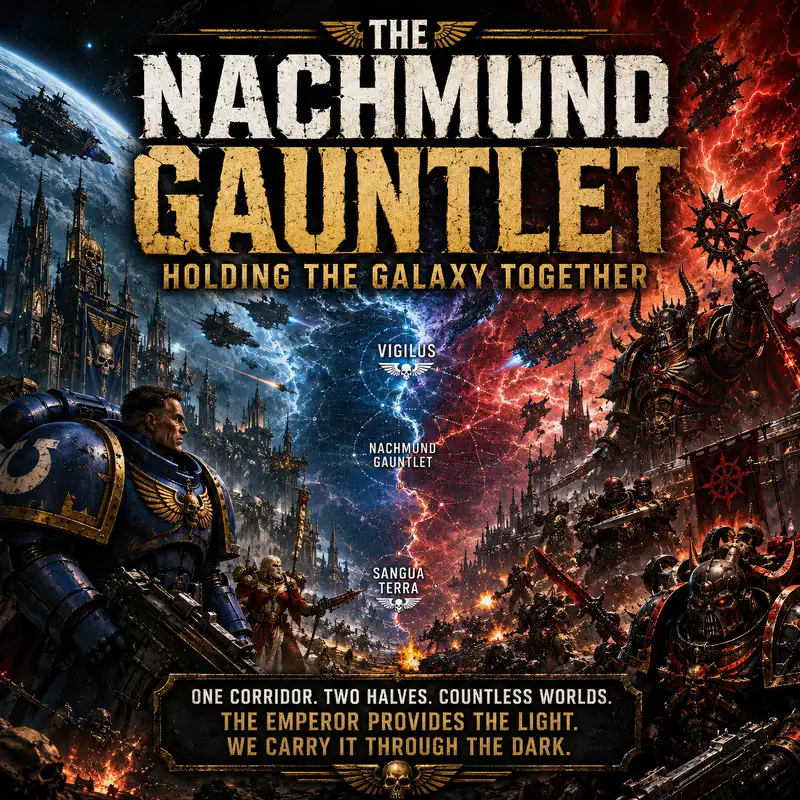
The Nachmund Gauntlet: Holding the Galaxy Together
The convoy waited at the edge of a wound in the stars. Behind it lay the Imperium Sanctus, where the Astronomican still offered Navigators something like a direction. Ahead lay a corridor of darkness bordered by storms that could swallow fleets and years. The route was called the Nachmund Gauntlet. Imperial charts described it as a passage through the Great Rift, which made it sound almost civilized. It was simply a place where crossing remained possible. Every transport carried soldiers, food, machines, messages, or refugees. Every ship that failed to arrive left another world more alone. A thin road through impossible weather had become one of the few things preventing half an empire from drifting into permanent night.
The disaster began with Cadia. When Abaddon the Despoiler destroyed the fortress world and its ancient pylons failed, warp storms joined into the Cicatrix Maledictum, the Great Rift. The phenomenon divided the Imperium into two regions. On Terra’s side, the Imperium Sanctus retained the clearest light of the Astronomican and central government. Beyond the Rift lay the Imperium Nihilus, where the beacon was obscured, astropathic communication became erratic, and familiar warp routes failed. Worlds lost more than reinforcements. They lost reliable proof that the wider Imperium still existed. Some endured under local rulers. Others fell to invasion, rebellion, or starvation. Some continued obeying orders issued decades earlier because no replacement had arrived, which is a remarkably Imperial way to face the end of civilization.
The Nachmund Gauntlet was not a tunnel bored cleanly through the Rift. It was a region of comparatively stable realspace and navigable warp routes running between the storms. Comparatively is doing heroic work in that sentence. Ships still faced violent tides, predators, corrupted signals, and warped time. Yet the Gauntlet offered a reasonable chance that a fleet entering one side might emerge from the other in recognizable formation. Vigilus and Sangua Terra stood near its opposing ends, and both possessed great deposits of blackstone, the substance associated with the pylons of Cadia. In the right configuration, blackstone can suppress the warp. Its presence helped stabilize the passage, turning two battered planets into anchors for a route on which uncounted systems depended.
The route’s importance was logistical before it was heroic. Armies require ammunition, fuel, replacement parts, food, medicine, and ships to carry them. Astropathic messages need relay stations. Navigators need tested routes and updated charts. Refugees need somewhere to go, even when the destination rations air. The Indomitus Crusade could win brilliant victories in the Imperium Nihilus, but without a dependable path behind it, victories became isolated sparks. The Gauntlet allowed reinforcements and information to move from Terra’s side into the dark half. Survivors and reports could return. That traffic maintained more than military strength. It maintained the claim that both halves still belonged to one Imperium. Empires are held together by banners and belief. They are held together rather more convincingly by supply ships arriving on schedule.
Abaddon understood this. He did not need to conquer every Imperial world beyond the Rift to deepen the division. He needed to make the bridge unusable. If Vigilus and Sangua Terra fell, if relay stations were silenced, and if the intermediate systems became hunting grounds for traitor fleets, then the Imperium Nihilus could be strangled without a decisive battle. A million isolated wars could be influenced by taking a single corridor. The defenders, by contrast, had to protect two anchor worlds and a chain of translation points, depots, stations, and inhabited systems. Chaos could choose where to strike. The Imperium had to be ready everywhere, a requirement it usually answers by being fully prepared in several places that are no longer relevant.
Vigilus guarded the Gauntlet’s far end toward the Imperium Nihilus. Its wars had already shown what control would cost. Orks descended upon the world. The Pauper Princes, a Genestealer Cult embedded inside Vigilus, rose from within. Drukhari raiders, Death Guard, daemonic incursions, and the Black Legion exploited the confusion. Marneus Calgar coordinated the Imperial defense and survived a brutal confrontation with Abaddon, while damage to the Vengeful Spirit forced the Despoiler to withdraw. Vigilus remained Imperial, but survival was not security. Its hives, roads, and orbital approaches were still battlefields. The victory bought time rather than peace. More importantly, it proved the war could not be settled by holding one fortress world while the rest of the corridor burned around it.
Roboute Guilliman had recognized the need for a permanent guard. During the Ultima Founding, the Castellans of the Rift were created to defend the Nachmund Gauntlet. Their task was less glamorous than conquest and harder than it sounded. They had to clear routes, escort fleets, destroy renegade strongpoints, and answer threats emerging without warning. Losses mounted faster than replacements arrived. Their Chapter Master, Ba’stien Grix, called for aid, and scattered Space Marine forces answered. Others were fragments of larger formations, survivors of destroyed systems, or warriors thrown far from their destination by the Great Rift. They swore to defend the passage and became known collectively as the Wardens of the Gauntlet.
The Wardens were not a new Chapter with a single doctrine. They were an alliance whose traditions did not always fit neatly together. Black Templars might fight beside more measured successors of Guilliman. Some Chapters brought fleets, while battered detachments brought little beyond armour and determination. Their shared symbol, a gauntleted hand, represented an oath rather than a unified command. That flexibility suited a war with no stable front. It also attracted the Inquisition, because a large body of Space Marines cooperating across Chapter boundaries can look uncomfortably like a Legion if one squints with sufficient suspicion. While the Wardens preserved the passage, investigators considered whether their cooperation might itself be improper. The bureaucracy remained vigilant, even when the galaxy was less obliging.
The Gauntlet held dangers belonging to neither principal side. Ork Freebooters attacked vulnerable ships because a burning convoy offered both entertainment and salvage. Drukhari raiders hunted refugees and stragglers. Aeldari forces pursued their own aims, sometimes opposing Chaos where their interests aligned with Imperial survival, and sometimes treating Imperial plans as another complication. Pirates, mutants, renegades, and minor warlords occupied isolated stations and worlds. The storms made centralized control nearly impossible. A fleet might own a system on paper while knowing nothing about its outer stations for months. Holding the Gauntlet meant patrolling Mandeville points for warp translation, protecting astropathic relays, maintaining fuel depots, and keeping enough warships mobile to answer distress calls. It was convoy warfare conducted beside the mouth of hell.
Abaddon entrusted the offensive to Haarken Worldclaimer. Haarken was no mere spear-carrying commander. He was the Herald of the Apocalypse, a figure who made proclamation and terror into weapons. He announced worlds for Abaddon before taking them, forcing defenders to fight beneath promised defeat. After Vigilus, he gathered a vast armada of Black Legion vessels and allied warbands. Advance forces struck communications, arsenals, and isolated bastions. Cults and agents worked ahead of the fleet. Haarken did not intend to batter every fortress in sequence. He meant to make the defense collapse system by system, leaving each world unsure whether help was coming and each commander uncertain which reports were true. In the Nachmund Gauntlet, uncertainty was already part of the terrain. Haarken simply armed it.
The first great disaster came at Dharrovar, a Knight world ruled by the renegade House Mandrakor under King Kaligius and supported by the Dark Mechanicum forge moon Omega-Threx. Its Chaos Knights and daemon engines made it a hostile strongpoint within the corridor. Imperial forces under the Castellans and their allies attempted to retake it. They secured landing zones and pushed into terrain honeycombed with caves, fortresses, and concealed routes. Every position taken could be attacked again from cleared passages. The campaign became an attritional siege, with loyalists spending lives to gain ground that had to be retaken. It was exactly the sort of battle the Imperium knows how to continue long after the original plan has stopped making sense.
Haarken’s arrival transformed the siege into an evacuation. His fleet struck the system’s approaches, overwhelmed Imperial rear guards, and filled communications with terror and confusion. House Mandrakor counterattacked while Black Legion forces descended behind exhausted loyalists. Imperial commanders understood that remaining meant annihilation. Front-line units stayed behind to cover the withdrawal. Space Marines, Battle Sisters, Guardsmen, and Tempestus Scions fought toward landing zones while transports overloaded or departed half empty. Some dropships were shot down as they climbed. Others never reached orbit. The survivors escaped with only a fraction of their former strength. Dharrovar was not a noble draw recast as spiritual victory. It was a defeat, and it opened the way for Haarken to drive deeper into the Gauntlet.
The Worldclaimer did not pause to reduce every Imperial position. His vanguard shattered relays, destroyed arsenals, nurtured uprisings, and sabotaged devices that monitored the warp. Some worlds were isolated and drowned in daemonic incursions. Others were bypassed because they did not matter to the advance. Haarken was not collecting planets to color a map. He was dismantling the systems that made movement possible. Behind him came warbands, pirates, and opportunists eager to join a successful invasion. The Wardens answered with raids, ambushes, and guerrilla attacks. They destroyed ships and rescued survivors, but could not halt an armada spread across the corridor. Refugees carried the news ahead of it. The northern Gauntlet was becoming enemy-held country broken by isolated loyalist islands.
Imperial commanders at Sangua Terra answered by creating the Sanctus Wall. Four systems that had served as Indomitus Crusade supply hubs were reinforced into a defensive network at the Gauntlet’s southern end. The name suggested a continuous barrier. In reality, it was fortified worlds, naval positions, and overlapping plans. A line was drawn near the shrine world of Centor’s Landing. Holdings closer to Vigilus, beyond the line, were ordered to endure as best they could. Populations on the safer side were evacuated toward the Wall, with military forces and materiel first. The decision was strategically understandable and morally brutal. To make one defense strong enough to matter, the Imperium abandoned worlds that still considered themselves defended. The official wording was doubtless more dignified. The transport schedules were not.
Preparing the Wall consumed the region around it. Weapons, regiments, food, and ships were stripped from neighboring systems. Refugees were placed into labor units or handed weapons. Civil unrest spread as rationing tightened and rumors outran official messages. Worlds weakened to reinforce the Wall became inviting targets for Orks, Genestealer Cults, and raiders. Alpha Legion cells, Word Bearers, corrupted regiments, and local cults attacked from within. They sabotaged supply lines, left gaps in fortifications, or waited to turn their guns. Inquisitorial cabals hunted them, sometimes successfully and seldom gently. The Sanctus Wall was under siege before Haarken reached it. Its commanders built a fortress while checking whether the laborers, blueprints, and several generals served the enemy.
Time became the most valuable resource. Lord Admiral Quirin Prisca led a fleet into the Grakiliod Narrow, a route Haarken’s armada could not easily avoid. Her force laid mines, disrupted communications, and ambushed the first traitor vessels. Prisca then drove a narrow Imperial formation into the assembling fleet, broke through its line, and attacked from within the confusion. For hours, discipline and preparation injured a larger enemy. Then Haarken restored order. His ships closed around the loyalists, boarding parties overran isolated vessels, and the Imperial fleet was largely destroyed. Prisca was believed lost. The battle was not a victory in any ordinary sense, but it delayed the advance long enough for reinforcements to spread across the Sanctus Wall. In the Imperium, buying time with a fleet is acceptable accounting, provided the fleet is someone else’s.
At the center of the Wall stood Sangua Terra, the sister anchor to Vigilus. Blackstone beneath the world helped hold open the Gauntlet, while the Rift scarred its surface. The equatorial Flare Scar marked the violence of the Rift’s birth. Its moon, Sigil, had become a daemon world. Sangua Terra bristled with orbital guns, hives, Titans, Space Marines, Battle Sisters, and soldiers from across the Imperium. Canoness Superior Junith Eruita arrived with a War of Faith to strengthen the defense. Yet the planet’s importance made it impossible to hide or bypass. If Vigilus was the throat of the passage toward the dark half, Sangua Terra was the gate facing Terra. Haarken had crossed the corridor to reach the lock on the other side.
The invasion began with deception. Captured Imperial ships, crewed by servitors, entered at several points and drew patrols from the true attack. Chaos fleets followed, surrounded Sangua Terra, and swept aside much of its orbital screen. Then the Planet Killer moved between the world and its corrupted moon. The vessel’s name was not metaphorical. It had been designed to break worlds, and its arrival showed that Abaddon could destroy Sangua Terra if he chose. Haarken withheld its greatest weapon. He wanted the planet, its defenses, and its position. Destruction might close the road. Conquest would turn it around, allowing Chaos forces to pour from the Imperium Nihilus toward the Sanctus. The same corridor that carried relief into darkness could become an invasion route pointed at Terra.
Bombardment struck key positions, followed by Traitor Legion and warband landings. Haarken attacked Accrandor Spaceport. Chaos Knights drove toward the Emperor’s Voice Grand Battery. Night Lords descended upon the Tower of Murmuration, where an astropathic choir linked the capital to the wider war. Cult uprisings erupted inside Urbanosprawl Alpha as the external assault began. The Night Lords used dread missiles that spread psychic terror and scream-filled interference, breaking formations and corrupting communications. Defenders prepared to meet armour and infantry found themselves fighting panic inside their own minds. The astropathic tower fell. The spaceport was taken. Each objective let Haarken land troops, silence warnings, and sever the capital from help. The campaign’s strategic logic was repeating at the scale of a city.
Junith Eruita’s Battle Sisters held around the Praefectus Bastion while Titans and Space Marines contested the grand battery. Faith mattered, but not as a guarantee of victory. It gave frightened defenders a reason to stand against the Night Lords’ terror. When Saint Celestine appeared, her presence rallied the Sororitas and drove back daemonic and traitor forces in purifying flame. For a moment, the defense looked capable of becoming the miracle its soldiers needed. Haarken answered by feeding more warriors, armour, and daemon engines into the assault. With the spaceport captured, he reinforced faster than the defenders replaced losses. The saint could inspire courage. She could not make ammunition, repair orbital guns, or restore a strategic situation already collapsing around the bastion.
Celestine found Eruita prepared to die with her position and told her that martyrdom was not the duty required that day. The defenders had to survive and continue the war. An evacuation began westward while Battle Sisters formed a rearguard. Wounded but fighting, Celestine held the retreat together. Elsewhere, Imperial Titans were overwhelmed. One princeps overloaded his Warlord Titan’s reactor rather than let the god-engine fall, consuming attackers in the explosion. Dropships lifted soldiers from both sides of the Flare Scar. Celestine and Eruita were among the last to leave. Haarken captured the capital’s command center and much of Urbanosprawl Alpha, but not the entire world. Sangua Terra remained contested, its defenders displaced rather than destroyed, and the war continued.
The later discovery of the Attilan Gate means Nachmund is not the only stable route through the Great Rift. Other perilous passages also exist. That does not make the Gauntlet expendable. It remains the largest and most stable known corridor, supported by worlds, charts, depots, and military infrastructure built at enormous cost. A second bridge does not diminish the first when a galactic storm divides an empire. More importantly, the enemy is already inside Nachmund. Haarken’s forces have taken much of the northern passage, broken major fleets, and seized the capital of its southern anchor. Loyalist worlds remain, Wardens raid behind enemy lines, and the Sanctus Wall endures. Yet the route that once carried Imperial relief is now a battlefield through which Chaos can advance.
So how does the Nachmund Gauntlet hold the galaxy together? Not by making the Great Rift smaller, and not by restoring the Imperium that existed before Cadia fell. It holds together the possibility of connection. Through it can pass orders, armies, pilgrims, machine parts, warnings, and witnesses. A world in the Imperium Nihilus may still receive proof that Terra remembers it. A crusade fleet may still obtain replacements. A survivor may carry news of a lost system back across the Rift, allowing the loss to be recorded. If the Gauntlet closes, the dark half will not disappear. It will fragment further into local realms, isolated wars, and fading loyalties. The Rift’s political division will become a practical, perhaps permanent separation.
The most revealing image is not Haarken raising his spear over a conquered spaceport, or Celestine burning through the dark with wings of fire. It is a damaged transport entering the corridor under escort, its holds packed with shells, rations, replacement soldiers, and messages months late. Warp storms press against a route maintained by blackstone, sacrifice, and stubborn navigation. Ahead, no one can promise that Vigilus is secure, that Sangua Terra will hold, or that the destination still belongs to the Imperium. The ship advances anyway. The Nachmund Gauntlet is no healed seam across the galaxy. It is the hand gripping both torn edges and refusing to let go. The Imperium is held together there not by certainty, but by vessels that keep entering the dark because the alternative is to admit that the galaxy has already broken.