The Mechanicus–Imperium Alliance: One Empire or Two?
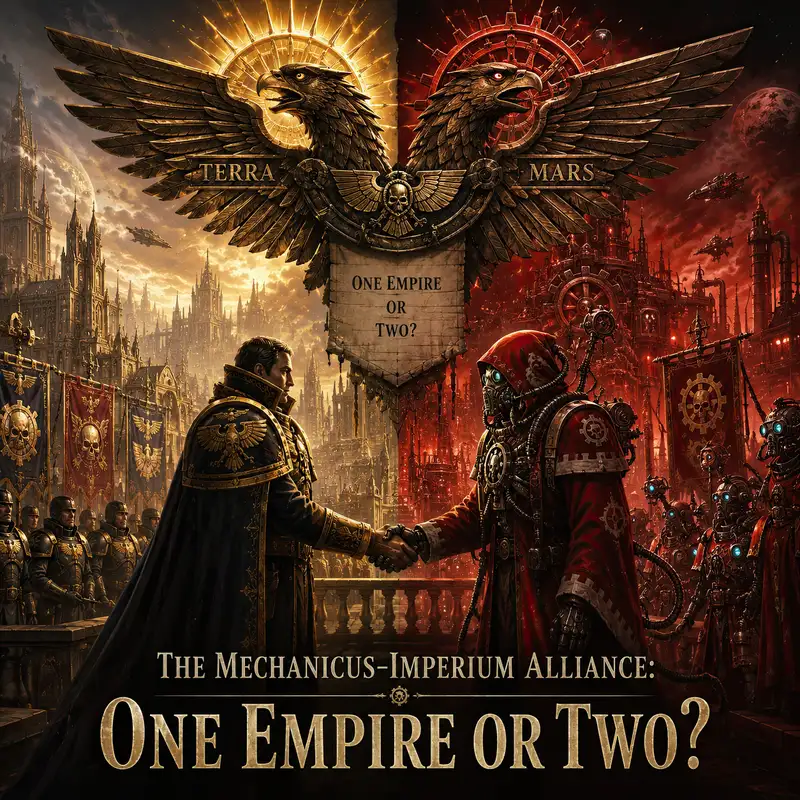
The double-headed eagle of the Imperium is usually presented as a symbol of total authority. It is also an admission. One head looks toward Terra. The other looks toward Mars. They share a body, but they do not share a mind. Across most Imperial worlds, a governor rules in the Emperor’s name, the Administratum counts the tithe, and the Ecclesiarchy instructs the population in the proper shape of belief. On a forge world, those assumptions become requests rather than certainties. The red-robed priesthood controls the factories, the archives, the armies, and often the planet itself. It worships through doctrines that are not quite the Imperial Creed, protects secrets that Imperial officials are not permitted to inspect, and possesses enough military power to make even a confident bureaucrat rediscover the value of courtesy. Yet the Adeptus Mechanicus is not foreign. It is woven into the Imperium at every level. Mars belongs to the Imperium. The question is what the word belongs actually means.
Long before there was an Imperium, Mars had already become something close to an empire of its own. During the Age of Strife, humanity’s old interstellar civilisation collapsed beneath war, isolation, psychic catastrophe, and the failure of technologies that earlier generations had trusted without understanding. Mars suffered terribly. Its environment was ruined, its machines were failing, and its survivors fought over power, water, shelter, and fragments of knowledge. Out of that devastation emerged the Cult Mechanicum. Its priests did not merely repair machines. They turned preservation into religion. Knowledge became sacred because ignorance had nearly killed them. Ritual became necessary because a procedure could remain reliable long after the reason behind it had been forgotten. The machine spirit gave a religious language to systems that behaved in ways few living people could fully explain. This was not simply superstition growing around technology. It was a survival culture built in the wreckage of a civilisation that had discovered, rather dramatically, that cleverness and wisdom are not the same thing.
The priesthood of Mars gathered what it could, buried what it feared, and guarded what remained. It created Skitarii armies, maintained Titan Legions, and sent expeditions beyond the Red Planet whenever the storms surrounding the Solar System allowed passage. Some expeditions vanished. Others founded or reclaimed forge worlds, each developing its own traditions while still looking toward Mars as the sacred centre of the Machine Cult. By the time the Emperor unified Terra, Mars was not a neighbouring province waiting to be annexed. It was an ancient industrial power with armed forces, political institutions, religious authority, and access to technologies that Terra desperately needed. The Emperor possessed gene-forged warriors and a plan to reunite humanity. Mars possessed the factories required to turn that plan into a galactic campaign. Terra could provide command, manpower, and purpose. Mars could provide ships, armour, weapons, engines, and the people who knew which prayer to recite when the reactor began making the wrong sort of noise.
Conquering Mars was possible in the broad sense that almost anything is possible if one is willing to burn the prize along with the defenders. It was also strategically foolish. A war between Terra and Mars could have wrecked the industrial base needed for the Great Crusade before the first expeditionary fleets had properly departed. The Emperor chose another method. He came to Mars not merely as a warlord demanding submission, but as a figure the Martian priesthood could recognise within its own sacred language. Accounts of his arrival describe him repairing a damaged Knight war machine with a touch. Whether every detail survived the later layers of Mechanicum doctrine is impossible to prove, but the political effect is clear. Many Tech-Priests accepted him as the Omnissiah, the physical manifestation of the Machine God. Others remained suspicious. The Emperor did not need unanimous devotion. He needed enough belief, calculation, and mutual interest to make agreement stronger than resistance.
That agreement became known as the Treaty of Olympus, the Treaty of Olympus Mons, or simply the Treaty of Mars. Its structure mattered more than every surviving clause. Mars recognised the Emperor’s wider project and committed its industrial power to the Great Crusade. The Emperor recognised the Mechanicum as a privileged partner rather than an ordinary conquered territory. The priesthood retained its faith, hierarchy, internal authority, and control over its knowledge. Certain technologies and lines of research were forbidden, especially those judged too dangerous even by the generous standards of an age preparing to conquer the galaxy. The treaty therefore granted autonomy, but not complete freedom. It offered unity, but not absorption. It also placed the Emperor inside Mechanicum theology as the Omnissiah, allowing both sides to describe the same settlement in terms their followers could accept. Terra called it alliance and compliance. Mars called it sacred recognition. Both sides called it necessary.
The Imperium’s two-headed eagle is often understood as a memorial to this compact, with Terra and Mars represented as the paired powers of the new order. The symbolism is almost suspiciously honest. The eagle has one body because the Great Crusade required a united war machine. It has two heads because that unity joined institutions that remained distinct. One side proclaimed the Imperial Truth, rejecting religion as a source of ignorance and division. The other side chanted litanies to the Machine God, burned incense before control panels, and treated technical knowledge as revelation. This contradiction was not hidden. It was managed. The Emperor’s secular Imperium made an exception for the religion that manufactured its tanks. Even the most determined rationalist can discover theological flexibility when the alternative is marching across a continent without armoured support.
During the Great Crusade, the arrangement worked because each side gained what it could not easily create alone. Imperial expeditionary fleets carried Space Marines, soldiers, iterators, administrators, and remembrancers into the dark. Alongside them travelled Mechanicum adepts, forge vessels, automata, Skitarii, and the specialists who kept advanced wargear functioning far from its place of manufacture. Titan Legions broke fortresses that conventional armies could not. Martian shipyards and distant forge worlds supplied the fleets. Newly compliant systems offered mines, labour, data, and the possibility of recovering lost Standard Template Construct knowledge. The Imperium expanded the territory the Mechanicum could search. The Mechanicum built the weapons of that expansion. It was a perfect circle, provided one did not stand underneath it when the machinery slipped.
This partnership did not make the Mechanicum a single, obedient block. Mars stood at the centre, but individual forge worlds could be ancient powers in their own right. Their priesthoods guarded local secrets, followed specialised doctrines, and competed for resources, relics, prestige, and influence. Some maintained close ties to Mars. Others interpreted obedience with remarkable creativity. A forge world might control its own Skitarii legions, allied Knight households, defence fleets, manufactoria, and sacred repositories. Its ruling Magi could negotiate with Imperial commanders as partners rather than subordinates. The wider Imperium depended on their output, but dependence did not guarantee access. A general might be given ten thousand tanks and denied the technical data needed to alter a single component. From the Mechanicum perspective, this was responsible stewardship. From the general’s perspective, it was Tuesday.
The Mechanicum’s independence was also religious. The Cult Mechanicum did not simply worship the Emperor in the same way as later Imperial citizens. It understood divinity through the Machine God, the Omnissiah, and the Motive Force. Knowledge was a sacred expression of the divine. The human body was an imperfect mechanism to be altered, replaced, and disciplined. The Quest for Knowledge was not academic curiosity. It was a holy obligation to recover fragments of truth believed to have been revealed in humanity’s lost past. After the Imperial Creed rose to dominance, the official compromise held that the Omnissiah and the God-Emperor were compatible aspects of the same sacred reality. This solution satisfied everyone who wished to remain alive and supplied with ammunition. It did not erase the differences. A cathedral priest and a Tech-Priest might both praise the Emperor while disagreeing about what he was, why he mattered, and whether flesh represented the highest form of human achievement or merely an unfortunate early draft.
The Horus Heresy revealed how fragile the arrangement had always been. Fabricator-General Kelbor-Hal and many other senior adepts resented the restrictions imposed by the Emperor. They feared that Terra was tightening its grip over Mars and denying the priesthood access to knowledge that rightly belonged to it. Horus understood the grievance. He offered captured technological treasures, permission to open sealed vaults, and freedom from the Emperor’s prohibitions. For adepts who believed knowledge was sacred, the offer was not merely political. It could be presented as liberation from a ruler who claimed to be the Omnissiah while forbidding his own priests from pursuing divine truth. The temptation was carefully designed. Chaos rarely begins by asking a civilisation to become monstrous. It begins by identifying the principle that civilisation already values and offering more of it without restraint.
Mars split. Loyalists and traitors fought through forge temples, data networks, manufactoria, and the deep vaults beneath the planet. Scrapcode spread through systems like a digital plague. War machines turned on their masters. Titan fought Titan beneath skies darkened by industry and fire. Kelbor-Hal sided with Horus, while loyalists rallied around Zagreus Kane and other adepts who believed fidelity to the Emperor remained consistent with service to the Machine God. The conflict became the Schism of Mars, but the name can make it sound cleaner than it was. This was a civil war inside a priesthood whose temples were factories and whose sacred relics included weapons capable of flattening cities. It destroyed knowledge that had survived the Age of Strife, corrupted machines that could not be replaced, and proved that the treaty had never settled the deepest question. Was the Mechanicum bound to the Emperor because he was the Omnissiah, because Mars had signed an alliance, or because the Imperium was too powerful to resist? Different priests gave different answers, then armed their Titans accordingly.
The crisis created an absurd political problem on Terra. Kelbor-Hal still claimed the title of Fabricator-General, but he was a traitor holding Mars. Kane led the loyalist priesthood, but his legal standing remained disputed. Within Mechanicum logic, two claimants to one office formed an unresolved binary succession. Within ordinary political language, the situation was a mess. Kane’s representative, Vethorel, pressed the Council of Terra to recognise a new body, the Adeptus Mechanicus, composed of the loyal elements of the old Mechanicum. The council resisted, fearing a Martian power grab at the worst possible moment. The loyal Titan Legions then made their position unmistakable. An Imperator Titan approached the council chamber while Vethorel’s allies indicated that the god-engines defending Terra might withdraw their support. The proposal was reconsidered with admirable speed. Political theory becomes wonderfully efficient when a walking cathedral points its weapons in the general direction of the debate.
The creation of the Adeptus Mechanicus marked a real change. The loyal machine priesthood was no longer merely the surviving half of the treaty-bound Mechanicum. It became a formal Adeptus within the Imperium, and its Fabricator-General gained a place among the rulers of Terra. The Titan Legions were likewise recognised within the new order. This appears to answer the question. Mars had been incorporated. The alliance had become administration. Yet the old privileges did not vanish. The Adeptus Mechanicus kept its creed, its forge worlds, its military structures, its secret archives, and its control over technology. It joined the Imperial state without becoming ordinary. The name changed from Mechanicum to Mechanicus, but the bargain survived. The Imperium had not swallowed Mars. It had built a larger legal chamber around it.
In the millennia that followed, this arrangement hardened into tradition. The Fabricator-General of Mars became one of the most powerful figures in the Senatorum Imperialis. Forge worlds supplied the weapons, vehicles, voidcraft, munitions, and technical expertise without which Imperial armies would collapse into brave speeches and stationary machinery. Tech-Priests maintained systems whose principles had been lost, including devices at the heart of Terra itself. Explorator fleets searched beyond established borders for relics and Standard Template Construct fragments. Skitarii legions fought to defend forge worlds or seize sites of technological importance. Titan Legions answered calls to war that could reshape entire campaigns. These forces carried Imperial authority, but they also served Mechanicus priorities. A recovered database might matter more to a Magos than the population living above it. The Imperium frequently discovered that its indispensable ally had interpreted the mission differently, usually after the excavation charges were already in place.
The dependence runs in both directions. Forge worlds consume immense quantities of ore, fuel, food, labour, and biological material. Many cannot sustain their populations without shipments from ordinary Imperial planets. Mechanicus fleets rely on the wider human systems of navigation, communication, trade, and defence. The priesthood may guard the secrets of a plasma reactor, but it still needs someone to deliver the raw materials, protect the shipping lanes, and replace the crew members lost when the reactor expresses a doctrinal disagreement. The Imperium provides scale. It offers a million worlds from which resources, soldiers, and discoveries can be drawn. It also provides political legitimacy. A forge world recognised as part of the Emperor’s domain can call upon Imperial armies, Space Marine Chapters, and sector fleets in a crisis. Independence is valuable. Reinforcements are also pleasant.
This mutual dependence explains why conflicts between the Mechanicus and other Imperial institutions rarely produce a clean decision about authority. The Inquisition claims the right to investigate threats anywhere in the Imperium, yet an Inquisitor entering a sealed Martian archive may find that legal certainty is not the same as physical access. The Ecclesiarchy proclaims a universal creed, yet it must tolerate a priesthood whose theology remains distinct. The Administratum attempts to count resources that the Mechanicus classifies as sacred mysteries. Imperial commanders demand modifications, replacements, and explanations. Tech-Priests respond that unauthorised alteration is heresy, the replacement will arrive after the proper rites, and the explanation is restricted to personnel with seventeen more augmetic implants than the commander currently possesses. Neither side can simply walk away. They argue because the relationship must continue.
Even within the Adeptus Mechanicus, there is no single answer to how close that relationship should be. Some forge worlds and priestly factions define loyalty to the Imperium as a sacred extension of loyalty to the Omnissiah. Others place Mars first and cooperate with Terra because the treaty, tradition, and practical calculation demand it. Some adepts pursue innovation beneath carefully chosen terminology. Others regard even minor deviation from an approved pattern as a step toward catastrophe. The rise of figures such as Belisarius Cawl exposes these divisions. Cawl’s works have been vital to the Imperium, yet many within his own priesthood consider his methods dangerously close to heresy. Imperial leaders may depend on what he creates while remaining unable to make the Mechanicus agree on whether creation was permissible. The institution is powerful partly because it monopolises knowledge, and divided partly because no monopoly remains peaceful when its members disagree about what knowledge means.
So, is the Adeptus Mechanicus a department of the Imperium? Yes. It is an Adeptus of the Imperial state. Its highest leader sits among the High Lords. Its armies fight beneath the wider banner of humanity, its forge worlds owe service to the Emperor, and its survival is tied to the survival of the Imperium. Calling it wholly separate would ignore ten thousand years of shared government, war, faith, and dependence. The Mechanicus does not maintain a foreign embassy on Terra as though Mars were merely another nation. It occupies part of the machinery of rule. When the Imperium moves, Martian gears turn within it.
Is it also an empire within the empire? Again, yes. It governs worlds through its own hierarchy, maintains a distinct religion, commands armed forces, controls strategic industries, guards its borders and archives, and negotiates with other Imperial powers from a position that resembles sovereignty. Its authority rests not only on law, but on the simple fact that no rival institution can replace it. The Administratum can issue decrees. The Ecclesiarchy can pronounce doctrine. The Astra Militarum can mobilise armies. None of them can manufacture and sustain the full technological foundation of Imperial war without the priesthood of Mars. The Mechanicus possesses the strongest Imperial privilege: being too necessary to abolish.
The alliance survives because it was never based on trust alone. It is held together by overlapping loyalties, shared enemies, theological compromise, economic dependence, and the memory of what happened when Mars split once before. Terra cannot safely dominate the Mechanicus without risking the machinery that keeps humanity alive. The Mechanicus cannot safely abandon Terra without losing the vast network that feeds, protects, and legitimises its forge worlds. Each side watches the other. Each complains about the other. Each possesses contingency plans that would probably make the other side reach for a weapon. Then the next invasion begins, the ammunition columns move, the engines ignite, and the ancient compact continues doing what it was built to do.
The Imperium is therefore one empire in law, one war machine in crisis, and two civilisations in almost every quieter moment. The Adeptus Mechanicus is not a foreign nation trapped inside Imperial borders, nor is it merely a ministry staffed by unusually metallic civil servants. It is the surviving partner of the oldest alliance in the Imperium, transformed by civil war but never fully absorbed. The double-headed eagle does not conceal this contradiction. It carries it openly. Terra and Mars face different directions, worship through different traditions, and guard different visions of humanity. Yet they remain joined because separation would cripple them both. One empire or two? One body, certainly. Two minds, without question. And after ten thousand years, neither head has found a way to survive without the other.