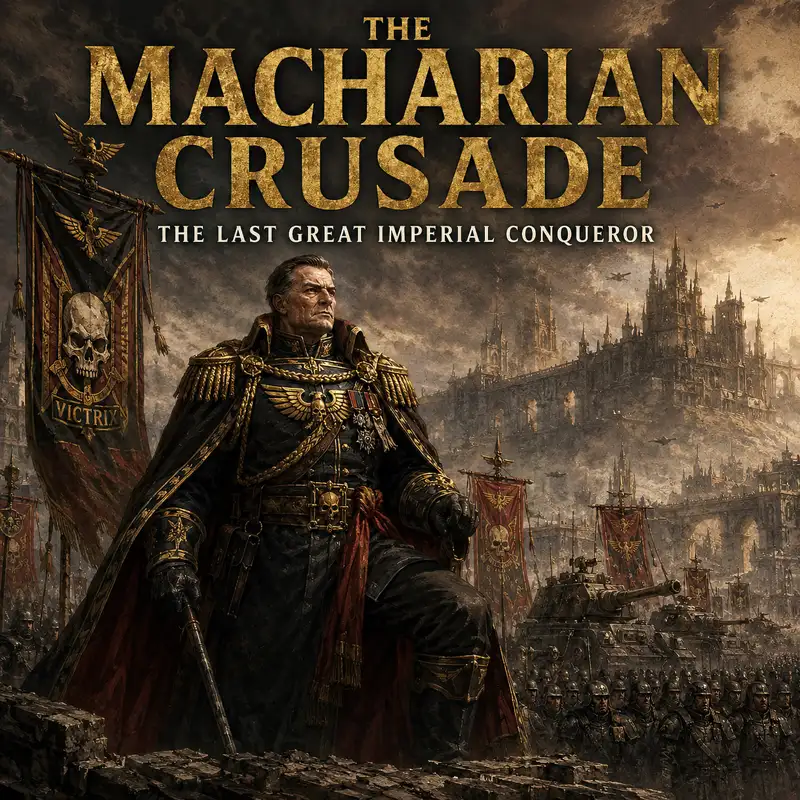
The Macharian Crusade: The Last Great Imperial Conqueror
The crusade ended at the edge of the light. Behind the armies of Macharius lay worlds taken by assault, worlds persuaded by threats, worlds returned to Imperial rule after millennia of isolation, and worlds so thoroughly destroyed that conquest became a matter of filing the correct forms over the ashes. Ahead waited the Halo Zone, where the Astronomican grew weak and the familiar geography of the Imperium dissolved into darkness. Macharius ordered the advance to continue. His soldiers did not obey. They had followed him across the western galaxy and had survived enemies that should have stopped them. What finally halted the greatest Imperial campaign since the age of the primarchs was not an opposing fleet or an impregnable fortress. It was the point at which frightened, exhausted human beings looked into the unknown and decided that their commander had asked for one victory too many.
That moment explains why Macharius became known as the last great Imperial conqueror. The title does not mean that the Imperium never launched another enormous crusade. It means that Macharius pursued conquest in the old sense: a single mortal commander driving a coherent war of expansion across an entire region, adding territory faster than Imperial institutions could absorb it, and holding the enterprise together largely through personal authority. His victories were military, political, religious, and theatrical. His defeat, when it came, was not simply that his armies stopped. It was that the empire he created could not remain whole without him. To understand the Macharian Crusade, then, we must look beyond the famous count of conquered worlds. The real question is how one man briefly made the Imperium behave as though it still possessed a single purpose.
Macharius rose during a period when the Imperium was recovering from the Age of Apostasy, a long catastrophe of civil war, tyranny, religious violence, and institutional collapse. The western regions of the galaxy had suffered badly. Systems had fallen out of contact. Local rulers had declared independence. Human civilizations had survived without Terra and developed beliefs, technologies, and political arrangements that Imperial authorities considered unacceptable, often before anyone had taken the trouble to ask how they had survived. The Segmentum Pacificus offered both a threat and an opportunity. Rebellion, alien expansion, and Chaos influence flourished in the gaps left by Imperial weakness. At the same time, every lost world could be presented as stolen inheritance. Reconquest therefore promised security, prestige, resources, and a convenient way to turn the Imperium’s internal violence outward.
Macharius was born on Donia, the son of its planetary governor, and entered Imperial military life with advantages most soldiers could only contemplate from a respectful distance. Privilege alone, however, does not explain his ascent. The surviving accounts present a commander of remarkable energy, personal courage, political instinct, and ruthless clarity. He distinguished himself in wars against rebels and warlords, gained the patronage of Lord Commander Solar Phillips, and eventually succeeded him. Macharius became Lord Commander Solar at an unusually young age, placing him among the highest military authorities in the Imperium. From that position he petitioned Terra for a campaign of reconquest on a scale not seen for generations. The High Lords approved. Whether they shared his vision or merely considered a distant, victorious general preferable to an ambitious one near Terra is left to the listener’s judgement.
The force assembled for the campaign became known as the Grand Army of Reconquest. It was divided into seven great army groups, each led by a commander chosen by Macharius. This structure allowed the crusade to strike along several axes at once rather than crawl forward as a single mass. Imperial Navy fleets carried troops, guarded supply routes, and delivered the orbital violence for which the Imperium has always shown a dependable administrative talent. Regiments of the Imperial Guard provided the overwhelming bulk of the manpower. Titans, priests, engineers, logisticians, adepts, and supporting formations followed behind. Space Marines sometimes joined particular battles, but the crusade was fundamentally a human undertaking. Its central figure was not a primarch or a genetically engineered demigod. He was a man commanding other men and women through an apparatus so large that merely feeding it was an act of war.
The famous achievement is almost absurd in its scale. Imperial records credit Macharius with bringing nearly a thousand worlds under Imperial control in roughly seven years, from three hundred and ninety-two to three hundred and ninety-nine of the forty-first millennium. The exact number deserves caution. Imperial chronicles are propaganda, accounting documents, devotional literature, and casualty reports, sometimes on the same page. A world might be counted as conquered when its governor swore loyalty, when its capital fell, when its last resistance cell was destroyed, or when someone many light-years away updated a map. Even so, the strategic accomplishment remains extraordinary. Macharius did not need to occupy every field and street personally. He needed to break organized resistance, secure routes, install compliant authority, and move before enemies could combine against him.
Speed was one of his greatest weapons. The seven army groups could isolate regions, bypass lesser objectives, and return later with overwhelming force. Worlds that resisted could be attacked from several directions or deprived of allies before the main assault began. Worlds willing to submit might retain local elites under Imperial supervision, provided those elites accepted taxation, recruitment, religious conformity, and the minor inconvenience of surrendering sovereignty forever. Conquered populations and former enemies could be folded into the advancing system. This was not mercy in the modern sense. It was economy. Every garrison left behind weakened the next advance, so Macharius preferred arrangements that converted defeated societies into resources. The crusade expanded by consuming the political and military capacity of the territories it crossed.
One of the first great tests came in the Karsk system, where the Cult of the Angel of Fire ruled behind a mixture of religious spectacle, military power, and hidden corruption. Later accounts portray the cult as a mask for the influence of Tzeentch. They also describe Macharius wounded, tempted by a daemonic power, and refusing its offer. The precise details belong to the unstable border between history and sacred biography, but their importance is clear. Macharius was not remembered merely as an efficient general. He became a figure of faith. Victories were treated as evidence that the Emperor favoured him. Survival became miracle. Opposition became heresy. Once that process begins, military obedience acquires the force of devotion, and criticism begins to look dangerously similar to blasphemy.
A later battle on Zaga Four strengthened that image. A bolt shell reportedly struck Macharius in the chest but failed to detonate. Confessors proclaimed the Emperor’s protection, and the story spread through the crusade. Perhaps the weapon malfunctioned. Perhaps armour and chance did their ordinary work. Perhaps the tale grew in repetition. None of those possibilities mattered as much as what the soldiers believed. Armies do not march for years on supply alone. They require a story explaining why suffering has meaning and why the next impossible order may succeed. Macharius gave his troops that story. He appeared at decisive points, accepted danger, and projected certainty. His presence could steady formations that had already reached the reasonable conclusion that survival was unlikely.
The worlds encountered by the crusade were not empty territories waiting for the correct flag. Some were human societies separated from the Imperium for thousands of years. Others were controlled by aliens, Chaos worshippers, warlords, or regimes that had developed powerful technologies of their own. Persepolis, for example, was brought back into contact with the Imperium after roughly five millennia. To Imperial chroniclers, such events were reunions. To the people being reunited, the experience may have looked rather more like the arrival of an armed religious empire demanding immediate compliance with laws written before their grandparents’ grandparents had learned the names of the stars. The distinction between liberation and invasion depended heavily on who survived to write the archive.
Macharius could be pragmatic when submission served the campaign. He could also be annihilating when resistance threatened momentum or prestige. The war for Adrantis Five became the clearest example. Adrantis Five possessed an advanced human civilization capable of holding Imperial forces at bay for two years. General Borgen Crassus suffered catastrophic losses trying to break it. Some accounts claim his army group lost nine soldiers in every ten. Conventional victory proved too costly, so Macharius chose a solution on the proper Imperial scale. He redirected a comet toward the world. The act destroyed the enemy’s capacity to resist by placing the continued existence of the battlefield in doubt. It was victory, provided one defines victory as eliminating the disagreement rather than obtaining anything useful from the planet.
Adrantis Five reveals the darkness beneath the legend. Macharius was not a humane unifier accidentally surrounded by a cruel system. He was an Imperial conqueror who accepted extermination as a legitimate instrument. He could admire courage and still destroy those who displayed it. He could offer terms and then impose a political order in which refusal was not a recognized category. His faith appears to have been sincere, which made him more formidable rather than less. He did not need to pretend that conquest served a greater purpose. He believed it. To Imperial citizens, this conviction made him a saintly hero. To populations crushed beneath the crusade, it meant that negotiation took place inside a moral universe where Macharius already possessed the only permissible answer.
Yet brutality alone cannot explain his success. The Imperium contains no shortage of brutal commanders, many of whom achieve little beyond producing impressive ruins. Macharius understood operational concentration, timing, morale, and the political use of spectacle. He selected talented subordinates and gave them enormous commands. Sejanus, Tarka, Lysander, Borgen Crassus, Arrian, and Cyrus became the pillars of the seven army groups. Their victories allowed the crusade to function across distances no single headquarters could control in detail. Macharius provided the common direction. His generals supplied local initiative. This balance created extraordinary momentum, but it also concealed a fatal weakness. Each army group became a power in its own right, loyal to the Imperium in theory and increasingly tied to its commander in practice.
The farther the crusade advanced, the more its supply lines stretched across recently conquered space. Reinforcements and munitions had to cross regions whose loyalty might be only days old. Ships vanished in the warp. Regiments were reduced by combat, disease, desertion, and the steady arithmetic of keeping soldiers in the field. Every victory created new responsibilities. Garrisons had to be placed. Administrators had to be installed. Tithes had to be assessed. Priests had to determine whether local customs were harmless, heretical, or merely unusual enough to require a bonfire. The campaign’s speed made it powerful, but speed also meant that consolidation lagged behind conquest. Macharius was building the road while marching at full pace along it.
This strain appeared in the changing relationship between Macharius and his commanders. The crusade depended on his willingness to demand what others considered impossible. At first, impossible demands produced victories. Over time, the same quality began to look like obsession. Trusted officers questioned whether the war could continue. Soldiers who had survived dozens of worlds no longer saw the next objective as proof of destiny. They saw another trench, another landing zone, another order issued by men who would not be standing in the first assault wave. The charisma that had unified the crusade could not repeal exhaustion. Faith could make fear shameful, but it could not make fear disappear.
Later narrative accounts place much of the final breakdown around Loki, an industrial world held by the traitor Richter, once one of Macharius’s trusted advisers. The campaign there became a plague-ridden war of trenches, attrition, betrayal, and collapsing morale. Other traditions emphasize the arrival at the edge of the galaxy, where the armies refused to advance beyond the Astronomican’s reliable light. These versions do not fit together perfectly, and the surviving record does not settle every sequence. They may describe different stages of the same exhaustion, or they may preserve competing attempts to explain an ending that Imperial authorities found uncomfortable. A crusade advertised as unstoppable had stopped. Someone had to decide whether the cause was treachery, disease, cowardice, strategic reality, or the limits of one man’s ambition.
The oldest and simplest account says that Macharius ordered his forces onward and they refused. He accused them of cowardice, turned back in bitterness, and died soon afterward from a fever contracted on Jucha. Other records describe a mysterious death during the return toward Terra. The later Macharian narratives present assassination and political intrigue, suggesting that Imperial authorities had begun to fear the power of a victorious commander whose soldiers followed him personally. Each version serves a different purpose. Fever preserves the saint from ordinary defeat. A broken heart makes his followers responsible. Assassination makes him the victim of the regime he served. The truth may include parts of several traditions, but certainty is impossible, and perhaps politically undesirable.
Macharius’s death exposed what his victories had concealed. The seven army groups had been united by his command, not by stable institutions. Rivalries among his generals erupted into the Macharian Heresy. Some remained loyal to Terra. Others created personal domains, rejected Imperial authority, or turned their armies against former comrades. Newly conquered worlds rebelled. Space Marine forces and Imperial factions became entangled in disputes and suppression campaigns that lasted for years. Territory won at extraordinary cost was lost, devastated, or reconquered yet again. The Imperium had discovered nearly a thousand reasons to celebrate and then converted many of them into additional wars. This was not an accidental footnote. It was the final phase of the crusade.
The aftermath also answers why Macharius was the last great conqueror. His campaign succeeded because he concentrated authority that the Imperium normally fragments. He made distant institutions, rival generals, fleets, priests, and armies move toward one objective. That unity was personal and temporary. When he vanished, the machinery did not continue. It tore itself apart. Later crusades could be immense, but they generally fought to recover lost territory, contain catastrophe, or prevent the Imperium from collapsing faster than its clerks could record. Macharius still belonged to an age when a mortal commander could imagine the frontier as something to be pushed outward rather than merely defended.
Imperial memory transformed him into the patron saint of the Imperial Guard. Pilgrims later followed the routes of his conquest, although only a fraction completed the journey. His name was placed on medals, war machines, worlds, and institutions. This was more than gratitude. The cult of Macharius offered ordinary soldiers a rare Imperial story in which human courage, rather than transhuman blood or divine intervention alone, reshaped the galaxy. He proved that a man could stand beside the legends of the Imperium. The official memory is careful not to dwell on the worlds erased, the armies spent, or the civil war that followed. Saints are easier to carry into battle when their contradictions have been polished smooth.
Macharius deserves neither simple worship nor simple dismissal. He was a strategic genius, a charismatic leader, a sincere believer, and a conqueror capable of destruction on a planetary scale. He restored Imperial control across a vast region and demonstrated what disciplined coordination could achieve. He also created a realm that could not survive his absence, because the force holding it together was not law, consent, or durable administration. It was momentum, fear, faith, and the authority of Macharius himself. His greatest strength and his deepest failure were therefore the same. He made the crusade depend on one man.
At the edge of the Halo Stars, his soldiers finally showed the limit of that arrangement. They had not ceased to believe that Macharius was extraordinary. They had ceased to believe that being extraordinary made him infallible. The conqueror who had defeated armies, civilizations, distance, and probability could not conquer the exhaustion of his own followers. Behind them stretched a new Imperial dominion already beginning to fracture. Ahead lay darkness beyond the reach of familiar light. Macharius ordered one more advance, and history remembers the silence that answered him. He was the last great Imperial conqueror because, for seven years, he made conquest look like destiny. His death revealed that it had always been an emergency held together by a human will.