The Lost and the Damned: Mortal Armies of Chaos
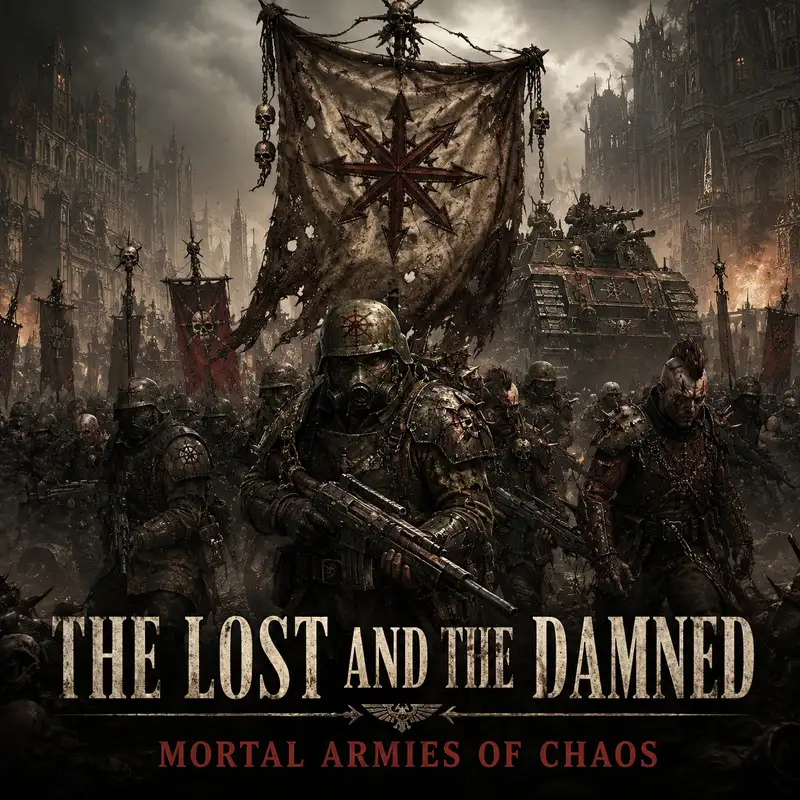
The sentry saw the shapes moving through the smoke and almost relaxed. They wore flak armour. They advanced in squads. Their rifles flashed with the familiar red pulse of lasfire, and a command vehicle followed behind them beneath the bent antennae of a field vox. Then the wind shifted. The banner above the column was not the double-headed eagle. It was an eight-pointed star stitched across the remains of an Imperial regimental standard. The soldiers beneath it had not come from another species or another age. They had come from the same barracks, the same factories, and perhaps the same world as the people they were advancing to kill.
The armies of Chaos are often imagined as ranks of corrupted Space Marines with daemons boiling out of the air behind them. Those forces are real, but they are not the whole war. Chaos Space Marines are comparatively few. Daemons are powerful but difficult to summon, harder to control, and often unable to remain in reality without the right conditions. Someone still has to seize the road junctions, dig the trenches, crew the artillery, patrol conquered streets, carry ammunition, and die in quantities that would make even the Departmento Munitorum pause briefly before requesting a second form. That work falls to mortals.
The Lost and the Damned is a broad name for those human and abhuman servants of Chaos who fight outside the ranks of the Heretic Astartes. It can describe cultists, mutants, renegade soldiers, pirates, armed pilgrims, corrupted labourers, rebellious planetary forces, and entire populations raised for war. It does not identify one unified army with a central command or a standard uniform. The phrase gathers countless forces under one grim label, often because Imperial authorities have no interest in distinguishing among the condemned. A trained traitor gunner and a half-starved fanatic may receive the same classification. From the Imperium’s point of view, both are targets.
The pattern is as old as the Imperium’s great civil war. During the Horus Heresy, the Warmaster’s hosts included vast numbers of human soldiers, conscripts, beastmen, and auxiliaries alongside the Traitor Legions. At the Siege of Terra, mortal formations were hurled against prepared defences in numbers the transhuman commanders could afford to lose. Some came as committed rebels. Others were coerced, enslaved, or swept forward by events beyond their control. The arrangement established a lasting model for Chaos warfare: precious champions and corrupted demigods at the centre, with ordinary bodies providing the weight that carries them to the enemy.
Their importance begins with a simple fact. The Imperium is made mostly of ordinary people, so Chaos must conquer it largely through ordinary people as well. A daemon can slaughter a platoon. A traitor clerk can redirect the platoon’s ammunition. A Chaos Space Marine can break a fortress gate. A corrupted engineer can open it before the attack begins. Mortal followers provide numbers, local knowledge, industry, and access. They already know which tunnels run beneath the palace, which officers are hated, which grain stores are empty, and which defence batteries have not been maintained since the last inspection was heroically falsified.
Not all of these people begin as frothing worshippers of the Dark Gods. Some join secret cults because they are desperate. Some want revenge against an overseer, a governor, a priest, or an entire social order that has treated them as replaceable machinery. Some are ambitious and believe forbidden powers will raise them above their station. Some encounter Chaos through military service, warp travel, criminal networks, or the influence of a charismatic leader. Others are conquered, threatened, deceived, or simply born on worlds where service to Chaos is the only life they have ever known. The road into damnation has many entrances, and most do not have a warning sign.
A Chaos cult may spend years as a hidden religious movement, a political conspiracy, a workers’ brotherhood, or a private circle among the powerful. Its members share symbols, phrases, favours, and secrets. They recruit carefully until circumstances change. A food riot becomes an uprising. A planetary invasion creates an opening. A governor declares independence. A regiment is ordered into a battle it cannot survive and decides that obedience has reached its natural limit. At that moment, the cult’s hidden structure becomes a military network. Cells seize armouries, sabotage communications, assassinate loyal officers, and mark targets for forces approaching from beyond the world.
This transformation explains why the first hours of a Chaos rebellion can be so dangerous. The enemy is already inside the defensive system. The people cutting power to the anti-aircraft guns may be the technicians assigned to maintain them. The soldiers guarding the governor’s residence may be the ones who arrest him. A cult does not always need to defeat the planetary defence force. Sometimes it only needs to become the planetary defence force. By the time loyal authorities understand the scale of the betrayal, the rebels may possess uniforms, codes, transport, trained personnel, and a perfectly respectable quantity of stolen paperwork.
The simplest mortal formations are cultist mobs. They may be poorly trained, lightly armed, and held together by fervour, fear, or the presence of a leader who claims to speak for the gods. Their weapons range from industrial tools and scavenged firearms to lasguns taken from the dead. Such mobs can overwhelm isolated positions, flood streets, screen more valuable troops, and force defenders to waste ammunition. They are often treated as expendable by their masters. This does not make them harmless. A thousand badly trained attackers remain a serious tactical problem, especially when they know the city and do not expect to survive it.
Cult leadership gives this violence direction. Demagogues turn private resentment into sacred duty. Rogue psykers offer visions, warnings, and powers that may be genuine, fraudulent, or both. Icon bearers provide a visible centre of faith, while armed champions enforce obedience with fewer theological complications. Ritual and command become difficult to separate. An order to attack may also be a promise of transformation. A retreat may be condemned not merely as cowardice but as disbelief. This can produce terrifying aggression, although it can also produce the sort of operational flexibility normally associated with charging a fortified position because the voices in the walls sounded encouraging.
Traitor Guard are different. These are soldiers who once served the Imperium, or forces trained in the same military tradition. They bring fieldcraft, weapons discipline, specialist skills, and experience of combined arms. They may operate mortars, heavy weapons, armoured vehicles, communications systems, and artillery. They understand patrol patterns and defensive layouts because they have used them themselves. Some retain their old ranks and organisation. Others are reorganised under enforcers, champions, or warlords. Their allegiance has changed, but their ability to lay a minefield or register a battery of guns has not.
That distinction matters because discipline does not belong exclusively to loyalty. A soldier can reject the Emperor and still clean a weapon, maintain spacing, conceal movement, and understand why ammunition should arrive before the attack begins. Some traitor formations deteriorate into competing gangs. Others become brutally effective armies. Chaos encourages selfish ambition and rivalry, but it does not erase professional competence on contact. Indeed, a commander who promises plunder, revenge, or divine favour may secure fierce loyalty for a time. The arrangement usually remains stable until someone receives a more attractive vision, grows an extra mouth, or decides that command would suit them better.
The Blood Pact of the Sabbat Worlds demonstrate how formidable a mortal Chaos army can become. They are associated with Urlock Gaur and are not merely a crowd pushed forward by armoured masters. They are organised, disciplined, and capable of fighting with tactics recognisable to experienced Imperial officers. Their warriors bear the signs of their bloody allegiance, but they also use infiltration, armour, fire support, and coordinated attacks. The terror they inspire comes partly from their corruption and partly from the uncomfortable discovery that the enemy knows how to conduct a campaign.
The Sons of Sek provide another example. Raised under Anakwanar Sek, they were intended to become an elite and regimented force, able to meet Imperial troops on more equal terms. Their existence reveals both the strength and weakness of mortal Chaos power. A capable warlord can create doctrine, hierarchy, training, and identity. Yet Chaos armies rarely escape the rivalries of their leaders. Competition between Sek and Gaur shaped their forces, and conflict between the Sons of Sek and the Blood Pact weakened the wider Chaos cause. The Dark Gods are generous with enemies and less dependable when asked to provide colleagues.
Vraks shows how an entire world can become the foundation of a mortal Chaos war. The rebellion began around the apostate Cardinal Xaphan on a heavily fortified armoury world. Local troops, militia, labourers, and other defenders were drawn into revolt, giving the renegades access to prepared positions and vast stores of war material. The Imperium did not face a handful of cultists in a cellar. It faced its own fortifications, weapons, and military infrastructure turned against it. As the siege deepened, greater powers were attracted to the conflict, but the mortal rebellion created the battlefield on which those powers could intervene.
This pattern appears again and again. Chaos Space Marines may provide the spearhead, the symbol, or the terrifying centre of a campaign, but mortal troops give it breadth. They hold secondary fronts. They garrison captured ground. They hunt survivors and suppress resistance. They protect ritual sites, supply depots, and landing zones. They crew ships and vehicles that would otherwise sit idle. They can be abandoned in a rearguard action without diminishing the strength of a warband’s precious Astartes. In strategic terms, the Lost and the Damned are not decoration around the real army. They are the structure that allows the real army to exist.
Their equipment often makes them a distorted reflection of the Astra Militarum. A traitor regiment may use lasguns, flak armour, Chimeras, artillery, and captured tanks. The machines acquire spikes, icons, chains, trophies, and devotional markings, but beneath the corruption the systems remain recognisable. This is one reason fighting Traitor Guard can be psychologically disturbing. Loyal soldiers are not facing an incomprehensible alien method of war. They are facing familiar weapons in familiar hands, employed by people who understand the same weaknesses, habits, and institutional blind spots.
The Moebian Sixth on Atoma Prime offers a particularly sharp version of that mirror. Once a celebrated regiment, its soldiers returned as servants of Nurgle and became the military core of the assault on Tertium. They retained the weapons and skills of trained troops while fighting alongside poxwalkers, cultists, mutants, and darker things. To the defenders, these were not distant barbarians. They were local heroes transformed into an occupying army. Their betrayal carried a message more dangerous than simple invasion: the institutions meant to protect the city could be converted into the means of its destruction.
Mortal Chaos forces also display every stage of physical corruption. Some look almost unchanged apart from symbols and scars. Others mutilate themselves as acts of devotion, replace equipment with trophies, or wear masks that erase their former identity. Long exposure to warp influence may bring mutation. Limbs twist, horns emerge, bodies swell, and human proportions become suggestions rather than rules. Some mutations are treated as blessings. Others mark a soldier for ridicule, exploitation, or sacrifice. Chaos promises transformation, but it does not promise that the result will be useful, dignified, or equipped with sleeves that still fit.
Mutants and abhumans often find places within these armies because Chaos can offer a brutal alternative to Imperial persecution. That offer should not be mistaken for compassion. A warlord may welcome the rejected because they are strong, numerous, angry, or easy to bind through promises of belonging. Beastmen and other altered humans have fought among traitor hosts from the Horus Heresy onward. Their presence reveals one of Chaos’s most effective methods. It finds the wound created by an existing society, calls the wound an identity, and then turns the injured against everyone nearby.
The promise of reward hangs over all of this. Cultists are told that courage will earn notice. Champions display mutations, weapons, or unnatural resilience as evidence that the gods are watching. A mortal may dream of becoming a mighty champion, perhaps even ascending beyond humanity. Such elevation is possible in the lore of Chaos, which is precisely why the promise works. It is also extraordinarily rare. Most followers receive no glorious transformation. They die in trenches, on sacrificial altars, beneath friendly tanks, or during rituals whose organisers described the casualty rate as spiritually acceptable.
Fear therefore remains as important as faith. Traitor enforcers and champions maintain order through punishment. Warlords take hostages, ration food, control access to weapons, and make examples of dissenters. Some armies use commissar-like figures stripped of any pretence that discipline serves a higher civic purpose. Others rely on cult hierarchy and communal belief. The result can be stable enough for war. It does not need to create a healthy society. It only needs to keep the guns firing, the workers labouring, and the next wave moving toward the breach.
For the individual soldier, motives can remain complicated even after open rebellion. One may believe the Emperor abandoned their world. Another may follow a commander out of personal loyalty. A third may fear what their comrades will do if they refuse. A fourth may genuinely embrace a Chaos God’s values. A fifth may have crossed the line so gradually that there is no single moment of decision to remember. Imperial records tend to flatten these differences because the legal outcome is identical. Once declared traitor, a person is unlikely to receive a careful interview about the emotional stages of their apostasy.
This lack of distinction serves Imperial security, but it also hides the causes of rebellion. Worlds where people are starved, brutalised, or worked to death provide fertile ground for cults that promise justice or power. Regiments abandoned by supply systems may listen when another patron offers food and ammunition. Mutants treated as vermin may join the first army that gives them a weapon and a name. None of this makes Chaos liberation genuine. The new masters are usually worse, and the promised freedom becomes another form of bondage. Yet the lie succeeds because it begins beside a truth the Imperium refuses to address.
On the battlefield, commanders underestimate these forces at their peril. A cultist horde may break under disciplined fire, or it may conceal veteran teams moving through tunnels. A traitor regiment may appear disordered while preparing an ambush. Mutants may absorb punishment that would stop ordinary infantry. Local collaborators can identify loyal officials, hidden routes, and supply caches. Even weak troops can be used intelligently by a strong commander. The Imperial habit of calling every opponent a degenerate can be emotionally satisfying. It is less useful when planning artillery concentrations.
The Lost and the Damned also make Chaos conquest sustainable. Daemons embody the power of the warp, but they do not run manufactoria with any great interest in quarterly output. Chaos Space Marines can dominate a world, but most warbands lack the numbers to administer every district, escort every convoy, and guard every bridge. Mortals perform those tasks. They mine ore, repair vehicles, load shells, pilot transports, process prisoners, and build the monuments demanded by their masters. A conquered population becomes a workforce, then a levy, then another army. Chaos feeds on humanity, but it also governs through humanity.
This is why mortal armies are often present before the most spectacular servants of Chaos arrive and remain after they leave. A hidden cult prepares the ground. A rebellion isolates the world. Traitor soldiers secure the ports. Labour gangs fortify the cities. Only then do the champions descend to claim a victory built by people whose names they may never learn. When the campaign moves on, those same mortals are left to defend the ruins, suppress the survivors, and discover how much divine gratitude can be carried aboard a departing strike cruiser.
To loyal Imperial citizens, the Lost and the Damned are proof that corruption can reach anyone. To Chaos warlords, they are manpower. To the Dark Gods, they are emotion made useful: rage placed behind a rifle, despair seated in a trench, ambition given a command, obsession assigned a target. Their humanity is not erased. It is exploited. The same qualities that once made them soldiers, workers, parents, believers, and citizens are redirected toward a new cause until the person and the weapon become difficult to separate.
The mortal armies of Chaos are therefore more than expendable crowds surrounding greater monsters. They are the principal means by which Chaos turns private corruption into public power. They convert whispers into uprisings, uprisings into campaigns, and campaigns into kingdoms of ruin. Their tragedy is not that they cease to be human. It is that they remain human enough to organise, obey, hope, resent, build, and fight, while every one of those abilities is placed in service to forces that will eventually consume them. They are lost because humanity can no longer reclaim them, and damned because Chaos never intended to save them.