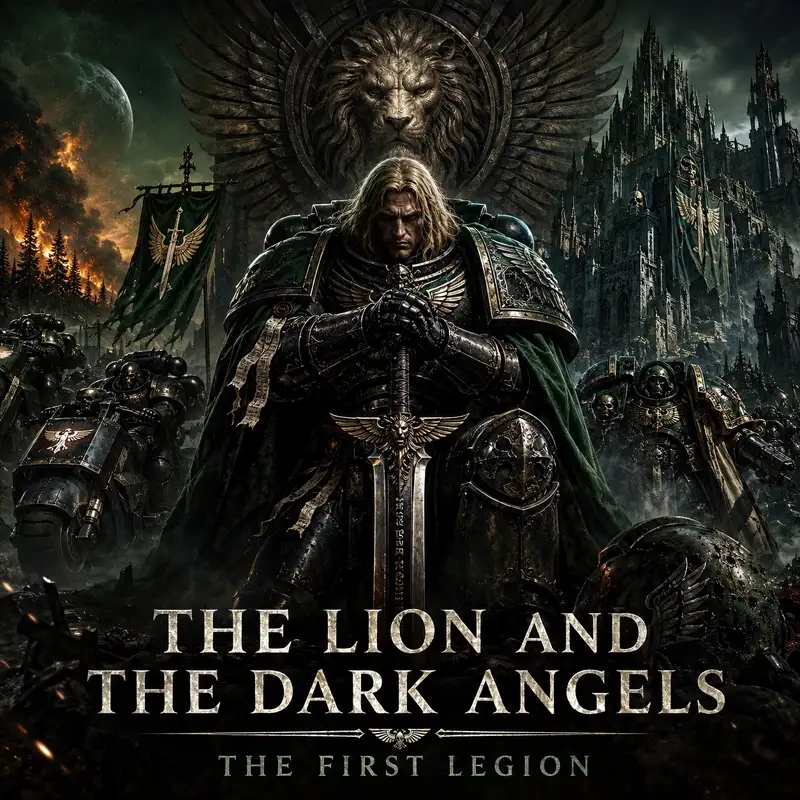
The Lion and the Dark Angels: The First Legion
Caliban died beneath the guns of its own sons. Its forests burned, its mountains split, and the fortress of the Order shook while two men fought in the ruins. One was Luther, the knight who had once spared a feral child and raised him as a brother. The other was that child grown into a Primarch, Lion El’Jonson, lord of the Dark Angels and master of the First Legion. Their duel ended without a clean victor. Luther was broken. The Lion vanished. The world itself was torn apart, and the survivors carried its fragments, its secrets, and its guilt into the next ten thousand years.
That catastrophe defines the Dark Angels, but it did not begin on Caliban. It began with a Legion that had been first in more than name. The Dark Angels were the earliest of the Emperor’s Space Marine Legions, created before their younger brother Legions had developed their own cultures and specialties. They fought beside the Emperor during the closing wars of Terra and served as a proving ground for methods that later Space Marines would inherit. Other Legions became famous for siegecraft, rapid attack, terror, endurance, or disciplined mass warfare. The First Legion had learned versions of all these things before many of the others existed.
Being first brought privileges. It also brought responsibilities that sensible people would have declined, had declining the Emperor been a serious career option. The First Legion received ancient warships, rare technology, and weapons too dangerous to place in ordinary hands. Their vaults held devices meant not merely to defeat armies, but to erase species, poison worlds, and end wars so completely that there would be nobody left to dispute the result. They were not simply an army. They were a sealed arsenal with a chain of command.
Their culture reflected that purpose. Long before they found their Primarch, the warriors of the First were divided into overlapping hosts, orders, and specialist brotherhoods. A Legionary could belong to his company, to a particular military formation, and to a hidden order that preserved some narrow and dangerous field of knowledge. Authority shifted according to the enemy. The warrior who commanded an assault might answer to another specialist when the campaign became a hunt, a siege, or an act of extermination. It was complicated, secretive, and apparently functional, which places it among the more remarkable administrative achievements of the Imperium.
The best-known expression of this system was the Hexagrammaton, the six Wings of the Legion. The Ravenwing mastered speed, reconnaissance, and the pursuit of elusive enemies. The Deathwing supplied elite warriors for the hardest assaults and the protection of key commanders. The Ironwing brought armour, engines, and overwhelming firepower. The Stormwing excelled in massed infantry warfare. The Firewing sought out leaders, command structures, and the hidden minds directing an enemy force. The Dreadwing existed for the moment when victory was no longer enough and annihilation had become policy. Together, the Wings allowed the First Legion to become whatever a war required.
Then the Legion found a Primarch who seemed designed for exactly that machine.
Lion El’Jonson had been cast across the galaxy as an infant and landed on Caliban, a death world of dark forests, isolated fortresses, and monstrous beasts. The creatures of Caliban were not merely large predators. Many were warped by the influence of Chaos, though the people hunting them understood the threat through the language of curses, legends, and knightly duty. Human settlements survived behind walls. Armed orders rode into the forests to kill what waited beyond the torchlight. Most who entered those woods alone did not return.
The Lion survived there for roughly a decade without human protection. When knights of the Order finally found him, they encountered a young giant who had lived among creatures that could tear armoured men apart. Luther, one of the greatest knights of Caliban, prevented his companions from killing the stranger. He brought the Lion into the Order, helped teach him language and custom, and gave him a place in human society. The two became extraordinarily close. Luther was mentor, brother, and in some respects father. The Lion soon surpassed him in strength, command, and reputation, but the bond between them shaped the fate of Caliban.
The Lion adapted to the knightly world with astonishing speed. He was not warm, but he was compelling. He could see how a battle would unfold, identify the decisive point, and drive men toward it with absolute confidence. He united Caliban’s rival knightly orders behind a campaign to destroy the great beasts. The forests became battlefields. Strongholds became bases of supply. Ancient rivalries were subordinated to a single objective. Under the Lion and Luther, Caliban accomplished what generations had considered impossible.
The victory also revealed the difference between them. Luther understood people. He could inspire affection, smooth rivalries, and translate ambition into loyalty. The Lion understood purpose. He could turn a scattered collection of warriors into an instrument and direct that instrument against a target with terrifying efficiency. Together, they were stronger than either man alone. The tragedy is that the Lion often treated human relationships as if they were another campaign problem. Once a decision had been made, he expected obedience. He rarely explained more than he believed necessary, and he often believed very little was necessary.
When the Emperor reached Caliban, he recognized the Lion as one of his lost sons. The Dark Angels received their Primarch, and Caliban became a new center of recruitment. The black-armoured veterans born on Terra now served beside warriors shaped by Caliban’s knightly orders. The Lion did not discard the Legion’s old systems. He absorbed them, placing himself at the center of its Wings, orders, and circles. The result was a force that combined the First Legion’s ancient military knowledge with Caliban’s oaths, symbols, and culture of concealed brotherhoods.
This made the Dark Angels formidable, but not simple. A Terran veteran might view the Legion as the Emperor’s first and most proven weapon. A Calibanite might see it as the Order expanded across the stars. A commander could hold several loyalties at once, each with its own rites and secrets. The Lion stood above them all, apparently trusting the system because he trusted his ability to master it. In battle, that confidence was usually justified.
The Rangdan Xenocides demonstrated the scale of what the First Legion could do and the price it could pay. The surviving record is deliberately incomplete, but the wars against the Rangda were among the most destructive campaigns of the Great Crusade. The Dark Angels suffered enormous losses while helping preserve the Imperium’s threatened frontier. The Lion emerged with a reputation as one of the Emperor’s most dangerous commanders. He did not win affection as easily as Horus, nor did he build political networks as naturally as some of his brothers. He won campaigns. For the Lion, that was the more important qualification.
Some believed he should have become Warmaster when the Emperor withdrew from the Great Crusade. The honor went to Horus instead. The Lion accepted the decision and remained loyal, but his manner did little to calm those who found him proud or unreadable. Even his famous feud with Leman Russ grew from this mixture of calculation and poor communication. During a joint campaign, the Lion killed an enemy ruler whom Russ had sworn to defeat personally. The ensuing argument became a prolonged brawl between Primarchs. Russ eventually recognized the absurdity and laughed. The Lion, who had not reached the same philosophical conclusion, knocked him unconscious.
The story is amusing because both men survived. It is also revealing. The Lion could grasp the logic of a campaign while missing the emotional meaning of an action to someone beside him. He did not betray his allies. He simply expected them to understand that the objective came first. That habit would become much less amusing on Caliban.
As the Great Crusade continued, Luther remained essential but increasingly overshadowed. He had once been the greatest man on his world. Now he stood beside a demigod who surpassed him in every visible measure. The Lion eventually sent Luther and other Calibanite warriors back to their home world to oversee recruitment and administration. Whatever the strategic reasoning, they experienced the assignment as exile. They trained new Space Marines while the Lion and the main fleet won glory among the stars.
Caliban itself was changing. Imperial industry cut into the forests, altered old ways of life, and tied the planet to a vast empire whose needs mattered more than local memory. The great beasts had been destroyed, but the world beneath them remained touched by the warp. Resentment grew among knights who believed they had traded their home for a place in someone else’s machine. Luther became the center of that resentment. His grievance was personal, political, and increasingly vulnerable to darker influence.
Then Horus rebelled.
Horus understood that the Lion was unlikely to join him. Before revealing his treachery, the Warmaster used his authority to send the Dark Angels far from Terra. The First Legion was too powerful to confront unnecessarily, so Horus removed it from the opening moves of the war. When news of the massacre at Isstvan reached the Lion, he responded with immediate loyalty to the Emperor and a determination to destroy the traitors. Loyalty, however, did not make him all-knowing. Believing Perturabo still faithful, the Lion handed important siege weapons to the Iron Warriors Primarch. Perturabo was already a traitor. Even the greatest strategist can make a poor decision when everyone involved is keeping secrets.
The Lion’s road toward Terra became a war against Konrad Curze and the Night Lords. The Thramas Crusade spread across the eastern galaxy, pitting the Dark Angels’ disciplined and adaptable warfare against a Legion built around terror, fragmentation, and murder. Curze was almost a dark reflection of the Lion. Both were hunters. Both inspired fear. Both had grown up alone on lethal worlds. Yet where the Lion imposed order upon violence, Curze treated violence as the only honest form of order.
The Dark Angels eventually broke the Night Lords as a coherent force, but the campaign consumed precious time. Curze escaped into the Lion’s fleet and later brought his private war to Ultramar. The Ruinstorm, a vast warp disturbance raised by the traitors, blocked the path to Terra and convinced several loyal Primarchs that the Emperor might already be dead. Roboute Guilliman created a secondary realm called Imperium Secundus. Sanguinius became its figurehead, and the Lion served as its chief protector.
The arrangement exposed every difficulty in the Lion’s character. He wanted to defend humanity, destroy Curze, and prepare for the possibility that Terra had fallen. He also concealed information, pursued private objectives, and used methods that alarmed even his loyal brothers. Guilliman valued systems that others could understand. Sanguinius inspired trust. The Lion expected trust without offering understanding. He was often strategically correct and politically disastrous, a combination the Imperium has traditionally rewarded with additional responsibility.
Once the loyal Primarchs learned that the Emperor still lived, they abandoned Imperium Secundus and sought a path through the Ruinstorm. Sanguinius reached Terra. The Lion and Guilliman struck at traitor worlds and supply lines, hoping to weaken Horus and force his commanders to look behind them. The Dark Angels destroyed strongholds and devastated the home worlds of enemy Legions. It was effective, ruthless, and too distant to place the Lion at the final defense of the Imperial Palace. The First Legion helped shape the war, but it missed the battle by which the war would be remembered.
When the Lion finally turned toward Caliban, the hidden conflict inside his own Legion erupted into the open. Luther and the forces on the planet rejected his authority. Some had embraced Chaos. Others appear to have fought for Caliban’s independence, out of resentment toward the Imperium, loyalty to Luther, hatred of the Lion, or some mixture of all four. Later Dark Angels tradition compressed this complexity into a single unbearable fact. Members of the First Legion had turned their weapons against their Primarch.
Caliban’s defenses opened fire on the returning fleet. The Lion answered with bombardment and invasion. Old comrades killed one another beneath the ruins of the world they had once saved together. At the heart of the fortress, the Lion confronted Luther. Chaos had magnified Luther’s power, but it had not removed the history between them. The surviving accounts do not provide a perfectly reliable description of the duel. What is clear is that Luther struck the Lion down, then collapsed in horror at what he had done.
The battle, the bombardment, and the warp’s influence tore Caliban apart. Traitor and rebel Dark Angels were scattered through space and time. They became known as the Fallen. The loyal survivors found Luther alive but broken. They did not find the Lion. In truth, he had been taken into the depths of the Rock, the fortress built from Caliban’s surviving fragment, where he would remain hidden for ten thousand years.
The Dark Angels faced a choice. They could reveal that part of the First Legion had rebelled, risking disgrace and perhaps destruction in an Imperium already purging anything touched by treason. Or they could conceal the truth and hunt every scattered survivor. They chose secrecy. Their successor Chapters inherited the mission and collectively became known as the Unforgiven. Officially, they were separate Chapters. In practice, their Inner Circles remained bound by a shared command, shared rituals, and a shared obsession.
The modern Deathwing and Ravenwing preserve fragments of the old Hexagrammaton. The Ravenwing finds and runs down the Fallen. The Deathwing, whose veterans know the Chapter’s deepest secrets, delivers the killing blow or takes the target alive. Interrogator-Chaplains seek confession and repentance before execution. Knowledge is granted in layers. A young Dark Angel may know only that his commanders pursue a hidden enemy. A veteran learns more. A member of the Inner Circle learns enough to understand why silence is considered sacred.
This system protects the Chapter, but it also imprisons it. Dark Angels have abandoned campaigns, misled allies, and redirected forces to pursue rumors of the Fallen. Their loyalty to the Imperium is real, yet their fear of appearing disloyal has repeatedly led them into acts that make others doubt them. They are not secretive because they are traitors. They are secretive because they are terrified that one ancient betrayal has already defined them.
Then the Lion returned.
He awoke in an Imperium divided by the Great Rift, far from the certainty of the Great Crusade and surrounded by the ruins of everything his father had built. He was older, not merely in appearance but in judgment. He still possessed the hunter’s instinct and the ability to move through strange, forest-like paths between distant places. He still met the enemies of humanity with decisive violence. Angron discovered this when the Lion faced his daemonic brother and banished him back to the warp.
The more important change was quieter. The Lion encountered warriors condemned as Fallen and did not assume that every one of them was equally guilty. Some had not embraced Chaos. Some had been misled, isolated, or swept into a rebellion whose meaning changed around them. The Lion accepted loyal sons back into his service. The man who had once judged quickly and explained little had begun to distinguish treachery from failure.
His reunion with the Dark Angels therefore carries an uncomfortable promise. For ten thousand years, they built their identity around the belief that their shame could be erased only when every Fallen had been captured and forced to repent. Their returned Primarch may not share that belief in its old form. The secret that preserved the Chapter has become the doctrine he may have to dismantle. The sons spent millennia asking how they could earn the forgiveness of a father who was not there. Now the father has returned and may ask why they allowed guilt to become their master.
The Dark Angels are the First Legion because they were the Emperor’s earliest complete weapon, masters of every form of war and guardians of powers entrusted to almost no one else. They are the Lion’s Legion because his virtues and failures became theirs. His discipline gave them strength. His secrecy gave them structure. His loyalty kept them true during the Heresy. His distance helped fracture his own home.
Their defining contradiction is not that they might secretly be traitors. It is that they are profoundly loyal warriors who have spent ten thousand years behaving as though loyalty can survive only behind locked doors. The First Legion conquered monsters in the forests of Caliban, but it never escaped the habits those forests taught. Every path was concealed. Every circle guarded another circle. Every brother carried a truth he could not share.
Now the Lion walks those shadowed paths again, older, armed, and no longer entirely certain that every lost son must be hunted. The future of the Dark Angels may depend not on whether they can destroy their final secret, but on whether the First Legion can finally survive the truth.