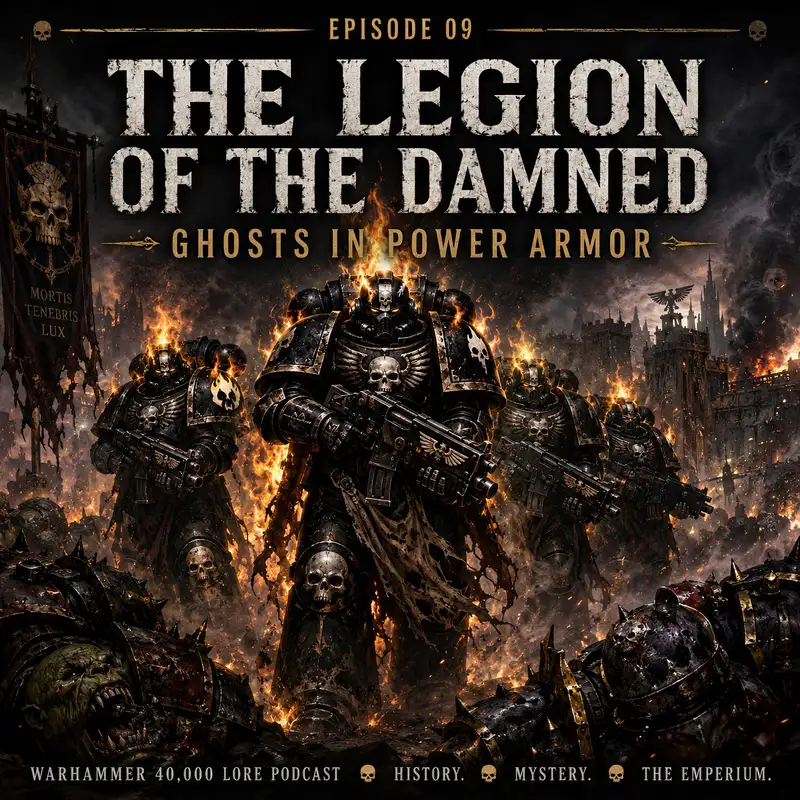
The Legion of the Damned: Ghosts in Power Armor
The defenders had reached the stage of a battle when ammunition was counted by individual rounds and time was measured by how long the next barricade might remain standing. Then the air shimmered. Figures in black power armour stepped through smoke that had concealed nothing a moment before. Flames crawled across their helmets and shoulder plates without consuming them. Bone-white skulls stared from armour marked for death. They did not identify themselves, answer hails, or request a place in the order of battle. They simply advanced, and the enemy line began to die.
This is how the Legion of the Damned enters Imperial history. Not by declaration, founding charter, or triumphal parade, but by interruption. They arrive when defeat appears certain, fight with a violence that even other Space Marines find unsettling, and disappear before anyone can ask the obvious questions. There are no transports waiting in orbit, no apothecaries collecting gene-seed, no serfs gathering spent equipment, and usually no bodies left behind. The Imperium has records of their interventions, but almost nothing that resembles an ordinary military existence.
That absence is the heart of their mystery. Space Marines are not self-sustaining legends. A Chapter requires recruiting worlds, armouries, fleet support, forge facilities, gene-seed vaults, navigators, astropaths, mortal crews, and an administrative burden capable of crushing a lesser civilisation. The Legion appears to possess none of these things. It has no acknowledged Chapter Master, no fixed fortress-monastery, and no recognised place within the Imperial chain of command. It behaves less like a formation moving through space and more like a condition that suddenly overtakes a battlefield.
Witnesses describe pale or corpse-like faces behind darkened lenses, black armour painted with bones and licking fire, and weapons that strike with unnatural force and accuracy. Enemy shots may fail to stop them. Wounds that should cripple an Adeptus Astartes seem to matter little. Some accounts describe the Legion as half substantial, as though its warriors are standing in two realities at once. Most disturbing of all, they fight in silence. No war cries. No boasts. No commands audible over the vox. Only the mechanical report of bolters and the steady approach of men who already look buried.
The simplest explanation is also the oldest and most compelling. The Legion of the Damned is what remains of the Fire Hawks, a loyal Space Marine Chapter swallowed by the warp. It is an answer with the satisfying shape of tragedy. The Fire Hawks entered the darkness as living warriors and returned as something else. Unfortunately, the Imperium rarely permits a mystery to remain that tidy. Its archives disagree, its dates refuse to cooperate, and the warp has never respected a historian’s desire for an orderly sequence of events.
The Fire Hawks were already marked by catastrophe long before their disappearance. They are commonly associated with the Twenty-first Founding, remembered as the Cursed Founding because so many of its Chapters suffered mutation, disaster, or ruin. The Fire Hawks developed a reputation for wrathful assaults and overwhelming firepower. Their history was not one of stable guardianship. It was a succession of wars, destroyed homes, near extinction, and furious returns. They survived the loss of more than one home world, which is impressive even by Imperial standards and perhaps a sign that the universe was trying to make a point.
During the Age of Apostasy, the Fire Hawks fought against the regime of Goge Vandire. Their home world, Zhoros, was destroyed amid those wars, but the Chapter endured. Sebastian Thor later granted them the use of Raptorus Rex, an ancient mobile star fortress dating back to the Great Crusade. From that point, they became a fleet-based Chapter. Their fortress was not a mountain rooted in stone. It was a wandering citadel, carrying the Chapter through a galaxy that had already burned away much of its past.
Centuries later, the Fire Hawks were among the first loyalist Chapters drawn into the Badab War. They entered with characteristic aggression after the Mantis Warriors attacked and captured one of their vessels. The response was immediate, punitive, and costly. Fire Hawk strength collapsed under severe losses, and their commanders were eventually pressured to withdraw before the Chapter destroyed itself through determination alone. They later returned to the war, because the Fire Hawks regarded survival as a temporary pause between opportunities for retaliation.
That history matters because the later Legion does not feel like an arbitrary transformation. Fire, wrath, repeated destruction, and refusal to die were already woven into the Fire Hawks’ identity. Even their mobile fortress made them a Chapter without a permanent home. When the story claims that these warriors became wandering revenants, the transformation feels less like a complete break than the final, terrible expression of what they had always been.
In the year nine hundred and sixty-three of the forty-first millennium, the Fire Hawks were ordered to the Crows World subsector to confront raiders identified in Imperial records as Eldar pirates. Their full fleet translated into the warp from the Pireaus System. Raptorus Rex went with them, along with five ships, more than eight hundred Space Marines, and roughly two thousand other personnel. The journey should have lasted no more than twelve hours. The fleet never arrived.
Twenty years later, the Imperium formally declared the Chapter lost. The Bell of Lost Souls was said to have sounded one thousand times in their memory, and a black candle was lit in the Chapel of Fallen Heroes. This was the administrative death of the Fire Hawks. The Imperium had done what it does when certainty is impossible. It created a ceremony, entered a conclusion into the record, and moved on while leaving several thousand unanswered questions behind.
One account claims that the fleet was caught in a warp storm and torn apart by entities within the immaterium. Ship after ship was destroyed until only a single craft escaped, emerging thousands of light years off course and beyond the reliable reach of the Emperor’s psychic beacon. About two hundred battle-brothers survived the initial disaster. Their initiates were dead, their gene-seed stores were lost, most of their leaders were gone, and none of their ordinary human attendants remained.
Then the survivors began to change. Their skin blackened and blistered. Their flesh decayed. Pain and madness spread through men engineered to withstand conditions that would kill ordinary humans almost at once. Many died during the long effort to return to Imperial space. Those who remained understood that their Chapter had no future. They could not recruit. They could not rebuild. They could only decide how to spend what was left of themselves.
According to this version, the survivors stripped away their old heraldry and painted their armour black. They decorated it with skulls, bones, and flames. Formal companies and ranks lost their meaning because death had made every remaining brother equal. Their disease was killing them, but it had not broken their loyalty. They would seek the enemies of Humanity, guided by visions and the Emperor’s Tarot, and die in battle rather than rot in isolation. The Legion of the Damned began as a suicide campaign that somehow never ended.
It is a powerful origin because it explains almost everything visible. It explains the death imagery, the silence, the disregard for wounds, and the preference for battles where annihilation is close. It explains why the Legion has no recruits in the ordinary sense and why it carries no recognisable Chapter badge. It even explains the strange combination of madness and purpose. These are warriors who believe themselves condemned, but who still insist that damnation can be made useful.
There is evidence supporting the connection. Inquisitorial investigations have linked sightings of the Legion to the vanished Fire Hawks. Rumours have placed Raptorus Rex near later interventions, still serving a force that should no longer possess it. The Legion’s visual language echoes a Chapter already associated with fire and repeated survival. Some named warriors and relics suggest continuity rather than a completely anonymous apparition. Taken together, the case is strong enough that many Imperial scholars treat the Fire Hawks as the most likely beginning of the story.
Beginning, however, is not the same as complete explanation. Records place appearances of the Legion before the Fire Hawks vanished. One catalogue includes interventions during the Pyrocataclysm of Vilidad Prime early in the fortieth millennium, at Ghodba in the forty-first, on Idharae, and at Andraxas in the year nine hundred and twenty-two. If those dates are accurate, then ghostly warriors were appearing decades, centuries, or even longer before the Fire Hawks entered their fatal warp jump.
Imperial dating is unreliable enough that this contradiction cannot settle the matter by itself. Reports arrive late, calendars drift, archives are copied incorrectly, and entire departments occasionally discover that they have been filing a century under the wrong heading. The warp adds a more serious complication. A vessel can emerge before, after, or far beyond the time in which it entered. If the Fire Hawks were transformed inside the immaterium, their later selves might not be confined to events occurring after their disappearance. Cause and effect are more of a local custom in the warp.
Still, the contradiction opens the door to broader theories. Some scholars argue that the Legion is a psychic backlash created by the collective trauma of the Adeptus Astartes. The betrayal at Isstvan, the death of Primarchs, and ten thousand years of war have left scars not only in institutions but in the minds of generations of Space Marines. According to this view, the Legion is vengeance given a body. The loyal dead return because the living cannot release their need to punish betrayal.
A related theory places the source not in the Space Marines alone, but in Humanity as a whole. The people of the Imperium have been taught to see the Adeptus Astartes as both angels and monsters, the Emperor’s wrath made flesh. Trillions of human minds possess tiny fragments of psychic potential. Under the pressure of imminent death, their combined terror and hope may shape the warp. When they beg for deliverance, the answer takes the form they have been conditioned to expect: a giant warrior in power armour, wreathed in holy fire.
This theory explains why the Legion appears at moments of absolute crisis. It also explains why witnesses often describe the warriors in religious rather than military terms. They are not reinforcements in the normal sense. They are an answered prayer with a bolter. The distinction is important, although perhaps not to the enemy receiving the answer. Imperial theology calls such things miracles. An Inquisitor may use more cautious language, particularly if the miracle arrives without a ship.
A third interpretation treats the Legion as servants of the Emperor operating through the warp, something close to daemons of Imperial faith. The word daemon carries an accusation in the Imperium, but technically it describes a being formed or sustained by the immaterium. Chaos does not own the laws of that realm. Human belief, sacrifice, rage, and loyalty also leave impressions there. Living Saints already demonstrate that Imperial faith can produce events that are difficult to separate from psychic manifestation. The Legion may be another expression of the same dangerous principle.
That does not mean the Legion is kindly. Its members are not shining guardians who arrive to reassure frightened civilians. They resemble burned corpses sealed inside armour. Their presence brings cold, fire, terror, and death. Even allied Space Marines regard them with unease. If they are agents of the Emperor, then they represent the Emperor as the Imperium has known him for ten thousand years: distant, wounded, implacable, and most visible when the alternative is extinction.
Their interventions follow a recognisable pattern. At Andraxas, Chief Librarian Tigurius led Ultramarines to rescue Adeptus Mechanicus personnel from an Ork conquest. The defenders were trapped within the Great Bastion, where the Mechanicus had uncovered a force staff associated with Malcador the Sigillite. Ork air superiority allowed reinforcements to pour toward the fortress, and the Ultramarines faced impossible numbers. As the defence approached collapse, the air distorted and the Legion appeared.
The Damned did not conduct a conventional relief operation. They struck with sudden, concentrated violence, shattering the Orks’ momentum and morale. Tigurius seized the opening, secured the bastion, and enabled the surviving Imperials to withdraw. Then the Legion was gone. The incident demonstrates their strange strategic intelligence. They did not need to conquer the whole planet. They appeared at the precise point where a short intervention could preserve lives, recover a significant relic, and change the meaning of the campaign.
Certus Minor offers a darker example. The cemetery world faced the Cholercaust, a vast Khornate war host of traitor Space Marines, cultists, and daemonic forces. The Fifth Company of the Excoriators defended the world and was effectively destroyed. Their surviving commander, Zachariah Kersh, endured while the battle became an offering of blood on a planetary scale. Only when the defenders had been reduced to the edge of extinction did the Legion of the Damned reveal itself and annihilate the invaders.
The timing is almost cruel. The Legion did not prevent the sacrifice. It arrived after sacrifice had become the defining fact of the battle. This pattern weakens the comforting idea that the Damned are simply guardians who rescue the innocent. They preserve what must survive, not necessarily everyone who deserves saving. A miracle in the Imperium is often indistinguishable from permission to pay a slightly smaller price.
During the fall of Cadia, the Legion appeared aboard the Blackstone Fortress called Will of Eternity and aided Space Wolves attempting to cripple the station. After the Great Rift tore across the galaxy, reports placed the Damned on Baal, Armageddon, Antagonis, and scores of other worlds attacked by Chaos. The scale of these manifestations makes an ordinary surviving Chapter increasingly difficult to accept. Even a full Chapter cannot be everywhere. A warp-born phenomenon can be wherever the boundary between desperation and faith becomes thin enough.
On the battlefield, the Legion behaves with directness rather than elaborate manoeuvre. It appears close to the decisive point, advances steadily, and pours fire into targets that should require far greater force to destroy. Its warriors seem resistant to weapons that kill normal Space Marines. They do not pause to coordinate with allies because they appear to know what must be done already. Older accounts connect this certainty to the Emperor’s Tarot, suggesting that enhanced psychic awareness guides them toward the right battle at the right moment.
No Imperial commander can request their support with confidence. There is no astropathic address for the dead, no liaison officer, and no useful box to mark on a reinforcement form. A general may pray, but prayer is not a dependable entry in an operational timetable. This preserves the Legion’s power as a symbol. The Imperium cannot own it, schedule it, or turn it into routine doctrine. The Damned remain outside the machinery they repeatedly save.
Their silence is equally important. Ordinary Space Marines announce identity through heraldry, oaths, battle cries, and the remembered names of their Primarchs. The Legion has stripped almost all of that away. It does not tell witnesses what Chapter it came from or what debt it is collecting. Silence protects the mystery, but it also suggests that individual identity has become less important than function. These warriors may once have been Fire Hawks, Excoriators, Imperial Fists, or members of Chapters forgotten entirely. In death, they are reduced to loyalty and wrath.
Some stories suggest that the Legion can draw new warriors into its ranks, or that fallen heroes may be claimed for further service. Such accounts are fragmentary and should not be treated as settled fact. They do, however, offer a way to reconcile the evidence. The Fire Hawks may have formed the core of the Legion without being its only members. A Chapter lost in the warp could have become the vessel for a much older phenomenon, gathering other dead Astartes across time and turning one tragedy into a host.
That interpretation also explains why the Legion looks recognisably like Space Marines while no longer behaving like a Chapter. It is not a preserved military organisation. It is the memory of one. Armour, bolters, tactical discipline, and brotherhood remain, but recruitment, hierarchy, territory, and political identity have fallen away. What survives is the part the Imperium values most: the ability to continue fighting after every reasonable basis for doing so has disappeared.
So, are the Legion of the Damned truly ghosts in power armour? The surviving evidence points toward something more complicated than either ghosts or living survivors. They interact with the material world, fire physical weapons, alter campaigns, and can be seen by many witnesses. Yet they ignore distance, chronology, logistics, and mortality in ways no ordinary Space Marines can. The most convincing answer is that they are warp entities shaped by the identity of dead or transformed Astartes, with the Fire Hawks providing the strongest known origin but not necessarily the entire substance.
This uncertainty is not a flaw in their story. It is what makes them belong so perfectly to the setting. Chaos proves that emotion, memory, and belief can become predators. The Legion suggests that loyalty and sacrifice can also take form, though not in a clean or comforting way. Humanity’s hope does not create gentle angels. It creates burned warriors who arrive without warning, kill what stands before them, and vanish before gratitude can become worship.
The Legion of the Damned may therefore be the Imperium’s purest kind of miracle. It saves without explaining, serves without belonging, and demands no future because its warriors have already lost theirs. When the last defence line breaks and black figures walk from impossible fire, the survivors cannot know whether they are seeing the Fire Hawks, the honoured dead, or the Emperor’s will wearing the shape of a Space Marine. They know only that the ghosts have come, and that for a few more hours, Humanity is not yet finished.