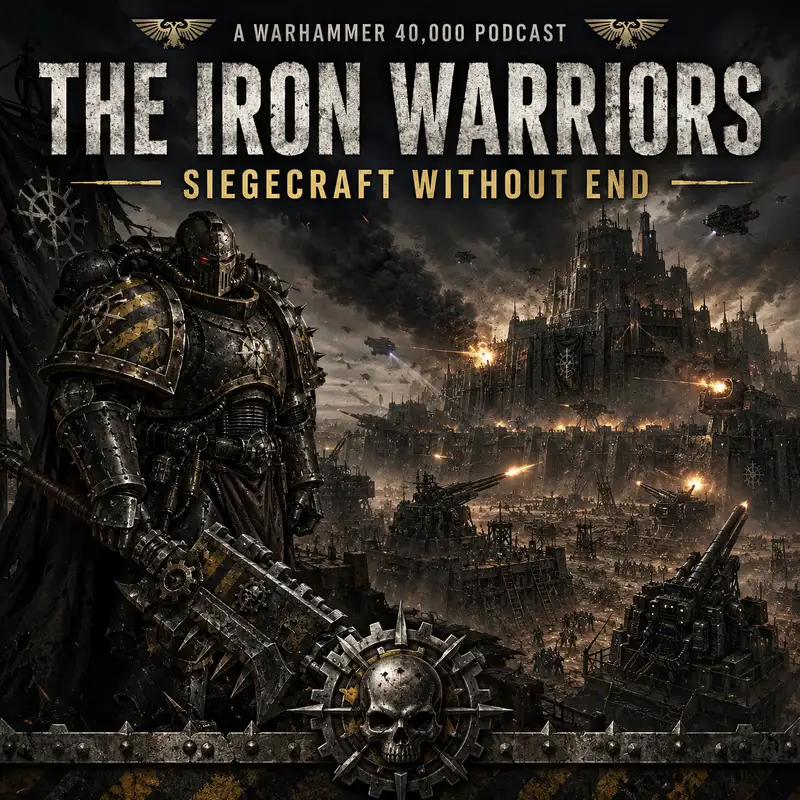
The Iron Warriors: Siegecraft Without End
The wall was already dead. Its defenders simply had not received the news. Beyond the range of their guns, surveyors marked angles in the dust. Artillery crews checked firing tables. Sappers advanced through trenches cut so straight they seemed drawn with a ruler across the ruined earth. No heroic charge announced the attack. The first shells struck the same section again and again, until a fracture became a wound, the wound became a breach, and the breach became a grave. This was how the Iron Warriors preferred to win. Not quickly. Not beautifully. Inevitably.
Many Traitor Legions are defined by what they became. The World Eaters surrendered to rage. The Emperor’s Children pursued sensation until desire became slavery. The Death Guard learned that endurance can be corrupted into acceptance of any horror. The Iron Warriors are different. Their fall did not replace their old identity. It hardened it. The methods they used for the Emperor became the methods they used against him, and then everyone else. Their story is about how a military specialty became a moral philosophy, how resentment became doctrine, and why the sons of Perturabo have spent ten thousand years building a war that can never be finished.
Before Perturabo was found, the Fourth Legion already possessed a reputation for brutal, methodical campaigning. Its warriors were deployed in difficult assaults, prolonged occupations, and the reduction of fortified enemies. They fought as though war were an industrial process. Strongpoints were isolated. Supply routes were severed. Guns were brought forward. Casualties were calculated and replaced. The Legion also became scattered across the growing Imperium, with detachments left to garrison conquered worlds. In practice, garrison service rarely inspired poets, and no triumphal procession has ever been improved by years spent watching a gate that no one intends to attack.
Their siegecraft was never simple brute force. The Iron Warriors valued reconnaissance, engineering, logistics, counter-battery fire, mining, armoured assaults, and the identification of weak points. They could raise fortifications as efficiently as they destroyed them. They understood that a fortress is not merely a wall. It is a system of weapons, supplies, communications, morale, terrain, and time. Break one element, and stone eventually follows. Their commanders could turn strength into confinement, forcing defenders to consume food, ammunition, and hope while the besiegers chose the pace. When direct assault became necessary, the Legion delivered it with overwhelming violence. Their plans were sophisticated. Their conclusions tended to involve very large guns.
The Great Crusade gave the Iron Warriors endless opportunities to practise. They were sent against enemies whose strongholds had resisted negotiation, manoeuvre, or previous attack. They took worlds that had to be taken the unpleasant way. They watched other Legions receive more visible honours for cleaner or more heroic victories. The Fourth was frequently assigned grinding work and thankless garrisons. Yet Perturabo helped create the pattern he resented. He accepted impossible tasks without demanding relief. He concealed the cost, delivered victory, and treated the absence of gratitude as proof of contempt. Each success demonstrated that he could endure another burden, so another burden arrived.
The Legion established itself within the Eye of Terror, most famously upon Medrengard, a world of fortresses, forges, slave pits, and impossible industrial strongholds. Unity did not survive intact. Like other Traitor Legions, the Iron Warriors fractured into warbands led by Warsmiths, each commanding through force, reputation, technical mastery, and the ability to prevent ambitious subordinates from arranging sudden structural failures beneath his quarters. Yet the Legion’s culture endured. Its warlords still valued artillery, armour, siege works, and calculated expenditure. They built citadels that served as bases, factories, monuments, and challenges to anyone impolite enough to live nearby.
Perturabo wanted to build wonders, but trained himself to see every structure as a future ruin. He wanted recognition, but distrusted anyone capable of giving it. He wanted command of reason, yet allowed resentment to choose the problems his reason would solve. His sons inherited that contradiction. They are among the greatest military engineers humanity ever produced, and they devote that genius to stronger prisons, larger guns, and more efficient roads toward the next battlefield. They can calculate the moment a wall will fall. They cannot calculate how many victories would finally be enough.