The Inquisition and Imperial Agents: Power Without Oversight
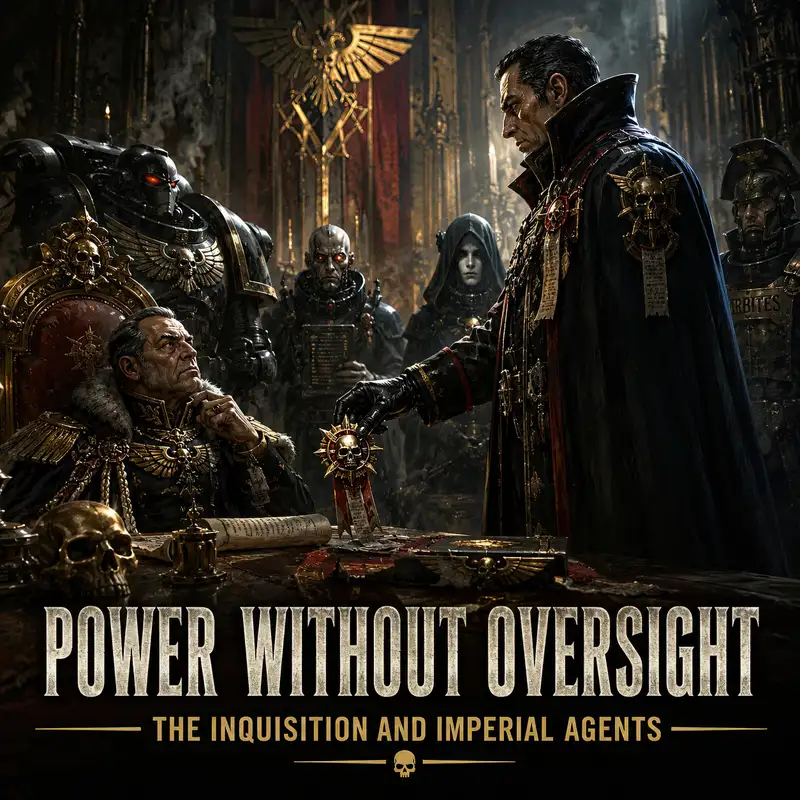
A planetary governor may command billions of subjects, possess armies large enough to drown rebellions in their own blood, and occupy a throne inherited from ancestors whose names have become part of the local calendar. Then a stranger enters the audience chamber, places a small rosette upon the table, and asks for the governor’s private archives. The stranger may have arrived with six companions and a battered shuttle. The governor has a palace, a dynasty, and an entire world. None of that guarantees that the governor may refuse.
This is the central contradiction of the Imperial Inquisition. It is one of the most powerful institutions in the Imperium, yet it is barely an institution in the ordinary sense. It has no simple chain of command, no transparent code of procedure, and no public court of appeal. Its members are investigators, judges, commanders, and executioners, often within the same hour. They can uncover threats that would otherwise destroy worlds. They can also become the threat. The mystery is not why the Inquisition possesses such power. The Imperium faces enemies that justify desperate measures almost daily. The mystery is how any civilisation survives giving that power to individuals.
The Inquisition emerged from the catastrophe of the Horus Heresy, although its precise beginnings remain buried beneath secrecy, contradiction, and later legend. Its origins are associated with Malcador the Sigillite and the hidden preparations made during the final struggle for Terra. That uncertainty is appropriate. The Inquisition was not created to administer ordinary life. It was created because ordinary institutions had failed to recognise treachery until half the Imperium was already burning. Its purpose was to look behind official reports, beyond lawful appearances, and beneath professions of loyalty. In a state built on obedience, the Inquisition was granted permission to distrust everyone.
An Inquisitor’s authority is represented by the rosette, but the object matters because of what the Imperium believes it means. In doctrine, an Inquisitor acts in the Emperor’s name. Local jurisdictions, hereditary privilege, military rank, and planetary custom are all secondary. An Inquisitor may demand records from the Administratum, question officers of the Astra Militarum, commandeer transport, requisition troops, seize forbidden artefacts, arrest senior officials, and order executions. In the most extreme circumstances, an Inquisitor may condemn an entire world. The signature may be written by one human hand. The fire that follows can be visible from orbit.
Near absolute authority does not mean unlimited ability. A rosette cannot conjure a fleet from empty space. It cannot make a proud Chapter Master obedient, force a forge world to surrender its secrets, or persuade a suspicious admiral to abandon a war merely because the request has been phrased sternly. Inquisitorial power depends upon reputation, evidence, allies, fear, and the willingness of others to recognise the symbol before them. Theoretically, an Inquisitor can requisition almost anything. Practically, asking a Space Marine Chapter for its battle-barge is a different experience from asking a clerk for a filing cabinet.
This is why Inquisitors rarely work alone. Around each of them gathers a retinue shaped by personality, mission, and obsession. One may employ soldiers, savants, sanctioned psykers, medics, interrogators, tech specialists, and a blank whose soulless presence repels warp-born creatures. Another may rely on priests, assassins, former criminals, alien experts, or agents who never learn the true name of their master. These people are not merely attendants. They are the Inquisitor’s eyes, memory, weapons, and conscience, though the last duty tends to have a discouraging survival rate.
Many future Inquisitors begin as acolytes or interrogators within such a retinue. There is no single academy that reliably produces the finished article. Some are drawn from the Schola Progenium. Others come from military service, the priesthood, noble houses, intelligence networks, or the wreckage of an earlier investigation. They learn by pursuing real enemies under a master whose methods may become their model or their warning. Promotion is personal. An established Inquisitor decides that a subordinate is ready to bear the rosette. The result is less a professional civil service than a chain of dangerous apprenticeships extending across generations.
The Inquisition itself is divided into Ordos, conclaves, factions, and informal alliances, none of which turns it into a tidy organisation. The three great Ordos dominate its public identity. The Ordo Hereticus hunts corruption within humanity, including cults, rogue psykers, mutation, apostasy, and treason. The Ordo Xenos confronts alien threats, whether they arrive as invasion fleets, hidden infestations, seductive diplomacy, or artefacts that should never have been brought through customs. The Ordo Malleus faces daemons and the powers of the warp, enemies so dangerous that knowledge of them can itself become a form of contamination.
These divisions describe priorities, not walls. A Genestealer cult is an alien infection, a heretical conspiracy, and a planetary security crisis at the same time. A daemon may be summoned through an alien relic by a governor whose court has already been compromised. Inquisitors cross Ordo boundaries, exchange information, steal one another’s agents, and dispute who has jurisdiction over a disaster. There are also many lesser Ordos devoted to narrower dangers. The Inquisition has created specialised offices for threats so obscure that most citizens would be executed merely for learning the office exists. Imperial administrative culture remains consistent, even at its most secretive.
Each major Ordo can call upon forces suited to its enemies. The Ordo Xenos is closely associated with the Deathwatch, Space Marine veterans trained to fight alien species with ruthless precision. The Ordo Malleus may seek the Grey Knights when daemonic war demands warriors created for that purpose. The Ordo Hereticus often works beside the Adepta Sororitas, whose faith, discipline, and firepower make them formidable allies against witches and heretics. These relationships do not mean every Inquisitor owns these forces. Cooperation still depends upon need, authority, politics, and whether the receiving commander considers the Inquisitor sane.
Sanity is not a trivial concern. Every Inquisitor spends a career studying enemies that corrupt those who study them. They read forbidden texts to recognise forbidden ideas. They interrogate cultists whose words may contain psychic traps. They handle alien devices, bargain with unreliable allies, and make decisions in which every available option is morally contaminated. An Inquisitor who refuses all dangerous tools may fail because purity left them helpless. An Inquisitor who uses every available tool may win so often that they no longer notice what they have become.
This divide produces the enduring conflict between Puritans and Radicals. Puritans argue that the Imperium cannot be saved by adopting the methods of its enemies. Daemons, alien technology, sorcery, and heretical knowledge are corrupting by nature. Radicals answer that refusing a weapon while humanity dies is not virtue. It is vanity. Between those positions lie countless factions, each convinced that it alone has found the exact point where necessity ends and damnation begins. Curiously, that exact point is usually located just beyond whatever its members did yesterday.
Gregor Eisenhorn is the classic illustration. He began as a determined Puritan and became increasingly willing to use forbidden means against enemies who could not be defeated by clean methods. His career led him to bind the daemonhost Cherubael into his service, an act that many Inquisitors would regard as proof of corruption by itself. Eisenhorn was branded a dangerous rogue more than once and was also judged loyal after accusations of treachery. That contradiction is not a flaw in his story. It is the Inquisition’s problem in human form. A servant may cross every acceptable line and still be the only person preventing something worse.
So who judges an Inquisitor? Other Inquisitors do. Regional conclaves can coordinate investigations, settle disputes, censure members, declare them rogue, and organise the hunt for those believed to have fallen. Respected Lord Inquisitors possess influence that can resemble rank, while Ordo leaders and political alliances can shape decisions across entire sectors. The Ordo Hereticus also watches for corruption among fellow Inquisitors. Yet none of this creates neutral oversight. The judges are peers with their own secrets, factions, enemies, and forbidden tools. A hearing may be an honest attempt to stop a traitor. It may also be the next move in a private war.
Inquisitorial oversight is therefore usually horizontal rather than vertical, secret rather than public, and retrospective rather than preventive. There is no ordinary inspector waiting to approve every interrogation or troop requisition. There is rarely an independent archive containing the full evidence. Witnesses may have been mind-wiped, classified, disappeared, or consumed by the thing they were asked to describe. By the time an Inquisitor’s peers decide that a line has been crossed, the suspect may command ships, agents, and loyal military formations. Serving the arrest warrant can become a campaign.
Fidus Kryptman demonstrates both the necessity and the horror of this system. As one of the Imperium’s greatest experts on the Tyranids, he understood that Hive Fleet Leviathan grew stronger by consuming populated worlds. His response was to deny it that biomass. Worlds in the hive fleet’s path were subjected to Exterminatus, killing billions to create a barren cordon. The strategy slowed the Tyranids, but the cost was too great even for the Inquisition to ignore. Kryptman was stripped of his standing and cast out.
His answer to disgrace was not retirement. Kryptman diverted the Tyranids toward the Ork empire of Octarius, intending each enemy to exhaust the other. The immediate logic was brutal and comprehensible. The consequences were less cooperative. Tyranids adapt through consumption. Orks grow stronger through war. The conflict became an enormous furnace in which both sides were given exactly the conditions they needed to become more dangerous. Kryptman’s story shows that an Inquisitor can be brilliant, justified by the available evidence, punished by peers, and still leave behind a catastrophe that no verdict can reverse.
Authority also has practical limits when another Imperial power refuses to yield. After the First War for Armageddon, the Inquisition attempted to contain knowledge of the daemonic invasion by controlling, imprisoning, and destroying those who had survived it. The Space Wolves resisted the treatment of loyal soldiers and civilians. The dispute escalated into the Months of Shame, a bitter conflict involving the Inquisition, the Grey Knights, and one of the Imperium’s most independent Space Marine Chapters. No calm constitutional court resolved the matter. Imperial law met Imperial honour, and both arrived armed.
That episode reveals the real balance beneath the doctrine. An Inquisitor may possess the right to command, but rights in the Imperium are strongest when backed by fleets, warriors, and allies. The Adeptus Mechanicus guards its mysteries. The Ecclesiarchy guards its spiritual authority. Space Marine Chapters guard their autonomy. The Adeptus Custodes recognise obligations older and higher than most Imperial institutions. A wise Inquisitor understands these boundaries and negotiates around them. An unwise one discovers that near absolute power and personal invulnerability are entirely different benefits.
The phrase Imperial Agents describes the wider collection of specialists who operate in these spaces between ordinary chains of command. They are not one coherent ministry and do not all answer to the Inquisition. They include Inquisitorial retinues, Rogue Traders, the Adeptus Arbites, Imperial Navy specialists, Navigators, priests, sanctioned operatives, and assassins. What unites them is not uniform or doctrine. It is their ability to appear inside another organisation’s war, exercise unusual authority, perform a precise task, and depart before anyone has decided which form should record the ammunition expenditure.
Rogue Traders possess a different kind of independence. Their Warrants of Trade permit them to travel beyond familiar Imperial borders, negotiate, explore, conquer, and profit where ordinary law becomes difficult to apply. Some warrants are ancient beyond reliable memory, and the oldest are associated with the Emperor’s own age. A Rogue Trader may command fleets, maintain private armies, deal with alien powers, and establish new domains in the Imperium’s name. They are pioneers, merchants, diplomats, warlords, and occasionally pirates whose paperwork is unusually impressive.
Their freedom serves a purpose. The Imperium cannot expand or even understand its frontiers by requiring every decision to pass through Terra. A Rogue Trader can act quickly, assume risks, and exploit opportunities. The same freedom can create private empires and dangerous compromises. Like an Inquisitor, a Rogue Trader survives through a mixture of legal authority, personal resources, patronage, and results. The warrant opens doors. The guns carried by the household ensure that the doors remain open long enough to be useful.
The Adeptus Arbites represent Imperial law rather than local justice. They are not ordinary police officers concerned with every theft, feud, or murder on a hive world. Local authorities handle local disorder, or claim to. The Arbites enforce the Lex Imperialis, protect Imperial institutions, pursue crimes against the wider state, and ensure that governors remember their obligations. Their precinct fortresses can become isolated bastions when a planet rebels. When seconded to an Inquisitorial operation, Arbitrators provide investigators and shock troops who already understand that status does not place a suspect above Imperial law.
The Officio Assassinorum embodies an even narrower solution. Its assassins are not independent adventurers roaming the galaxy in search of interesting people to kill. Their deployment is a matter for the highest Imperial authority, because a single operative can alter the fate of a campaign or government. A Vindicare may end a war through one distant shot. A Callidus can infiltrate a court and reshape it from within. An Eversor is released when subtlety has been examined and found insufficiently explosive. A Culexus turns the absence of a soul into a weapon against psykers.
These agents demonstrate why the Imperium prefers targeted power when it can manage it. Removing one commander may prevent the deployment of a million soldiers. Destroying one cult cell may save a hive. Seizing one relic may stop a daemon from entering reality. The Inquisition and its allies exist because the Imperium’s conventional forces are immense, slow, divided, and usually pointed at visible enemies. A battlefleet is excellent at bombarding a continent. It is less useful when the enemy is a phrase hidden in a prayer book.
Small teams also preserve secrecy. An Inquisitor can compartmentalise knowledge so that each agent understands only part of the mission. Troops may believe they are arresting smugglers when they are actually containing an alien infection. A governor may be told that a district was destroyed by industrial accident. Entire regiments can fight beside the Grey Knights and then discover that surviving the battle was not the final danger. In the Inquisition’s logic, ignorance is armour. Unfortunately, the armour is often fitted after the witnesses have been shot.
There are genuine victories behind this cruelty. Cults are broken before they summon their gods. Genestealer infestations are uncovered before a hive fleet answers their psychic call. Daemonic artefacts disappear into sealed vaults. Corrupt officials are removed before they can surrender a system. These successes are difficult to measure because the disaster did not happen. No monument is raised to the invasion that never arrived. The Inquisition’s best work leaves behind silence, falsified records, and citizens who never learn how close their world came to ending.
That secrecy also protects failure. An innocent population can be condemned because an Inquisitor mistook fear for guilt. A Radical can hide corruption beneath claims of necessity. Rival agents can destroy one another’s operations while both insist they are serving the Emperor. Information becomes a weapon, and the person deciding what remains classified often has the strongest interest in keeping it so. The Imperium created the Inquisition to penetrate lies. It then allowed the Inquisition to survive by manufacturing them.
Power without oversight is therefore not quite the truth. The Inquisition is watched by its own conclaves, rival Inquisitors, suspicious allies, hostile institutions, and the consequences of its actions. Its members can be censured, stripped of authority, hunted, or killed. Yet this oversight rarely protects the ordinary citizen in time. It is inconsistent, political, and conducted by people who possess the same powers they are judging. The system can stop a rogue Inquisitor, but often only after another Inquisitor decides to become equally ruthless.
The Imperium accepts this arrangement because the alternatives appear worse. A tightly controlled Inquisition might be too slow to stop a cult, too visible to penetrate a conspiracy, or too cautious to confront a governor protected by law and armies. An entirely uncontrolled Inquisition would consume the state it was meant to defend. The compromise is a hidden order of independent hunters who police one another through reputation, faction, evidence, and force. It is not a stable design. Stability is a luxury the Imperium abandoned several apocalypses ago.
The rosette on the governor’s table is therefore not merely a badge of office. It is the symbol of a civilisation that has chosen survival over accountability, then tried to recover accountability through secret wars among its guardians. The governor sees the Emperor’s authority. The Inquisitor sees permission to act. The agents standing behind them see a mission. Somewhere beyond the chamber, another investigator may already be collecting evidence against everyone present. The Inquisition’s final safeguard is that no Inquisitor can ever be certain they are not already under investigation.