The Indomitus Crusade: Fighting Across the Great Rift
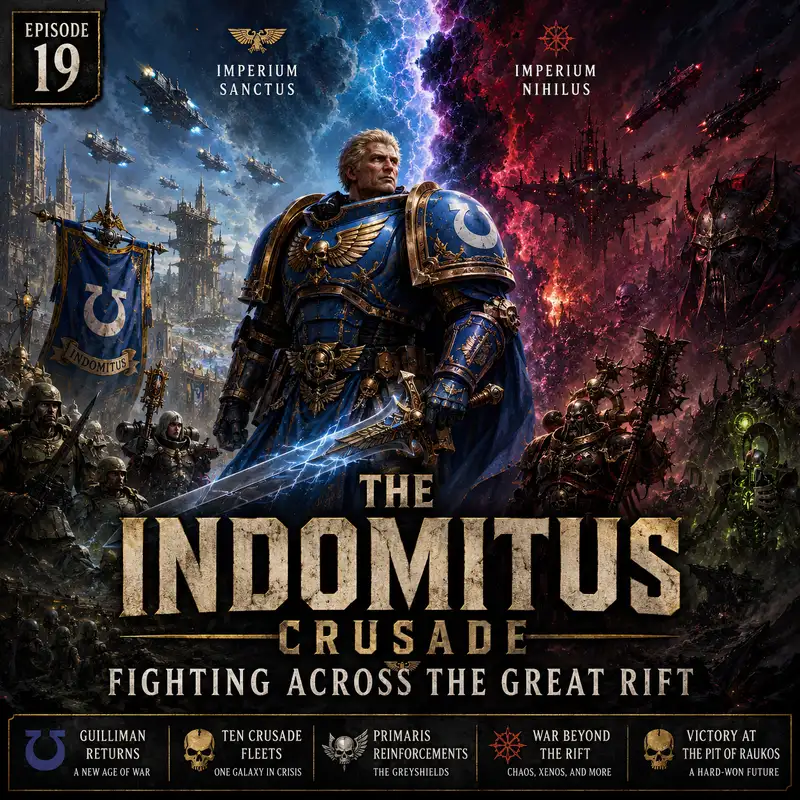
The first sign that the Imperium had broken was not an explosion, but silence. Astropaths reached into the warp and found storms where familiar voices had been. Navigators searched for the Astronomican and saw its light vanish behind a wound stretching across the galaxy. On Terra, maps still showed worlds, sectors, and supply routes in their proper places. The maps were accurate in the way a portrait of a dead man is accurate. The names remained. The roads between them did not. Into that silence, Roboute Guilliman prepared the greatest Imperial counteroffensive since the Great Crusade. His problem was simple to describe and nearly impossible to solve. How do you save an empire when half of it can no longer hear you?
The answer became the Indomitus Crusade, but the name can be misleading. This was not one army marching from battlefield to battlefield. It was a galaxy-wide emergency operation conducted by fleets that often could not speak to one another, trust their charts, or know whether the worlds they had been ordered to rescue still existed. Guilliman was not trying to win one war. He was trying to make Imperial warfare possible again. Before the crusade could reconquer territory, it had to restore routes, reinforce strongpoints, reopen communication, and convince isolated populations that the Imperium had not abandoned them. In some places this required a primarch. In others, it required fuel, replacement parts, and someone who knew where the ammunition had been stored.
The disaster began with the fall of Cadia and the opening of the Cicatrix Maledictum, the Great Rift. Warp storms joined into a scar that divided the galaxy. On the side still reached by the Astronomican lay Imperium Sanctus, battered but connected to Terra. Beyond the Rift lay Imperium Nihilus, the Dark Imperium, where the Emperor's beacon was hidden and long-range travel became a wager made with lives. Daemons erupted onto unsuspecting worlds. Chaos warbands poured through new passages. Orks, Necrons, Tyranids, and lesser threats found borders stripped of defenders. The Imperium had always been slow, divided, and badly informed. The Great Rift took those weaknesses and made them geographical features.
The Rift also damaged time. Ships emerged from the warp to discover that years had passed, or that they had arrived before the messages summoning them. Entire regions dated the beginning of the new age differently because it had not begun at the same moment everywhere. An order issued on Terra could reach a commander after the campaign was over, assuming it arrived at all. A relief force might be celebrated as salvation, condemned as deserters, or fired upon by descendants who no longer remembered requesting help. Imperial administration responded in its traditional manner, by producing more records. For once, the clerks were not the chief cause of confusion. Reality itself had become an unreliable filing system.
Guilliman understood the problem because administration and war were never separate things to him. He had returned to a realm that worshipped his father as a god, feared innovation, and survived through institutions layered with ten thousand years of ritual. He could defeat armies in person, but a primarch's sword could not escort every convoy or repair every astropathic relay. His greater weapon was organization. He accepted the title of Lord Commander, confronted the politics of Terra, and turned the Sol System into the assembly ground for a counterstroke. Fleets had to be recalled, regiments reassigned, forge worlds compelled to increase production, and ancient authorities persuaded that immediate extinction would be administratively inconvenient.
Terra itself had barely survived the opening of the Rift. Daemons of Khorne had assaulted the Throneworld, making the old assumption of safety impossible to maintain. The crusade began beneath the shadow of a home front already at war. Imperial Navy squadrons gathered beside troop transports, Mechanicus vessels, pilgrim ships, and the warships of the Adeptus Astartes. The Astra Militarum supplied mass. The Sisters of Battle supplied faith and disciplined violence. The Custodes left Terra in numbers not seen for ages. The Inquisition, Sisters of Silence, Knight households, Titan Legions, and less public institutions joined the muster. Cooperation was achieved through necessity, hierarchy, and the occasional reminder that Guilliman was several metres tall.
The initial design called for ten immense crusade fleets, each divided into battle groups that could separate again into smaller task forces. This was the key to the campaign. One concentration of force might smash anything before it, but it could only be in one place. The crisis existed everywhere. Fleetmasters received broad objectives. Groupmasters were assigned missions suited to particular regions. Some formations would relieve besieged worlds. Others would seize warp nexuses, destroy enemy strongholds, escort colonists, or establish defensive lines. The crusade was centralized in purpose and decentralized in execution, an elegant solution until the warp removed three commanders, two supply convoys, and the only copy of the revised orders.
The most dramatic new resource came from Archmagos Belisarius Cawl. For millennia, Cawl had worked on a project begun after the Horus Heresy. He now unveiled the Primaris Space Marines, larger and newly equipped warriors created from the gene-lines of the loyal primarchs. Many first served as the Unnumbered Sons, also called the Greyshields. They fought in mixed formations before being assigned to existing Chapters or used to found new ones. To desperate commanders, they were superhuman reserves arriving at the moment of greatest need. To some established Space Marines, they were strangers carrying familiar blood and unfamiliar weapons. To Guilliman, they were both a military answer and a political problem that worsened while they remained gathered in legion-sized strength.
The fleets departed Terra in waves, and the idea of one crusade dissolved into hundreds of local wars. Fleet Primus, closely associated with Guilliman and Cawl, sent spearheads through the Segmentum Solar and beyond. Fleet Secundus pushed toward the shattered approaches of the old Cadian Gate. Other fleets drove toward regions where Imperial control had weakened or vanished. Every advance depended upon points that looked insignificant on a galactic map. A stable translation route, a fuel-producing moon, a shrine world with working astropathic choirs, or a fortress controlling one narrow passage could determine whether whole armies continued forward. The war was fought for planets, but also for the ability to reach the next planet.
Gathalamor showed what that meant. It was a shrine world sacred to the Imperial Creed, but its strategic value was just as important. Gathalamor sat upon a warp nexus that allowed fleets to move out from the Segmentum Solar. If it fell, the crusade's momentum would be threatened near its beginning. Word Bearers and Iron Warriors attacked, combining fanaticism, siegecraft, and a plan involving the strange properties of blackstone. Mordian soldiers and Sisters of Battle fought to hold the line while Custodes raced ahead of Fleet Primus. The defenders were not merely protecting churches and relics. They were guarding a hinge in the road from Terra.
The battle was brutal, confused, and small beside the crusade as a whole, which is why it mattered. Guilliman's strategy depended upon people who could not see the grand design. A Mordian in a trench did not experience the liberation of the galaxy. He experienced mud, collapsing ammunition stocks, and an enemy who had brought artillery. A Sister of Battle did not need every route on the fleet charts. She needed to keep one gate closed. The Custodes uncovered a threat reaching beyond the planet, while the defenders bought time to stop it. Gathalamor was secured, and the crusade continued. The largest campaign in ten thousand years turned upon soldiers surviving one more night.
Fleet Secundus carried a different burden. Its route led toward the Eye of Terror and the broken Cadian region, where Imperial planners expected Abaddon's forces to strike toward Terra. The fleet fought along a path called the Road of Martyrs. Chaos armies, Ork invasions, warp entities, and attrition wore down its strength. The Officio Logisticarum struggled to supply it as distances widened and routes failed. Religious fervour grew among warriors who crossed one corrupted system after another. This was not necessarily irrational. When the walls bleed and the dead begin offering tactical advice, more prayer is understandable. Yet zeal could sustain a fleet without replacing its ships, and Secundus paid for every secure system with irreplaceable lives.
Fleet Quintus acquired an even darker reputation. Misfortune clung to it before departure. Disease spread. Sabotage was suspected. A warp-drive disaster among ships anchored near Uranus devastated vessels that had not yet left the Solar System. Later, apparently straightforward missions became prolonged slaughters. Officers punished talk of a curse, which ensured that everyone discussed it more quietly. Some disasters came from enemy action, some from the warp, and some from ordinary failures that follow any enormous undertaking. The surviving accounts do not make the distinction easy. In the Era Indomitus, superstition and intelligence analysis often examined the same evidence and reached conclusions that were equally alarming.
The crusade discovered that Chaos was not the only power exploiting the fractured galaxy. Battle Group Kallides entered the Nephilim region and encountered the Pariah Nexus, where Necron technology suppressed the warp and produced a suffocating stillness. The Great Rift was an excess of warp power. The Pariah Nexus threatened through its absence. Astropaths faltered, human will weakened, and familiar assumptions about communication failed for a different reason. The Imperium had launched a crusade to repair one cosmic disaster and found another waiting in the dark. Guilliman's fleets were not moving through empty territory toward a single enemy. They were entering a galaxy in which every ancient power had begun rearranging the board.
That scale can make the campaign sound abstract, so return to the ships. Every fleet consumed food, fuel, ammunition, spare components, trained crews, replacement soldiers, and psychic labour at a rate that could exhaust worlds. Muster orders stripped regiments from defensive zones facing threats of their own. Forge worlds redirected production. Merchant traffic was seized or rerouted. Governors were instructed to provide resources they had already promised to three other authorities. Some obeyed from loyalty. Some obeyed because warships were in orbit. A world saved by the crusade might survive because another had been left exposed. Imperial strategy had always required sacrifice. Guilliman made the sacrifices deliberate, but he could not make them painless.
He also had to work through the Imperium that existed, not the one he remembered. Guilliman did not share the Ecclesiarchy's understanding of the Emperor, yet faith held armies together and moved populations in ways rational orders could not. Visions, saints, relics, and prophecy shaped decisions around him. Some were frauds. Some were sincere. A few produced results difficult to dismiss, even for a primarch who preferred a well-prepared memorandum. Guilliman could challenge corrupt officials and reorganize commands, but he could not remove ten millennia of belief without breaking the state he was trying to save. The crusade carried a contradiction at its heart. It was rational reconstruction conducted by an empire that interpreted survival as divine proof.
The Great Rift prevented the crusade from solving its largest problem directly. It could not advance on a broad front into Imperium Nihilus. Stable passages were rare, shifting, and fiercely contested. The Nachmund Gauntlet became vital because it offered a comparatively reliable path through the storm. Vigilus, positioned near its throat, became a world whose survival affected communication between the two halves of the Imperium. Abaddon understood this as clearly as Guilliman did. Battles around Nachmund were not merely contests for territory. They were attempts to close or hold a door. One corridor through the Rift could carry orders, reinforcements, pilgrims, refugees, and hope. It could also carry invasion fleets in the opposite direction.
Beyond that door lay Imperium Nihilus, where Imperial authority became local, improvised, and often symbolic. Some sectors retained strong commanders and functioning fleets. Others fragmented into isolated enclaves. Worlds went generations without reliable contact. The Blood Angels' fortress world of Baal survived Hive Fleet Leviathan only after catastrophic losses, warp upheaval, and intervention in a region where time had become difficult to measure. Guilliman's wider crusading effort brought Primaris reinforcements and recognized Commander Dante as the leading Imperial authority in the dark half of the galaxy. The title did not give Dante a working communication network. It acknowledged that someone beyond the Rift had to act without waiting for Terra.
This was how the Indomitus Crusade fought across the Great Rift. It did not erase the division. It built temporary connections, reinforced those who could still command, and delegated authority where centralized rule had become fiction. Guilliman could issue a grand objective, but Dante, fleetmasters, Chapter Masters, admirals, canonesses, and planetary commanders had to interpret it locally. Some made wise decisions. Some pursued old grudges while sectors burned. Some never received the order. The crusade restored a measure of unity by accepting that uniform control was impossible. That is a very Guilliman solution: define the achievable structure, assign responsibility, and then discover which subordinates have been eaten by daemons.
After roughly twelve years, the first great phase reached a turning point at the Pit of Raukos. Guilliman concentrated powerful forces against Chaos warships and fortifications around an old warp rift. The Imperial fleet held the enemy in place while Space Marines assaulted the world below. Sisters of Silence helped deny daemonic reinforcement. The battle ended in a major victory, and the triumph that followed carried political meaning as well as military celebration. Guilliman broke up the remaining large formations of Unnumbered Sons. They would be assigned to Chapters, formed into new ones, or sent to other commands. The crusade was not over. One dangerous phase had ended, and its most conspicuous legion-like army had outlived its usefulness.
Dispersing the Greyshields revealed Guilliman's limits. He needed massed Primaris strength to launch the campaign, but retaining it invited comparison with the old Legions and the civil war that destroyed the Imperium's first age. Guilliman had written the Codex Astartes partly to prevent such concentrations of power. Keeping a private legion would have been convenient and politically disastrous. By dividing the Unnumbered Sons, he reinforced the wider Imperium and reduced suspicion, but surrendered a force he could command with unusual cohesion. The choice matched his purpose. The crusade was meant to rebuild a system, not replace it with one immortal ruler and his army, however tempting that might have seemed on difficult mornings.
The first phase achieved real victories. Vast regions of Imperium Sanctus returned to tentative Imperial control. Strategic routes reopened. Enemy offensives were broken. Old Chapters received new warriors, while new Chapters established strongholds where permanent defenders were needed. Worlds that had assumed Terra was dead saw Imperial fleets return. That mattered because morale was not decorative. A population that believed itself abandoned might surrender, rebel, embrace a cult, or stop sending tithes. The crusade restored the idea of Imperial survival before it restored stable government. In a realm held together by messages, oaths, and fear, the arrival of a fleet could be as politically important as the battle it won.
Success was not repair. The Great Rift remained open. Imperium Nihilus remained cut off from the Astronomican. Nachmund remained contested. The Pariah Nexus became a major war zone. The Plague Wars drew Guilliman toward Ultramar, while new Tyranid invasions and other threats forced the Imperium to strip one frontier to reinforce another. Some crusade fleets were mauled, corrupted, diverted, or swallowed by wars that had not existed when their orders were written. The Indomitus Crusade bought space and time, but the Imperium spent both immediately. Its reward for surviving one emergency was the opportunity to face several more with depleted ammunition.
Comparisons with the Great Crusade only go so far. The Emperor's armies advanced into a divided galaxy with the confidence of a rising power. Guilliman's armies advanced through the wreckage of a declining one. The Great Crusade sought to unite humanity beneath a new order. The Indomitus Crusade sought to keep an ancient order from coming apart faster than its defenders could brace it. One campaign built roads behind its armies. The other fought to discover whether the roads still existed. One promised a future. The other promised there might still be a tomorrow, provided the convoy arrived and nobody had falsified the fuel report.
Guilliman's greatest achievement was not reconquest in the simple sense. It was converting panic into coordinated resistance. He gave shattered institutions a plan, isolated commanders a direction, and newly awakened warriors a purpose. The Imperium could not be restored by one decisive battle because the enemy was not only Abaddon, daemons, or xenos empires. The enemy was strategic collapse. Every secured nexus, reinforced Chapter, reopened route, and surviving astropathic choir pushed that collapse farther away. The crusade did not heal the galaxy. It taught the wounded Imperium how to keep fighting while divided.
Somewhere beyond the Great Rift, an Imperial ship still travels without a clear view of the Astronomican. Its navigator follows a weaker beacon, an uncertain chart, and orders copied so many times that the original seal is a dark blur. The crew may believe Guilliman is coming. They may believe he has already passed them by. Both can be true, depending upon the clocks. What matters is that another ship is moving toward them, and another behind it, carrying soldiers, grain, gene-seed, or merely news. The Indomitus Crusade was never a clean line driven across the map. It was a chain of scattered lights, each trying to reach the next before the darkness closed between them.