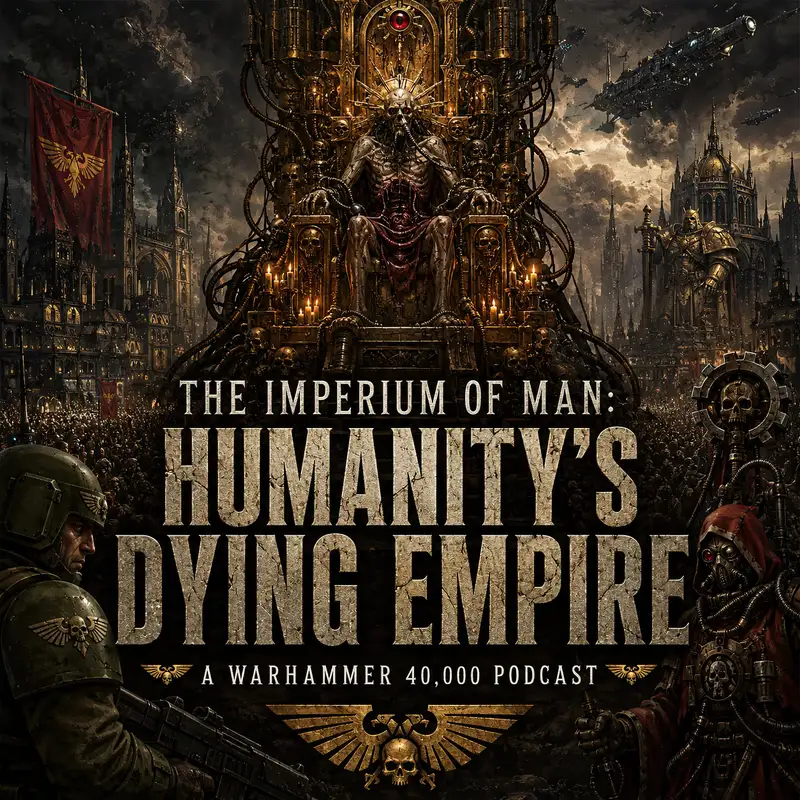
The Imperium of Man: Humanity’s Dying Empire
The largest human empire still standing is ruled by a man who has not spoken publicly for ten thousand years. His ruined body is locked within the Golden Throne on Terra, neither properly alive nor mercifully dead, while uncounted generations worship him as a god. His psychic will helps guide the light by which Imperial ships cross the warp. The machinery surrounding him is sustained at a terrible human cost. If that machinery fails, the Imperium may not merely lose its ruler. It may lose the ability to remain an empire at all.
That contradiction is the Imperium of Man in miniature. It is immense, powerful, and permanently close to catastrophe. It protects humanity from enemies that can devour worlds, enslave souls, or erase civilizations. It also grinds human beings into soldiers, laborers, test subjects, offerings, and figures in ledgers so vast that no living official can fully understand them. The Imperium is humanity’s shield, but it is a shield made from humanity itself.
Calling it a dying empire does not mean that it is weak in any ordinary sense. The Imperium can raise armies numbering in the millions, send fleets across interstellar distances, and turn the output of entire planets toward a single war. It can lose systems and still possess more worlds than most minds could imagine. It can suffer disasters that would end a lesser civilization and respond by stamping the proper form, dispatching a crusade, and declaring the matter temporarily contained.
The word dying describes something deeper. The Imperium survives by consuming the resources, knowledge, people, and possibilities that might have given it a future. It preserves ancient machines rather than truly understanding them. It repeats rituals whose practical purpose may have been forgotten. It answers political failure with repression, military failure with larger armies, and spiritual crisis with fire. These methods often work. That is part of the horror.
Humanity was not always trapped inside this structure. Long before the Imperium, human civilization spread through the galaxy during an age of extraordinary technological power. Later Imperial tradition remembers this as the Dark Age of Technology, although the darkness may say more about the people naming it than the people who lived through it. Human societies possessed machines of astonishing sophistication, traveled widely, and established colonies across immense distances.
Then the old order collapsed. The surviving accounts are fragmentary, contradictory, and buried beneath ten thousand years of fear. Wars involving artificial intelligences appear to have played a major role. The emergence of uncontrolled psykers brought new dangers. Warp storms cut worlds off from one another, while daemonic forces and human warlords exploited the isolation. Civilizations that had depended upon interstellar trade found themselves alone. Some endured. Some regressed. Some became things their ancestors would no longer have recognized.
This was the Age of Strife, and its memory shaped everything that followed. To later generations, isolation meant vulnerability. Uncontrolled technology meant rebellion. Untrained psychic power meant possession. Alien contact meant conquest or extinction. Those conclusions were not always fair, but they had been written in the ruins of worlds.
On Terra, the Emperor emerged as the most powerful figure of the age. He united the planet through wars of conquest, created armies of genetically engineered Space Marines, and launched the Great Crusade. Its declared purpose was to reunite the scattered branches of humanity beneath a single authority. From the Imperium’s perspective, this was a liberation. From the perspective of a human civilization that had survived perfectly well without Terra, the arrival of expeditionary fleets could feel rather different.
The language of the Great Crusade was compliance. A world could accept Imperial rule, contribute its resources, and join the new human order. If it refused, the Emperor’s armies imposed the decision. Some worlds were rescued from monsters and tyrants. Others were destroyed for choosing the wrong form of independence. The Imperium was born with a promise of unity and a habit of conquest.
The Emperor also imposed the Imperial Truth, a secular doctrine that rejected religion and dismissed gods as superstition. The policy may have been intended, in part, to weaken the influence of the warp powers. Yet it concealed too much. The warp was not merely a strange dimension used for travel. It was shaped by thought, emotion, and nightmare. Its predators were real, even if the government insisted that gods were not.
The contradiction proved fatal. Horus, the Emperor’s favored son and Warmaster, rebelled. Half of the Space Marine Legions followed him, and the Great Crusade became the Horus Heresy, a civil war of almost incomprehensible scale. Worlds burned. Legions that had conquered the galaxy turned their weapons upon one another. At the Siege of Terra, the Emperor defeated Horus but was mortally wounded. He was placed upon the Golden Throne, where he has remained ever since.
The Imperium survived the Heresy, but the civilization the Emperor had intended did not. His surviving sons disappeared one by one. Most of the great loyalist Space Marine Legions were divided into smaller Chapters. Military power was separated among institutions so that no single commander could easily repeat Horus’s betrayal. Suspicion became a principle of government.
Over the millennia, the Imperial Truth vanished. The Emperor became the God-Emperor. Temples rose in his name. Saints, relics, pilgrimages, and holy wars became central to Imperial life. The ruler who had tried to ban worship became the focus of the largest religion humanity had ever known. The official explanation would call this revelation. A less charitable observer might call it ten thousand years of administrative drift.
There is no single everyday experience of the Imperium. It is too large, and communication is too uncertain. One citizen may live beneath the smokestacks of a hive city where the sun has not been visible for generations. Another may work on an agricultural world whose entire economy exists to feed distant populations. Another may be born into a feudal society where advanced machines are treated as sacred objects and the stars are known only through sermons.
Forge worlds are governed by the Adeptus Mechanicus and devoted to industrial production. Shrine worlds receive oceans of pilgrims. Death worlds produce people hardened by environments that appear to resent the inconvenience of human settlement. Civilized worlds may resemble recognizable states, at least until the tithe ships arrive. The Imperium permits enormous local variation because it has little practical alternative.
What binds these worlds together is not a uniform culture or a responsive central government. It is a network of obligations. A planetary governor must maintain order, recognize the Emperor’s authority, suppress forbidden threats, and pay the tithe. The tithe may be grain, minerals, machinery, weapons, soldiers, psykers, or some combination determined by officials who may never have seen the planet they are assessing.
The Administratum attempts to count, classify, and extract the resources of an empire spread across the galaxy. Its archives are mountains of paper, data, seals, precedents, and contradictory instructions. Messages can be delayed by warp storms. Ships can arrive years later than expected. Entire wars may begin and end while a request for reinforcement is moving through the proper offices.
This bureaucracy is often presented as absurd, and it is. It is also performing an impossible task. No faster, safer system exists at Imperial scale. A clerk who misfiles a report may doom a regiment, but a clerk who processes it correctly may still discover that the regiment’s home world was destroyed before the request was written. The Imperial response can be swift, decisive, and separated from the problem by three sectors and a century.
Because Terra cannot manage every local decision, planetary rulers possess broad authority. Some are competent. Some are hereditary despots. Some are merchant councils, military regimes, noble houses, or priestly dynasties. The Imperium usually cares less about how they rule than whether their worlds remain productive and loyal. Freedom is not a standard tithe category.
When a world fails in its obligations, the consequences can be severe. The Adeptus Arbites enforce Imperial law. The Inquisition investigates threats that ordinary authorities cannot be trusted to understand. The Astra Militarum may be sent to crush rebellion, while the Imperial Navy controls the space above. If a crisis is judged sufficiently dangerous, entire populations may be sacrificed to prevent something worse from spreading.
The uncomfortable phrase is something worse, because in this universe it is often true. Chaos cults can summon daemons. Genestealer cults can prepare a world for consumption by a Tyranid hive fleet. Uncontrolled psykers can become doors through which the warp enters reality. An alien artifact may not merely be dangerous in theory. It may rewrite minds, awaken an ancient army, or signal something hungry between the stars.
Imperial paranoia therefore has evidence behind it. The problem is that evidence does not make every accusation correct, every purge necessary, or every atrocity wise. A regime built to prevent corruption can create the misery, secrecy, and desperation in which corruption grows. A citizen who has nothing to lose becomes an excellent recruit for anyone promising change, even when the recruiter has horns.
Religion helps hold the Imperium together. The Ecclesiarchy teaches that the Emperor protects humanity and that service, obedience, and sacrifice are sacred duties. Local customs vary enormously. On one world, the Emperor may be depicted as a sun god. On another, as a warrior ancestor. On another, as a distant judge enthroned among the stars. The forms differ, but loyalty must point toward Terra.
For ordinary people, this faith is not simply propaganda imposed from above. It provides identity, community, and hope in lives that may contain little of any three. Imperial soldiers carry devotional tokens because they are afraid. Families pray because ships vanish in the warp. Pilgrims cross continents to touch the wall of a shrine because belief may be the only possession the state has not yet taxed.
Faith also has power. Miracles are reported. Saints appear. Daemons recoil from conviction as well as weapons. The setting does not allow the comfortable conclusion that religion is merely false. It does, however, ask what happens when genuine faith is controlled by institutions that reward fanaticism, punish doubt, and possess flamethrowers in industrial quantities.
Psykers reveal the Imperium’s moral problem with particular clarity. Psychic ability is essential. Astropaths transmit messages across interstellar distances. Navigators guide ships through the warp. Sanctioned psykers serve in armies, courts, and the Inquisition. Yet uncontrolled psychic talent can be catastrophically dangerous.
The Imperium’s answer is the Black Ships. Psykers are gathered from human worlds and transported toward Terra. Some are trained for service. Some are judged too dangerous. Others are consumed by the systems that sustain the Emperor and the psychic institutions surrounding the Golden Throne. The process protects countless worlds, and it destroys countless lives. Both statements are true.
Technology is governed by a similar mixture of necessity, fear, and ritual. The Adeptus Mechanicus is not merely a department of Imperial engineers. It is a powerful religious civilization centered on Mars, allied to the Imperium while retaining its own hierarchy, armies, laws, and mysteries. Its priests worship the Machine God and identify the Emperor with the divine Omnissiah.
The Mechanicus preserves devices that no other Imperial institution could maintain. Its rituals may appear superstitious, but many are also compressed procedures inherited from people who understood the machines far better. When the repair manual has become scripture, reciting the correct litany may still keep the reactor from exploding.
The tragedy is that preservation has hardened into monopoly and dogma. Ancient designs are copied because experimentation is dangerous and because knowledge is power. Artificial intelligence remains forbidden, shaped by the memory of ancient catastrophe. Alien technology is distrusted. Innovation occurs, but it must survive political, religious, and practical obstacles that can be as hazardous as the invention itself.
This caution is not entirely foolish. In the Imperium, a corrupted data system can carry a daemonic infection. A machine can possess a spirit in more than the metaphorical sense. A recovered device may be a weapon built by a civilization that considered planets disposable. The difficulty is that fear of dangerous knowledge has become fear of knowledge itself.
The result is a civilization capable of building city-sized warships while struggling to reproduce some of the systems inside them. It can field weapons thousands of years old, repair them with sacred oils, and execute the technician who suggests a more efficient component. The machine continues to function, but fewer people understand why.
War is the purpose around which much of the Imperium is organized. Planetary tithes feed the Astra Militarum, whose regiments provide the overwhelming mass of Imperial ground forces. The Navy carries war between systems. Space Marines strike at critical targets, rare and terrifying figures whose appearance may save a world or announce that the situation has already become very bad. The Sisters of Battle defend the faith with disciplined violence. The Mechanicus deploys armies of its own, along with Titans that turn theology into artillery.
These forces are not fighting imaginary enemies. Ork empires gather for wars that can consume sectors. Tyranid hive fleets strip worlds to lifeless rock. Necron dynasties awaken beneath planets humanity thought it owned. Drukhari raiders carry populations into slavery and torment. Chaos attacks the Imperium from within and without, offering power to the desperate and damnation to the ambitious.
That does not make every Imperial war just. The Imperium treats alien life as guilty by existence and human independence as rebellion waiting to happen. Temporary alliances occur when survival demands them, but extermination remains the instinctive policy. The state claims to speak for humanity, then destroys human societies that refuse to be spoken for.
Still, the courage of those defending it is real. A Guardsman holding a trench against a Tyranid swarm is not an abstract symbol of authoritarianism. She is a frightened human being trying to keep the creatures away from the people behind her. An Imperial Navy crew fighting to keep a transport route open may save billions they will never meet. A medic can be compassionate even when the institution issuing the bandages is monstrous.
This is one reason the Imperium matters as a setting. It is not a simple villain wearing human skin, and it is not a noble kingdom forced into a few regrettable measures. It is a civilization in which individual heroism and institutional cruelty support one another. Good people keep the system alive because the system is defending other good people from horrors that are entirely real.
The Imperium also endures because it is not one machine with a single point of control. It is a web of worlds, fleets, cults, noble houses, military commands, trade routes, and local bargains. A sector can be lost while another continues as before. A governor can die without the tithe stopping. A crusade can be launched by authorities who have only the faintest understanding of conditions at the front.
Its inefficiency creates a strange resilience. No enemy can easily capture one palace and command the whole empire. Even Terra’s orders must pass through layers of interpretation before becoming action. The Imperium is held together as much by habit, belief, and fear as by administration. People obey because their parents obeyed, because the Emperor is divine, because the Navy controls the sky, or because the things beyond the border are worse.
Then the Great Rift tore the galaxy in two. After the fall of Cadia, a vast warp storm split Imperial space. On the Terra-facing side, the Imperium Sanctus remained battered but connected to the Astronomican. Beyond the rift, the Imperium Nihilus was plunged into deeper isolation. Travel became more dangerous. Communication failed. Worlds that had depended upon distant authority were forced to survive with whatever leadership, faith, and ammunition remained.
At almost the same moment, Roboute Guilliman returned. He was a primarch, one of the Emperor’s engineered sons, and a living figure from the age before ten thousand years of decay. He became Lord Commander of the Imperium and launched the Indomitus Crusade to stabilize the realm, reclaim lost worlds, and restore some measure of coordination.
His return did not solve the Imperium’s problems. It revealed their scale. Guilliman could command fleets and rewrite institutions, but he could not erase ten thousand years of theology, bureaucracy, rivalry, and fear. He had to work through the very systems that appalled him. A primarch may be able to conquer a world. Reforming its tax office is another campaign entirely.
The Imperium is therefore not motionless. It develops new weapons, raises new armies, and adapts when disaster leaves no alternative. Commanders learn. Engineers improvise. Worlds rebuild. Yet these changes occur inside a structure that cannot question its deepest assumptions without risking collapse.
That is why the Imperium is dying. It cannot stop fighting long enough to become something better, and it cannot become something better without changing the methods that allow it to keep fighting. Every crisis strengthens the institutions created to manage crisis. Every invasion justifies greater military power. Every rebellion justifies harsher surveillance. Every technological disaster confirms the wisdom of ignorance. Every act of resistance becomes proof that more obedience was needed.
It survives for the same reason. The enemies are real. The distances are immense. The machinery is ancient. The people are afraid. No alternative has the reach to replace it, and every local attempt at freedom must face a galaxy that does not pause while political ideals are being refined.
At the center of it all sits the Emperor, worshipped as a god by the empire he founded upon the denial of gods. His light guides ships that carry soldiers to preserve a civilization built from endless sacrifice. His silent presence offers hope to billions and demands the deaths of people whose names will never reach the archives.
The Imperium of Man endures not because it has mastered the future, but because each generation is ordered to burn its share of that future to keep the throne lit for one more night.