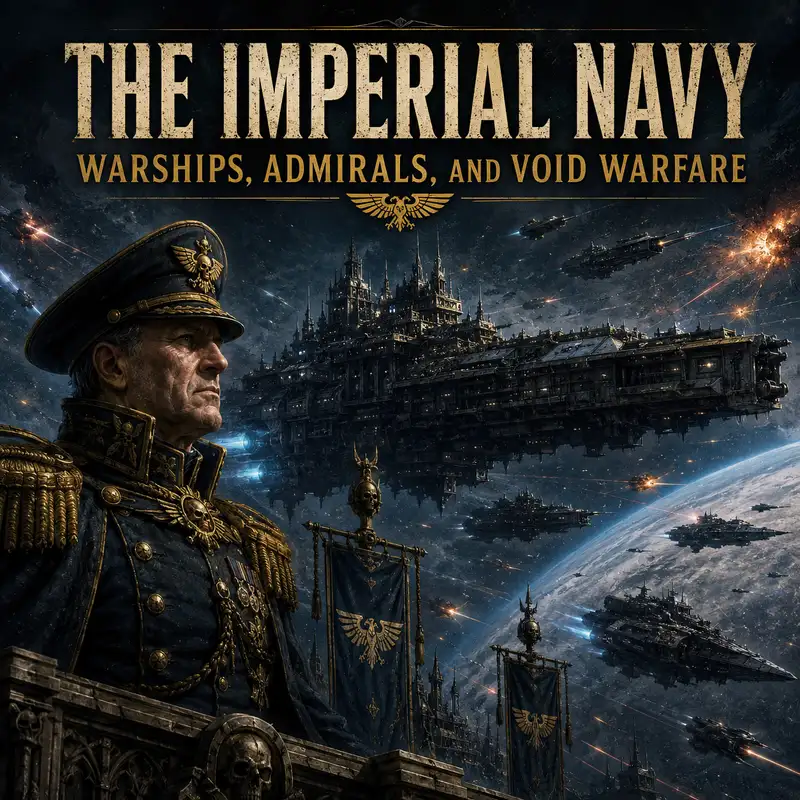
The Imperial Navy: Warships, Admirals, and Void Warfare
The first warning was not the enemy. It was the shape of the trap.
For a week, Lord Admiral Cornelius von Ravensburg had pursued a Chaos fleet through the Gethsemane system. His task force contained seventeen capital ships and a screen of escorts, a concentration of strength that the battered Battlefleet Gothic could scarcely afford to lose. The enemy appeared to be retreating. Imperial scouts pressed forward. The fastest ships lengthened the chase.
Then a second Chaos force appeared behind them.
The Imperial fleet had committed its momentum, its formation was stretched, and no vessel several kilometres long changes direction with anything resembling urgency. In void warfare, the moment when an admiral understands the danger and the moment when the fleet can answer it may be separated by hours. Those hours are usually filled with torpedoes.
Ravensburg escaped the first engagement, reorganised his ships, and went hunting again. He had been deceived, but not defeated. Days later, his fleet found the enemy above Gethsemane Two. The Chaos ships were faster and the Imperial force was outnumbered, yet Ravensburg ordered a direct attack. Torpedoes went forward. Armoured prows faced the return fire. Battleships and cruisers closed until their broadside batteries could speak.
That battle reveals nearly everything important about the Imperial Navy. Its ships are ancient, brutally powerful, and often less agile than their enemies. Its admirals work with incomplete information, unreliable communication, divided authority, and distances that punish every mistake. Its victories rarely come from elegance. They come from endurance, concentration, judgement, and a willingness to keep advancing while the fleet is being torn apart.
The Imperium is usually imagined through its armies. Space Marines descend from the sky. Guardsmen fill trenches from horizon to horizon. Titans stride through burning cities. Yet none of those forces matter if the ships carrying them never arrive. Every crusade, planetary invasion, relief force, food convoy, and reinforcement depends upon control of the void. A regiment stranded on the wrong world is not an army. It is a very large collection of people waiting for transport.
The Imperial Navy is therefore more than a collection of warships. It is the armed framework holding the Imperium together.
That distinction matters because not every Imperial vessel belongs to the Navy. Merchant fleets carry the grain, ore, machinery, pilgrims, troops, and tithes that keep distant worlds alive. Civilian and chartered vessels travel licensed routes. The Adeptus Mechanicus, the Inquisition, Rogue Traders, and Space Marine Chapters maintain ships of their own. The Imperial Navy is the military arm among this vast traffic. It guards routes, escorts convoys, patrols borders, hunts pirates, transports armies, supports planetary assaults, and destroys hostile fleets.
In practical terms, it must make an empire of a million separated worlds behave as though those worlds share a frontier.
Control of the void does not mean occupying every empty point around a star. It means controlling the places that matter: the approaches from which ships can safely enter, the orbital anchorages where they refuel and repair, the stations that relay messages, and the lanes through which transports must pass. A fleet can lose a planet’s surface and still prevent the enemy from exploiting it. It can also win every ground battle and lose the war because hostile ships own the orbit above. From the Navy’s perspective, a world is not only territory. It is a port, a supply source, a sensor position, and sometimes a very large obstruction around which everyone must manoeuvre.
The Navy took its present form in the aftermath of the Horus Heresy. During the Great Crusade, the armies and fleets of the Imperium had been joined within a single military structure. That arrangement was powerful. It also allowed rebellious commanders to take soldiers, transports, warships, and entire expeditionary forces into treason together.
The post-Heresy settlement divided power. The Imperial Guard would fight on the ground. The Imperial Navy would control movement through space. Space Marine Legions were broken into smaller Chapters, while other institutions retained their own chains of command. The result was deliberately inconvenient. A general could not casually seize a battlefleet. An admiral could not simply gather an army and declare a private empire.
The Imperium had learned that military efficiency becomes less attractive when the efficient commander is Horus.
This separation helps prevent another single rebellion from controlling every instrument of war, but it also means that Imperial campaigns are exercises in negotiation. A naval commander may have authority over the ships but not the soldiers aboard them. A Lord General may know exactly where the army must land and have no power to order the fleet through a suicidal approach. An Inquisitor may produce a seal that ends the argument, although it may begin several more.
The Navy itself is organised through enormous regional fleets, then divided into battlefleets responsible for sectors and subsectors. A battlefleet is not usually one permanently assembled armada. It is a pool of vessels scattered across patrol routes, convoy duties, dockyards, listening stations, and active war zones. When danger appears, commanders must gather what can be reached.
That sounds straightforward until distance enters the calculation.
Astropathic messages can be delayed, distorted, or reduced to symbolic impressions. Warp storms may silence whole regions. A ship ordered to rendezvous may emerge late, early, or nowhere near the intended point. Another may receive the command after the battle has already been lost. Even when every captain obeys, the fleet may assemble in pieces.
An admiral in the Imperial Navy does not command from a perfect map covered with obedient lights. The map is incomplete. Some lights are months out of date. One represents a cruiser that may have been destroyed. Another represents a squadron that has arrived, fought a battle, and departed before the order calling it there was even sent.
This is why Imperial admirals require more than rank. They need the ability to act without certainty. They must decide which worlds can be defended, which convoys must be sacrificed, which rumours deserve ships, and how much strength can be risked before a sector is left exposed elsewhere. The grandest title in the fleet does not produce more warships. It merely ensures that the shortage is now your responsibility.
Beneath the admirals are commodores, captains, junior officers, specialists, and ratings. Each ship is a military command, an industrial complex, a religious community, and a city sealed inside armour.
Imperial warships are not sleek machines built for a single deployment. Cruisers may stretch for several kilometres. Battleships are larger still, carrying populations that can number in the tens or hundreds of thousands. Their interiors contain command decks, magazines, engine halls, chapels, manufactories, launch bays, barracks, hospitals, prisons, storehouses, and passages whose original purpose may have been forgotten.
Some vessels are older than the institutions that currently operate them. Ravensburg’s own flagship at Gethsemane, the Emperor class battleship Divine Right, had been recovered from a space hulk centuries earlier. Its surviving systems suggested an origin far older than the crew who salvaged it. Returning the vessel to service required decades of labour. The Navy did not consider this excessive. It considered it a successful refit.
A ship of that scale cannot be run by naval officers alone. Navigators from the great hereditary houses guide it through the Warp. Astropaths carry messages across interstellar distances. Tech-priests tend engines and weapons whose operation blends engineering with ritual. Armsmen guard vital compartments, repel boarders, and suppress mutiny. Skilled voidsmen maintain the systems that keep everyone alive.
Below them are labourers, indentured workers, servitors, and press-ganged ratings. Some load ammunition, move fuel, seal damaged compartments, and perform the endless manual tasks demanded by a machine too vast to automate completely. Many are born aboard and die aboard. Their understanding of the wider ship may be limited to a deck, a shrine, a work gang, and the warning klaxons that tell them when someone they will never see has made a serious navigational decision.
A naval vessel develops its own customs over centuries. Families inherit duties. Officers inherit rivalries. Compartments acquire saints, superstitions, and forbidden doors. A captain may command a warship while still depending upon guilds and priesthoods that know parts of it better than the bridge does. Authority is absolute in theory. In practice, it must pass through a great deal of very old plumbing.
The ships themselves fall into broad roles.
Battleships are the great centres of fleet power. They carry immense weapon batteries, thick armour, powerful shields, and command facilities suited to an admiral and staff. Some are built around devastating broadsides. Others act as carriers, launching waves of interceptors, bombers, and assault craft. They are precious, slow to replace, and rarely risked without support.
Cruisers are the workhorses. They patrol, blockade, raid, escort, and form the main battle line. The Lunar class cruiser became widely used because it could do several jobs reasonably well. It combined torpedoes, weapon batteries, and lances in a hull tough enough to close with the enemy. This is not glamorous praise, but fleets are usually saved by ships that are available and competent rather than magnificent and elsewhere.
Light cruisers and escorts perform scouting, screening, convoy protection, and pursuit. Destroyers may carry torpedoes dangerous enough to threaten capital ships. Frigates defend larger vessels against attack craft and smaller raiders. Their size does not make them expendable to their crews, although fleet plans sometimes arrive at a different conclusion.
Void combat begins long before two captains can see one another.
Ships search with augurs across immense distances, trying to distinguish enemy vessels from debris, radiation, planetary bodies, and deliberate deception. Commanders study vectors, acceleration, fuel, firing arcs, and the gravity of nearby worlds. A fleet that turns at the wrong time may expose its vulnerable side. A squadron that accelerates too aggressively may be unable to support the main line when the enemy finally commits.
The battlefield is three-dimensional, but Imperial ships still fight in formations shaped by their weapons and armour. Many Navy vessels carry heavily reinforced prows. They advance toward the enemy with their strongest protection forward, launch torpedoes, endure the first exchange, and then turn to bring their broadside batteries to bear.
Torpedoes in this kind of war are not small missiles flickering between fighters. They are enormous weapons launched in salvos, each capable of crippling a warship if it reaches the hull. Their immediate value is not always destruction. A torpedo wave can force the enemy to turn, break formation, divide defensive fire, or present a weaker aspect to the Imperial line.
Macrocannon batteries then deliver massed fire. Their shells cross distances that would make a planetary artillery officer quietly reconsider the scale of his profession. A single battery may include many guns firing together, not because every shell will hit, but because enough metal moving through the target’s predicted position makes evasion increasingly theoretical.
Lance batteries serve a different purpose. They concentrate energy against a point, cutting through armour once void shields are weakened. Some capital ships carry nova cannons, massive prow weapons that hurl projectiles at almost the speed of light. A successful strike can devastate a formation. A missed shot remains an impressive demonstration of resources being converted into distance.
Attack craft extend a fleet’s reach. Interceptors protect the line. Bombers attack damaged or isolated vessels. Assault boats carry boarders toward enemy hulls. These small craft are tiny only when compared with the ships launching them. Their crews still cross a battlefield filled with defensive fire, debris, radiation, and the possibility that their carrier will no longer exist when they return.
Void shields absorb the first punishment, flaring under impacts until overloaded. After they fail, armour must endure what follows. Compartments rupture. Atmosphere escapes. Fires spread through galleries and ammunition decks. Damage-control teams seal bulkheads, sometimes with living crew members still on the wrong side. The ship may remain in action despite casualties that would empty a city.
Destruction is not always immediate. A cruiser can fight while burning, lose engines but retain weapons, or drift helplessly with most of its population still alive. This creates opportunities for boarding.
Boarding actions may seem archaic in a battle fought with weapons capable of scarring continents, but an ancient warship is worth capturing. Assault boats, boarding torpedoes, and teleport attacks place armed teams inside the enemy hull. Naval armsmen seize control rooms and magazines. Space Marines, when present, turn the operation into a much shorter discussion. Boarders may plant charges, disable engines, capture officers, or take the ship as a prize.
Ramming is the final expression of the same logic. Imperial prows are heavily armoured. A crippled ship may have little left except mass, momentum, and an enemy directly ahead. Under those circumstances, the captain is not abandoning naval doctrine. The captain is using the largest remaining weapon.
At Gethsemane, Ravensburg used all of these principles.
After escaping the Chaos trap, the Imperial fleet spent days searching the system. Scout frigates found the enemy above the second world. Ravensburg attacked before the faster Chaos ships could slip away. His warships launched torpedoes while closing head-on, presenting their armoured prows and forcing the enemy to react.
The Imperial line then drove into the Chaos formation and split it. Cruisers turned through the gap, bringing their broadside batteries onto targets at close range. The exchange was ruinous. Escorts vanished. Capital ships were crippled. Bombers struck launch bays and burning hulls. The Navy was winning the position by spending ships it could not easily replace.
One Imperial cruiser, Excellent, was left badly damaged. Its captain ordered the burning vessel to ram the Chaos grand cruiser Foe Reaper. The names are almost too appropriate, even by Imperial standards. The impact removed both ships from the battle.
Ravensburg’s manoeuvre broke the coherence of the Chaos fleet, but it did not produce a clean victory. The surviving enemy ships withdrew behind mines, and their greater speed offered escape.
Then an Aeldari fleet appeared in their path.
Some Imperial officers expected betrayal and urged an immediate attack. Imperial command held fire. The Aeldari had their own reasons for opposing Chaos, and those reasons were sufficient. Their ships closed the route of escape and helped destroy the trapped fleet.
The Battle of Gethsemane became the turning point of the Gothic War, but the word victory conceals the cost. Imperial vessels were crippled or destroyed. Captains and crews died in great numbers. Ravensburg’s own son was among the dead. The fleet survived because its admiral recognised what kind of battle his ships could win, recovered from deception, concentrated force, and accepted an alliance that Imperial doctrine would normally regard with suspicion.
He did not control every event. No admiral does. He created a position in which unexpected events could still favour him.
That is the real work of command in the void.
Imperial doctrine can appear blunt because the ships themselves reward commitment. Armoured prows, torpedo attacks, close-range broadsides, and stubborn damage control allow Navy formations to survive punishment and keep pressing. Yet good admirals know that doctrine is a tool, not a substitute for thought.
Chaos fleets may be faster and armed for long-range engagements. Aeldari vessels rely upon speed, deception, and technology that makes a conventional firing solution an optimistic suggestion. Ork ships can be crude, heavily armed, and alarmingly enthusiastic about collision. Tyranid fleets are living organisms whose command structures are biological. Necron vessels can make ancient Imperial technology feel newly invented and already obsolete.
The Navy cannot answer every enemy in the same way. It must protect convoys against raiders, hold orbital space over contested worlds, blockade rebellious systems, support landings, and fight fleet actions against opponents that do not share its assumptions. An admiral who seeks only the enemy’s largest ship may win a dramatic engagement while losing the transports, fuelers, repair docks, and supply routes that made the campaign possible.
Wars are often decided by less celebrated actions. An escort squadron holds a corridor open. A cruiser arrives before a planet surrenders. A damaged carrier launches one more wave of fighters. A convoy reaches a starving fortress. A patrol captain believes an astropathic warning that everyone else dismisses.
The Imperial Navy is full of magnificent battleships, but its purpose is continuity.
Its warships are moving fortresses built from inherited knowledge. Its crews are societies trained to endure confinement, terror, and losses on a scale almost impossible to imagine from the ground. Its admirals command across distances that prevent close control and within a political system designed to restrict their power. They win not because the Imperium has solved those problems, but because generations of voidfarers have learned to fight inside them.
The Navy does not make the Imperium efficient. It makes the Imperium connected enough to survive.
Somewhere, a world under siege looks into the night and sees new stars moving against the sky. They are not stars. They are the running lights of ships that crossed the Warp, arrived despite the storm, found the correct system, and brought the war with them. The people below may never know the name of the admiral, the ships lost along the route, or the crews sealed behind damaged bulkheads so the fleet could continue.
They know only that the sky still belongs to the Imperium.
For the Imperial Navy, that is what victory looks like.