The Hrud: Migration, Entropy, and Stolen Time
On Golghis, the Iron Warriors learned that a fortress could die of old age. Walls that had been raised to endure orbital bombardment softened, cracked, and shed their outer layers like ancient bone. Weapon housings seized. Seals failed. Ammunition degraded inside its magazines. The legionaries defending those works were transhuman soldiers built to survive wounds that would kill ordinary men, yet some withered inside their armour before they could identify what had touched them. Their enemy was not battering down the gates. It was gathering beneath the ground, and its mere presence was dragging the future into the present.
That is the central terror of the Hrud. They do not need to conquer a world in the familiar sense. They do not have to plant a banner, declare a new regime, or even remain once the fighting is over. A Hrud migration can pass through a system like a population on the move and leave behind the consequences of centuries. Metal corrodes. Stone erodes. Crops become dust. Soldiers discover that the years they expected to live have already been spent. The Hrud are often described as creatures of entropy, but that phrase can sound almost tidy. There is nothing tidy about watching an army become old in the space between one heartbeat and the next.
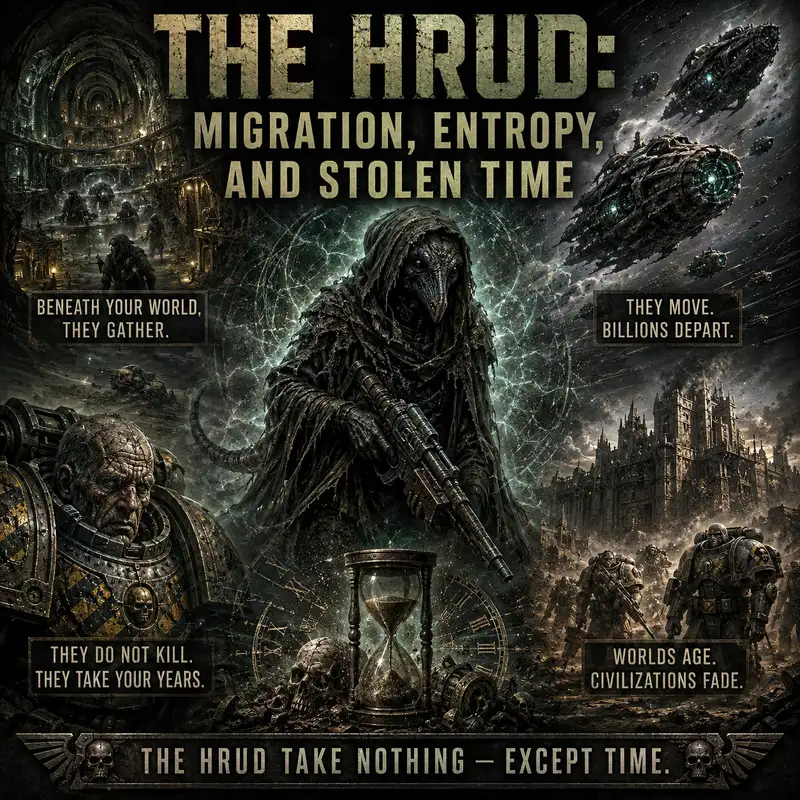
Even deciding what a Hrud looks like is difficult. Imperial accounts disagree. Some old images show a hunched, cloaked scavenger with a narrow tail and a long firearm. Other records describe tall, flexible-limbed beings whose bodies seem unpleasantly fluid beneath ragged shrouds. Later xenologists have treated the contradiction as part of the evidence. The Hrud distort light, heat, and time around themselves. Witnesses see flickers or black shapes where no stable outline can be fixed. Dead specimens decay with such speed that careful study becomes a race against the corpse. The Imperium has not enjoyed classifying an alien that will not remain the same age long enough to be measured.
What does emerge from the surviving evidence is a picture of a genuine civilisation, not a species of vermin wearing stolen weapons. Hrud communities establish vast tunnel-cities, often beneath the settlements of other peoples. They live in darkness, salvage what they need, and conceal their numbers until concealment is no longer possible. They keep careful archives, storing historical and technical knowledge in crystalline forms that Imperial scholars only partly understand. When a tribe moves, it does not merely carry food and weapons. It carries memory. The Hrud may inhabit the margins of other societies, but they do not consider themselves creatures without a past. That past may be the possession they defend most fiercely.
Their great migrations appear to begin when a hidden population has grown beyond the capacity of its warren. The process is more complicated than a column of refugees boarding conventional transports. Scouts may travel ahead as stowaways. Warrens can become the foundations of migration craft. Entire communities vanish into routes combining void travel, warp mechanisms, and temporal effects. A world may believe it has a local infestation, only to discover that the tunnels beneath its cities are staging grounds for movement across the stars. By the time officials accept the scale, the problem is usually already leaving, which is not the same as being solved.
Every Hrud generates a distortion field. Their own word for it is the ssaak, a kind of concealing mist produced by the creature itself. It bends perception and makes a stationary Hrud almost impossible to distinguish from shadow. It creates violent temperature shifts and confuses sensors with blooms of accelerated activity. More importantly, it alters the rate at which surrounding matter experiences decay. A single Hrud is dangerous. A cluster is worse. A full warren creates overlapping fields whose effects multiply until the environment itself begins to fail. The Aeldari call them Those Who Evade the Crone, because even seers struggle to track their passage through fate. The Hrud do not simply carry a weapon. Their collective presence becomes a zone in which ordinary time loses authority.
Calling this accelerated ageing is useful, but incomplete. A human body exposed to the field does not merely receive grey hair and an interesting perspective on retirement. Cells fail. Organs deteriorate. Bones weaken. Armour that should outlast generations pits and flakes away. A fortress can experience centuries of weathering without a century of weather. Food spoils, fuel breaks down, and machinery reaches the end of its service life before a maintenance crew can reach it. The Hrud force ordinary processes to occur at impossible speed. They do not have to invent a new way for a wall to collapse. They make every old weakness in that wall arrive at once.
This also makes fighting them an exercise in betrayal by familiar things. A projectile enters a region where metal, propellant, and momentum no longer behave as expected. A vehicle advances and discovers that its lubricants, seals, and power systems have aged at different rates. Rangefinders offer readings already out of date. Thermal vision may reveal the Hrud more reliably than ordinary sight, yet even that image can dissolve into a glare of frantic molecular activity. Directed-energy weapons may fare better than solid munitions, but there is no simple answer. The Hrud turn logistics into mortality. Every machine carries a date on which it will fail, and near them that date becomes negotiable.
Their oldest stories suggest that this way of life was not chosen freely. Hrud religion remembers a benevolent group of ancient gods and a war against beings called the Mirror Devils. Only one protector, Qah, is said to have remained. In the Hrud account, Qah transformed or guided them into becoming nocturnal scavengers so they could survive enemies too powerful to meet openly. He later departed, promising a future reunion when the scattered tribes would gather for a final struggle. Imperial scholars compare these figures to legends of the Old Ones and their enemies, but resemblance is not proof. What matters is how the Hrud understand themselves. Hiding, scavenging, preserving memory, and moving on are sacred methods of survival.
That perspective changes the meaning of a migration. To an Imperial governor, it is an infestation becoming a planetary emergency. To the Hrud, it may continue a duty older than human civilisation. Their communities do not necessarily move because they wish to seize a human world. They move because growth, danger, memory, and prophecy demand it. Unfortunately, motives offer little comfort to a family whose home has just aged into rubble. The Hrud can be refugees and catastrophe at the same time. Warhammer forty thousand is particularly fond of situations in which understanding an enemy does not make the enemy less lethal. It makes the tragedy more precise.
The clearest demonstration came near the end of the Great Crusade, in the Sak Trada Deeps. The Imperium ordered Perturabo and the Iron Warriors to cleanse the region of Hrud warrens and secure its worlds. It was the kind of assignment routinely handed to the Fourth Legion: difficult, unglamorous, and costly. Perturabo approached it as an engineer and a commander. The Hrud occupied territory. Their fields had measurable effects. Therefore, those effects could be countered, their settlements isolated, and their population destroyed. It was rational, and Perturabo was often most dangerous inside a problem whose true boundaries he had not accepted.
The Iron Warriors were designed by culture and experience for battles of endurance. They reduced fortifications through calculation, artillery, mining, and relentless pressure. They understood attrition and paid its price without complaint. Against the Hrud, those strengths became liabilities. A fixed position gave the enemy time to gather beneath it. Heavy machinery offered thousands of components that could decay. Dense formations placed more warriors inside overlapping entropic fields. Even their confidence in endurance worked against them. They believed any wall could be broken and any siege survived. The Hrud presented no proper wall and conducted no proper siege. They simply made endurance pass more quickly.
Early encounters produced deaths that seemed less like wounds than sudden archaeological discoveries. Ceramite showed the wear of millennia. Flesh failed inside armour before warning signals could be understood. Warriors near the strongest fields aged beyond even their altered bodies' limits. The Hrud moved as distortions among tunnels and ruined works, striking from a darkness that travelled with them. Imperial troops could kill them, but each advance entered deeper temporal pressure. The closer the Iron Warriors came to the heart of a warren, the more their own equipment testified that the battle had somehow lasted far longer than the clocks admitted.
Warsmith Barabas Dantioch was ordered to hold the approaches through the Vulpa Straits and defend worlds including Golghis against the migration. He was an experienced Iron Warrior accustomed to impossible demands. The Hrud did not attack his positions as a conventional army. Their numbers accumulated through tunnels and sudden appearances until local contacts became a tide. Fortifications that should have channelled an assault were rotting from below. Reinforcements arrived aged, broken, or not at all. Dantioch faced the decision commanders are often praised for avoiding in official histories. He could obey an order that no longer described reality or save what remained.
During the fighting, Dantioch was exposed to an immense concentration of Hrud entropy. The effect was estimated at roughly three thousand years of ageing. He survived because an Iron Warrior is very difficult to kill, though survival in this case came with a certain lack of generosity. His body became stooped and painful. His face took on the appearance of extreme age. His armour had to support what the Hrud left behind. Dantioch ordered a retreat, then reported the failure directly to Perturabo. He neither claimed victory nor disguised the threat. He told his primarch that the campaign could not be won at an acceptable cost.
Perturabo heard weakness where Dantioch intended honesty. The warsmith was disgraced and sent away. The judgement was revealing. Dantioch had endured millennia in moments, yet his offence was admitting that endurance had limits. Perturabo, already embittered by decades of thankless campaigns, could not accept that the assignment itself might be strategically worthless. If the Iron Warriors failed, then someone had failed him. The Hrud had stolen Dantioch's youth, but the deeper damage was to the relationship between a primarch and a son who had told him the truth. The Imperium had converted an alien disaster into a family grievance.
Perturabo did eventually devise an answer to the entropic fields. Working with the Mechanicum, he developed a stasis countermeasure that suppressed the Hrud's temporal effects locally. For the first time, the Iron Warriors could engage concentrations of Hrud without immediately watching their weapons and bodies decay. They inflicted immense casualties. It looked decisive. The device denied the Hrud the advantage on which their defence depended. Perturabo had solved the local problem. He had also given an entire migratory civilisation a reason to panic.
The response was not surrender. Hrud populations began leaving by the billion. Migration vessels rose in their thousands, many obscured behind their own temporal distortions. On Gugann, enormous sections of the planet broke free and revealed themselves as continent-sized warrens prepared for departure. Underground settlements became a voidborne exodus. The scale made previous estimates meaningless. An Imperial fleet can blockade ships. It struggles to blockade pieces of a world wrapped in fields that age ammunition, armour, and the space between them.
As the migration surged outward, the Hrud unleashed effects that shattered the Iron Warriors fleet. Temporal shockwaves tore across ships and disrupted cause and consequence. The Iron Blood, Perturabo's own flagship, survived only through brutal manoeuvre amid the destruction. Other vessels were ruined or displaced by forces their crews could not describe. The Hrud escaped in vast numbers, leaving broken worlds and a scattered Imperial armada behind them. Perturabo won the ground on which his countermeasure operated. The enemy had responded by abandoning the ground. It was a tactical success in the traditional sense, which was unfortunate, because the traditional sense had ceased to matter.
The campaign did not by itself turn Perturabo against the Imperium, but it sharpened every resentment already within him. He had spent his Legion on a task with little glory and uncertain value. He had punished a capable commander for reporting reality. His solution had expanded the disaster. Soon afterward came news of rebellion on Olympia, his adoptive home world, and Perturabo carried the bitterness of the Deeps into the catastrophe that followed. The Hrud did not cause the Horus Heresy, but they exposed a fault line in one future traitor: the belief that suffering deserved recognition, and that unrecognised suffering justified almost anything.
The Hrud remained dangerous long after the Great Crusade. On the agri-world of Ursula Spinal, their presence reduced cultivated fields to dust and aged defenders by decades over a matter of months. Valhallan regiments sent to purge the infestation suffered such severe premature ageing that large numbers of survivors were no longer fit for service. Authorities treated the problem as something soldiers could clear from tunnels. Then the environment joined the enemy. An agricultural world need not lose every citizen in battle to be destroyed. It only needs its harvest, machinery, and workforce to reach old age together.
Haakonath offered an even larger warning. A Hrud migration approached behind temporal disturbances from the outer void, and the Star Phantoms Chapter attempted to defend its home world. The Space Marines fought and still found the numbers multiplying as the migration coalesced from shadow. They were eventually forced to evacuate. Surviving the migration was an achievement, though it came with the administrative complication of no longer having a home. It showed why victory against advance elements can mislead. The warriors at the front of a migration are not necessarily the army. They may only be the first visible edge of a moving population.
On the shrine world of Damhal, Imperial forces tried another grim calculation. Ordinary troops and Space Marines were overcome by the Hrud's fields, so the Deathwatch committed ancient Dreadnoughts to the final assault on the world-warren. Their armoured life-support sarcophagi let them endure long enough to reach the Hrud leaders and collapse the tunnels. The strike succeeded. All eight Dreadnoughts were lost. Their shells were recovered as rusted relics, while the biological remains within had been reduced to dust. The Imperium had sent warriors already preserved beyond a natural lifespan to fight an enemy that weaponised lifespan itself. It worked, in the narrow and distinctly Imperial meaning of the word.
These stories can make the Hrud sound like a supernatural plague, and Imperial records often describe them in exactly that language. Yet the archives, migration customs, religion, and organised technology point to something more unsettling. The Hrud are people. Alien people, dangerous people, and people whose presence can destroy a city without a declared attack, but people nonetheless. They preserve their history because they expect to move. They hide because their legends say survival belongs to those who avoid stronger enemies. They scavenge because permanent possession is difficult for a species built around departure. Every civilisation calls its own movement settlement and someone else's movement invasion. The Hrud make that distinction collapse along with the buildings.
They also reveal how narrow the Imperium's usual categories can be. The Hrud have no empire with borders to map. They are not a single fleet whose destruction ends the threat. They do not offer a capital world that can be bombarded into compliance. Their communities exist beneath others, then cross the void in forms that may have begun as tunnels. Their greatest weapon is inseparable from their bodies, and its strength increases with population. Diplomacy would be difficult, extermination has repeatedly produced migration, and containment requires knowing where they are before the walls begin to age. The standard Imperial solution is overwhelming force. Against the Hrud, that provides more things to decay.
So what do the Hrud steal when they steal time? They do not appear to add another creature's years to their own lives. Theft describes the victim's experience, not a proven exchange. A soldier loses the decades between youth and frailty. A machine loses the centuries between manufacture and ruin. A world loses the generations needed to adapt, repair, and remember. The Hrud force the destination to arrive without the journey. That is why their migrations are so destructive. Civilisations survive change by spreading its cost across time. The Hrud remove that mercy.
When a migration leaves, the clocks may show only hours or days. The survivors know better. They stand among corroded weapons, collapsed tunnels, and comrades wearing faces from another century. Beyond the system, the Hrud carry their archives into darkness, preserving a history outsiders can barely read. Behind them lies a world that has experienced too much future all at once. The Hrud do not merely move through space. They move through the years of everything around them, and what they leave behind is not conquest, but age.