The Horus Heresy in One Episode
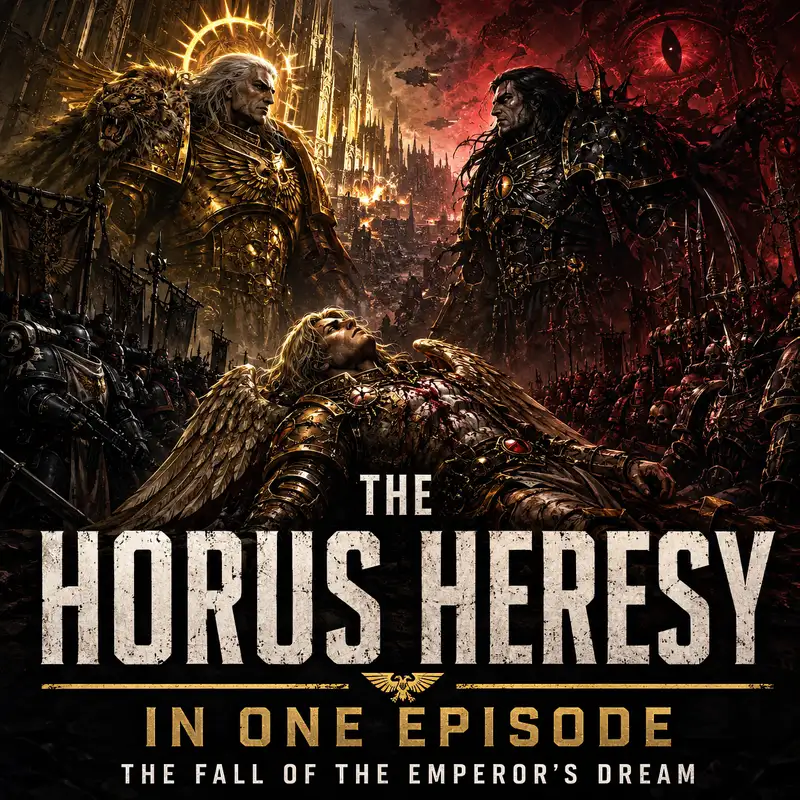
At the end of the war, the Emperor found his most trusted son standing above the body of another. Sanguinius lay broken on the deck of the Vengeful Spirit. Horus, once the brightest commander of the Great Crusade, had become something vast enough to frighten even the man who created him. Terra burned outside as father and son prepared to decide whether humanity would endure, become the property of the Chaos Gods, or disappear beneath the wreckage.
That final confrontation is the image at the heart of the Horus Heresy, but it can hide the larger tragedy. The Heresy was not simply a good son turning evil, nor a family disagreement conducted with an unreasonable number of battleships. It was the collapse of the Emperor’s vision for humanity. The more revealing question is not merely why Horus rebelled. It is how an empire built to destroy superstition produced the greatest daemonic war in human history.
The answer begins during humanity’s last great age of confidence. In the thirty-first millennium, the Emperor had conquered Terra and launched the Great Crusade to reunite the human worlds scattered during the Age of Strife. His armies crossed the galaxy behind banners of reason, unity, and human supremacy. Some worlds joined willingly. Others received a practical demonstration of what the word compliance meant when delivered from orbit.
At the center of the crusade were the primarchs, genetically engineered beings created by the Emperor to command his Space Marine Legions. Twenty had been made, although the records of two were later erased. A catastrophe scattered them before they could be raised on Terra. Each grew on a different world, shaped by its wars and cultures. The Emperor eventually recovered them and placed them at the head of Legions made from their own genetic legacy.
They were called his sons, and many genuinely thought of him as their father. The relationship was never simple. The Emperor trusted unevenly, explained little, and expected obedience on a planetary scale. Some primarchs admired him. Some feared him. Some resented him. A few worshipped him despite his insistence that no gods existed. Each also commanded an army capable of conquering a star system, which made unresolved family tension a matter of strategic importance.
Horus Lupercal stood above the rest. In the official history, he was the first primarch recovered and the one who spent the longest at the Emperor’s side. Battlefield skill alone did not explain his influence. Horus understood people and could make a mortal officer or one of his brothers feel seen. His Legion, the Luna Wolves, became the spear point of the Great Crusade.
After the triumph at Ullanor, the Emperor named Horus Warmaster and gave him command of the crusade. It was the highest honour any son had received. The Emperor then returned to Terra to pursue a secret project, leaving Horus to manage conquests, rival primarchs, Imperial administrators, and the expectations of a father who had not explained why he was leaving.
The secret was the Imperial Webway project. The Emperor intended to free humanity from dependence on warp travel by gaining access to the ancient network used by the Aeldari. If successful, it might have reduced humanity’s exposure to the predators of the warp. Yet almost no one was told the full purpose. Horus saw withdrawal. Other primarchs saw mortal bureaucrats gaining authority over the empire they had bled to create.
Those grievances did not cause the Heresy by themselves. The danger was that the Emperor had denied the true nature of the enemy waiting behind them. The Imperial Truth dismissed gods and daemons as superstition. Humanity was ordered to reject religion without being told that immensely powerful beings fed upon ambition, hatred, despair, obsession, and hope. Ignorance was treated as protection. It proved to be a very thin kind of armour.
One primarch had already discovered the cost of that contradiction. Lorgar, master of the Word Bearers, believed the Emperor was divine. He built temples and converted conquered populations with a devotion that slowed his campaigns. The Emperor answered by ordering the destruction of Monarchia, a city raised in his honour, and forcing Lorgar and his Legion to kneel in humiliation before the Ultramarines.
Lorgar did not abandon faith. He looked for gods who would accept it. Guided by Kor Phaeron and the chaplain Erebus, he found the powers of Chaos. The Word Bearers embraced them deliberately and spent years preparing a wider rebellion. Warrior lodges spread through other Legions, presenting themselves as private circles of brotherhood while creating hidden networks of influence. Erebus understood that treason works better when it arrives disguised as fellowship.
Horus was not corrupted by a single angry thought. He was isolated, flattered, wounded, deceived, and then given a choice. On the moon of Davin, he was struck by a weapon called the anathame while fighting the corrupted governor Eugan Temba. The wound would not heal. His officers, desperate to save him, placed him in the hands of the Serpent Lodge. During the ritual that followed, Horus experienced visions shaped by Chaos and presented as revelation.
He saw a future Imperium in which the Emperor was worshipped as a god while Horus and several of his brothers had been forgotten. The vision was manipulative, but not entirely false. That was what made it effective. Chaos rarely needs to invent a grievance when it can sharpen one already present. Horus feared the primarchs would be discarded after their wars were finished and that mortal officials would inherit the Imperium. He may even have believed he was saving humanity from tyranny.
Magnus the Red attempted to warn him within the vision, but Horus rejected the warning. When he awoke, he did not emerge as a mindless puppet. He began making decisions. Chaos influenced him, lied to him, and eventually transformed him, but Horus chose rebellion. He recruited allies, concealed his intent, arranged massacres, and accepted powers whose nature became increasingly clear. The tragedy is not that responsibility vanished. It is that a man skilled at reading others refused to examine what was happening to himself.
The primarchs who joined him did not share one motive. Lorgar served Chaos through conviction. Angron hated the Emperor who had taken him from his doomed comrades. Perturabo carried years of bitterness over thankless sieges. Fulgrim pursued perfection until corruption consumed him. Konrad Curze treated betrayal as inevitable and became what he predicted. Mortarion opposed tyranny and ended by serving powers far worse.
The Alpha Legion entered the war behind layers of deception, and its purpose remains disputed. Magnus did not begin as Horus’s willing ally. His attempt to warn the Emperor through forbidden sorcery shattered the wards protecting the Webway. Horus helped turn the order to return Magnus to Terra into the destruction of Prospero. The Space Wolves attacked, the Thousand Sons were driven into catastrophe, and Magnus gave himself to Tzeentch. Horus was building a coalition from faith, resentment, coercion, and wounded pride.
His first great problem was that many warriors inside the rebel Legions remained loyal to the Emperor. Horus solved it at Isstvan Three. He sent selected companies from the Sons of Horus, Emperor’s Children, World Eaters, and Death Guard down to suppress a rebellion. These were the men their primarchs suspected would refuse treason. Once they were committed to the surface, the fleet bombarded the planet with life-eater virus weapons.
The loyalists were meant to die without understanding why. Saul Tarvitz of the Emperor’s Children learned enough to warn those below, allowing many to reach shelter before the virus struck. The survivors fought their own Legions through the ruins for weeks. Their resistance bought time for Nathaniel Garro and the frigate Eisenstein to escape with warning of the betrayal.
Isstvan Three revealed what the war truly was. Legion loyalty did not automatically decide personal loyalty. Sons remained faithful when their fathers fell. Old friends became executioners. Warriors who had conquered worlds together hunted one another through poisoned cities. The Heresy was not a clean division between loyal and traitor Legions. It was a fracture running through fleets, squads, command staffs, and individual consciences.
The Emperor’s response force gathered at Isstvan Five. The Iron Hands, Salamanders, and Raven Guard attacked first. Four more Legions arrived behind them as supposed reinforcements. Then the second wave opened fire on the first. The Word Bearers, Iron Warriors, Night Lords, and Alpha Legion had already joined Horus. The loyalists were trapped between prepared defences and allies who had never been allies at all.
The Drop Site Massacre shattered three loyal Legions. Ferrus Manus, primarch of the Iron Hands, was killed by Fulgrim. Vulkan vanished amid the destruction. Corvus Corax escaped with remnants of the Raven Guard. Horus had done more than win a battle. He had crippled the Imperium’s ability to concentrate its strength and proved that no order of battle could be trusted simply because it appeared on an Imperial slate.
From that point, the Heresy spread across the galaxy. Horus had sent potential enemies far from the center before revealing himself. The Dark Angels, Blood Angels, and Ultramarines were isolated by distance, deception, and warp storms. The White Scars received conflicting messages and had to determine which side was lying. The shattered survivors of Isstvan fought as raiders and improvised warbands rather than complete Legions.
At Calth, the Word Bearers ambushed the Ultramarines and turned a world of ordered cities into a battlefield beneath a poisoned sun. Lorgar and Angron then drove the Shadow Crusade through Ultramar, feeding slaughter into the Ruinstorm. Guilliman, Sanguinius, and the Lion briefly feared Terra had fallen and created a secondary empire. When they learned the truth, they abandoned it and tried to reach the throne world.
Elsewhere, the Night Lords fought the Dark Angels across the Thramas sector, while the Alpha Legion conducted wars whose visible aims often concealed other purposes. Mars descended into civil war as part of the Mechanicum sided with Horus. Forge fought forge, Titan fought Titan, and the industrial heart of the Imperium began destroying the weapons both sides needed.
The conflict consumed far more than Space Marines. Army regiments, Solar Auxilia cohorts, Mechanicum troops, naval crews, workers, and civilians entered battles decided by primarchs they would never see. Populations were punished for a governor’s allegiance or the location of a supply route. Daemons entered the war openly as the barriers between reality and the warp weakened. A military coup became a metaphysical invasion wearing the uniform of a civil war.
This transformation changed Horus as well. Early in the rebellion, he could still present himself as a political alternative to the Emperor. By the time his armies approached Terra, that claim had become impossible to sustain. His brothers were becoming daemons, monsters, or prisoners of their own compulsions. Their Legions were losing discipline. The rebellion that promised freedom from one distant ruler had placed itself beneath four gods who regarded human souls as both currency and food.
Chaos poured its power into Horus. He became stronger, but less entirely himself. This was the bargain inside every promise of Chaos. It granted power while reshaping desire until service became the only outcome. Horus wanted to replace the Emperor. By the end, he was the instrument through which the Chaos Gods hoped to destroy him and claim humanity.
Terra prepared for siege under Rogal Dorn, primarch of the Imperial Fists. The Imperial Palace became a fortress complex on a continental scale. Walls were reinforced, approaches cleared, guns emplaced, and every resource measured against the certainty that Horus was coming. Dorn had to defend not only the heart of the Imperium, but the Emperor himself, who remained bound to the Golden Throne because of the disaster in the Webway.
When Magnus broke the protective wards, daemons flooded the human-built passages beneath the Palace. The Emperor and his Custodians fought a secret war to hold them back. The project that might have freed humanity from the warp became a breach only the Emperor’s power could contain. At the moment of crisis, he could not leave his throne without risking invasion from beneath the Palace. There are administrative bottlenecks, and then there is the Golden Throne.
Horus’s fleets fought through the Solar System and closed upon Terra. The defenders included Imperial Fists, Blood Angels, White Scars, Custodians, Sisters of Silence, Mechanicum loyalists, Army formations, and civilians pressed into labour and battle. Against them came traitor Space Marines, corrupted Titans, daemonic hosts, cult armies, and war machines gathered across the conquered galaxy.
The Siege of Terra was a contest of engineering, endurance, faith, and disintegration. Perturabo directed much of the methodical assault. Yet the closer the traitors came to victory, the less coherent they became. The Emperor’s Children abandoned strategy for private excess. Angron had become a daemon driven by rage. The Death Guard brought supernatural plague. Commanders pursued grudges while reality failed around them.
The loyalists were equally desperate. The White Scars launched a savage counterattack to seize a vital spaceport. Sanguinius fought wherever the line seemed closest to collapse, becoming the visible hope of defenders who knew hope was not part of the official supply system. Dorn sacrificed positions, units, and pieces of his own certainty to keep the Palace standing. Every hour mattered because loyalist reinforcements were racing toward Terra.
Horus finally opened a path to the Vengeful Spirit. Whether it was challenge, trap, impatience, or all three, the Emperor accepted. Malcador the Sigillite took his place upon the Golden Throne so the Emperor could leave it. The effort consumed Malcador. The Emperor, Sanguinius, Dorn, and chosen warriors teleported aboard the traitor flagship, but the warp-twisted vessel scattered them through corridors that no longer obeyed ordinary space.
Sanguinius reached Horus first. The Angel had been burdened by visions of his own death, yet he went forward because refusing would not save Terra. Horus killed him. Later Imperial tradition turned the moment into sacred martyrdom, but beneath the religious meaning remains something painfully direct. One brother faced another, knowing what the encounter would cost, and died rather than accept the future Horus offered.
The Emperor’s battle with Horus survives beneath layers of myth, propaganda, and supernatural distortion. The precise sequence is less certain than the result. Horus possessed power granted by all four Chaos Gods. The Emperor confronted both his son and the powers acting through him. Horus died. The Emperor was mortally wounded. Whatever affection, hesitation, deception, or final recognition passed between them could not restore what either had destroyed.
Rogal Dorn found the Emperor and carried him back to the Palace. Malcador had been reduced to the last remnants of his life by the Golden Throne. The Emperor was placed upon it and gave his final instructions before becoming the silent, ruined presence that would dominate the next ten thousand years. Horus’s armies broke and withdrew. The traitor Legions fled toward the Eye of Terror, pursued during the wars known as the Scouring.
The loyalists had won, but victory meant preventing immediate extinction, not preserving the future they had fought for. Sanguinius and Ferrus Manus were dead. Other loyal primarchs would vanish, fall, or withdraw. The Space Marine Legions were divided into smaller Chapters so no single commander could again control such overwhelming force. Institutions hardened around fear of another betrayal. Emergency measures became traditions because the emergency never truly ended.
The greatest irony concerned religion. The Emperor had demanded a secular Imperium and punished Lorgar for worshipping him. After the Heresy, humanity increasingly embraced the Emperor as a god. The faith Lorgar had once preached became, in altered form, a foundation of Imperial society. Horus had been shown a future in which the Emperor was worshipped and the primarchs became myth. By rebelling to prevent that future, he helped create it.
The Traitor Legions also survived, though survival inside the Eye of Terror was another form of damnation. They carried old hatreds into the Long War. For them, the Heresy never became distant. Abaddon, once Horus’s foremost captain, rejected his father’s failure while continuing the war. Every Black Crusade and every ancient traitor emerging from the warp carries the original rebellion forward.
The Horus Heresy explains why the Imperium of the forty-first millennium looks the way it does. The Emperor is trapped upon the Golden Throne. Space Marines are divided into Chapters. The Inquisition hunts corruption with methods that often resemble the terror it opposes. Technology is guarded by ritual. Psykers are feared and exploited. Faith holds the Imperium together while making it harsher. Betrayal is remembered so intensely that suspicion has become a governing philosophy.
The Emperor did not cause the Heresy alone, and Horus was not merely a victim. The Chaos Gods worked through deception, temptation, and supernatural force. Horus chose atrocity. The traitor primarchs made choices shaped by real wounds but not excused by them. The loyalists defended an empire built through conquest, yet also prevented humanity from falling to powers that would have consumed it without limit. There are no clean hands, but there is a difference between flawed rule and daemonic enslavement.
The deeper failure was structural. The Emperor built unity through conquest, demanded trust while withholding truth, and placed armies of transhuman sons beneath a hierarchy centered on himself. He tried to abolish religion without teaching humanity what lurked behind it. He treated the primarchs as family when affection helped and as weapons when obedience mattered. Chaos did not create every crack in that system. It entered through cracks already there.
That is why the Heresy remains more than ancient background. It is the moment when the promises of the Great Crusade reversed. Horus rose against tyranny and became the slave of darker masters. The Emperor fought to end superstition and became the object of a galaxy-wide faith. The loyalists saved the Imperium’s body but could not save its intended future. The war ended with Horus dead and the Emperor enthroned, yet the rebellion achieved one final victory. It made the nightmare of the forty-first millennium seem necessary.