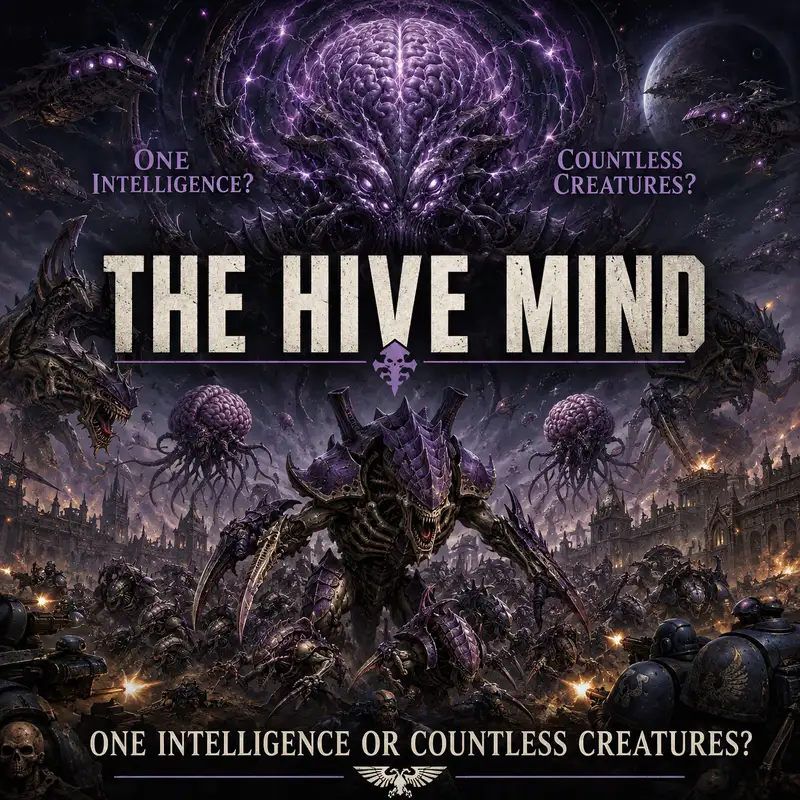
The Hive Mind: One Intelligence or Countless Creatures?
The gaunts were advancing in perfect silence when the synapse creature died. One moment, hundreds of bodies moved as though a single hand had placed every claw and weapon. The next, the formation broke apart. Some creatures hurled themselves at the nearest target. Others crouched, hissed, or began feeding on the fallen. A Carnifex continued forward because forward was where the noise and blood happened to be. Then another synaptic presence reached across the battlefield. The swarm tightened. Heads turned together. The attack resumed, and the brief animal chaos vanished beneath a will too large to see.
What disappeared in that interval? It was not courage, because gaunts do not require courage in any human sense. It was not a spoken command, a battle plan, or the authority of an officer. Something more fundamental had been interrupted. The creatures had lost the organizing intelligence that made thousands of separate nervous systems behave as one weapon. Yet they had not become lifeless. They still sensed, hunted, feared, and fed. That contradiction lies at the heart of the Tyranids. Is the Hive Mind one intelligence ruling countless creatures, or is it the intelligence created by those creatures acting together?
The phrase Hive Mind encourages several misleading pictures. It suggests a queen hidden at the center of the swarm, issuing orders to obedient drones. It might suggest a council in which millions of small minds somehow vote on which planet to devour next. It can even sound like a separate psychic god that possesses Tyranid bodies from a safe distance. None of those images fits particularly well. No central throne has been found. No supreme organism has been identified whose death would silence the species. The Hive Mind appears to exist through the Tyranids rather than above them.
The closest human comparison is a living body. One being is made from uncountable cells performing different tasks. Muscle does not debate with nerve tissue, and each part operates within a greater system. Tyranid organisms appear to function in a similar way, except that their body is spread across voidships, planets, and entire regions of space. A gaunt may be less like a soldier in an army than a mobile cell inside an enormous predator.
Even that comparison is too simple, because a gaunt is not merely tissue. It has senses, a brain, instincts, and enough local awareness to chase prey or avoid danger. A Lictor can stalk, learn a target’s habits, and choose an approach without waiting for a distant committee to approve each footstep. A Ripper knows how to feed. A wounded beast can react to pain. Tyranid organisms are genuine creatures, not empty shells. What most of them lack is an enduring identity separate from the purpose for which they were grown. They can act alone, but they do not necessarily think of themselves as alone.
The bridge between those creatures and the greater intelligence is the synaptic web. Hive Tyrants, Tyranid Warriors, Zoanthropes, Neurotyrants, and other specialized bioforms serve as powerful nodes within it. They do not shout orders across a battlefield. They channel psychic imperatives, sensory information, and the pressure of the collective will. Lesser organisms near them cease behaving like competing predators and become elements of a coordinated design. A brood can change direction without confusion. One wave can sacrifice itself while another exploits the opening. Artillery organisms fire at targets revealed through senses they do not personally possess.
This is why a Tyranid attack can appear both bestial and unnervingly precise. The claws and teeth are animal. The timing behind them is not. A defending commander may see creatures rush a wall in wasteful numbers and conclude that the enemy lacks strategy. Then the bodies clog the guns, the spores blind the observation posts, burrowing organisms emerge beneath the ammunition stores, and the apparent waste reveals itself as calculation. The Hive Mind does not value individual survival because the individual is not the scale at which it understands loss. It spends organisms as a human body spends blood, skin, or heat.
Every sensation gathered by the swarm can become part of that calculation. A weapon that burns through one strain of carapace provides information. A fortress that channels attackers into a killing ground reveals the habits of its builders. Tyranid adaptation is not always immediate, and accounts often exaggerate its speed, but the broader pattern is clear. The swarm experiments through contact, tests defenses with living material, preserves useful solutions, and returns with forms better suited to the problem.
The psychic presence created by this network is known as the Shadow in the Warp. Long before the first feeder organism reaches the ground, astropaths may fall silent, Navigators may struggle to read the currents of the immaterium, and psykers may feel an oppressive weight gathering around the system. The Shadow isolates prey worlds at precisely the moment they most need help. It fills the mind with alien pressure, not because billions of Tyranids are all thinking separate thoughts at once, but because their linked existence produces a psychic presence vast enough to drown ordinary signals.
Whether the Shadow began as a deliberate weapon or as a natural consequence of the Hive Mind remains uncertain. The distinction may no longer matter. Specialized organisms can focus and intensify it, which means the swarm can use its own psychic footprint as part of an invasion. A Neurotyrant is not simply a large brain carried into battle for decorative effect. It is a mobile concentration of synaptic authority, able to reinforce the network and magnify the terror pressing against enemy minds. The Hive Mind has learned to make its presence tactical. Even its thoughts have become part of the ammunition supply.
When synapse creatures are destroyed, the lesser organisms do not all react in the same way. Some rush toward prey. Some seek shelter. Some begin feeding. Others continue the last pattern imposed upon them until instinct overrides it. The result depends on the creature’s design and surroundings. This is important because it shows that synapse does not animate dead matter. It suppresses conflicting impulses and aligns living creatures toward a common purpose. Remove that alignment, and the pieces remain dangerous. They simply stop being one danger. The Imperial answer is usually to shoot the larger creature first, which is unusually sensible by Imperial standards.
On a local battlefield, that tactic can work. Kill the Warriors guiding a gaunt swarm, and the assault may lose cohesion. Destroy a Hive Tyrant, and nearby broods may falter long enough for defenders to recover. Yet this is disruption, not decapitation. Another node may assume control. A more distant synaptic organism may extend its reach. The swarm may have redundant pathways built into its advance. Tyranid command is difficult to sever because it is not a narrow chain with one general at the top. It is a web, and webs are inconvenient things to behead.
The same problem appears at the scale of a hive fleet. Deep within the living ships are reproductive and directive organisms commonly called Norn Queens. The title is useful, but it tempts the listener to imagine a monarch, a court, and a manageable succession crisis. The Tyranids provide none of those comforts. Norn Queens shape genetic material, produce new organisms, and help govern the biological machinery of the fleet. They are among its most important organs, but they are not known to rule the Hive Mind as separate sovereigns.
A hive ship is less a vessel than an ecosystem trained to cross the void. Its weapons are organisms, its ammunition is alive, and its crew are extensions of the ship’s functions. The line between passenger, machine, animal, and organ becomes useless. The fleet grows armies, deploys them, recovers their biomass, and uses the material again. A creature may fight for hours, die, dissolve in a reclamation pool, and become part of something entirely different before the invasion is over.
That cycle makes Tyranid identity profoundly strange. Other species preserve the dead through memory, ritual, records, or souls. The Tyranids preserve usefulness. Flesh is temporary. Genetic information, learned responses, and successful patterns matter more than the body that carried them. The Hive Mind does not need every organism to survive because it can reproduce the function. Death is still a loss of time and biomass, but it is not necessarily the end of whatever the creature contributed. The swarm remembers in a way that is biological, psychic, and distributed across forms that can be melted down and made again.
Higher Tyranid organisms complicate the picture further. Hive Tyrants display tactical intelligence, adaptability, and a much closer relationship with the collective mind than lesser beasts. They can make decisions within the larger purpose of an invasion. They may react to particular enemies, coordinate complex assaults, and preserve experience through the Hive Mind. Calling them puppets understates their intelligence. Calling them independent commanders overstates their freedom. A Hive Tyrant is better understood as a concentrated expression of the greater mind, capable of local judgment because local judgment is exactly what the greater organism requires.
The Swarmlord is the clearest example. It is not merely one unusually large Hive Tyrant that has survived many campaigns. Its body can be destroyed and grown again. What returns is a strategic pattern, a repository of experience shaped through repeated encounters with the galaxy’s strongest defenders. The Swarmlord can therefore seem like an individual with a history, because the Hive Mind recreates more than claws and armor. It recreates a particular intelligence. The body is replaceable. The pattern persists.
Does that make the Swarmlord a person? The lore does not provide a clean answer, perhaps because human ideas of personhood are poorly suited to it. The Swarmlord may possess continuity, memory, preferences in battle, and the capacity to recognize recurring enemies. Yet those qualities are inseparable from the Hive Mind that stores and restores them. It may be an individual in the same way a recurring thought is individual within a human mind. The thought has a recognizable shape and history, but it does not live independently of the mind thinking it.
The hive fleets create a similar uncertainty on a larger scale. Behemoth struck with immense, direct force. Kraken spread in divided tendrils and attacked across a broader front. Leviathan approached through unexpected regions of the galaxy and employed strategies shaped by the failures and successes that came before. Other fleets have displayed specialized patterns, including unusual rates of adaptation or a particular effectiveness against enemies touched by the Warp. To Imperial observers, these differences can make each fleet look like a separate species, culture, or personality.
It is possible that hive fleets possess a degree of distinct identity within the greater whole. A distributed intelligence need not be uniform at every level. Different portions can emphasize different responses, just as parts of a brain perform specialized work. Yet the available evidence generally points toward common purpose rather than competing civilizations. The fleets do not negotiate borders, defend national traditions, or argue over doctrine. Their differences resemble adaptation and specialization. One tendril may learn what another later uses. One may become the claw while another becomes the stomach.
Tyranids can also fight Tyranids, which seems to prove separate wills. It does not. Living systems compete within themselves. Cells are culled, compromised tissue is destroyed, and biological material is consumed rather than politely reassigned through paperwork. Conflict between swarms may eliminate weaker strains, redistribute biomass, or reflect separation from broader synaptic control. The meaning varies by circumstance. It does not automatically provide evidence of Tyranid politics. Two broods tearing each other apart are not necessarily having a constitutional crisis.
Genestealer Cults reveal another layer of the same structure. A Genestealer infection does not immediately turn a population into obvious Tyranid organisms. It creates generations of hybrids, family bonds, secret faith, and a psychic community centered upon a Patriarch. Cultists can work, plan, resent, hope, and believe. Many experience their coming rebellion as liberation. Their Broodmind links them, but it does not erase every human habit or personality. The cult is therefore neither a collection of free individuals nor a simple remote-controlled swarm. It is a society whose private lives have been bent toward a biological purpose they rarely understand.
When a hive fleet draws near, that local psychic structure can be absorbed into the far greater presence of the Hive Mind. The cult’s long-promised angels arrive, but salvation means consumption. Some accounts suggest that the Patriarch’s relationship to the cult changes as the greater will takes hold, and the emotional certainty binding the uprising may collapse when its purpose is fulfilled. The tragedy works because the cultists were capable of genuine feeling. Their love, loyalty, and faith were real experiences, even though the system producing them was designed to prepare a world for harvest.
This layered control helps explain why contact with the Hive Mind is so difficult to describe. Human psykers who brush against it do not encounter a conversational voice waiting to explain policy. They perceive scale, pressure, hunger, hostility, and an awareness that seems to look through innumerable senses. The experience is filtered through a human mind that was never built to contain it. Descriptions therefore vary. Some portray the Hive Mind as cold and instinctive. Others portray focused attention so intense that it resembles hatred. Both may be honest attempts to translate something fundamentally alien.
The distinction matters when considering the Blood Angels and the devastation of Baal. Some accounts present the Hive Mind as directing a particular malice toward them, not merely choosing a rich source of biomass. That suggests memory, recognition, and emotional fixation. Yet even there, the emotion may not be human hatred scaled upward. It could be the response of a vast predator to repeated injury, expressed through a psychic medium that human witnesses interpret in familiar terms. The Hive Mind may hate, but its hatred would be the hatred of an ecosystem that remembers who burned it.
Hunger is often used to describe the Tyranids, and rightly so, but hunger alone can sound mindless. The Hive Mind does not simply drift toward the nearest meal. It probes, isolates, deceives, adapts, and chooses where to spend its strength. It creates organisms for reconnaissance, sabotage, psychic warfare, siege, pursuit, and digestion. It can withdraw from an unfavorable attack and return by another route. Its central drive may be consumption and reproduction, but a simple motive does not imply a simple intelligence. Human empires have built elaborate institutions around motives no more sophisticated than fear, pride, and the desire to own the next hill.
The Hive Mind’s intelligence is visible not because it writes philosophy, but because it solves problems. Armor thickens where guns are strong. New sensory forms appear when stealth is required. Synaptic creatures maintain control, while vanguard organisms weaken a world before the main fleet commits itself. Tyranids can still be surprised, outmaneuvered, or destroyed. Their adaptations carry costs, and a form suited to one enemy may be inefficient against another. The Hive Mind is formidable, not infallible. It learns through losses because losses are one of the ways it touches reality.
For those fighting it, the Hive Mind creates a cruel hierarchy of victories. Destroying a synapse node can save a squad. Breaking a swarm can save a city. Crippling a hive ship can save a world. Defeating a tendril can save a sector. None of those victories necessarily kills the intelligence that planned the attack. The defenders have destroyed parts of its body and denied it biomass, but the greater presence remains. There is no confirmed skull to take, no capital to occupy, and no ruler who can be persuaded that the campaign has become too expensive.
Could the Hive Mind die? Presumably, because it depends upon living Tyranid organisms and the psychic network they create. If every connected component were destroyed, there would be nothing left through which the mind could exist. The practical difficulty is the scale. The fleets inside the galaxy may be only portions of something far larger beyond it. Imperial estimates are uncertain, and certainty would not be especially comforting. Killing one hive fleet is not like killing the creature. It is closer to cutting away a probing finger and discovering that the hand has not yet fully entered the room.
The central question therefore contains a false choice. The Hive Mind is one intelligence, because it displays unified purpose, strategic memory, attention, and the ability to coordinate life on a scale no ordinary commander could manage. It is also countless creatures, because those creatures are not merely subjects under its rule. They are its senses, nerves, weapons, digestive organs, reproductive system, and physical memory. The Hive Mind is not one being commanding the swarm. It is the swarm achieving the condition of one being.
That answer also explains why the Tyranids feel more alien than an empire of conquerors. An empire can be divided against itself. Its generals can rebel, its citizens can lose faith, and its ruler can die. The Hive Mind may contain local autonomy and specialized patterns, but these do not amount to political factions in any familiar sense. Its unity is anatomical. A Hive Tyrant does not obey out of loyalty. A gaunt does not sacrifice itself out of patriotism. The relationship is closer than obedience, because the distinction between ruler and ruled has almost disappeared.
On a consumed world, the final Tyranid organisms march willingly into the reclamation pools. The creatures that won the war are dissolved with the creatures that died in it. Their bodies become fluid, their useful material rises into the waiting ships, and the fleet turns toward another star. No medal is awarded. No veteran remembers the battlefield around a fire. Yet the next invasion may carry the lessons of the last one in thicker armor, sharper instincts, and a strategy refined by billions of deaths. Countless creatures vanish, and one intelligence moves on.