The High Lords and the Adeptus Terra
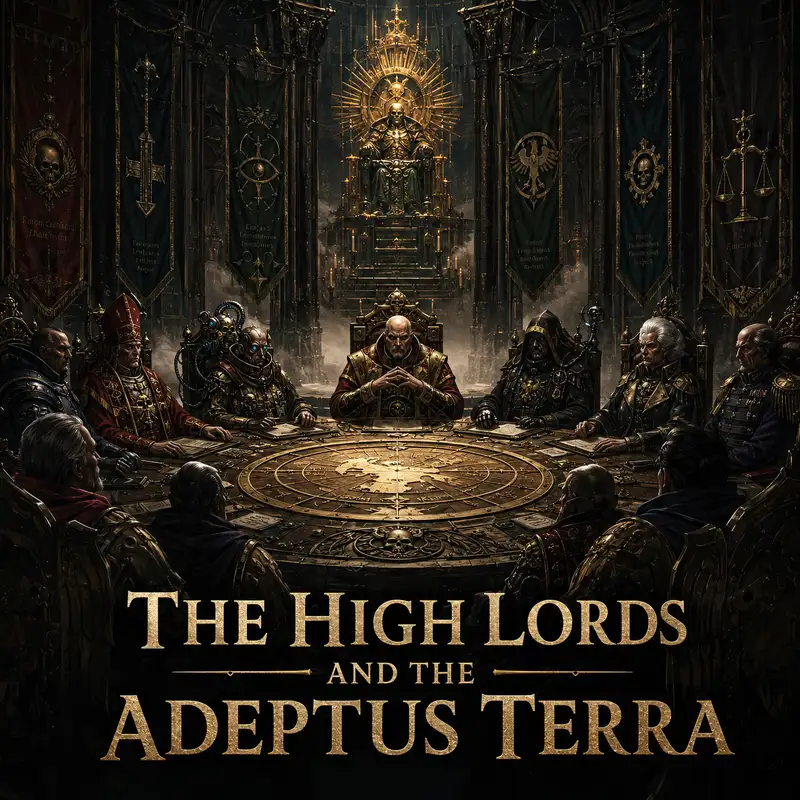
At the heart of the Imperial Palace, beneath ceilings lost in incense and shadow, twelve rulers gather to speak for a man who does not answer them in any ordinary human way. Beyond their chamber, worlds wait for orders that may arrive decades late, if they arrive at all. Fleets need fuel, armies need bodies, psykers must be gathered, judges dispatched, tithes calculated, rebellions condemned, and entire sectors abandoned so that others may survive. The Emperor sits upon the Golden Throne. The High Lords claim to interpret his will. Between those two facts lies the government of the Imperium.
The obvious question is how twelve people can rule a realm spread across the galaxy. The answer is that they cannot, at least not in the manner of a modern cabinet issuing clear instructions to obedient departments. The High Lords do not personally manage every war, appoint every governor, or decide where every regiment will march. They rule by controlling the institutions that make Imperial action possible. One commands the records. Another speaks for the priesthood. Another controls access to machines. Others represent the Navigators, the psykers, the judges, the assassins, or the armed forces. A High Lord is powerful not because one voice can reach every world, but because the office behind that voice controls something the Imperium cannot survive without.
Their formal gathering is the Senatorum Imperialis, the Council of the High Lords of Terra. Its full body contains far more than twelve people. Lesser lords, hereditary dignitaries, senior adepts, envoys, secretaries, petitioners, and officials crowd the machinery of government beneath them. The High Twelve conduct the most important business, but even they depend upon layers of committees and chanceries to turn a decision into something resembling an order. The council is therefore less a single mind than a summit where immense institutions negotiate with one another. It is also the place where ambition acquires seals, robes, and a sufficiently ancient title to be mistaken for constitutional principle.
This arrangement emerged from catastrophe rather than careful design. During the Great Crusade, the Council of Terra handled civil government while the Emperor, Malcador, the primarchs, and the Warmaster carried immense personal authority. The Horus Heresy made that concentration of power impossible to trust. After the Emperor was enthroned and Malcador was gone, the surviving Imperium elevated civilian and institutional offices as a counterweight to its demigod generals. The High Lords were not created to replace the Emperor with twelve lesser emperors. They were a compromise built to prevent another Horus.
The High Lords are charged with interpreting and enacting the will of the Emperor. That phrase is the foundation of their authority and the source of its deepest danger. The Emperor does not provide them with a daily agenda. He does not settle disputes over tithes, crusades, or jurisdiction. His will must be inferred from ancient law, religious doctrine, precedent, necessity, and whatever political interest has managed to dress itself most convincingly in gold. Every faction claims obedience. Every rival may be accused of misunderstanding. In such a system, interpretation is power. The High Lords do not merely decide what should be done. They decide which action can be described as the Emperor’s command.
Beneath and around them stands the Adeptus Terra, often called the Priesthood of Earth. This is not one tidy organisation with a single chain of command. It is an umbrella covering much of the central Imperial state, and its branches function with considerable independence. The Adeptus Administratum, the Adeptus Astra Telepathica, the Adeptus Astronomica, the Adeptus Arbites, the Adeptus Custodes, and numerous lesser offices all belong within this vast structure. The Ecclesiarchy, the Adeptus Mechanicus, and the Inquisition are generally treated as separate powers, while the Space Marines remain only loosely bound to the central bureaucracy. Yet all of them must bargain with it. The Adeptus Terra is less a department than the administrative climate of the Imperium. Everyone complains about it. No one can leave it.
The largest of its organs is the Adeptus Administratum. This is the empire of ledgers, archives, census rolls, tithe schedules, property claims, shipping warrants, genealogies, and decrees. Its clerks attempt to record the obligations and resources of worlds they may never see, using reports that were already old when they began their journey to Terra. The Master of the Administratum is therefore often among the most powerful members of the council. Control the records, and one can influence what the Imperium believes exists. A planet entered in the wrong category may receive too little grain, too much tax, or a regiment it cannot support. A missing seal can halt a fleet. A duplicated order can send two armies to one war and none to another. The bureaucracy does not merely describe reality. Given enough time, it manufactures reality, usually with regrettable consequences for whoever has been filed under the wrong heading.
Within that administrative mass, the Departmento Munitorum performs one of the least glamorous and most decisive tasks in the galaxy. It raises, equips, transports, and supplies the armies of the Astra Militarum. Generals may win battles, but only after someone has assigned ammunition, replacement parts, rations, landing craft, medical stores, and several million pairs of boots. The Munitorum turns planetary tithes into military force. It also reveals why the Imperium can be both unimaginably powerful and painfully clumsy. Its resources are immense, but information moves slowly, distances are vast, and mistakes become institutional before anyone notices. The Imperial war machine is not a sword held in one hand. It is a mountain pushed forward by paperwork, faith, coercion, and an impressive number of people who have been informed that delay is heresy.
Other branches control things even more fundamental than supplies. The Adeptus Astra Telepathica identifies, transports, trains, sanctions, and deploys human psykers. Its astropaths make long-range Imperial communication possible, while the Black Ships gather dangerous psychic individuals from across the Imperium. The Master of the Adeptus Astra Telepathica therefore represents both a communications network and a system of survival. Without sanctioned psykers, distant worlds fall silent. Without the gathering of the untrained, those same worlds risk possession, catastrophe, or worse. The office sits at the council table because the Imperium cannot govern what it cannot hear, and it cannot safely ignore the minds through which it hears.
The Adeptus Astronomica maintains the Astronomican, the psychic beacon by which Navigators orient Imperial vessels through the Warp. Its Master holds a place among the High Lords because nearly every strategic decision depends upon movement between the stars. The beacon is often spoken of as though it were a lighthouse. That is accurate only if the lighthouse were powered by trained psykers, sustained through sacrifice, and visible across a dimension that actively resents being mapped. The Astronomican does not guarantee safe passage. Nothing guarantees safety in the Warp. It makes passage possible often enough for an interstellar civilisation to exist, which by Imperial standards is an outstanding success.
The Adeptus Arbites represents another necessity: obedience. Arbitrators are not ordinary local police. Planetary rulers may maintain their own enforcers, armies, and courts, but the Arbites uphold Imperial law and watch the governors themselves. Their concern is the tithe, sedition, treason, forbidden activity, and any failure that threatens the bond between a world and Terra. The Grand Provost Marshal speaks for that authority among the High Lords. An Imperial Commander may be a monarch at home, worshipped by billions and protected by armies, yet still discover that a fortress of black-armoured judges has kept careful records of unpaid obligations. Local power is broad. Imperial patience is long. Neither should be mistaken for mercy.
Then there is the Officio Assassinorum, whose Grand Master traditionally holds one of the most secure seats on the council. This may seem strange until one remembers that the Imperium frequently encounters problems too dangerous, too politically sensitive, or too expensive to solve with open war. An assassin can remove a rebel leader, silence a compromised official, break an enemy command structure, or alter a succession without deploying an army. The Officio is not merely a collection of killers. It is a strategic instrument of state, shaped by secrecy and tightly controlled authorisation. In theory, that control prevents murder from becoming policy. Imperial history has offered several practical demonstrations of the limits of theory.
Not every institution represented among the High Lords formally belongs to the Adeptus Terra. That distinction is important. The Fabricator-General speaks for the Adeptus Mechanicus, a partner empire whose forge worlds supply the weapons, ships, engines, and sacred technology upon which the Imperium depends. The Ecclesiarch leads the Adeptus Ministorum, whose faith binds countless cultures to the worship of the Emperor. An Inquisitorial Representative gives the secretive Inquisition a voice, though no single representative can truly command all Inquisitors. The Paternoval Envoy speaks for the Navis Nobilite, the great Navigator houses whose mutants guide ships through the Warp. These powers sit at the table because legal neatness matters less than leverage. Each controls a monopoly. Each can cripple the others. Imperial unity is therefore maintained by devotion, mutual dependence, fear, and the knowledge that civil conflict would be inconvenient even by the standards of Terra.
The traditional council contains nine offices regarded as nearly permanent, with three additional places drawn from other powerful commands. Those variable seats may go to figures such as the Lord High Admiral, the Lord Commander Militant of the Astra Militarum, the Abbess Sanctorum, the Captain-General of the Adeptus Custodes, the Chancellor of the Estate Imperium, or another leader whose influence has become impossible to exclude. The exact balance changes with era and crisis. This flexibility is not democratic representation. It is an admission that power has shifted and should probably be given a chair before it starts breaking doors.
The absence of a permanent Space Marine seat is equally revealing. The Adeptus Astartes are among the Imperium’s greatest defenders, but they are not supposed to rule humanity. The Horus Heresy demonstrated what could happen when genetically engineered warlords combined military power, political authority, and personal loyalty on a galactic scale. After the Heresy, Roboute Guilliman divided the Legions and helped establish a political order in which civilian and institutional authorities would restrain the warriors. Space Marines can advise, threaten, intervene, or ignore commands they consider illegitimate. What they generally do not possess is a permanent place among the High Twelve. The Imperium remembers the danger of military government, though it has occasionally required a Space Marine to rescue it from civilian government.
Consider what happens when a distant sector reports an invasion. An astropathic fragment reaches Terra through the Adeptus Astra Telepathica. The Administratum searches its records to determine which worlds exist, what they owe, and whether the warning matches earlier reports. The Inquisition may suspect deception or corruption. The Navy explains that its nearest battlefleet is already committed. The Munitorum has regiments available, but not the transports to move them. The Mechanicus asks which forge worlds and relic sites are at risk. The Ecclesiarchy points to pilgrimage worlds whose loss could ignite panic far beyond their military value. None of these institutions needs to be lying. Each sees the emergency through the part of the Imperium it is built to preserve.
The High Lords must turn those competing truths into priority. They may authorise a crusade, redirect a fleet, appoint a commander, increase a tithe, release forbidden weapons, or decide that one region must be sacrificed to save another. Their decision then passes through chanceries, relay stations, sector commands, naval headquarters, and planetary courts. By the time it arrives, the original crisis may have changed beyond recognition. The order remains powerful because it carries law, resources, and the threat of punishment. It is not constant control. It is pressure applied across distance by institutions capable of making refusal very expensive.
This explains both the endurance and the cruelty of the Imperial system. Terra rarely possesses enough knowledge to solve local problems precisely, so it governs through obligations that can be measured from afar. Pay the tithe. Provide soldiers. Protect the psykers until the Black Ships arrive. Obey the Lex Imperialis. Maintain the faith. Keep the shipping lanes open. A governor who meets these requirements may retain extraordinary freedom, even if that governor is brutal, corrupt, or bizarre. A humane ruler who fails them may be removed. The central government is not designed to create good worlds. It is designed to keep worlds attached to an empire at war.
Imperial history contains several warnings about what happens when that negotiation fails. During the War of the Beast, the High Lords faced an Ork assault of extraordinary scale. The council was divided by pride, rivalry, and fear, even as the danger approached Terra. Military leaders and officials competed over authority while the Imperium’s response faltered. Koorland of the Imperial Fists eventually rose as Lord Commander of the Imperium, forcing the state toward coordinated action. The crisis exposed a central weakness. A council designed to prevent any one faction from dominating can become paralysed when rapid command is essential. Balance protects the Imperium from tyranny right up to the moment when indecision begins killing it.
The aftermath produced an even darker answer. Drakan Vangorich, Grand Master of Assassins, concluded that the High Lords had failed beyond redemption. He arranged their deaths in the event remembered as the Beheading and replaced them with a compliant council. For a time, his rule appeared more effective than the government he had destroyed. That is how such stories usually become dangerous. Efficiency offered legitimacy, success quieted objections, and the man who had removed corrupt rulers became a ruler accountable to no one. Vangorich’s regime decayed into instability and bloodshed until Space Marines ended it. The lesson was not that assassins should never enter politics. The Imperium retained the Grand Master’s seat. The lesson, if one can call it that, was to choose the assassin more carefully.
Centuries later, Goge Vandire demonstrated the danger of combining institutions that were meant to restrain one another. As Master of the Administratum and Ecclesiarch, he joined bureaucratic control with religious authority. Orders carried the weight of law and faith at once. Opposition could be condemned as both treason and heresy. Vandire manipulated the machinery of Terra, concealed the extent of his tyranny, and drove the Imperium into the Reign of Blood. The High Lords could not contain him because he had captured the channels through which containment would have been organised. His fall required resistance from beyond the normal council process, including the forces that confronted him on Terra and the women who would become the foundation of the Adepta Sororitas. The system survived, but only after proving how readily sacred offices could be turned into weapons.
These disasters did not destroy the Adeptus Terra because the Imperium cannot replace it. A tyrant may be killed. A council may be purged. A department may be reorganised and given a new seal. The work continues because ships still require routes, armies still require food, and worlds still owe tithes. This is the bureaucracy’s greatest strength. It outlives individuals, dynasties, and reforms. It is also its most frightening quality. An unjust order can continue long after the official who signed it has died, because thousands of adepts inherit only their portion of the process. No one clerk sees the whole consequence. Everyone has the correct form.
The return of Roboute Guilliman brought the oldest possible critic into this system. Guilliman had helped shape the post-Heresy order, and he returned to find it swollen, ritualised, and trapped by ten thousand years of precedent. As Imperial Regent and Lord Commander, he removed High Lords, dismissed lesser officials, and launched a broad purge of the bureaucracy. Yet even a primarch could not simply abolish the state and begin again. The Indomitus Crusade needed ships, astropaths, Navigators, tithes, priests, forge worlds, and administrators. Guilliman could replace people and redirect priorities. He could not escape interdependence.
Resistance followed. Some current and former High Lords longed for the Imperium Eterna, the old order in which Terra’s institutions ruled without a returned primarch standing above them. Their opposition culminated in the conspiracy known as the Hexarchy. The plot failed, but its existence revealed that the struggle was larger than personal ambition. To its supporters, Guilliman’s reforms threatened the structure that had preserved the Imperium through his absence. To Guilliman and his allies, that same structure had confused survival with stagnation. Both claims contained truth. The old system had endured. It had also allowed disaster to become tradition.
The High Lords and the Adeptus Terra therefore do rule the Imperium, but not as masters directing a single obedient machine. They rule as custodians, rivals, priests, monopolists, and interpreters standing at the junctions of systems no one fully controls. Their authority is immense because their reach is incomplete. Every delay creates discretion. Every distance creates local power. Every sacred institution protects humanity while defending its own privileges. The Imperium survives not because its government is efficient, and not merely because it is cruel. It survives because countless organisations, each indispensable and suspicious of the others, continue to force a civilisation of impossible scale through another day.
In the Great Chamber of the Senatorum Imperialis, the High Twelve speak beneath the shadow of the Golden Throne. They issue commands in the Emperor’s name, knowing that many will arrive too late, be misunderstood, or create consequences no one intended. Yet silence would be worse. That is the final contradiction of Imperial government. The people at its summit possess almost unimaginable power, but they spend that power trying to steer institutions older, larger, and more stubborn than themselves. The High Lords are not the minds of the Imperium. They are the hands upon its failing controls, pulling levers whose labels were written by the dead.