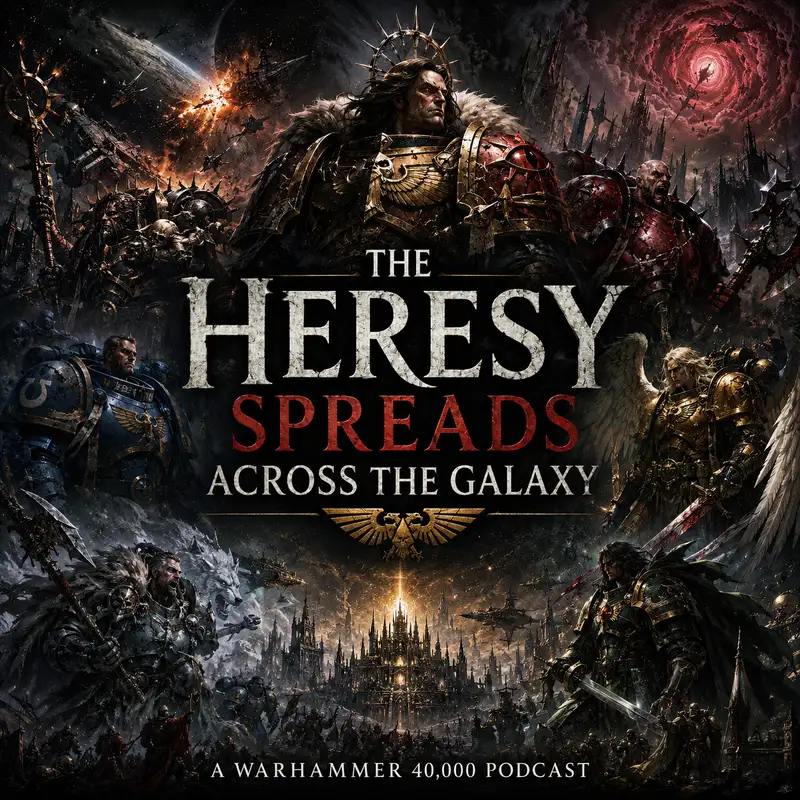
The Heresy Spreads Across the Galaxy
The first warning reached some worlds as a scream in the dreams of an astropath. On others it arrived as a damaged warship, its armour burned black and its surviving crew accusing heroes of treason. Many worlds heard nothing at all. By the time a governor learned that Horus had rebelled, the fleet entering his system might already carry the Warmaster’s orders, the Emperor’s seal, and enough guns to make the distinction academic.
Isstvan revealed the betrayal, but it did not yet decide the war. Horus had shattered three loyal Legions and exposed the scale of his alliance, but he had not destroyed the Imperium’s capacity to resist. Terra was alerted. Rogal Dorn was fortifying the Palace. Guilliman commanded the immense resources of Ultramar. Sanguinius, the Lion, Jaghatai Khan, and Leman Russ remained somewhere beyond Horus’s immediate reach. A direct rush at Terra promised a siege against an awakened enemy and perhaps an army at his back. The Warmaster needed time, territory, supplies, and above all, separation.
The solution was the same one he had used throughout the Great Crusade: operational art on a galactic scale. Horus did not think of the Imperium as a map of planets. He saw it as a system of fleets, routes, fuel depots, forge worlds, astropathic stations, and personal loyalties. Break the links and the worlds became isolated fortresses. Corrupt the links and Imperial strength could be made to fight itself. The Great Crusade had created an empire held together by orders and trust. Unfortunately, the man issuing many of those orders was now the enemy.
Long before Isstvan, Warmaster authority allowed Horus to move the pieces. He sent powerful loyal Legions to distant campaigns, arranged joint musters with future traitors, and placed commanders whose loyalties he had cultivated near vital regions. The Dark Angels were pushed toward the eastern fringe. The White Scars were drawn into Chondax. The Blood Angels were sent toward Signus. The Ultramarines were summoned to Calth beside the Word Bearers. The Space Wolves were directed toward Prospero, where Horus helped turn a mission of censure into a catastrophe. None of these orders looked like rebellion when they were issued. That was why they worked.
When the war opened, Horus’s strategy was not simply to conquer. It was to blind, bleed, and confuse. Raiding squadrons attacked commerce. Assassins and infiltrators struck commanders and relay stations. Rebellions erupted on worlds where resentment had been cultivated for years. Forge worlds, Knight houses, Army regiments, and Titan Legions divided, sometimes along ideological lines and sometimes because the local rival had chosen first. The Imperium discovered that a civil war is less tidy than a campaign against aliens. The enemy knew the codes, the doctrine, the fuel requirements, and precisely which senior officer had been promoted beyond his abilities.
One region after another became a laboratory for what Horus’s followers called Dark Compliance. In the Coronid Deeps, his forces struck industrial systems, seized supply networks, and built a new domain from territories cut off by warp turbulence. Some worlds submitted when the fleets appeared. Others were destroyed so completely that their ruins became the argument offered to the next system. Horus understood terror as logistics. A reputation for annihilation could save ammunition, shorten sieges, and persuade governors to open their ports before the first landing craft launched. It was efficient, provided one does not object to governing a realm of frightened survivors and radioactive ash.
Terra could issue orders, but an order is useful only if it arrives and if the recipient believes it. Astropathic messages crossed the Warp as symbols, emotions, fragments, and pain. Storms distorted them. Agents falsified them. Months could pass before confirmation. A commander might receive one message naming Horus traitor, another bearing Horus’s authority, and a third reporting that the first two sources had themselves rebelled. The Imperial response was energetic, contradictory, and frequently delivered to places that no longer existed.
Rogal Dorn faced the impossible task of turning that confusion into a defence. He recalled forces, fortified the Sol System, and tried to identify which armies could still be trusted. Yet even the Imperial Fists paid for Horus’s preparations. A vast retribution fleet sent toward Isstvan became stranded at Phall, where the Iron Warriors waited in ambush. The battle bloodied both Legions and kept powerful loyalist ships away from the decisive theatre. It also showed a pattern that would recur. Horus did not need every ambush to end in annihilation. Delay was often enough.
At the same time, the Mechanicum split. The alliance with the Fabricator General and his followers gave Horus access to forge worlds, war engines, and technologies the Emperor had forbidden. Loyalists on Mars fought within sight of Terra, turning the Imperium’s greatest arsenal into a battlefield and forcing the throneworld to blockade a planet it depended upon for weapons. Across the galaxy, local forge masters chose between loyalty, ambition, and the chance to open vaults that had been ordered sealed. Every decision multiplied outward. A forge world that changed sides did not merely add soldiers. It changed which fleets could refuel, which Legions received armour, and which campaigns starved.
His most dangerous remaining opponent was Roboute Guilliman. The Ultramarines were numerous, disciplined, and supported by the Five Hundred Worlds. If Guilliman gathered his strength and marched west, Horus could be trapped between Ultramar and Terra. So Calth was prepared as both massacre and lock. The Ultramarines assembled there believing they would campaign alongside the Word Bearers against an Ork empire. Their former rivals arrived as allies, passed through every defence, and took position among ships that had powered down for refit and loading. The trap did not break the walls. It was invited through the gate.
The first blow came from an insignificant fleet tender called the Campanile. Seized and driven to impossible speed, it became a missile. It tore through the crowded orbital anchorage, destroyed warships in seconds, shattered command systems, and disabled the network controlling Calth’s defences. Then the Word Bearers opened fire. On the surface, units that had shared muster grounds turned their weapons on the Ultramarines beside them. Cultists and corrupted machines joined the assault. The attack was planned to make surprise itself a weapon of mass destruction.
Calth was personal for Lorgar. The humiliation of Monarchia still burned within the Word Bearers, and many wanted not merely victory but vengeance. Yet the larger purpose belonged to Horus’s war. The Ultramarines were to be crippled before they could affect the march on Terra. The violence also served a ritual design. As Calth’s star was turned lethal and the slaughter fed the Warp, the Ruinstorm rose, a vast region of unnatural turbulence that severed much of the eastern Imperium from Terra. A military ambush had become geography.
The Word Bearers failed to exterminate the Ultramarines. Guilliman survived. His sons recovered from the first shock, re-established command, and fought back with the methodical fury of men discovering that their administrative system had been used to arrange their murder. Yet Horus did not require total success. Calth cost the Ultramarines ships, warriors, worlds, and time. It trapped them behind the Ruinstorm and forced Guilliman to defend Ultramar rather than march immediately on Terra. The blow missed the heart, but it broke enough ribs to slow the body.
The assault expanded into the Shadow Crusade. Lorgar and Angron carried war across the Five Hundred Worlds, each serving a different purpose. Lorgar pursued ritual and transformation. Angron pursued the enemy because stillness had never been his preferred solution to anything. Worlds were burned, armies scattered, and Ultramar forced into a struggle for survival. At Nuceria, the home world that had shaped Angron’s hatred, Lorgar’s designs helped raise the World Eaters’ primarch into daemonhood. The Heresy was no longer only a rebellion led by angry sons. It was becoming an invasion by powers the Imperial Truth had declared unreal.
Sanguinius had been isolated by a different weapon. Horus sent the Blood Angels to Signus under a false account of alien danger and the possibility of understanding the flaw hidden within their blood. What awaited them was a daemonic trap. The aim was more ambitious than killing a Legion. Horus wanted Sanguinius corrupted, because the Angel’s fall would wound the Emperor’s cause in a way mere casualties could not. At Signus Prime, the Blood Angels confronted creatures of the Warp, while the Bloodthirster Ka’Bandha attacked both their bodies and their shame.
The trap nearly succeeded. Sanguinius was struck down, and the psychic shock of his suffering drove many of his sons toward uncontrolled fury. Their secret hunger, long mastered through discipline and culture, became the lever Chaos tried to pull. Yet the Blood Angels did not surrender. They fought through the daemonic assault and escaped the system battered, changed, and finally aware of Horus’s betrayal. Horus had removed them from the wider war for precious time, but he had failed to claim them. The distinction would matter at Terra.
Far to the east, the Night Lords turned entire sectors into a beacon of terror. Their atrocities forced the Dark Angels to respond, drawing the First Legion into the Thramas Crusade. This was classic strategic diversion conducted with rather more skinning than most staff colleges recommend. Konrad Curze did not need to conquer every world. He needed to create a threat the Lion could not ignore. The resulting campaign kept two powerful Legions locked in a private war while Horus advanced elsewhere. The Dark Angels would eventually break the Night Lords as a coherent force, but victory came after years the Lion could not recover.
The White Scars presented a subtler problem. Jaghatai Khan was independent, difficult to predict, and personally close to Horus, but he had not been brought into the conspiracy. Horus sent him to Chondax, where an Ork campaign could occupy his Legion while the Alpha Legion interfered with communications and shaped the battlefield around him. When fragmentary reports of rebellion finally arrived, they contradicted one another. Some named Horus a traitor. Others accused the Emperor’s servants. The Khan did not choose by instinct or friendship. He chose to investigate.
That pause was dangerous. Elements within the White Scars favoured Horus, and the Legion itself came close to division. Yet the Khan refused to let another man’s timetable decide his loyalty. He broke free of Chondax, sought the truth, and eventually declared for the Emperor. Horus’s plan had delayed the Fifth Legion, but it had also reminded the Khan why he distrusted every master who assumed he could be managed. The White Scars would ride for Terra, though the road would be long and blood-soaked.
The Space Wolves had already been used against another loyal Legion. Sent to bring Magnus the Red to account for his forbidden sorcery, Leman Russ was pushed toward destruction rather than arrest. Prospero burned. The Thousand Sons were driven into the embrace of powers that had long hunted them, while the Wolves suffered losses they could ill afford. Afterward, Alpha Legion forces struck the Space Wolves again, keeping them wounded and distant. Horus had achieved something remarkably efficient. Before most of the Imperium knew there was a civil war, one loyal army had helped ruin another.
Isstvan itself also refused to remain a closed chapter. Survivors of the Iron Hands, Salamanders, and Raven Guard scattered into the darkness. Their Legions had been broken, their primarchs dead, missing, or believed lost, and their chains of command torn apart. They did not stop fighting. Mixed warbands formed around surviving captains and shared vengeance. They raided supply lines, assassinated officers, destroyed depots, and forced Horus to spend resources hunting enemies who no longer behaved like conventional Legions. The Warmaster had shattered their armies and accidentally created insurgents.
Corvus Corax escaped Isstvan and attempted to rebuild the Raven Guard with genetic knowledge granted from Terra. The Alpha Legion infiltrated the effort and corrupted it, turning hope into another wound. Elsewhere, shattered units changed colours, abandoned old titles, or fought under commanders who had no legal authority beyond the fact that everyone else was dead. Some remained loyal. Some joined Horus. Some served only themselves. Later records call many of these warriors Blackshields, but the name can make the reality sound more organised than it was.
The war spread below the level of the primarchs as well. A governor might declare for Horus because he believed the Emperor had betrayed the ideals of the Great Crusade. Another might do so because a rival remained loyal. A forge world might choose the side that promised access to forbidden research. A regiment might follow its general, its home world, or the fleet that controlled its food. Horus offered compliant worlds a place in his new order and made examples of those that refused. Submission was cheaper than conquest, especially when the example in the neighbouring system was still burning.
Not every rebel understood Chaos, and many would have rejected the word. Some believed they were defending the rights of the Legions against distant rule. Some followed their primarchs because loyalty had been engineered into their bodies and cultures. Some saw opportunity. Others had already accepted the gods of the Warp and regarded the civil war as a sacred unveiling. These motives could cooperate long enough to destroy a common enemy. They could not remain aligned forever, which was a problem Horus postponed with the traditional tools of command: charisma, fear, and increasingly, supernatural coercion.
The loyalist side was no simpler. The Emperor had hidden truths, enforced obedience, and withdrawn from the Great Crusade without explaining why. Many commanders remained loyal not because every Imperial claim was convincing, but because Horus’s methods revealed what his victory would mean. The choice was often made with incomplete information between two authoritarian powers, one of which had begun filling its ships with daemons. Nuance has limits under battlefield conditions.
The Ruinstorm made every uncertainty worse. Travel routes became lethal or unusable. Astropathic messages vanished into storms. Terra could not know with confidence whether the Blood Angels, Dark Angels, or White Scars still lived, let alone where they stood. Guilliman, cut off in Ultramar, faced the possibility that Terra had already fallen. Local commanders acted under their own authority because waiting for orders might take months and obeying the wrong order might doom a sector. The Heresy no longer possessed a single front. It became thousands of wars sharing a cause but not always a command.
From a historian’s distance, maps tempt us to draw loyalist and traitor territories in different colours. For those living through the war, the boundaries were rarely so clear. A system might have a loyal governor, a traitor fleet commander, a divided Mechanicum enclave, and an Army garrison waiting to see who won the orbital battle. A single planet could contain several civil wars at once. The front line might be a void dock, a palace corridor, a Titan hangar, or the bridge of a ship where the captain and the first officer had received different orders. The Heresy spread fastest in such fractures.
This fragmentation changed the armies themselves. Both sides accelerated recruitment, created new formations, and threw inexperienced Space Marines into battles beside veterans of the Great Crusade. Forge worlds became prizes because armour, ammunition, and replacement ships mattered as much as ideology. Titan Legions split. Knight households divided. Army cohorts and fleet squadrons fought former comrades whose uniforms differed only by hastily repainted symbols. The banners remained grand. The logistics were increasingly desperate.
Horus gained enormous advantages from this chaos. He carved out territories, captured industry, and kept loyalist primarchs separated. He made the Imperium defend everywhere at once. Yet his strategy carried a hidden cost. The more widely the war spread, the less completely anyone controlled it. Traitor commanders pursued grudges and revelations of their own. Loyalist survivors adapted. The Ultramarines endured Calth. The Blood Angels escaped Signus. The White Scars chose Terra. The Dark Angels eventually broke through Thramas. Shattered Legions kept striking from the dark.
The quick decapitation Horus wanted became a long war of attrition and transformation. Every month gave Terra time to build walls, gather fleets, and turn the Imperial Palace into a fortress. Every month also drove the traitor Legions deeper into corruption and made reconciliation less imaginable. The Heresy spread because Horus was brilliant enough to exploit the Imperium’s scale. It endured because even he could not fully command what he unleashed.
The galaxy did not fall into war as a neat wave moving outward from Isstvan. It fractured wherever trust failed. A message arrived late. A fleet bore valid orders from a commander now declared traitor. A world chose a side to survive, then discovered that survival had acquired a price. Brother fought brother not only because Horus had won allies, but because he had made certainty impossible. His greatest weapon was not a Legion, a primarch, or a god. It was isolation. The Heresy conquered the galaxy first not by taking every world, but by making every world believe it stood alone.