The Great Scouring: Hunting the Traitor Legions
Horus was dead, Terra was saved, and the war had developed the unfortunate habit of continuing. Beyond the battered walls of the Imperial Palace, the sky still burned. Traitor vessels clawed their way out of the Solar System while loyalist ships rose after them with broken armour, exhausted crews, and ammunition magazines that had become matters of faith. The Warmaster’s rebellion had failed, but failure did not make nine Traitor Legions disappear. It left them wounded, fanatical, and scattered across a galaxy filled with their garrisons, allies, supply worlds, and old grudges. The Imperium had survived the Siege in the narrow military sense that its capital still existed. Much of that capital was on fire, the Emperor could no longer speak, and several of his sons were dead or missing. Victory had arrived wearing the expression of a casualty clerk.
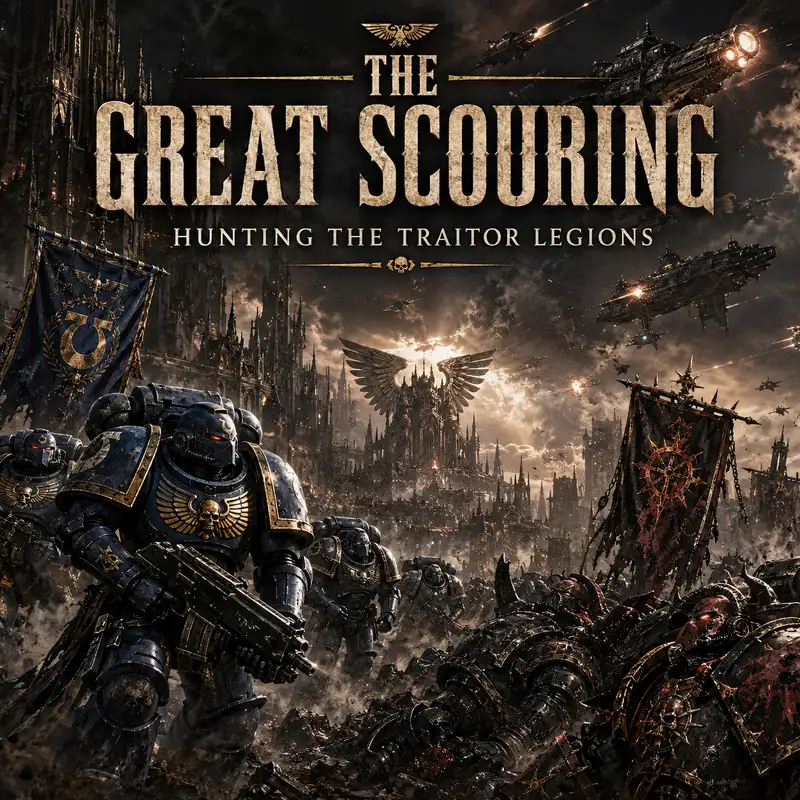
The campaign that followed became known as the Great Scouring, a seven-year struggle to drive Horus’s surviving forces out of the Imperium and into the Eye of Terror. Its name suggests a cleansing action, decisive and complete. That was how Rogal Dorn wanted it understood. Yet the central question is not whether the Loyalists pursued the Traitors. They did, with extraordinary violence. The harder question is what that pursuit accomplished. Did the Scouring destroy the rebellion, or force it into a new shape? The answer lies between military victory and historical failure. The Loyalists reclaimed the heart of the Imperium, shattered the Traitors’ power bases, and denied them the empire Horus had promised. They also drove their enemies toward the one refuge where ordinary strategy, sane geography, and reliable timekeeping ceased to apply. The Scouring closed the Horus Heresy, but opened the long war that would define the next ten thousand years.
The first task was not a grand advance across the stars. It was survival inside the Solar System. The Traitors had not vanished when Horus fell. Their ships remained around Terra, Luna, Mars, and the approaches to Sol. On the ground, isolated formations continued to resist, withdraw, or kill whatever they could reach. Mars remained divided between loyalist Mechanicum forces and the servants of the Dark Mechanicum. The Battle of Luna followed the Siege, and the liberation of Mars consumed much of the next phase. Only after the last major Traitor forces were expelled from Sol could the Imperium begin a wider pursuit. The Loyalists were not launching from a secure capital with fresh armies. They were clearing their own headquarters dock by dock and world by world. Every vessel sent after a fleeing enemy was a vessel not repairing Terra, guarding the Emperor, or suppressing rebellion closer to home.
The Traitor retreat was not a single orderly withdrawal. Horus had held his alliance together through authority, fear, and the promise of victory. His death removed all three. The Sons of Horus had lost their primarch and the centre of their identity. The Emperor’s Children were consumed by appetite and private obsession. The World Eaters were less an army retreating than a chain of massacres moving away from Terra. The Death Guard remained formidable, but corruption had changed what discipline meant. The Word Bearers still possessed doctrine, organisation, and a cause larger than Horus. The Iron Warriors retained enough cohesion to turn retreat into fortified withdrawal. The Night Lords saw opportunity in disorder. The Alpha Legion remained so divided, secretive, or deliberately misleading that even identifying its operations is difficult. These Legions had fought together against the Emperor. They did not agree on what came after defeat.
Once Sol was secure enough to breathe, Rogal Dorn gave the next phase its purpose. The Traitors were not merely to be contained. They were to be scoured from the galaxy. The words suited Dorn’s condition. He had defended Terra, failed to save the Emperor from the Golden Throne, lost Sanguinius, and watched the Imperium’s greatest war end without peace. Vengeance offered direction where grief offered only silence. It also reflected a genuine strategic need. Traitor fleets still controlled worlds, shipyards, fortresses, and routes through the warp. Leaving them in place would allow the rebellion to recover. Yet the language of cleansing encouraged commanders to treat compromise, surrender, and local ambiguity as contamination. The Great Crusade had demanded compliance in the name of unity. The Scouring repeated its movement, but with fewer hopes, harsher memories, and considerably less patience.
A pursuit across the galaxy is not a cavalry charge with better engines. Warp travel is uncertain, intelligence arrives late, and a defeated fleet can divide into a hundred smaller threats. The Loyalists had to seize fuel depots, restore astropathic links, reopen shipyards, and decide which burning system deserved help first. A fleet can pursue only as far as its Navigators, supplies, and crews permit. Vengeance remains stubbornly dependent on logistics. Traitor commanders exploited that fact. Some left rearguards in fortress systems. Some stirred uprisings among populations terrified of Imperial punishment. Others raided loyal worlds to replenish themselves or ensure pursuit remained costly. Every delay gave another warband time to disappear. Every rapid advance risked leaving hostile territory behind. The Scouring became a web of campaigns, with loyalist forces advancing along different axes toward enemies no longer obliged to behave like a unified army.
The worlds caught between them rarely enjoyed the moral clarity later Imperial histories preferred. Some had openly supported Horus. Others obeyed whichever fleet occupied their orbit. Some governors changed allegiance twice and called both decisions loyalty. Entire populations had been conscripted, starved, or used as shields by masters they never chose. Loyalist commanders faced an ugly problem. Leniency might leave Traitor networks intact. Collective punishment could destroy the Imperium they claimed to restore. Surviving records compress many decisions into phrases such as pacification or compliance restored. Those words can conceal bombardment, executions, forced resettlement, and generations of suspicion. The Imperial response was often swift and based on information that had crossed half the galaxy through a nightmare. The Scouring hunted Legions, but it also remade civilian worlds under pressure of fear. Humanity had seen the Emperor’s sons tear the Imperium apart, and many no longer regarded any Legion with uncomplicated trust.
That loss of trust shaped the Loyalist command. Guilliman returned with the Ultramarines and the resources of Ultramar, bringing troops and an argument about what the Imperium must become. Dorn embodied endurance and retribution. Leman Russ carried the memory of Prospero, Terra, and the roles he had been ordered to play. The Khan had defended the Palace while retaining a suspicion of rigid authority. Corax had watched his Legion nearly destroyed and his efforts to rebuild it poisoned by treachery. Vulkan’s path was marked by survival that never felt like victory. Each primarch understood the rebellion through a different wound. They could agree that the Traitors must be pursued. They did not agree on how power should be organised afterward, who should command, or how much of the Emperor’s design remained possible. The Scouring was a military campaign conducted inside a constitutional crisis, although the Imperium preferred sharper words and larger guns.
Guilliman’s answer was the Codex Astartes and the division of the surviving Loyalist Legions into smaller Chapters during the Second Founding. No future Warmaster would be allowed to command a force on Horus’s scale. The change was practical, political, and personal. Legions had been families, nations, and living extensions of their primarchs. Breaking them apart meant asking veterans to surrender the identities that had carried them through the Heresy. Dorn resisted the division of the Imperial Fists, and his objections were not simple vanity. Unity had allowed the Legions to prosecute wars across the galaxy. Fragmentation might prevent another Horus, but could make coordinated defence harder. Guilliman believed concentrated power was the greater danger. The eventual settlement created Chapters with their own heraldry, traditions, recruiting worlds, and command structures. The Scouring was still being fought while the weapons of victory were dismantled and rebuilt into a new institution.
Across the following years, the pursuit moved through names that survive like fragments on a damaged campaign map. Avellorn. Gamma-Horgan. Vanaheim. Molech. Seraphina. Paramar. At Gamma-Horgan, fleeing Traitors used local turncoats to seize the world before Imperial forces drove them onward. Around Vanaheim, scattered Traitor elements attempted to gather strength and were defeated again. The war beneath Calth finally ended long after the original betrayal above that world, a reminder that some battlefields refused to recognise that history had moved on. Molech, once the site of Horus’s darkest ascent, was scoured. Later came the return to Isstvan the Fifth, where the Dropsite Massacre had revealed the rebellion’s full scale. Operation Carthage was more than an action against a strategic location. It was a return to a graveyard. The Loyalists were fighting over supply lines and strongpoints, but also revisiting the places where their understanding of the galaxy had been murdered.
Isstvan reveals the emotional engine of the Scouring. Loyalist forces could destroy installations, purge enemies, and mark the world as reclaimed, yet none of that reversed the massacre. The Iron Hands could not recover Ferrus Manus. The Salamanders and Raven Guard could not restore the brothers lost in the killing fields. Punishment was possible. Restoration was not. That distinction drove many of the Scouring’s excesses. The Imperium treated physical destruction as proof that moral balance had been restored, because destruction was the tool it still possessed in abundance. The Traitors sometimes used this against their pursuers. A fortress could be abandoned after consuming months of siege. A world could be poisoned before withdrawal. A loyalist commander could be forced to choose between catching an enemy fleet and saving a population. The campaign’s cruelest victories often left the victor standing on ruins, holding a position that had lost the reason anyone wanted it.
The Traitor Legions were also changing under pressure. Defeat stripped away shared purpose and exposed rivalries that had existed throughout the Heresy. Some warriors still imagined themselves as revolutionaries who meant to build a new human order. Others had embraced the Chaos Gods so completely that political rule seemed almost quaint. These visions could coexist within a Legion only while survival demanded it. Even then, they produced betrayal, duels, assassinations, and commanders pursuing private wars while the Loyalists closed in. The Scouring did not simply push the Traitors backward. It accelerated their fragmentation. Legion formations became fleets, hosts, brotherhoods, cults, and warbands. Command increasingly depended on strength, ships, patronage, or favour from powers that rarely rewarded stability. The Loyalists divided their Legions by law. The Traitors divided theirs through ambition, corruption, and the difficulty of sharing refuge with thousands of heavily armed demigods who blamed one another for losing.
No Legion carried defeat more visibly than the Sons of Horus. They had been first among the Legions, the Warmaster’s own, and the rebellion had worn their colours. After Terra, that prestige became a target. Loyalists hunted them for vengeance, while other Traitors blamed them for Horus’s failure and coveted their resources. Their dead primarch could no longer impose meaning on sacrifice. The Legion that expected to rule the Imperium entered the Eye fractured and disgraced. Its later rebirth as the Black Legion would not be a simple continuation. Abaddon would have to reject the idea that the Traitors failed only because Horus died. That development belonged to the wars within the Eye and the centuries beyond the Scouring, but its roots lay in this retreat. The Great Scouring removed the Sons of Horus from galactic power and left them choosing between becoming a tomb for Horus’s memory or building something more dangerous from its ruins.
The Iron Warriors offered a different answer. Perturabo had always understood war as engineering shaped by grievance. During the retreat, his Legion could turn pursuit into calculation. That instinct reached its most infamous expression at the Iron Cage. On Sebastus the Fourth, the Iron Warriors prepared a fortress system designed not merely to resist the Imperial Fists but to consume them. Dorn entered the trap with a Legion scarred by Terra and under political pressure. Later accounts disagree over what followed. Imperial tradition emphasises the Imperial Fists’ refusal to break and the eventual arrival of the Ultramarines. Iron Warrior memory presents a deliberate humiliation of Dorn and proof of Perturabo’s superiority. Both accounts acknowledge immense loss. The battle annihilated neither Legion. It converted grief into casualties on an industrial scale, perhaps the most faithful monument the Heresy could have received.
The Iron Cage marked a turning point for Perturabo. In its aftermath he ascended to daemonhood, then returned toward Olympia and the establishment of his Iron Empire while a long siege unfolded there. The spiritual meaning of his transformation remains one of the setting’s sharper contradictions. Perturabo despised weakness, resented manipulation, and often regarded open worship with contempt. Yet he accepted, pursued, or was drawn into immortality granted by the same powers that had consumed his brothers. One interpretation is that the Scouring proved there was no road back to the secular rebellion he may once have imagined. The empire he wanted was gone. The Imperium would never forgive him, and Chaos never offers gifts without ownership. His fortress victory therefore carried an irony. Perturabo escaped Dorn’s judgment, but not the logic of the cause he had joined. He won the cage and entered a larger one.
By the final phase, the Eye of Terror had become the destination toward which the Traitors were driven, drawn, or both. From outside it was a wound in realspace, where the warp bled into the material galaxy. For the Loyalists, it was a boundary they could approach but not conquer by ordinary means. Ships entering its depths risked madness, mutation, temporal distortion, and navigation without trustworthy stars. For the Traitors, it offered sanctuary and access to the powers they served. It also offered scarcity, instability, and constant rivalry. Imperial histories preferred the image of victorious Legions casting their enemies into damnation. Traitor traditions could describe a deliberate withdrawal into a realm where they would be renewed. The truth is less tidy. Some fled because they had no alternative. Some sought the Eye as a promised land. The Loyalists were strong enough to deny them the Imperium, but not strong enough to follow and finish the war.
That limitation did not make the Scouring meaningless. The Loyalists reclaimed Sol, broke Traitor corridors, destroyed strongholds, and prevented the rebellion from becoming a rival empire in realspace. The Imperial government survived. Forge worlds resumed production. Astropathic routes were restored. Armies could again be directed from Terra rather than fighting as isolated remnants. These were enormous achievements purchased at enormous cost. Yet the recovered Imperium was darker than the one that entered the Heresy. The Emperor was silent on the Golden Throne. Malcador was gone. Fear of another rebellion justified central control, rigidity, surveillance, and punishment. The Imperial Creed had not reached its later form, but its emotional ground was being prepared. People who had watched reason, science, and demigod leadership fail were ready to seek certainty elsewhere. The Scouring restored territory while narrowing the futures the Imperium could imagine.
It also transformed the Space Marines. Before the Heresy, the Legions had been the spearhead of expansion, commanded by the Emperor’s sons and supported by the Great Crusade. After the Scouring, Chapters became guardians of a wounded realm, dispersed across distant regions and shaped by local traditions. Their smaller size limited the danger posed by one commander, but encouraged isolation. Over generations, shared Legion history became ritual, legend, and sometimes secret shame. The Traitors experienced the opposite change under similar pressure. Their old Legions survived in name, but warbands developed distinct loyalties and interpretations of defeat. Both sides emerged less unified than they entered the Heresy. The Loyalists called division a safeguard. The Traitors called it freedom, necessity, or betrayal, depending on who held the ammunition. In both cases, the age of vast brotherhoods moving under one purpose was ending.
The Great Scouring succeeded at the task it could perform. It hunted the Traitor Legions out of territories from which they might have renewed Horus’s war. It destroyed the possibility of an immediate second siege of Terra. It gave the Imperium time to rebuild and forced Chaos into a hostile refuge. It did not cleanse the galaxy of treason, corruption, or the ambitions that caused the Heresy. Those things could not be bombarded from orbit because they were embedded in institutions, memories, and souls on both sides. The Loyalists won the map and lost the future they had expected. The Traitors lost the Imperium and gained a sanctuary that would deform them into enemies more alien than the rebels who marched on Terra. The Scouring was not the final act of the Horus Heresy. It was the furnace in which the familiar Imperium and the familiar forces of Chaos were made.
At the edge of the Eye, the pursuit ended because reality itself ceased to offer a road the Loyalists could safely follow. Behind them lay seven years of liberated worlds, ruined fortresses, divided Legions, and graves too numerous for an honest roll of honour. Ahead, the last Traitor fleets vanished into storms that looked less like weather than an open wound. Imperial commanders could report that the enemy had been expelled. They could fortify the approaches, rebuild their Chapters, and declare the age of rebellion closed. They could not know when those ships would return, or what the Eye would make of the warriors aboard them. The Great Scouring answered the demand for vengeance without delivering final safety. It ended the hunt not with the Traitor Legions destroyed, but with them alive beyond the frontier, divided, corrupted, and learning how to wait.