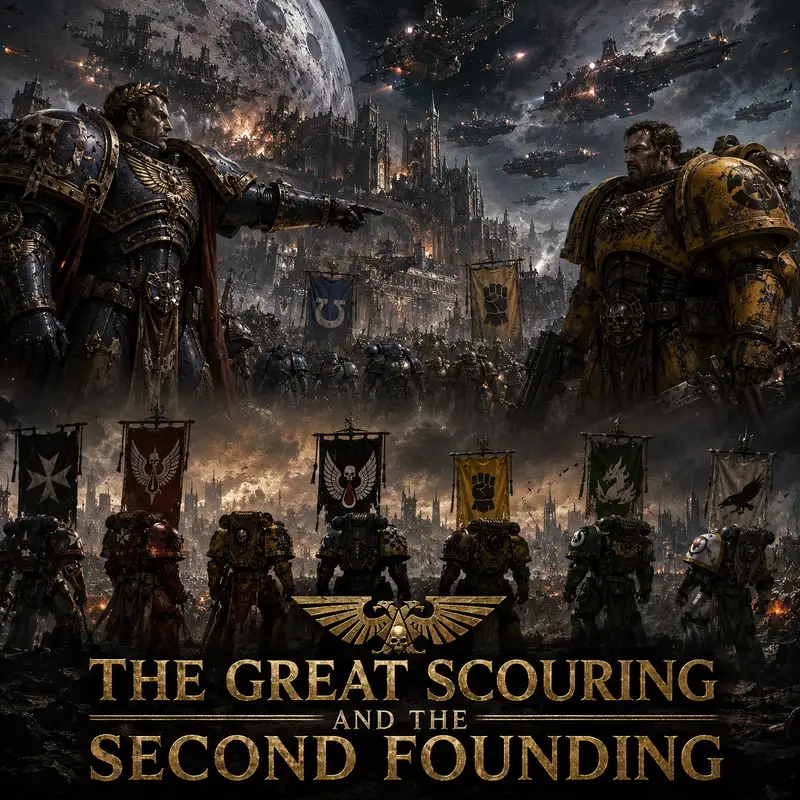
The Great Scouring and the Second Founding
The first battle of the Imperium’s revenge after Horus died was fought over Luna, beneath the light of a ruined Terra. The Imperial Palace still burned. Entire districts had become burial grounds. The Emperor had been carried from the Vengeful Spirit and sealed within the Golden Throne, alive in a sense that no one fully understood and silent in every sense that mattered. Horus was dead, but his armies had not vanished with him. Traitor warships fled the Solar System carrying legionaries, cult troops, corrupted machines, and commanders who had already begun deciding whom to blame. The loyalists were exhausted, divided, and furious and their victory had saved the Imperium, but it had not restored the Great Crusade. It had left them with a corpse of an empire and a galaxy full of armed men who knew exactly how vulnerable Terra had become.
That is the central contradiction of the Great Scouring. The Imperium had won the Horus Heresy, yet it could not simply return to the world that existed before it. The Emperor no longer ruled in person. Malcador was gone. Sanguinius was dead. Ferrus Manus had fallen years earlier, and many of the surviving primarchs carried wounds that could not be placed inside a stasis vault or repaired by an apothecary. The traitors had to be hunted, their strongholds broken, and their allies punished. At the same time, the loyalists had to answer a more dangerous question. How could the Imperium survive another rebellion by the very armies created to protect it? The Great Scouring would pursue the traitors across the stars. The Second Founding would dismantle the military system that had allowed Horus to come so close to victory.
The first task was brutally practical. The Solar System was not secure. Luna had been occupied and fortified. Mars remained torn between loyalist and traitor factions, its industrial regions scarred by civil war and daemonic corruption. Enemy fleets, isolated garrisons, and hidden cells still operated near the heart of the Imperium. Before anyone could discuss reconstruction, doctrine, or the proper size of a Space Marine command, the loyalists had to clear their own doorstep. Luna was retaken within months of the Siege. Mars followed after a hard campaign. By the end of the following year, the last major traitor forces had been purged from the Solar System and its immediate approaches. The timetable sounds efficient until one remembers that this was the capital region of the victorious side. Victory, in this case, required more than a year to reach the outskirts of home.
The surviving loyalist Legions then turned outward. Rogal Dorn, bitter and grief-stricken after the defence of Terra, gave the campaign its defining purpose. The traitors would be scoured from the galaxy. The word suited the mood. This was not presented as a limited operation to restore borders. It was cleansing by force, an attempt to erase the military power, political influence, and memory of Horus’s rebellion wherever it could be reached. The campaigns that followed lasted seven years, roughly as long as the Heresy itself. They carried loyalist fleets through systems that had changed allegiance, worlds that had been abandoned, and regions where no one was entirely certain who had won the last battle. The Great Crusade had once advanced beneath promises of unity. The Scouring often advanced beneath lists of names to be avenged.
There was still strategy beneath the anger. The traitor Legions had lost their Warmaster, but they retained ships, armouries, recruitment worlds, forge alliances, and experienced commanders. Left alone, they might have created rival empires beyond Terra’s immediate reach. Some still thought in the old language of conquest and secular authority. Others had embraced Chaos so completely that the idea of rebuilding Horus’s Imperium seemed almost quaint. These factions did not agree on what defeat meant. To some, retreat was temporary. To others, the material galaxy had become only one battlefield among many. The loyalists therefore faced an enemy that was weaker but less predictable. There was no single command structure to decapitate. Every pursuit risked becoming an ambush, and every abandoned stronghold might conceal a cult, a weapon stockpile, or something with considerably more teeth than a weapon stockpile.
The Scouring moved through places already heavy with memory. Molech, where Horus had gained terrible power, was purged. The long war beneath Calth finally ended. Isstvan Five, the site of the Dropsite Massacre, was subjected to an operation whose purpose was as symbolic as it was military. The loyalists revisited the scenes of their greatest humiliations and attempted to turn them into proof that order had returned. Yet ruins are poor witnesses. A blasted world cannot confirm that justice was done. It can only show that someone possessed enough firepower to make the argument permanent. Across the Imperium, campaigns of liberation and retribution blurred together. Some populations had willingly supported Horus. Others had obeyed the only army present. Imperial investigators were rarely inclined to spend years studying the distinction.
The traitors were driven steadily toward the region that would become their refuge, the Eye of Terror. It was not merely a hiding place. It was a wound in reality where the laws of time, matter, and sanity weakened under the pressure of the Warp. The loyalists could pursue conventional fleets, besiege fortress worlds, and destroy supply lines. They could not conduct a normal occupation inside the Eye. By the end of the Scouring, the bulk of the surviving traitor forces had been forced or drawn into that impossible sanctuary. Whether they fled there because the loyalists had defeated them, or chose it because Chaos offered power and protection, depends on which traitors are being discussed. Both explanations can be true. The Imperium won control of its territory. Chaos kept the armies that would spend the next ten thousand years trying to take it back.
The loyalist primarchs were not united by victory. Lion El’Jonson returned to Caliban and found civil war waiting for him. The destruction of that world and the disappearance of the Lion opened a secret wound within the Dark Angels that would never properly close. Jaghatai Khan continued the hunt into regions where conventional maps offered limited assistance and was eventually lost. Vulkan withdrew from public command. Corax pursued the traitors into darkness and carried his own grief with him. Leman Russ remained loyal, but loyalty did not require him to agree with every order issued from Terra. Rogal Dorn wanted vengeance and certainty. Roboute Guilliman wanted a system that could survive after the primarchs were gone. For once, the administrator had identified the more frightening battlefield.
Guilliman’s conclusion was simple enough to state and painful enough to implement. The Legions were too powerful. Before the Heresy, a primarch might command tens of thousands of Space Marines, vast fleets, human army formations, supply networks, and the loyalty of entire sectors. Horus had not needed to construct a rebellion from nothing. He had taken an existing command system, persuaded half of its greatest leaders to follow him, and turned the machinery of the Great Crusade toward Terra. The disaster was personal, but it was also structural. Horus mattered. So did the fact that the Imperium had placed enough force under one man to threaten the species. Guilliman’s answer was the Codex Astartes, a vast body of military doctrine that addressed strategy, organisation, recruitment, logistics, command, and the conduct of Space Marine warfare.
The most consequential proposal was the division of the Legions into Chapters. A Chapter would contain roughly one thousand Space Marines, organised into companies and supported by its own officers, armouries, fleet assets, and recruitment system. The exact practice would vary, and many Chapters would treat the Codex as guidance rather than holy arithmetic. The political principle was more important than the number. No single commander should again control a Legion-sized concentration of transhuman warriors. A Chapter could conquer a world, break an invasion, or save a sector. It could not easily march on Terra with the mass once available to Horus. The Imperium’s solution to catastrophic concentration of power was controlled fragmentation. It was not elegant, but elegance had recently been beaten to death on the walls of the Palace.
Dorn resisted. His opposition was not the sulking refusal of a commander who disliked paperwork. The Imperial Fists had held Terra when almost every larger plan failed. Their identity rested upon unity, endurance, and obedience to the duty given by the Emperor. To divide the Legion could feel like punishing the loyal for the crimes of the traitors. It also raised a legitimate military concern. Legions had been built for campaigns on a galactic scale. Breaking them into Chapters reduced the danger of rebellion, but it also reduced the Imperium’s ability to concentrate force quickly under one proven command. Guilliman saw resilience through separation. Dorn saw strength being cut apart while the enemy was still retreating. Both men were responding to the same catastrophe. They simply feared different versions of the next one.
Their disagreement brought the Imperium close to another armed crisis. Guilliman had political support and one of the largest coherent military forces among the loyalists. Dorn possessed enormous prestige and warriors who had just defended the throneworld. Neither wanted civil war, but recent history had demonstrated that primarchs could reach civil war by insisting they were preventing it. The crisis was eventually resolved, though not through a calm committee meeting and a mutually satisfactory revision process. The Imperial Fists would pass through one final ordeal before accepting division. That ordeal was the Iron Cage, a battle that combined military rivalry, grief, pride, and the sort of decision that becomes easier to explain only after everyone involved is dead.
Perturabo prepared the trap on Sebastus Four. His Eternal Fortress was a layered system of bunkers, trenches, minefields, gun positions, false objectives, and killing zones designed to exploit every predictable response of the Imperial Fists. Dorn attacked. The accounts differ in emphasis. Iron Warrior traditions present the battle as Perturabo’s proof of superiority over the brother he had always resented. Imperial Fist traditions frame it as a terrible test, almost a Legion-wide passage through the pain glove, burning away the old structure before the new one could emerge. The less ceremonial explanation is that the Imperial Fists entered a prepared siege complex and suffered appalling losses. Communications failed. Formations broke apart. Ammunition ran low. Guilliman’s forces eventually intervened and helped extract the survivors. No interpretation changes the mud, the dead, or the fact that pride had found an efficient method of calculating interest.
After the Iron Cage, Dorn accepted the Codex settlement. The Imperial Fists became a Chapter, and their remaining warriors were divided among new Successors. The Black Templars carried forward the most uncompromising crusading spirit of the Legion. The Crimson Fists inherited another strand of Dorn’s character, disciplined, dutiful, and stubborn enough to continue fighting after sensible men would have begun preparing memorials. Other successors preserved different officers, formations, habits, and grudges. This was the deeper logic of the Second Founding. A Legion was not divided into identical copies. It was separated along existing lines of temperament and experience. The new Chapters shared gene-seed and ancestry, but they did not share the same future.
The same process transformed the other loyalist Legions. The Ultramarines produced many Successor Chapters because they remained numerous, organised, and well supplied. Some adhered closely to Guilliman’s doctrines. Others carried particular regional traditions or the influence of veteran commanders into independent service. The Blood Angels created successors that inherited both the nobility of Sanguinius and the genetic curses buried within his sons. The Flesh Tearers, for example, embodied a harsher and more violent expression of the same lineage. The Raven Guard, Iron Hands, White Scars, and Dark Angels also divided, though not always with equal enthusiasm or transparency. The Second Founding did not erase Legion culture. It multiplied its variations.
Nor was compliance uniform. The Space Wolves rejected much of the standard Chapter structure and continued to organise according to the traditions of Fenris and the will of Russ. The Salamanders had been so badly reduced by the Heresy that the normal pattern of division did not apply cleanly, and later records remain uncertain about the full story of their successors. The Dark Angels formally created separate Chapters, yet bonds of ancestry, secrecy, and shared purpose continued to connect them. Even among strict followers of the Codex, a thousand warriors was never a perfectly measured reality. Fleets were scattered. Casualties varied. Recruits were in training. Specialists and command staff complicated the count. The Imperium had invented a rule to prevent another Horus. It immediately discovered that rules become flexible when applied by armoured warrior-monks with their own fleets.
The Second Founding changed more than unit size. It changed what a Space Marine was for. The Legions had been instruments of conquest, designed to fight sustained wars across broad fronts and bring entire regions into compliance. Chapters became independent strike forces. They could respond rapidly, operate without a primarch, and preserve their traditions even if another Chapter was destroyed. This made the Adeptus Astartes harder to eliminate as a whole. It also made them harder to coordinate. Future Imperial commanders could not simply order every descendant of a Legion into one formation. They had to request aid, negotiate priorities, respect ancient privileges, and hope that several Chapter Masters interpreted the crisis in approximately the same way. The system traded unity for survivability, and the Imperium would spend ten thousand years discovering both sides of that bargain.
It also created new identities with astonishing speed. A newly founded Chapter received warriors, gene-seed, ships, relics, and a portion of its parent Legion’s history. It might receive a homeworld or remain fleet-based. Its first Chapter Master was often a veteran whose personality shaped the culture that followed. Over generations, local recruitment, battlefield experience, religious practice, and isolation would make each Chapter distinct. One lineage might produce crusaders who never settled. Another might become guardians of a particular region. Another might cultivate secrecy, ritual, or an unusual method of war. The Second Founding therefore preserved the Legions by making their inheritance impossible to keep in one place. The old armies died, but their fragments became institutions capable of outliving the primarchs themselves.
Guilliman’s reforms reached beyond the Space Marines. The Imperial Army was divided so that ground forces and void fleets no longer sat comfortably beneath the same commander. Political authority shifted toward mortal institutions on Terra. The exact machinery would evolve, harden, and accumulate titles over time, as Imperial machinery tends to do when left unattended near a large supply of parchment. The principle remained consistent. Power would be separated, responsibilities divided, and rival organisations made dependent upon one another. This reduced the chance that one rebel could seize everything at once. It also created the overlapping jurisdictions, delays, and mutual suspicion that would define the later Imperium. The system was safer from a single usurper and less capable of acting as a single state.
That is why the Great Scouring cannot be understood as a simple victorious pursuit. It was the funeral march of the Great Crusade. Loyalist fleets reclaimed worlds, destroyed traitor strongholds, and drove their enemies into the Eye of Terror. Yet every success revealed how much had been lost. The primarchs began to vanish, die, withdraw, or become legends. Human populations learned that liberation could resemble bombardment from a different direction. The Emperor’s project of rational unity gave way to emergency rule, sacred memory, and institutions designed around distrust. The loyalists won the military campaign, but they could not restore the confidence that had made the old Imperium possible. They could only build a new order around the expectation of betrayal.
The Second Founding was the clearest expression of that expectation. It punished no specific loyalist and accused every future commander. Its message was not that the surviving primarchs were traitors. Its message was that no one, not even a primarch, should again be given the opportunity Horus had received. This was both sensible and tragic. The Legions had won the Great Crusade because they could concentrate extraordinary power behind singular leaders. The same quality had nearly destroyed humanity. Guilliman preserved the Space Marines by reducing the scale at which they could act alone. Dorn accepted the division only after the old form of his Legion had bled itself nearly to death. The new Chapter banners rose from the remains of the old Legion standards.
By the end of the seven-year Scouring, the traitors had not been annihilated. They had been expelled from the Imperium’s heartlands and forced into a realm the loyalists could not conquer. The Eye of Terror became both prison and fortress, protecting the defeated while corrupting them further. Outside it, the Imperium began the long transition from an empire led by the Emperor and his sons to an empire governed through councils, commands, cults, and inherited fear. The Space Marine Legions that had once conquered the galaxy were gone. In their place stood Chapters, smaller, more numerous, fiercely independent, and bound to one another by bloodlines that no law could entirely dissolve.
The Great Scouring answered the immediate question of survival by driving the traitors away. The Second Founding answered the deeper question by ensuring that the loyalists themselves could never again become one overwhelming army. Together they ended the age of the Legions. Not because the warriors disappeared, and not because their primarchs ceased to matter, but because the Imperium had learned what happened when too much of humanity’s future rested in a single pair of hands. From ruined Terra, the old banners went back into the galaxy in smaller pieces, each carrying a fragment of a Legion, and none permitted to become whole again.