The Great Rift, the Indomitus Crusade, and the New Age
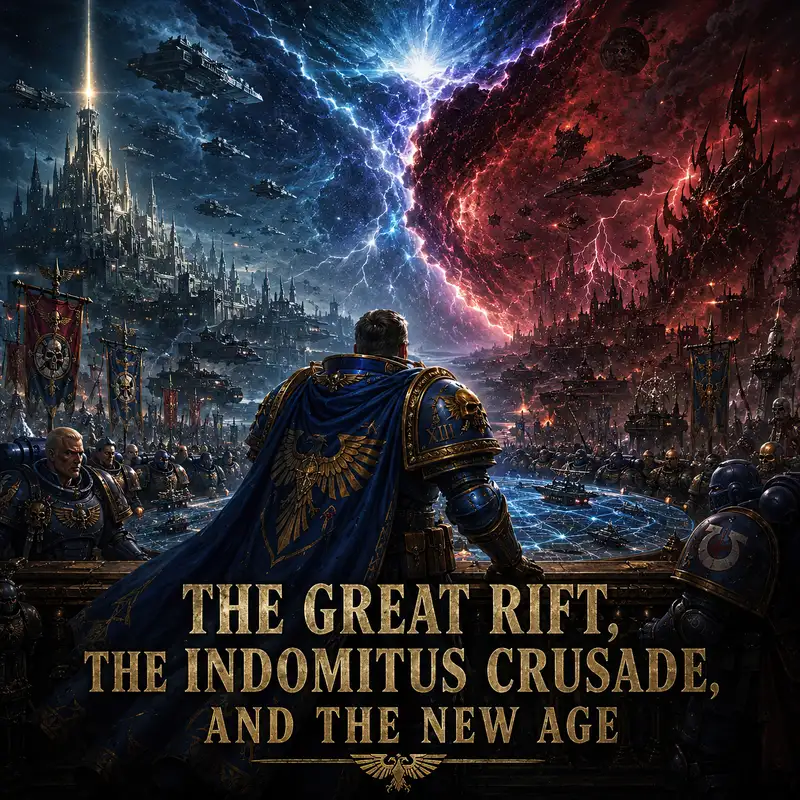
The night did not fall across the Imperium. It tore open. One moment, distant worlds still looked toward Terra through the light of the Astronomican. The next, astropaths screamed in their choirs, navigators found familiar routes swallowed by madness, and a wound of impossible scale burned across the galaxy. On planets far from Cadia, people who had never heard the fortress world’s name watched the heavens change color. Daemons walked through streets that had known only ordinary human cruelty. Fleets emerged from the warp centuries late, or before they had departed, or not at all. For a time, even the Emperor’s psychic beacon vanished. The Imperium had survived rebellion, invasion, plague, and ten thousand years of its own administration. It had never faced this. The Great Rift did not simply divide Imperial territory. It destroyed the assumptions that allowed the Imperium to function. Roboute Guilliman’s Indomitus Crusade would answer that catastrophe with armies, ships, and a new generation of Space Marines. The harder question was whether he could restore the Imperium, or only teach its ruins how to keep fighting.
The disaster began with victory for Abaddon the Despoiler. Cadia had guarded the most reliable passage from the Eye of Terror for millennia, but its importance ran deeper than fleets and fortresses. Ancient blackstone pylons stood upon the world and throughout the region. Their purpose was only partly understood, which placed them among the Imperium’s more carefully maintained categories of essential equipment. Whatever their makers had intended, the pylons constrained the power of the warp. During the thirteenth Black Crusade, Imperial defenders fought with the stubbornness that made Cadia a symbol, but symbolism could not stop a Blackstone Fortress hurled into the planet. Cadia broke. The destruction of its pylons removed a critical restraint on the empyrean, and the existing storms around the Eye of Terror erupted outward. The Cicatrix Maledictum, the Great Rift, spread across the galaxy like a burning scar. Abaddon had not conquered Terra. He had achieved something more strategically useful. He had made much of Terra’s empire unreachable.
That distinction matters because the Imperium was never a solid block of territory. It was a web of inhabited systems separated by enormous distances, held together by warp travel, astropathic messages, tithes, threats, and faith. A governor might never see an Imperial official from beyond the local sector, yet grain from that world could feed soldiers on another, while recruits from a third guarded a shipping lane serving a fourth. Break enough of those links and a million worlds become a million sieges. The Great Rift turned navigation into gambling with daemons as the house. Astropathic communication failed or arrived as fragments. Time itself became unreliable. On one world, the darkness lasted days. On another, generations passed before the wider Imperium made contact. Local rulers declared emergency powers, which in the Imperium is rather like announcing that the cathedral contains stone. Some remained loyal. Others became tyrants, separatists, cult leaders, or all three before lunch. The darkness did not create every weakness in the Imperium. It simply gave each weakness room to become a war.
When the Astronomican returned, its light could still guide much of the side of the galaxy containing Terra. This region became known as the Imperium Sanctus. The name suggests safety, but it should be understood as a comparative term. Sanctus remained beset by Chaos, Orks, Necrons, Tyranids, rebellion, starvation, and the normal hazards of Imperial governance. Beyond the Rift lay the Imperium Nihilus, the Dark Imperium, where the Emperor’s beacon was hidden or dangerously faint. There, long-range warp travel became far more perilous, reinforcement uncertain, and central authority often theoretical. Isolated systems had to survive through local alliances, short jumps, psychic beacons, and whatever courage remained after the first daemonic incursion. A few passages through the Rift, especially the Nachmund Gauntlet, became strategic arteries worth entire wars. Control of a narrow route could determine whether fleets, messages, and gene-seed reached half a galaxy. The Imperium had been divided into a bad side and a much worse side, a classification precise enough for military planning.
Terra itself was not spared. During the period remembered as the Noctis Aeterna, the darkness reached the Throneworld. The failure of the Astronomican threw the Sol System into confusion while Khorne’s daemons assaulted the Lion’s Gate spaceport. The Custodes, Sisters of Silence, Space Marines, and desperate defenders fought within sight of the Imperial Palace. For ten thousand years, Terra had presented itself as the immovable center of human power. Now the center was under direct attack, its fleets disordered and its beacon dark. The victory at Lion’s Gate prevented catastrophe, but it also revealed the scale of the new reality. No fortress was beyond reach. No institution could assume that relief would arrive. The Imperium’s capital had survived because warriors already present held the line long enough for order to return. Countless other worlds possessed neither Custodes nor the good fortune to be defended by people whose ceremonial equipment could survive being hit by a tank.
Into this crisis came Roboute Guilliman, a son of the Emperor restored after nearly ten thousand years in stasis. His awakening on Macragge had required the work of Belisarius Cawl, the strange intervention of the Aeldari Yvraine and her allies, and an Imperial coalition that would have caused several inquisitorial investigations under less urgent circumstances. The Armour of Fate preserved Guilliman’s life. He then fought his way toward Terra through a galaxy already coming apart, gathering warriors into what became the Terran Crusade. On the Throneworld, he entered the presence of the Emperor. The exact nature of that encounter remains difficult to describe, even in accounts closest to Guilliman. He did not emerge comforted. He emerged burdened. The Imperium he found was a religious tyranny built around a father who had once opposed such worship. Its institutions were ancient, powerful, mutually suspicious, and often unable to distinguish tradition from survival. Guilliman could not rebuild the realm he remembered. He could only command the one that existed.
He accepted authority as Imperial Regent and Lord Commander, then approached the galaxy as both a primarch and an administrator. That combination was less glamorous than prophecy and considerably more useful. Guilliman understood that the Imperium could not answer the Great Rift with a single fleet or one decisive battle. It needed a coordinated mobilization on a scale not attempted since the Great Crusade. Ships had to be found, repaired, crewed, armed, supplied, and directed. Regiments had to be raised. Forge worlds had to surrender matériel they had been saving for emergencies, despite the distressing discovery that an emergency had actually occurred. Rival organizations had to cooperate without first settling ten thousand years of grievances. Guilliman also confronted a simpler problem. The Imperium did not reliably know what year it was. Conflicting calendars, lost records, and the Rift’s temporal distortions made chronology a battlefield of its own. He created new historical offices to recover facts, because before reconquering the galaxy, someone had to determine when the galaxy currently was.
The Indomitus Crusade was the result. Its name carried the promise of being unconquered, a useful declaration when half the empire appeared to have been conquered by geography. Vast forces assembled around Terra, Luna, Mars, and other mustering zones. Imperial Navy warships, Astra Militarum armies, Space Marine strike forces, Adepta Sororitas, Custodes, Mechanicus cohorts, Knights, Titans, inquisitorial agents, and countless support vessels were organized into great crusade fleets and smaller battle groups. These formations did not advance as one clean spearpoint. They dispersed along threatened routes, relieved besieged systems, restored communications, destroyed Chaos strongholds, and established staging areas for later campaigns. Some fleets carried enough military power to break a sector. Others carried the less dramatic cargo that made victory possible: replacement crews, food, fuel, ammunition, astropaths, engineers, and orders written by people with sufficient authority to make local commanders stop arguing. The crusade was not merely an invasion. It was armed reconstruction conducted while the building remained on fire.
Guilliman possessed one advantage that had been prepared long before Cadia fell. After the Horus Heresy, he had entrusted Belisarius Cawl with a project of extraordinary ambition: improve the Space Marines and create new warriors for a future crisis. Cawl spent ten thousand years pursuing that task, which is either admirable patience or a warning about allowing a Tech-Priest to define a deadline. Hidden within his vessels and vaults were thousands of Primaris Space Marines, many taken as recruits in ancient times, transformed, trained, and held in suspended animation. They were larger and more resilient than earlier Space Marines, equipped with new organs, Mark Ten armour, improved weapons, and technologies that challenged the Imperium’s usual preference for innovation to occur several millennia ago. Their existence was military salvation wrapped in political danger. Guilliman needed them immediately. The Adeptus Mechanicus had to decide whether Cawl was a visionary, a heretic, or an especially productive combination of both.
The first Primaris warriors often fought as the Unnumbered Sons, informally called Greyshields. They were organized by the gene-lines of the loyal primarchs rather than by established Chapter, allowing sons of Guilliman, Dorn, Sanguinius, Russ, the Lion, Ferrus Manus, Vulkan, Corax, and the Khan to serve in vast temporary formations. For new warriors, this offered a rare sense of kinship with cousins they might never otherwise meet. For Imperial politicians, it looked uncomfortably like someone had rebuilt the old Legions and merely chosen friendlier stationery. At the same time, Torchbearer fleets carried Primaris reinforcements, gene-seed, weapons, and the means to create more of them to existing Chapters across the Imperium. Some Chapters accepted the newcomers as desperately needed brothers. Others viewed them as replacements designed by an outsider. A few distrusted Cawl’s work on principle, which was not entirely unreasonable. Many changed their minds after examining casualty reports. Firstborn veterans also began crossing the Rubicon Primaris, a dangerous transformation that allowed established heroes to gain the new physiology without abandoning their identities.
These reinforcements changed the Space Marines, but they did not make them uniform. Primaris warriors sent to the Space Wolves encountered a culture that had no interest in becoming tidier Ultramarines. Black Templars judged newcomers through faith and battle rather than laboratory certification. Blood Angels received warriors whose enhanced bodies did not free them from the legacy of Sanguinius. The new Marines had to become members of living Chapters, adopting histories, rituals, rivalries, and curses that no hypno-indoctrination could fully reproduce. Guilliman also used Primaris forces to found entirely new Chapters in the Ultima Founding. As the crusade advanced, the Unnumbered Sons were gradually broken apart and assigned to these Chapters or to reinforce older ones. The Triumph at Raukos marked the end of their largest remaining formations and the close of the crusade’s first phase, not the end of the wider campaign. Even Guilliman understood that legion-sized armies commanded by a primarch were likely to make people recall the Horus Heresy, a historical comparison rarely helpful during budget discussions.
The relief of Baal showed what the Indomitus Crusade could accomplish and what the Great Rift had already done. The Blood Angels and their successor Chapters had nearly been destroyed defending their home system from Hive Fleet Leviathan. The Rift’s birth shattered the battle’s reality, disrupting the Tyranids and unleashing further horrors while time lost any obligation to behave consistently. When Guilliman’s forces arrived, Baal had survived, but survival was measured in ruins and names carved for the dead. Guilliman brought Primaris reinforcements and the means to rebuild the sons of Sanguinius. He also elevated Commander Dante, naming him Lord Regent of the Imperium Nihilus. It was a necessary delegation. Guilliman could not rule both halves of the galaxy across an abyss that swallowed messages and fleets. Dante was given authority over a realm that often could not hear his commands. His appointment did not reunite Nihilus. It gave its scattered defenders a symbol, a chain of command where one could be maintained, and proof that Terra had not entirely forgotten them.
The crusade’s advance never became a simple procession of victories. Chaos forces attacked its supply lines, corrupted shrine worlds, opened new rifts, and pursued plans that extended beyond conventional conquest. Fleets became exhausted. Regiments dwindled. Worlds greeted Imperial relief with gratitude, suspicion, or gunfire, depending on what local rulers had been doing in the darkness. After the first phase, Guilliman turned toward Ultramar, where his brother Mortarion and the Death Guard had launched the Plague Wars. This conflict exposed another feature of the new age. The ancient struggle of the primarchs was no longer buried history. Daemon primarchs walked openly in realspace, while Guilliman had to defend the realm he had built before the Heresy. His victories against Mortarion preserved Ultramar, but they did not remove the Great Rift or end the crusade. Every emergency answered by Guilliman created space for three others to become urgent. The Imperium had acquired a demigod of logistics and immediately discovered that the galaxy could generate disasters faster than he could schedule them.
Nor was Chaos the only power transformed by the new age. The Necrons awakened in greater numbers, and the return of the Silent King gave their dynasties a figure from before humanity’s rise. Within the Pariah Nexus, Necron technology suppressed the warp so completely that human souls and wills began to wither. To an Imperium divided by a warp storm, the ability to still the empyrean offered both a threat and a possible clue. Cawl and other Imperial thinkers looked again toward blackstone and the pylon networks, seeking a way to contain or heal the Rift without understanding the full price of Necron methods. Hive Fleet Leviathan attacked from new directions and drove the Imperium into the Fourth Tyrannic War. Angron returned in fury. Vashtorr and Abaddon pursued weapons and pathways tied to ancient powers. In the darkness of Nihilus, Lion El’Jonson returned, not as a commander marching beside Guilliman, but as a wandering protector moving through a realm his brother could barely reach. Even Guilliman has now crossed the Great Rift and become isolated on the far side, while Cawl races to stabilize the Attilan Gap. The new age brought back legends. It did not make the legends convenient.
Guilliman’s greatest conflict may therefore be with the Imperium he is trying to save. He values reason, record keeping, efficient government, and human lives as resources that should not be wasted without purpose. The Imperium venerates suffering, hides knowledge, divides authority, and often treats inefficiency as proof of sanctity. Guilliman cannot simply abolish its religion, because faith now binds worlds together and sometimes produces miracles he cannot comfortably dismiss. He cannot dismantle every corrupt institution, because those institutions raise armies, collect tithes, and keep the Golden Throne functioning. He cannot openly reject the image of himself as the Emperor’s divine son while also benefiting from the obedience that image inspires. Each reform risks civil war. Each compromise preserves something he despises. He is powerful enough to command crusades, but not powerful enough to make ten thousand years disappear. The tragedy is not that Guilliman fails to recognize the Imperium’s sickness. It is that he understands how many diseased organs must continue working if the patient is to survive the operation.
Did the Indomitus Crusade save the Imperium? In the immediate sense, yes. It prevented the shock of the Great Rift from becoming total collapse. It secured routes, relieved worlds, reinforced Chapters, restored chains of command, and gave humanity something it had almost forgotten how to recognize: forward movement. Yet it did not reunite the galaxy. Imperium Nihilus remains a realm of isolated wars. The Great Rift still burns. The Nachmund Gauntlet and other crossings remain contested. Crusade fleets bleed themselves white holding gains that may vanish when the next message fails to arrive. The Imperium Sanctus is stronger than it was during the first darkness, but strength is not health. Guilliman has not restored the empire of the Great Crusade, and he has not created a new golden age. He has converted catastrophe into a campaign, which may be the most Imperial form of hope imaginable.
That is the meaning of the Era Indomitus. It is not an age in which the darkness recedes. It is an age in which the darkness has become geography. Humanity now lives on both sides of an open wound in reality, guided by a resurrected primarch who remembers what the Imperium was supposed to become and must command what it actually is. New Space Marines march beneath banners older than their bodies. Ancient kings and lost sons return to wars that never ended. Faith grows stronger beside doubt. Technology advances beneath accusations of heresy. Every victory proves that survival is possible, and every map proves how much has already been lost. The Great Rift made the old Imperium impossible. The Indomitus Crusade did not restore it. Guilliman’s achievement was colder, harder, and perhaps more important. He taught a divided civilization to keep moving when the light ahead could no longer be seen. The galaxy remained night. Humanity learned to march by fire.