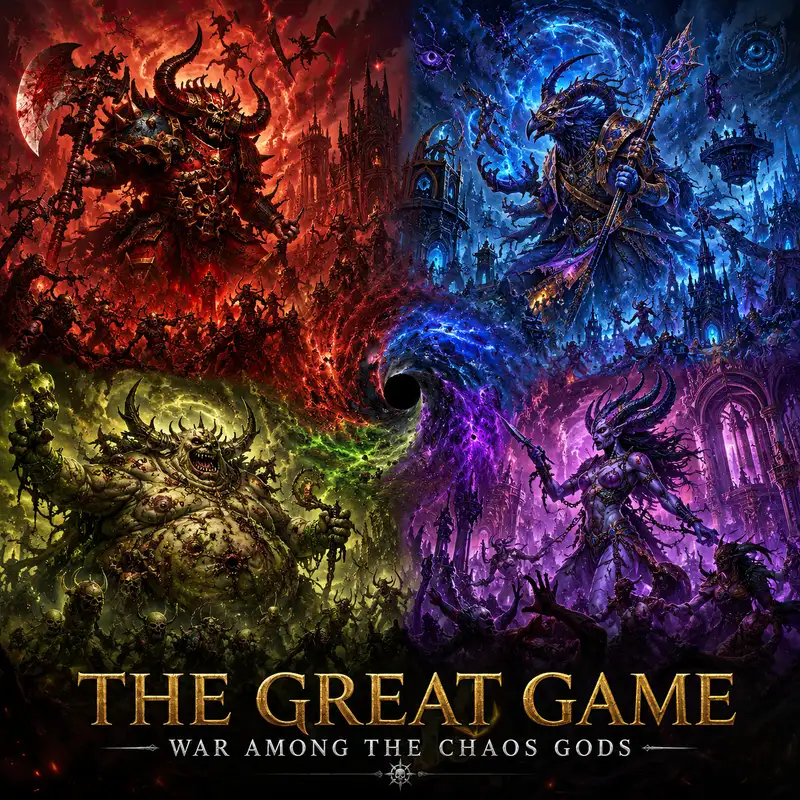
The Great Game: War Among the Chaos Gods
At any moment, if the word moment has meaning in the Warp, a brass host may be tearing into a crystal fortress while a tide of living plague drowns a palace built from desire. The victors raise their standards. The landscape changes around them. Then the defeated return from another direction, because direction is also negotiable there. No treaty follows. No border remains fixed. No final casualty list is compiled, which may be the one administrative mercy the galaxy has been granted. This is the Great Game, the endless struggle among Khorne, Tzeentch, Nurgle, and Slaanesh for supremacy over Chaos, the Warp, and every mortal soul that can be made to serve.
The name makes it sound almost civilized. It is not. There is no board resting between four thrones, and there are no rules accepted by all sides. The players, the pieces, and much of the battlefield are formed from the same psychic substance. Daemons march as armies, yet every daemon is also an expression of the power that created it. Mortal champions make choices, betray rivals, and conquer worlds, yet their victories become currency in a conflict they can rarely comprehend. Even the landscape of the Realm of Chaos reflects shifting power. A road may exist because ambition demands a path forward. A swamp may spread because despair has become stronger. A battlefield can be both a real place and an argument made with claws.
What do the Chaos Gods actually want from this war? The simple answer is dominion. Each seeks to become the greatest power in the Warp and to reshape existence according to its own nature. Khorne would drown creation in violent conflict. Tzeentch would make everything mutable, ambitious, and subject to endless design. Nurgle would enfold existence in decay, endurance, and surrender. Slaanesh would drive every desire beyond restraint until nothing remained except the need for one more sensation, one finer achievement, one deeper transgression. Yet the simple answer conceals the central contradiction. A final victory would deny each god the very conditions that make it what it is.
Khorne is the most direct expression of this problem. He is rage, slaughter, murder, and the exultation of physical power. His followers may speak of martial strength, courage, or the purity of facing an enemy blade to blade. Khorne’s appetite is less selective. Blood shed for a noble cause still feeds the same current of violence as blood shed in betrayal. A defending soldier who kills in fury and a butcher who kills for pleasure are not morally equal, but the Warp is not a court of law. It registers emotion, intensity, and action. Khorne wants war without end, which means even his greatest victory must lead to another battle. A universe in which all opposition had been destroyed would leave the Blood God with a serious shortage of opponents.
Tzeentch approaches the same impossibility from the opposite direction. He is change, ambition, sorcery, conspiracy, and the hope that the present order can be overturned. That hope may begin in a prisoner dreaming of freedom or in a tyrant dreaming of greater power. Tzeentch does not require the dream to be decent. He requires it to move. His plans coil through other plans, not always because complexity is useful, but because plotting is part of his nature. A scheme that ends every scheme would be a kind of death for the Architect of Fate. If Tzeentch ever achieved a perfectly controlled future, with every possibility settled and every rival removed, then change would cease. The god of change would have constructed the one prison he could never tolerate.
Nurgle offers what Tzeentch cannot. He offers an end to struggle, though not an end to suffering. Nurgle is disease, entropy, despair, resignation, and the strange comfort found in accepting that nothing can be saved. His followers often appear joyful because the burden of resistance has been taken from them. Pain becomes a gift once they are too numb to oppose it. Rot becomes renewal inside the logic of Nurgle’s garden, where death feeds hideous life and every corpse becomes fertile ground. This is not kindness. It is captivity disguised as relief. Nurgle’s victory would not be a silent, empty universe. His nature depends upon cycles of decline and rebirth, infection and endurance. Even his stagnation writhes with flies.
Slaanesh is the youngest of the four great powers, born from the catastrophic excess of the ancient Aeldari civilization. Youth does not make the Dark Prince minor. Slaanesh is temptation, obsession, pride, sensation, perfection, and every appetite that grows by being fed. The first indulgence promises satisfaction. The second proves the first was insufficient. Soon the seeker is no longer pursuing pleasure, beauty, mastery, or knowledge. The seeker is pursuing the vanished ability to feel complete. Slaanesh cannot accept enough because enough is the boundary that Slaanesh exists to destroy. A final triumph would therefore become merely the opening act of a greater craving. Perfection must always be surpassed, even after perfection has lost all meaning.
These powers do not divide reality neatly between them. Their domains overlap, and that overlap turns rivalry into hatred. Khorne and Slaanesh are often treated as natural enemies. Both can feed upon battle, but they interpret it differently. Khorne exalts the blow, the rage, and the taking of life. Slaanesh savors technique, sensation, pride, and the intoxicating desire to make the next kill more exquisite than the last. A warrior can begin with wrath and end with obsession. The same massacre may strengthen both gods, which makes every shared boundary a theft. Their conflict is not merely disagreement. It is a dispute over ownership of the same scream.
Tzeentch and Nurgle form another deep opposition. Tzeentch whispers that circumstances can change. Nurgle whispers that resistance is pointless. One cultivates ambition, possibility, and restless transformation. The other cultivates resignation, endurance, and the acceptance of decline. Yet even they cannot remain separate. Plague forces societies to adapt. Mutation is change written into flesh. Failed schemes breed despair. A revolutionary who loses hope may exchange Tzeentch’s promises for Nurgle’s embrace without ever realizing that the battlefield has shifted inside the same mind. The Great Game is fought in impossible fortresses, but it is also fought during the quiet second when a person decides whether to struggle, surrender, rage, or crave.
The Realm of Chaos gives these rivalries form. Khorne’s domain is imagined through brass, fire, weapons, and mountains of the dead. Tzeentch’s power manifests as labyrinths, impossible architecture, color, flame, and paths that rewrite their own destinations. Nurgle’s garden swells with diseased abundance, a place of decay that insists upon calling itself fertility. Slaanesh’s palace draws intruders through temptation, vanity, hunger, and the promise that the next threshold will finally satisfy them. These are not countries in the mortal sense. Their borders expand and contract with the fortunes of their gods. A cartographer sent into the Warp would require unusual courage, no expectation of returning, and a professional tolerance for maps that resent being observed.
Daemonic wars within those realms are not symbolic in the sense of being unreal. Bloodthirsters lead charges. Lords of Change direct sorcerous campaigns. Great Unclean Ones spread corruption through rival territories. Keepers of Secrets hunt opportunities to humiliate competing powers. Lesser daemons swarm beneath them, each with enough personality to hate, boast, plot, and remember injury. Yet daemons are also fragments or emanations of their patron gods. When one daemonic host tears another apart, the gods are striking at one another through portions of their own being. The Great Game is therefore both civil war and self-mutilation conducted on a cosmic scale.
Most mortals never see those battles. They experience the Great Game through consequences. A cult dedicated to change undermines a planetary governor. Its rebellion releases years of stored anger, and Khornate killers seize the streets. Siege, famine, and disease follow, opening the population to Nurgle’s promises of endurance. Among the survivors, some begin to worship suffering, cruelty, or the perfection of their own survival, and Slaanesh finds a door. This is not a fixed sequence and no single patron controls every step. It is an example of why Chaos victories so often fracture. A successful corruption creates emotional conditions that rival gods can exploit.
The competition for mortal champions is especially vicious. The gods offer strength, knowledge, resilience, beauty, authority, or transformation. The offer is tailored to weakness but presented as recognition of hidden greatness. A warrior believes Khorne has noticed courage. A sorcerer believes Tzeentch has recognized genius. A sufferer believes Nurgle alone understands pain. An artist believes Slaanesh has finally found someone worthy. Gifts follow. So do mutations, compulsions, and demands. The path to glory has excellent opportunities for advancement, provided one is comfortable with the employer eventually owning the employee’s body, soul, and job description.
A champion who serves one god becomes a weapon against the other three. Rival warbands raid one another’s shrines, sabotage rituals, steal relics, and hunt favored servants. A Khornate warlord may attack a Tzeentchian sorcerer with greater enthusiasm than an Imperial commander because sorcery is an insult and rival favor is intolerable. Slaaneshi champions seek to prove their superiority over Khorne’s blunt killers. Nurgle’s servants smother Tzeentchian revolutions beneath patient corruption. These conflicts can look like ordinary military rivalry, but every trophy and humiliation carries metaphysical weight. The gods are not only counting territory. They are competing for meaning.
Chaos Undivided does not end this conflict. The term can describe devotion to the pantheon as a whole, allegiance to Chaos without exclusive service to one patron, or a practical refusal to let a single god claim ownership. Forces raised under that banner can be terrifyingly effective because they draw upon several forms of corruption at once. They are also coalitions built over an abyss. A commander must keep Khornate fury from destroying Tzeentchian plans, prevent Nurgle’s patience from becoming paralysis, and persuade Slaaneshi pride that cooperation is not humiliation. This is less a unified command than an armed negotiation in which every participant has brought monsters.
The Horus Heresy showed what can happen when the four gods find a common enemy. The Emperor’s project threatened Chaos in several ways. He rejected worship of the Warp powers, pursued control over humanity’s psychic future, and sought a civilization less dependent upon the Immaterium. The gods’ interests aligned around the corruption of Horus and the destruction of the Emperor’s dream. For a time, the powers poured gifts, daemons, omens, and influence into the same rebellion. That cooperation did not make them friends. It made Horus the meeting place of four hungers.
By the Siege of Terra, the Warmaster carried power vast enough to confront the Emperor, but that power came from patrons whose unity depended upon immediate need. Horus was exalted and consumed at the same time. His rebellion served all four gods because it tore apart the Imperium, flooded the galaxy with terror, and ensured humanity’s future would remain bound to war, ambition, despair, and excess. Yet no single god emerged as uncontested master of the victory. The Heresy created a wounded civilization that feeds every part of Chaos. In that sense, the gods achieved something better suited to their nature than clean conquest. They created a conflict that could continue for millennia.
Abaddon the Despoiler later became a different kind of shared instrument. He bears the favor and marks of all four powers while refusing exclusive devotion to any one of them. That balance gives him access to resources no single-god warlord could command. It also places him at the center of constant pressure. Each god has reason to support him, reason to tempt him, and reason to prevent a rival from claiming him. Whether Abaddon is truly using the gods, being used by them, or maintaining a dangerous mixture of both remains one of the central tensions of his character. He survives partly because the Great Game makes agreement about his ownership more difficult than agreement about his usefulness.
Lesser powers and independent daemonic figures also maneuver within this struggle. Be’lakor, the first Daemon Prince, is a warning about what happens when the four powers elevate a servant together and discover that the servant has ambitions of his own. Vashtorr the Arkifane occupies another dangerous position. His industry and daemon-forging make him useful to multiple factions, and striking against him can risk driving his weapons and services toward a rival. Their importance comes from exploiting the spaces between them. In the Great Game, neutrality is rarely innocence. It is usually leverage with better accounting.
The rivalry among the gods is one reason Chaos so often appears disorganized in realspace. Armies turn upon allies. Reinforcements pursue private objectives. Rituals fail because another cult interferes. A warlord on the edge of victory abandons sound strategy to win divine attention. From an Imperial perspective, this can look like a saving weakness. Sometimes it is. Worlds have survived because their enemies preferred murdering one another to completing the conquest. The fact that two predators are fighting does not make the enclosure safe.
Division also makes Chaos more dangerous. Competition rewards escalation. A champion who fears losing favor seeks a greater sacrifice. A sorcerer who suspects a rival plan attempts a more reckless ritual. A plague-maker releases a disease too virulent to control because moderation rarely attracts divine notice. A duelist pursues an impossible standard because yesterday’s perfection has become ordinary. The Great Game drives every servant to demonstrate devotion through excess. It produces waste, betrayal, and failure, but it also produces relentless experimentation in cruelty. Chaos does not need efficient institutions when catastrophe itself is a form of worship.
No god can secure permanent supremacy because every advance creates energy for rivals. War produces rage for Khorne, but it also produces ambition for Tzeentch, despair for Nurgle, and obsession for Slaanesh. Disease strengthens Nurgle, but fear of disease inspires desperate innovation, violent blame, and an obsessive hunger for purity. A grand conspiracy feeds Tzeentch, but its betrayals inspire wrath, its failures breed hopelessness, and its intricate execution may become an object of pride. Even resistance to one god can nourish another. Mortals do not move through clean categories. They carry several doors inside them.
The other gods also turn against whichever rival grows too strong. Their alliances are temporary, suspicious, and useful only while the imbalance lasts. Daemons that despise one another may attack a common enemy. Mortal warbands may march beneath the same campaign banner while planning the division of the spoils and several inventive betrayals. This is not reconciliation. It is balance-of-power politics written in daemonic blood, preserving the conditions under which the struggle can continue.
Time itself prevents the Great Game from behaving like a mortal campaign. The Warp does not follow a reliable sequence of cause and effect. A daemon may experience an event before the mortal action that summoned it. An ancient defeat can remain emotionally present. A future possibility can cast a shadow backward through prophecy. This does not mean anything can happen without consequence. It means the gods conduct war across a medium where history is unstable and symbolism can be strategic terrain. Mortals ask when a battle began. In the Warp, the more useful question may be which emotion made the battle possible.
This is why talk of one Chaos God finally winning should be treated carefully. Temporary dominance is possible. A god can gain influence, seize territory, corrupt populations, and force rivals into alliance. The balance shifts constantly. Permanent victory is another matter. Khorne cannot end conflict without denying himself. Tzeentch cannot complete every plan without ending change. Nurgle cannot reach a final stillness without ending his cycles of corruption and renewal. Slaanesh cannot be satisfied without ceasing to embody excess. Each god pursues an outcome that retreats as the god approaches it.
The Great Game is therefore not a distraction from the war against the mortal galaxy. It is the deeper war that gives those invasions shape. A Black Crusade, a daemonic incursion, a plague fleet, a cult uprising, or a massacre may serve immediate military goals, but it also alters the balance among the powers. Every conquered shrine denies one god and glorifies another. Every corrupted hero becomes both servant and prize. Every world destroyed is removed from the board, yet the terror, rage, despair, and craving produced by its destruction may echo through the Warp long after the ashes cool.
For the inhabitants of the Imperium, the rivalry offers no comforting moral. Chaos is divided, but its division is active rather than limiting. The gods compete because they are strong enough to turn civil war into a permanent condition of reality. Their hatred can spoil one another’s plans, but it also ensures that no defeat ends the threat. Drive out the plague, and the survivors may burn with rage. Break the berserkers, and ambitious conspirators may inherit the ruins. Expose the conspiracy, and despair may do what sorcery could not. Victory over one form of corruption can become the opening through which another enters.
Somewhere in the galaxy, a mortal is making an irreversible choice. The mortal may believe the decision is personal, perhaps even secret. In the Warp, that anger, hope, surrender, or hunger joins a tide older than empires. A god notices, or seems to notice. A gift is offered. A rival power watches for its own opportunity. The mortal thinks the gods are playing for possession of one soul. The gods think they are playing for possession of reality. Yet even the gods cannot step away, change their deepest nature, or accept an ending. The Great Game has no final victor because the four powers are not merely playing it. They are the game.