The Great Crusade: Reuniting Humanity at Gunpoint
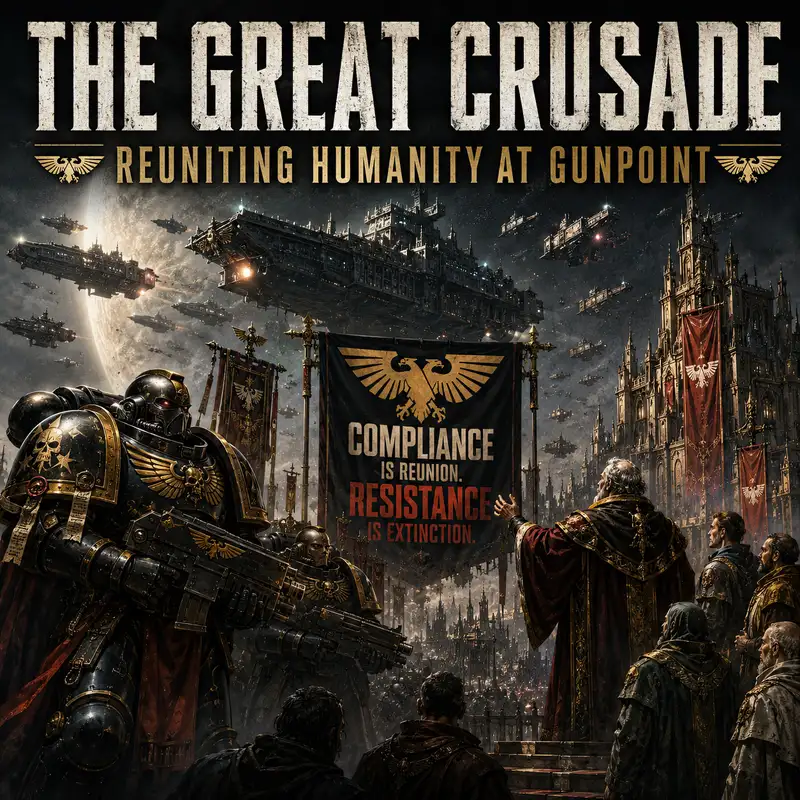
The first sign that humanity had found you again was often an eclipse. An expeditionary fleet would emerge from the Warp, spread across the sky, and announce that isolation was over. A voice from orbit offered protection, trade, knowledge, and a place in the new Imperium of Man. Behind that voice waited warships, soldiers, Titans, and genetically engineered warriors built to end disagreements with remarkable efficiency. The message was called Compliance. The choice was presented as reunion. The guns made clear how many answers were acceptable.
That contradiction sits at the heart of the Great Crusade. It was one of the most ambitious rescue operations in human history, and one of its greatest wars of conquest. It liberated populations from alien masters, mutant tyrants, predatory warlords, and the long nightmare of Old Night. It also destroyed human civilizations whose principal crime was refusing to recognise the authority of a ruler on distant Terra. The Great Crusade promised to reunite humanity, but it never seriously considered asking humanity what reunion should look like.
The Crusade began because the Age of Strife had left the species scattered and wounded. For thousands of years, Warp storms had cut star systems off from one another. Human colonies survived alone, changed alone, and often died alone. Some regressed into feudal societies. Others preserved fragments of the technology of an earlier age. A few built new interstellar powers. Many endured invasion, enslavement, psychic catastrophe, or rulers who had discovered that the end of civilisation created excellent opportunities for personal advancement.
When the great Warp storms began to recede, the Emperor had already conquered Terra. He did not see the opening of the stars as an invitation to cautious exploration. He saw a closing window. Humanity was divided, alien empires were expanding, and the species was becoming increasingly psychic. In his view, fragmentation was not cultural variety. It was a death sentence waiting to be carried out. Only a united human empire could survive what was coming.
That belief explains the urgency of the Great Crusade. It also explains its cruelty. The Emperor appears to have concluded that the survival of the species mattered more than the consent of any individual world. A planet could object that it had survived Old Night without Terra. It could point to its own laws, traditions, science, or alliances. The Imperial answer remained the same. Survival had been temporary. Independence was dangerous. History had already rendered its verdict, and the fleet in orbit had arrived to enforce it.
The first great partnership of the Crusade was made with Mars. The Emperor needed the Mechanicum’s shipyards, weapons, engines, and technical knowledge. Mars needed access to Terra, protection, and the opportunity to recover lost technology across the stars. The resulting compact gave the new Imperium the industrial power required to leave the Solar System. It also established an enduring Imperial habit. Principles were absolute until an indispensable ally required an exception.
The Crusade proclaimed the Imperial Truth, a secular doctrine that rejected gods, superstition, and supernatural explanations. Yet the Mechanicum retained its religious identity and many of its ancient rites. The Emperor was accepted by many on Mars as the Omnissiah, a divine figure within the Machine Cult. Thus, the great rational campaign against religion began with a religious compromise. The arrangement was politically necessary, strategically brilliant, and philosophically untidy. The Imperium would become rather good at that combination.
From Terra and Mars came the Expeditionary Fleets. They were not simply collections of Space Marine warships. They were travelling instruments of state. Imperial Army regiments provided mass, endurance, occupation forces, artillery, armour, and the ordinary human labour of war. The Mechanicum supplied engines, priests, technicians, and Titan Legions. Naval crews carried the armies between worlds. Navigators guided ships through the Warp. Administrators, diplomats, iterators, and agents of Compliance followed behind the spearhead, ready to explain why the conquered had chosen wisely.
The Space Marine Legions were the decisive edge. They could strike command centres, destroy orbital defences, seize void ports, and break an enemy government before a conventional army had finished unloading. Their purpose was not to occupy every street on every world. It was to make resistance collapse. Once the leadership was dead, captured, or reconsidering its position from beneath several tonnes of fallen masonry, the larger Imperial machine could move in.
Compliance could be peaceful. Many worlds welcomed the fleets. Some had preserved stories of Terra and saw the Emperor’s arrival as the fulfilment of ancient hopes. Others were desperate for protection, medicine, trade, or contact with a wider human civilisation. A world trapped beneath alien rule might experience the Legions as genuine liberators. Human slaves freed from Ork empires or other xenos powers did not need a lecture on the moral ambiguities of Imperial expansion. The arrival of an army that killed their masters was a fairly persuasive argument in its own right.
The benefits could be real. Warp routes reopened. Isolated economies entered networks of exchange. Technology, expertise, and military protection became available. Stable worlds gained access to a civilisation operating on a scale no single planet could match. The Great Crusade did not expand for nearly two centuries through terror alone. It carried hope, confidence, and a powerful belief that humanity had survived its worst age and was now reclaiming the future.
Yet peaceful Compliance was never an agreement between equals. The Imperium might preserve a local ruler, legal system, or military tradition, but sovereignty belonged to the Emperor. A compliant world accepted Imperial authority, contributed resources, provided troops when required, and abandoned practices judged incompatible with the new order. It could negotiate the details. It could not negotiate the central fact. Terra ruled.
This is why the phrase reuniting humanity at gunpoint is more than a joke. The weapon did not need to fire to shape the conversation. A planetary council might sign a treaty after cordial discussions, but the warships remained visible through the windows. Imperial diplomats could be patient because the fleet had nowhere else to be until the correct conclusion was reached. The Crusade preferred bloodless victory. It did not confuse preference with restraint.
The Imperial Truth made Compliance ideological as well as political. The Emperor was not merely assembling a defensive alliance. He was attempting to remake human civilisation. Religions were suppressed, temples destroyed, cults broken, and beliefs associated with Old Night treated as dangerous infections. The official argument was that reason would free humanity from fear and manipulation. That claim had force. The galaxy contained entities that fed upon mortal emotion and used faith as an opening. Unfortunately, the Imperial Truth protected humanity by denying people enough knowledge to understand what they were being protected from.
The result was a strange form of enforced enlightenment. Imperial agents taught that the universe was rational while travelling through a dimension shaped by thought and nightmare. They denied gods while following a golden immortal who could bend armies to his will. They burned sacred texts while carrying banners, relics, oaths, and rituals of their own. The new Imperium rejected religion, but it understood the political value of ceremony perfectly well.
The rediscovery of the Primarchs transformed the Crusade. The Emperor’s lost sons were found across the galaxy, each shaped by the world that had raised him. Each took command of the Legion created from his genetic legacy. Their arrival gave the Legions fathers, identities, and commanders of extraordinary ability. It also meant that the Emperor’s supposedly unified vision would be carried out by a collection of demigods with sharply different ideas about war, rule, honour, fear, and the appropriate number of artillery shells required to make a philosophical point.
A world’s first experience of the Imperium could therefore depend upon which Primarch reached it. Horus was charismatic, politically alert, and often willing to seek a negotiated solution. Roboute Guilliman thought beyond victory toward administration, supply, and stable government. Rogal Dorn understood duty, fortification, and the permanent architecture of power. Jaghatai Khan valued independence more than many of his brothers and remained uneasy with the machinery of empire even while serving it.
Other Legions made Compliance a darker word. The Night Lords used terror as strategy, punishing selected populations so brutally that entire systems might surrender rather than invite their attention. The Iron Hands valued strength and regarded resistance as proof that harsher correction was required. The Death Guard endured conditions that destroyed ordinary armies and advanced through wars of attrition with grim patience. The World Eaters increasingly made conquest inseparable from slaughter. The Imperium possessed many tools. Some were hammers. Some were also hammers, but with different heraldry.
These differences were not accidents outside the system. The Emperor employed Legions according to their nature. A stubborn technological power might face the Iron Hands and the engines of the Mechanicum. A realm held together by fear might discover that the Night Lords understood the subject professionally. A complex human civilisation might receive Horus, whose charm could accomplish what bombardment could not. The Great Crusade was flexible in method because it was inflexible in purpose.
Guilliman showed what Imperial expansion could achieve at its best. The worlds associated with Ultramar were not merely defeated and stripped. They were organised, defended, connected, and made productive. His victories created institutions that could survive the departure of the conquering fleet. This was still empire, and it still rested upon ultimate force, but it offered many populations security and functioning government in exchange for obedience. In a galaxy recovering from Old Night, that was not a trivial bargain.
Lorgar offered a different answer. He did not want merely compliant worlds. He wanted believing worlds. Under his influence, the Word Bearers lingered after conquest, rebuilding cities and teaching populations to worship the Emperor as a god. The worlds they shaped could be deeply loyal and prosperous, but their faith violated the Imperial Truth and their careful conversions slowed the pace of expansion. The Emperor’s response was not a theological debate.
The city of Monarchia was destroyed by the Ultramarines as a public lesson. Its population had already accepted Imperial rule. Its offence was that it embodied the wrong form of loyalty. Lorgar and his Legion were forced to kneel in the ashes of what they had built and acknowledge that the Emperor was not a god. The message was precise. The Imperium demanded belief in the Imperial project, but reserved the right to define which beliefs were permissible. Devotion did not excuse disobedience.
Monarchia reveals that the Great Crusade was not only about bringing isolated worlds into the fold. It was also about disciplining the conquerors and standardising the meaning of unity. Even a Primarch could not create his own interpretation of the Emperor’s mission. The Crusade’s authority ran downward from one source. The further it spread, the more it depended upon commanders acting independently, yet those commanders were punished if their independence produced the wrong kind of success.
Some human societies posed a more difficult problem because they demonstrated that survival outside the Imperium was possible. The Diasporex was a nomadic civilisation in which humans and aliens lived together. It did not seek to conquer the Imperium. It wanted to continue its own existence and refused the demand that its human members abandon their xenos allies. To the Great Crusade, that refusal made the entire society an enemy.
The Diasporex was destroyed by Imperial forces after a hard campaign. Its existence challenged one of the Crusade’s central assumptions. Humanity, according to the Imperial vision, could survive only through unity under the Emperor and separation from alien powers. A mixed civilisation that had endured through cooperation was therefore not evidence to be considered. It was a contradiction to be eliminated. The Crusade did not merely defeat threats. It also destroyed alternatives.
The Interex offered an even more painful glimpse of another path. It was an advanced human civilisation with knowledge of Chaos and a relationship with an alien species it had defeated and later incorporated into its society. When Horus encountered the Interex late in the Great Crusade, he did not immediately demand war. He considered diplomacy, partly because he had begun to question whether every human culture needed to be forced into the same pattern.
That opening collapsed through mistrust, cultural misunderstanding, and deliberate sabotage. A weapon was stolen, suspicion fell upon the Imperials, and violence followed. The Interex was not proof that lasting peace was certain. Its leaders viewed the Imperium with understandable alarm, and both sides carried assumptions that made conflict easier. Still, the encounter mattered because Horus briefly recognised that reunion might require something more imaginative than Compliance. The machinery around him was much better prepared for conquest.
The treatment of alien species made the Crusade especially uncompromising. Some xenos empires were obvious predators. Orks built expanding war states founded upon violence and enslavement. Other species preyed upon human worlds or had exploited humanity during its weakness. Against such enemies, extermination could appear not only practical but necessary. The mistake was turning a judgement about many dangerous aliens into a universal law about all of them.
Imperial policy left little room for coexistence. A human world with alien allies was suspect. A culture that had borrowed xenos technology might be condemned. A species that posed no immediate threat could still be removed because it occupied territory intended for human expansion. The Crusade spoke the language of survival, and survival gradually became entitlement. Once the future belonged to humanity by definition, anyone already living in that future had become an obstacle.
The scale of the campaign encouraged moral distance. Expeditionary Fleets operated far from Terra, separated by unreliable communication and months or years of travel. Commanders made decisions with limited information. Administrators measured progress in compliant systems, secured routes, tithe capacity, and military production. A world reduced to a line in a campaign record could look remarkably tidy, especially after the parts that objected had been removed.
Every new conquest also fed the next. Compliant worlds supplied soldiers, ships, food, fuel, and industrial output. Local regiments joined the Imperial Army and marched toward worlds they had never heard of. Some fought willingly, proud to take part in humanity’s restoration. Others served because their new obligations were not optional. The Great Crusade became a self-expanding engine. It conquered worlds to gain the strength required to conquer more worlds, all in pursuit of the peace that would begin once conquest was complete.
Its greatest public triumph came at Ullanor. There, the Imperium confronted a vast Ork empire powerful enough to threaten the entire project. The campaign required enormous force and the direct leadership of the Emperor and several Primarchs. Victory demonstrated that the Crusade was not merely inventing enemies to justify itself. The galaxy contained powers capable of destroying human civilisation, and only a united military effort could defeat some of them.
Ullanor seemed to vindicate everything. The Emperor’s armies had crossed the stars, found his lost sons, broken rival empires, and raised humanity from isolation to dominance. At the triumph that followed, Horus was named Warmaster and given command of the Great Crusade. The Emperor withdrew to Terra to pursue work he did not fully explain. To those watching, the transfer appeared to mark the beginning of the Crusade’s final stage. The greatest threats had been defeated. The remaining work could be entrusted to the most celebrated of the Primarchs.
Yet the victory concealed the weaknesses created by the campaign itself. The Imperium had expanded faster than trust, law, and shared understanding could follow. Its unity depended heavily upon personal loyalty to the Emperor, while the Emperor increasingly removed himself from those who had won his empire. The Primarchs had been given armies, worlds, and immense authority, but not a full explanation of the future they were building. They knew how to conquer for their father. They did not all know what he intended to do with the victory.
The Legions had also learned that force resolved political disagreement. For two centuries, they had encountered unfamiliar societies, judged them against Imperial requirements, and destroyed those that failed the test. They had been praised for speed, obedience, and decisive violence. Compromise was useful only when it produced Compliance. When a dispute later arose within the Imperium itself, its greatest commanders possessed an extraordinary range of weapons and very little practice accepting that two visions of humanity might coexist.
The Great Crusade succeeded on its own terms. It reunited enormous numbers of human worlds, reopened the stars, shattered genuine threats, and created the Imperium. Without it, humanity might have remained divided until stronger powers consumed its fragments one by one. To call it nothing but tyranny ignores the people it rescued and the dangers it defeated.
To call it liberation, however, requires accepting the Emperor’s definition of freedom. Humanity was freed from isolation so that it could obey Terra. It was freed from superstition through censorship and fire. It was freed from alien domination by an empire that often treated all alien life as guilty in advance. It was given a common future, but not a vote on the terms.
The tragedy of the Great Crusade is not that its promise was entirely false. The promise was powerful because much of it was true. Humanity needed connection, defence, knowledge, and hope after Old Night. The Emperor offered all of them. He also made one ruler, one ideology, and one empire the price of admission. The rescue fleet and the invasion fleet were the same ships.
Beneath the banners of unity, the scattered worlds of humanity were joined together at last. Each link in the chain was recovered from the darkness, tested for obedience, hammered into shape, and held in place by a weapon that never quite lowered.