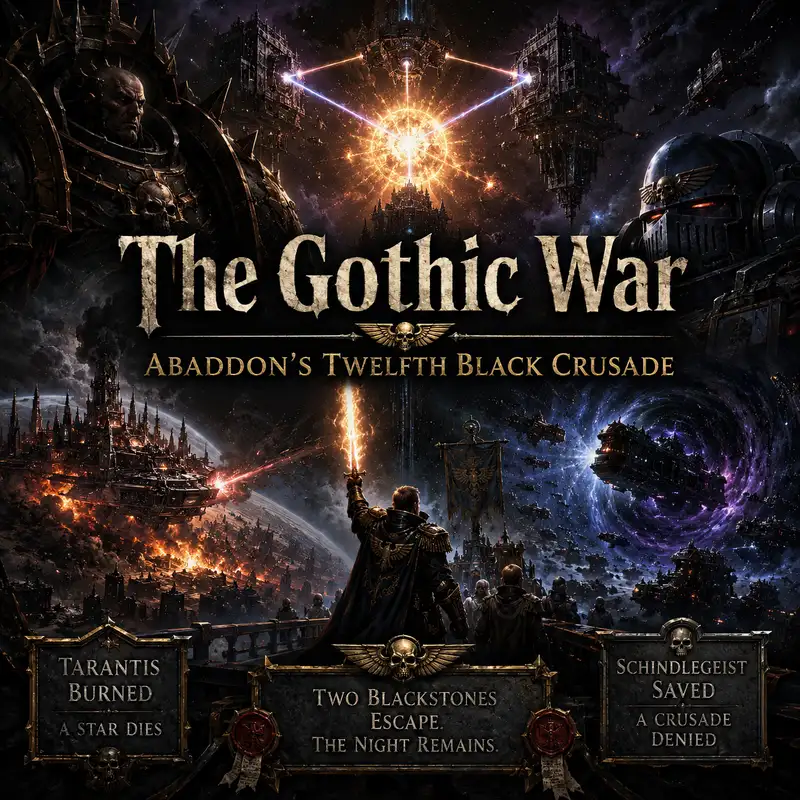
The Gothic War: Abaddon’s Twelfth Black Crusade
The star at Schindlegeist had already been sentenced when Captain Abridal turned the Flame of Purity toward the light. Three Blackstone Fortresses hung across the system, ancient structures arranged like points on a weapon no human engineer truly understood. Their beams began to converge upon the sun. If they joined, the star would die and every world around it would follow. Abridal drove his battleship into the gathering energy. The Flame of Purity vanished. Its crew vanished with it. The beams broke apart, the star endured, and Abaddon the Despoiler was forced to abandon the field with only two of his stolen fortresses.
It was one of the clearest Imperial victories of the Gothic War, and it concealed the war's most uncomfortable truth. The Imperium stopped Abaddon from taking everything he wanted. It shattered fleets, reclaimed systems, and eventually drove the invaders back toward the Eye of Terror. Yet Abaddon escaped with two weapons of almost incalculable power, while the remaining Blackstone Fortresses were destroyed. The Gothic Sector survived, but its greatest strategic assets did not. The central question is therefore not whether the Imperium won the final battle. It did. The question is whether that victory prevented Abaddon from achieving the purpose of his Twelfth Black Crusade.
The Gothic Sector lay in the Segmentum Obscurus, a region of inhabited systems, naval stations, forge facilities, shrine worlds, mines, and trade routes held together by the Imperial Navy. Its heart was Port Maw, headquarters of Battlefleet Gothic. On a map, the sector could be marked with a tidy symbol. In reality, it was an expanse so vast that messages might arrive after the crisis they described had become a historical subject. Imperial warships were floating cities of steel, scripture, machinery, and exhausted human labour. They could break continents from orbit, but they could not be everywhere. That limitation would shape the entire war.
Abaddon understood it. His Black Crusades were not simply repeated attempts to charge through the Cadian Gate until someone ran out of ammunition. Each could serve a narrower objective, gathering relics, testing defences, breaking alliances, or opening another step along what later accounts call the Crimson Path. Before the Gothic War, the sorcerer Zaraphiston and the prophet Moriana helped direct him toward two artefacts, the Hand of Darkness and the Eye of Night. These were not trophies for a cabinet, assuming Abaddon kept cabinets. They were keys, or something close to keys, capable of helping him awaken and control the Blackstone Fortresses scattered through the Gothic Sector.
The six fortresses known to the Imperium were relics from an age so remote that even their builders remained uncertain. The Aeldari knew them as the Talismans of Vaul and associated them with an ancient war against the star gods called the C'tan. Imperial authorities had found the structures dormant and done what the Imperium often does with incomprehensible technology. They installed personnel, guns, docking facilities, and devotional machinery, then declared the result understood well enough for government service. As naval bases, the fortresses were formidable. As awakened weapons, they could focus energies capable of killing worlds and, when linked together, murdering stars.
Warnings came before the main assault, but they arrived as fragments. In one hundred and thirty-nine of the forty-first millennium, the scout frigate Ascendance received a broken plea from the station at Arx. Reinforcements took months to arrive. They found the garrison slaughtered and the attackers gone. Elsewhere, abandoned vessels drifted with their crews dead at their posts, disease spreading through sealed corridors. Rumours blamed the plague ship Plagueclaw. Rebellions flared across the sector. Patrols sighted heretic warships where no major Chaos fleet was supposed to be. Inquisitor Thadus Valconet Horst saw the pattern, but seeing a storm gather is not the same as knowing where it will break.
The obvious fear was another direct attack through Cadia. Imperial commanders strengthened the Cadian Gate, while Abaddon moved against more distant targets and secured the artefacts he needed. Then the warp itself closed around the Gothic Sector. A vast storm cut astropathic communication, disrupted navigation, and isolated Battlefleet Gothic from outside reinforcement. Whether every part of this isolation was deliberately engineered is difficult to prove, but Abaddon exploited it with brutal precision. Lord Admiral Cornelius von Ravensburg ordered total mobilisation. Merchant vessels were pressed into service. Recruitment widened. Forge facilities shifted production. Every usable hull became valuable, including several that would ordinarily have been considered valuable mainly as warnings to junior engineers.
In one hundred and forty-three, Chaos fleets struck naval bases across the sector. The timing was devastating. Warships were attacked in dock, where engines were cold, crews dispersed, and manoeuvre impossible. Orbital stations fell. Repair yards burned. Yet the assault was not uniformly successful. At Orar, forces already alert from suppressing rebellion evaded the opening torpedo attack and mauled the raiders. This mattered because the Gothic War was never one clean advance. It was a patchwork of disasters, local recoveries, betrayals, raids, and fleet actions separated by distances that made central control painfully slow. Abaddon had the initiative, but he did not possess perfect command of the void.
The true objective soon became visible at Rebo. A Chaos force overran the system, and the Blackstone Fortress stationed there mysteriously lost power. The ancient installation was captured with alarming ease. This was no ordinary seizure of a naval base. Abaddon had demonstrated that the fortresses could be silenced from within their own forgotten systems. The Imperium had occupied them for thousands of years without discovering the full nature of what it guarded. Now an enemy armed with the correct relics and forbidden knowledge was opening doors that Imperial priests had spent centuries polishing.
Then the Planet Killer appeared over Savaven. The vessel was unlike any standard Imperial design, a vast engine of destruction built or completed within the Eye of Terror and bound to powers the Adeptus Mechanicus could not comfortably explain. Its main weapon fired into the Cardinal World. Continents broke. The atmosphere burned. The planet came apart, and its population died with it. Surviving reports disagree over exact numbers, as Imperial records often do when the number has become too large to change the decision. The strategic effect was immediate. Abaddon had not merely destroyed a world. He had shown every governor in the sector what refusal might cost.
Terror became a logistical weapon. Some systems resisted. Others surrendered, calculating that service to Chaos might leave someone alive to regret it. The world of Saviour yielded its orbital docks and began supporting the invaders. The choice was coerced, but its consequences were practical. Chaos fleets gained repair, fuel, and replacement capacity inside the sector they were attacking. This is one reason the Gothic War lasted so long. Abaddon did not depend entirely on supply lines reaching back through the Eye of Terror. He converted threatened Imperial infrastructure into support for his own campaign. Planetary annihilation was spectacular. Capturing a functioning dockyard was, in its quieter way, just as useful.
A second Blackstone Fortress fell near a Mechanicus installation in the Lukitar region. At Fularis the Second, Abaddon defeated the defending battlegroup and brought two captured fortresses into alignment. Their combined discharge stripped the world of its atmosphere and erased life from its surface. He then secured a third Blackstone. The escalation was unmistakable. One fortress was a prize. Two were a planetary execution device. Three could reach into a star. The Imperium was not simply losing bases. It was teaching Abaddon, through successful use, how much of the ancient weapon he could command.
The war widened around this central struggle. Chaos fleets under rival commanders ranged through the sector. The Black Legion fought beside forces devoted to different gods and ambitions. Human pirates attacked weakened shipping. Ork freebooters hid among asteroid fields and ambushed whichever side offered the most satisfying explosion. Aeldari corsairs raided Imperial routes from the Graildark Nebula. Some of these factions fought Abaddon as readily as they fought the Imperium. For von Ravensburg, that offered opportunities, but it also made every report difficult to interpret. An Ork attack on a Chaos convoy was helpful. An Ork attack on the Imperial convoy sent to exploit that help was less so.
Battlefleet Gothic survived through discipline rather than dramatic rescue. Convoys had to move. Damaged cruisers had to reach repair docks. Isolated worlds had to be supplied even when no admiral could promise relief. Naval crews fought actions that never became famous because their achievement was simply that a transport arrived. Von Ravensburg also recognised a weakness in Abaddon's strength. The Chaos armada was larger, but it was dispersed among separate fleets, commanders, and objectives. If the Imperials could concentrate against one portion at a time, they might destroy the enemy in pieces. The difficulty was finding those pieces before they found another undefended world.
The Aeldari gradually changed that equation. Early in the war, corsairs had been predators exploiting Imperial weakness. Yet the Blackstone Fortresses were not merely human concerns. To the Aeldari, they were ancient weapons tied to dangers older than the Imperium itself. Cooperation began from necessity, not affection. Imperial commanders assisted Aeldari forces against Ork attackers, and Aeldari leaders supplied intelligence that the Navy could not obtain alone. Other corsairs continued raiding, because no treaty in the Gothic Sector was permitted to become uncomplicated. Still, a working alliance emerged. The Imperium brought mass and endurance. The Aeldari brought speed, foresight, and routes through space that human navigators could not use.
Years passed under blockade and attrition. Entire subsectors slipped under Chaos control. Stranivar resisted for two years before the Planet Killer devastated it. On Corilia, Black Legion Terminators struck directly into the ruling hive, slaughtered defenders, and disappeared with the governor. On Drakulu, millions were enslaved, sacrificed, or forced into service aboard Chaos vessels. These were not disconnected acts of cruelty. They weakened administration, fed sorcery, replaced labour, and persuaded other worlds that no defence was certain. The Gothic War was fought by capital ships, but it was sustained by frightened populations, stolen industry, and human beings reduced to fuel for systems both mechanical and occult.
Abaddon's campaign nevertheless carried its own fractures. Chaos unity is often strongest at the moment of invasion and weakest during the long work that follows. The Warmaster could compel obedience, promise plunder, and direct major operations, but his subordinate commanders still pursued private rivalries and opportunities. Fleets became separated. Pirates disrupted supply. Imperial resistance did not collapse on schedule. The Planet Killer itself required resources taken from conquered worlds. Abaddon possessed weapons of extraordinary destructive power, yet destruction could not by itself secure every route, dock, and system. The war became a contest between his narrowing window of opportunity and the Imperium's ability to remain alive until that window closed.
By one hundred and fifty-one, the warp storms began to weaken. Von Ravensburg seized the moment before reinforcements had even fully arrived. A major Chaos fleet moved toward Gethsemane, and Battlefleet Gothic concentrated against it. The engagement was savage, but the Imperial plan worked. When the Chaos commander attempted to withdraw, an Aeldari force struck from the rear. Trapped between fleets that had once regarded each other as enemies, the Chaos formation was annihilated. Gethsemane became the first great, unmistakable Imperial victory of the war. More important than the ships destroyed was the change in momentum. Abaddon's scattered fleets could now be hunted rather than merely endured.
The storm's retreat opened the sector to outside aid. Fresh Imperial warships entered the campaign. Space Marines from several Chapters arrived to reinforce hard-pressed systems. Routes that had been sealed for nearly a decade began carrying men, ammunition, and information. Abaddon understood what this meant. His advantage had depended upon isolation. With each new Imperial battlegroup, the chance of capturing the remaining Blackstones diminished. He responded not by quietly withdrawing, but by demonstrating the full power of the three fortresses already under his control.
At Tarantis, the Blackstones aligned and fired upon the system's sun. The star went supernova. The system died. This was destruction beyond conventional bombardment, beyond invasion, and beyond any useful concept of surrender. A planet threatened by the Planet Killer might yield. A star offered no terms. Tarantis proved that Abaddon had not crossed the Gothic Sector merely to raid it. He had acquired a strategic weapon able to erase entire systems, and he was willing to use it. It also revealed his next likely move. If three fortresses could do this, then taking the remaining installations might give him a weapon on a scale the Imperium could not survive.
Aeldari scouts identified Schindlegeist as his next target. Abaddon sent the Planet Killer under Malefica Arkham to strike elsewhere as a diversion, while his main force moved toward the fortress orbiting Schindlegeist. The Imperial and Aeldari fleets used routes unavailable to the Chaos armada and arrived first. They prepared an ambush. When Abaddon entered the system, he found the defenders concentrated and waiting. For three days, ships fought across the void. Batteries fired at ranges measured in thousands of kilometres. Attack craft vanished in defensive fire. Burning cruisers continued forward because turning a dying ship away from the enemy would have wasted its last useful minutes.
Unable to break the allied fleet, Abaddon ordered his three Blackstones to destroy the star. That was the moment Captain Abridal made his attack. The Flame of Purity entered the converging beams and was consumed, but its destruction disrupted the firing sequence. The delay was enough. Abaddon's fortresses were exposed, his fleet had suffered heavily, and Imperial reinforcements were closing. He withdrew into the warp with two Blackstones. The third was boarded by Space Marines of the Angels of Redemption. They found no crew and no resistance. Soon afterward, it self-destructed. The three Blackstones still held by the Imperium destroyed themselves at nearly the same time. The surviving records do not settle who triggered their deaths, or why.
The battle drove Abaddon from the sector, but it did not end the killing. Chaos squadrons remained at large. Pirates had built small empires among ruined systems. Aeldari raiders did not all honour the alliances made by others. Malefica Arkham, abandoned with the Planet Killer, attempted to become a power in his own right. Imperial accounts later credited four Lunar class cruisers with destroying the great vessel by sustained torpedo attack near Kharlos the Second, although later reports make its final fate less certain. The clean-up continued until one hundred and sixty of the forty-first millennium. By then, nearly two decades had passed since the first warnings at Arx.
Measured by possession of the battlefield, the Imperium won. Battlefleet Gothic remained. Port Maw remained. Abaddon's main fleet retreated, his attempt to seize another fortress failed, and the sector's trade routes were eventually restored. The cost was beyond ordinary calculation. Worlds had been broken, populations erased, fleets reduced to wreckage, and whole regions left vulnerable to pirates and rebellion. Four of the six Blackstone Fortresses were gone. The other two belonged to Abaddon. An Imperial victory had preserved the sector while removing every one of the ancient weapons from Imperial control.
Measured by Abaddon's larger purpose, the answer is darker. He did not achieve a perfect victory. Schindlegeist was a genuine defeat, not a performance staged for Imperial morale. He lost ships, commanders, time, and the chance to claim all six fortresses. Yet the two he carried away became instruments of later strategy. One helped purchase the allegiance of Huron Blackheart. The other, known as the Will of Eternity, returned during the Thirteenth Black Crusade and became part of the destruction of Cadia. The prize taken from the Gothic Sector did not win the Twelfth Crusade in the conventional sense. It helped make the next one catastrophic.
This is why the old claim that Abaddon's first twelve Black Crusades were simple failures misses the nature of the Long War. It is equally misleading to pretend that every setback was secretly intended and every lost fleet merely advanced an immaculate design. Abaddon can be strategically successful without being infallible. In the Gothic War, he planned carefully, exploited ancient knowledge, isolated his target, and escaped with weapons he wanted. He was also surprised, resisted, and beaten at the decisive battle. Both facts matter. The campaign shows a commander capable of turning an incomplete victory into a future advantage, which is more dangerous than a villain who never truly loses.
The Imperium commemorated the war with immense monoliths engraved with the names of those who served, from Lord Admiral von Ravensburg to the crews of humble merchant vessels. The monuments were deserved. Schindlegeist had been saved by courage, Gethsemane by sound command, and the sector by years of labour from people who could not know whether help would ever arrive. Yet monuments record sacrifice more easily than consequence. While the names were carved into stone, two darker stones were already moving through the warp in Abaddon's possession. The Gothic War ended with the sector saved, the enemy driven away, and the weapon that would one day break Cadia already vanishing into the dark.