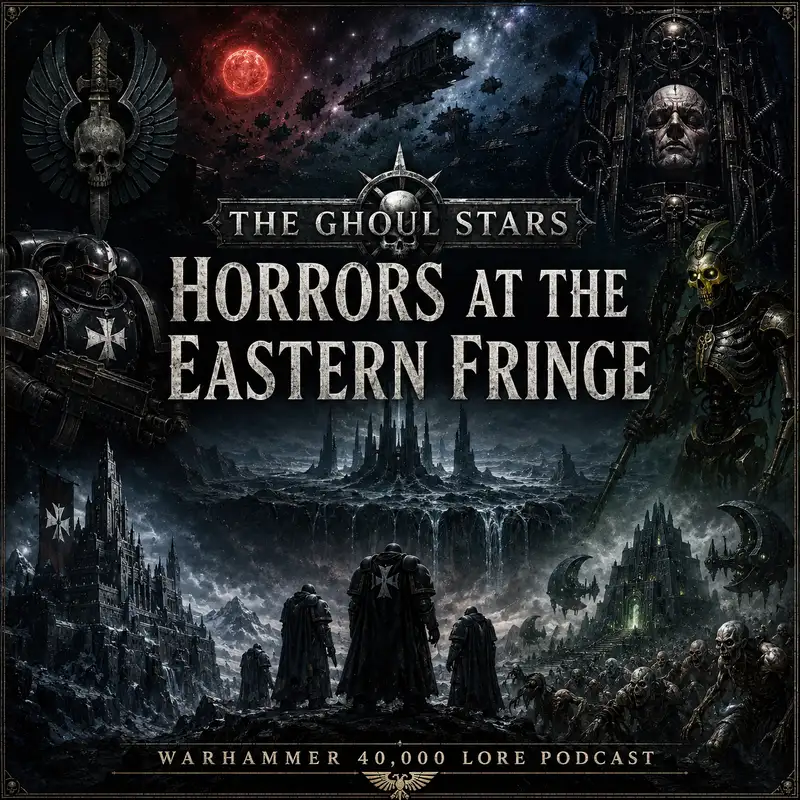
The Ghoul Stars: Horrors at the Eastern Fringe
The Black Templars reached the final Cythor stronghold expecting a last stand. Their crusade had burned through system after system, smashing alien outposts and driving the surviving fiends toward the heart of their realm. The warriors prepared for a fortress assault. Their guns were loaded, their oaths spoken, and their High Marshal was ready to finish the war. Then the fleet entered the core worlds and found them empty.
There were structures, platforms, and the remains of a civilisation, but no enemy waiting to defend them. At the former Cythor capital, the Templars tried to destroy the world itself. Even that proved strangely difficult. They eventually set its atmosphere burning, which was a very Imperial way of expressing dissatisfaction, but the victory felt hollow. The Cythor Fiends had not been defeated in the manner the crusaders understood. They had simply ceased to be where the Imperium expected them to be.
The Death Spectres, who had watched the Ghoul Stars for generations, were not surprised. They had warned that the Cythors might evade destruction. Some of their ships had waited in ambush for years, guarding routes through which the aliens might return. That difference between the Black Templars and the Death Spectres tells us almost everything important about the Ghoul Stars. One force entered the region believing that a war could be concluded. The other had learned that nothing there ever ends quite so cleanly.
The Ghoul Stars lie at the extreme northeastern edge of the galaxy, beyond the comfortable fiction that the Imperium controls everything shown on its maps. They are sometimes called the Ghost Stars, and the name suits them. Dying suns cast cold light across dead worlds. Human settlements appear in the records, then vanish from them. Ancient ruins stand beneath unfamiliar skies, while entire systems seem to belong more to archaeology than to living civilisation.
This is not merely remote space. The Imperium contains many remote places, most of which are dangerous in the familiar ways. Pirates raid shipping. Orks gather. Tyranids consume. Governors rebel and then discover that the Administratum has, after several centuries of careful consideration, misplaced the paperwork needed to save them. The Ghoul Stars are different because familiar explanations begin to fail. The deeper expeditions go, the thinner the surviving accounts become.
Navigation is uncertain. Astropathic messages are fragmentary. Rescue, when it comes at all, arrives after events have become history. The few Imperial colonies scattered across the region exist behind a defensive philosophy that is not really designed to defend them. Forces watching the Ghoul Stars are often more concerned with preventing something from escaping toward the wider Imperium than with saving whoever already lives inside the cordon.
The region was old and ruined before the Imperium reached it. During the Great Crusade, Imperial fleets pushed into parts of the Ghoul Stars and found what later accounts would describe as a graveyard of empires. Even the Dark Angels, armed with some of the most terrible weapons available to the Emperor, treated campaigns there as matters of secrecy and final sanction. The message is difficult to miss. Humanity did not discover an empty frontier. It arrived late at the scene of several extinctions.
The Horus Heresy made the border still worse. Nostramo, the lost homeworld of the Night Lords, had stood near the edge of the region. War, raiding, and the collapse of Imperial authority depopulated worlds that had only recently been claimed. The Imperium had planted flags in the dark, then turned its weapons upon itself and left many of those flags standing over graves.
One account from the Great Crusade places Lion El'Jonson and the First Legion far from the triumph at Ullanor, pursuing a single rebellious world in the Ghoul Stars. The public reason looked too small for the force committed. The implied reason was that the Lion knew something he would not share, even with most of his own sons. In this region, secrecy was not an administrative habit. It was part of the weaponry.
One human power did endure beyond ordinary Imperial control. The Ashen Claws began as warriors of the Raven Guard Legion, veterans sent into exile by Corax during the Great Crusade. Bitter, isolated, and increasingly loyal only to one another, they rejected both the Emperor and the Warmaster. They carved out a pocket empire around Atargatis and survived through raiding, trade, and a willingness to adapt in ways a conventional Chapter would consider intolerable.
Ten thousand years in the Ghoul Stars changed them. They remained violent and piratical, but their isolated human population became too valuable to treat as entirely disposable. Local tribes gained influence over the renegade Space Marines who ruled them. The result was not a kinder society. It was simply a society shaped by scarcity rather than Imperial doctrine. In the Ghoul Stars, even superhuman warriors become something their founders did not intend.
That is one layer of the region's horror. The Ghoul Stars do not merely kill intruders. They alter the institutions that remain. Crusaders become permanent sentries. Loyalists become raiders. Protectors learn to calculate which worlds may be sacrificed. Survival demands compromise, and the compromise rarely stops at the point where anyone would like it to stop.
Atargatis itself reflects that long exile. Its red sun lashes a barren world of grey tundra, black stone, asteroid fields, and radioactive winds. The Ashen Claws hid their stronghold in the mountains and built a realm that no Imperial tithe ship could easily reach. They survived not because the frontier became safe, but because they learned to treat isolation as both fortress and prison.
The greatest warning from the region came during the late thirty-fourth millennium. The Imperium was already divided by the political and religious upheaval remembered as the Nova Terra Interregnum. From the Ghoul Stars emerged a threat later called the Pale Wasting. Almost everything about it is uncertain, and that uncertainty is not an accident. Inquisitorial authorities destroyed or censored much of the surviving record.
The fragments that remain do not agree with one another. Some describe a plague born among the stars, spreading across world after world. Others speak of nightmare machines slaughtering entire sectors. These may have been two aspects of the same enemy. They may describe several connected horrors. They may be the frightened language of witnesses trying to explain something for which Imperial classification offered no useful category.
What is clear is the scale of the response. The Novamarines and eleven other Space Marine Chapters were sent against the Pale Wasting. The conflict was remembered as apocalyptic. Eleven Chapters were destroyed, while the Novamarines became associated with the desperate resistance that finally stopped the threat. Later generations were left with little more than scattered references and an old memorial on Terra.
Consider what that means. Space Marine Chapters are among the Imperium's most durable military institutions. Each carries centuries of experience, its own fleets, relics, fortresses, and gene-seed. The loss of one Chapter can reshape wars across a sector. The Pale Wasting consumed eleven, yet the Imperium preserved almost no coherent explanation of what they fought.
Perhaps the records were destroyed because the truth was dangerous. Perhaps officials wished to hide the scale of their failure. Perhaps the surviving accounts were so contradictory that censorship became easier than understanding. The precise reason is unknown. The result is a warning carved into absence. Something came out of the Ghoul Stars, and the Imperium decided that remembering it clearly was itself a risk.
The force most closely associated with guarding that absence is the Death Spectres. They are successors of the Raven Guard, probably raised during the mysterious thirteenth Founding. Their duty is to watch the Ghoul Stars and prevent its inhabitants from threatening the wider galaxy. Their home is Occludus, a dark world where their fortress monastery, the Logopol, rises as a city built in the image of a crypt.
The memorial on Terra is therefore more disturbing than a complete battle record might have been. It honours courage while withholding the identity of the enemy. It preserves sacrifice but not comprehension. That is a familiar Imperial arrangement. The dead receive stone, incense, and ceremonial praise. The living receive a sealed archive and instructions not to ask why eleven Chapters failed to return.
At the heart of the Logopol is the Shariax, also called the Throne of Glass. The first master of the Chapter was drawn to it by a vision and found the alien device hidden beneath the planet. Every Chapter Master who follows him takes his place upon that throne and remains there until death. The artefact drains his life while granting some power essential to the Death Spectres' vigil.
The Chapter does not fully explain that power, and it has good reason to keep the Shariax hidden from the Inquisition. A Space Marine Chapter sworn to defend humanity has placed its highest commander inside an alien machine that slowly kills him. Day-to-day authority passes to other officers while the Chapter Master becomes a living component in a system no Imperial priest or engineer can safely claim to understand.
This is not presented by the Death Spectres as corruption. It is sacrifice. Their entire culture is built around death, rebirth, duty, and the hope of a future resurrection that will justify what they have endured. Their fallen are preserved beneath the fortress. Their symbols repeat the language of skulls, thrones, and transcendence. In another part of the Imperium, such customs might be ceremonial. On Occludus, they are practical arrangements.
The Chapter's protection also has hard limits. The Death Spectres guard the wider Imperium, not every human living within the Ghoul Stars. They have allowed local worlds to die when saving them offered no strategic benefit. They have taken human populations for recruitment and treated communities as sources of future aspirants. To the people caught beneath their shadow, the distinction between a Space Marine guardian and an alien raider may be doctrinally important but operationally subtle.
That ugliness matters because it prevents the Ghoul Stars from becoming a simple tale of noble sentries holding back monsters. The sentries are necessary. They are also frightening. The region has taught them to think in centuries, bloodlines, and containment zones. A village may see armed giants descend from the sky and never learn whether it has been rescued, harvested, or merely moved to a more useful grave.
The Cythor Fiends offered a different kind of terror. They possessed advanced technology, stealth vessels, and the ability to evade an extermination campaign that had apparently cornered them. Imperial observers classified them, fought them, and named their worlds, yet never reached a confident understanding of where the species went. Later evidence suggested that at least some Cythors survived far beyond the Ghoul Stars.
Their abandoned worlds remained behind. On Sarvakal Twenty-Two B, nightmare oceans washed beneath monolithic alien spires. The Ordo Xenos quarantined the planet after the crusade. Death Spectres warships continued their long watch, waiting for an enemy that had vanished before and might return by methods the Imperium did not comprehend.
The Black Templars had captured eighteen worlds and forced their way to the center of Cythor territory. By every conventional measure, they had won. The Cythors' armies were broken, their installations destroyed, and their capital set ablaze. Yet the enemy's disappearance turned conquest into uncertainty. A fortress can be stormed. A fleet can be sunk. It is much harder to kill a civilisation that has stepped sideways out of the battlefield.
Not every horror in the Ghoul Stars hides. Drazak, the Bone Kingdom, is terrible in a much more direct way. It is a Necron tomb world populated largely by Flayed Ones, creatures feared and rejected even by other Necrons. Their metal bodies are afflicted by a curse that drives them to imitate the flesh they lost long ago. They kill living beings, cover themselves in stolen skin, and attempt to satisfy appetites their mechanical forms can never fulfil.
Even the chronology of the Ghoul Stars Crusade is disputed in surviving accounts. That uncertainty does not change its outcome, but it reinforces the larger pattern. The Imperium can count worlds taken and ships lost with great confidence, then become vague at the exact point where the enemy does something impossible. Its records are precise about expenditure and remarkably philosophical about disappearance.
The streets of Drazak are filled with ruin, bone, and decaying trophies. Its inhabitants fight over scraps that cannot nourish them. Above the planet drift the empty remains of ancient Necron warships, a dead armada hanging in orbit like the wreckage of a forgotten judgement. The world is both kingdom and asylum, a place where the Necron race sends those whose damaged minds expose the cost of its immortality.
A ruler known as Valgul presides over this kingdom. When Drazak's supply of flesh runs low, its fleets launch raids against nearby worlds in periods called Times of Bounty. The phrase has the calm sound of an agricultural festival. In practice, it means that something ancient has decided the surrounding systems contain harvestable bodies.
Drazak is horrifying, but it is almost reassuring compared with the Pale Wasting or the vanished Cythors. Drazak has a name. Its rulers can be studied. Its raiding patterns can be tracked. The Flayed Ones are nightmare creatures, yet they belong to a known civilisation with motives that, however diseased, can be described. The worst parts of the Ghoul Stars are those that leave no stable category behind.
Reports mention other alien predators, ruined enclaves, and species known from little more than a name attached to a dead expedition. Even a Tyranid splinter moving through the region was recorded as becoming disoriented and twisted before changing course. That does not prove the Ghoul Stars possess a single will or curse. It proves only that the region can disturb forces that usually behave with terrifying consistency.
The Flayer curse is more than hunger. It is the collapse of Necron identity after immortality has already stripped away almost everything that once made its victims living beings. A Flayed One remembers flesh without possessing it, remembers appetite without digestion, and remembers a body it can only imitate with trophies. Drazak turns that private ruin into a political order, complete with a ruler, a court, and harvest seasons.
In the current age, the Great Rift has made the northeastern frontier still more isolated. The Ghoul Stars lie within the darkness of the Imperium Nihilus, where communication and reinforcement have become even less reliable. A later Black Templars force, the Oparian Crusade, disappeared into the region. Imperial belief insists that its warriors may still be fighting. Imperial belief is often what remains after evidence stops arriving.
This is why the Ghoul Stars should not be understood as one mystery waiting for one final answer. They are a stack of unfinished wars. The bones of ancient Necron conflict orbit above cursed worlds. Human empires rise beyond Imperial law. Alien species abandon their capitals without revealing how. A forgotten catastrophe destroys Chapters, then disappears behind censorship. The guardians themselves sit upon xenos machinery and slowly become part of the warning system.
The region's deepest horror is not that reality always fails there. It is that reality fails just often enough to make every ordinary explanation suspect. A silent world may have been abandoned. It may be sleeping. Its inhabitants may have escaped. They may still be present in a form that Imperial senses cannot detect. A missing fleet may be destroyed, lost in the warp, or continuing a war from which no message can return.
The Imperium responds with the tools it understands. It declares quarantines. It launches crusades. It stations Space Marines in crypt cities and orders them to watch the dark. Sometimes those methods work. The Pale Wasting was stopped. Cythor territory was broken. Drazak's raids can be fought. Humanity survives because someone holds the boundary, even when no one can explain exactly what lies beyond it.
Yet every success carries an asterisk large enough to cover a sector map. The Pale Wasting may be gone, but its nature remains unknown. The Cythors were driven from their worlds, but they were not conclusively erased. The Death Spectres keep watch, but their vigilance depends upon an alien throne that consumes their masters. The Ghoul Stars are contained, except for all the things that leave.
That is the answer to why this region inspires such dread. The Ghoul Stars are not simply crowded with dangerous creatures. The galaxy is crowded with dangerous creatures. They are frightening because they reveal the limits of Imperial knowledge, power, and memory at the same time. The Imperium can burn a planet and still not know whether it has won. It can sacrifice eleven Chapters and still be unable, or unwilling, to say what they died fighting.
Far beneath Occludus, a Chapter Master sits upon the Throne of Glass while his life drains away. Around distant Sarvakal, silent warships wait for an enemy that has already vanished once. Over Drazak, dead fleets circle a kingdom that hungers for living skin. Beyond them, cold suns illuminate worlds whose histories ended without witnesses. The Ghoul Stars are the place where the map does not merely become blank. It begins to look back.