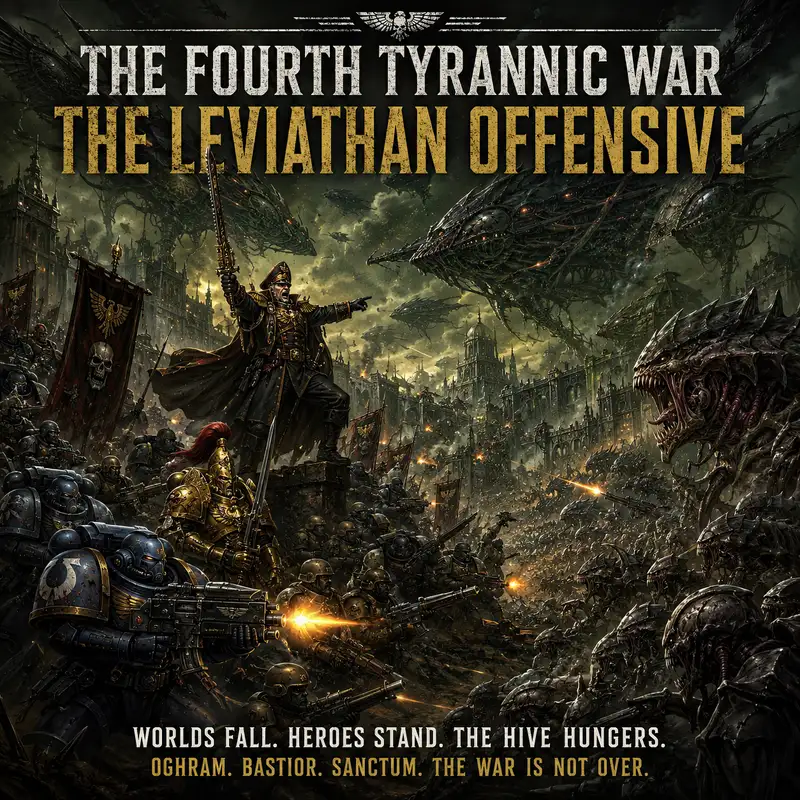
The Fourth Tyrannic War: The Leviathan Offensive
Oghram did not fall in a single glorious last stand. It died by stages. First came the spores that turned the sky into a bruised ceiling. Then came winged swarms in numbers large enough to become weather. Fortresses held, counterattacks succeeded, and fresh Imperial troops arrived. For a time, the defenders could believe courage and firepower had changed the outcome. Then the Matasori Delta collapsed beneath toxic fog. Great Hive Thaddorius was breached through its own water system. Retreating armies were surrounded on the Jatasora Heights, and the last evacuation craft rose above cities already being hollowed into feeding grounds. Oghram’s billions were not merely killed. They were rendered down, reprocessed, and prepared to return as the next wave of the invasion. That is the central horror of the Fourth Tyrannic War. The Imperium is watching its own worlds become ammunition.
The name Fourth Tyrannic War makes the conflict sound tidy, as though an archivist placed three completed volumes on a shelf and opened another. The reality is less obliging. Hive Fleet Behemoth struck the Eastern Fringe and nearly destroyed the Ultramarines at Macragge. Hive Fleet Kraken spread in countless splinter fleets, forcing the Imperium to fight a dispersed and unpredictable enemy. Leviathan then emerged from below the galactic plane, attacking across a vast front and bringing catastrophe to Octarius and Baal. The battles at Baal inflicted immense damage, but they revealed how little the Imperium understood Leviathan’s scale. A hive fleet is not one armada with a single flagship that can be sunk to end the war. It is a distributed biological invasion, guided by the Hive Mind, able to divide, learn, and return from directions that make Imperial maps look painfully two-dimensional.
The Fourth Tyrannic War began with silence in the western reaches of Segmentum Pacificus. Astropathic messages failed. Systems vanished from communication. Refugee fleets appeared with contradictory reports of living ships, world-sized shadows, and entire populations disappearing behind the psychic pressure called the Shadow in the Warp. At first, the pattern was missed because the Imperium is vast, warp storms routinely break communication, and local authorities were already occupied with other threats. In Imperial administration, a missing planet can be a catastrophe, a clerical error, or a request waiting for the correct seal. By the time the losses formed a recognisable pattern, whole regions had already been consumed. The first warning was the absence of dispatches, followed by survivors who carried panic and sometimes the organisms or spores of the enemy.
When Imperial strategists finally assembled the fragments, they found two enormous tendrils advancing through the galactic west. Nautilon approached from above the galactic plane. Promethor rose from below it. They moved in roughly parallel courses toward Segmentum Solar, the region surrounding the heart of the Imperium. Their precise ultimate objective remains uncertain. The Hive Mind does not issue communiqués explaining its intentions, which is inconsiderate but consistent. Yet the projected direction was enough to alarm Terra. The tendrils spread into smaller fleets, sought biomass, doubled back where prey remained, and maintained pressure across multiple sectors. This was a coordinated offensive conducted by an intelligence that expressed strategy through migration, hunger, and adaptation rather than speeches or banners. Leviathan appeared to understand the shape of the defence forming against it.
The Imperium faced this danger at a poor moment. Roboute Guilliman’s Indomitus Crusade had drawn fleets, regiments, Space Marine strike forces, and supplies into wars across both halves of a broken galaxy. The Great Rift had already damaged communication and made reinforcement uncertain. Segmentum Pacificus was not empty, but many of its strongest mobile formations were elsewhere. Captain-General Trajann Valoris of the Adeptus Custodes and Lord Commander Solar Arcadian Leontus helped organise the response. Their problem was nearly impossible to solve. The Tyranids could attack across an immense volume of space, while Imperial forces depended on navigable warp routes, stable bases, fuel, ammunition, repair facilities, astropathic relays, and enough surviving clerks to record where all of these things had gone. Leviathan needed food. The Imperium needed a functioning civilisation behind every gun. That difference shaped the campaign.
The Imperial answer had two parts. The first was the Sanctus Line, a defensive network built around heavily reinforced Anchor Worlds positioned along major warp routes. The Tyranids did not depend upon those routes, but the defenders did. An Anchor World could store armies, repair ships, coordinate astropathic traffic, and support operations across neighbouring systems. Each became the hub of a regional war machine. The second part was the creation of Solblades, fast and unusually autonomous strike forces assembled from elite Imperial elements. A Solblade might include Space Marines, Sisters of Battle, Tempestus Scions, Knights, agents of the Inquisition, Mechanicus troops, or even Custodes. Their purpose was not to hold every world. It was to move quickly, strike synapse organisms and hive ships, rescue critical assets, and disrupt the swarm before it could concentrate. For the Imperium, granting local commanders such freedom was almost revolutionary.
At first, the method worked. Solblades attacked the scattered fleets of Nautilon and Promethor, exploiting the fact that the Tyranids were advancing across a broad front rather than as one compact mass. Imperial forces won numerous local victories. Hive ships were destroyed. Splinter fleets were diverted. Worlds that should have fallen received time to prepare or evacuate. The two great tendrils slowed and began to fragment under constant attack from Imperial and alien enemies. This was not decisive, but it created hope, and hope is dangerous when delay is mistaken for control. The Hive Mind only needed to keep feeding, testing, and identifying the pattern of resistance. Whether its next move had been prepared from the beginning or developed in response to the Solblades cannot be known. While Imperial attention fixed on two jaws, a third opened behind them.
That third tendril was designated Grendyllus. It surged upward from beneath the galactic plane, bypassed much of the Solblade screen, and struck into the rear of the defensive network. Its emergence transformed the Bastior Sub-sector from a protected base area into the centre of the war. Battle Group Faustus, commanded by Groupmaster Tysen Yacobe, began to understand the danger after several task forces disappeared. Survivors confirmed that this was another major arm of Leviathan. At Sanctum, the key Anchor World of the Formidyre System, Leontus recognised that Bastior could not be defended everywhere. He initiated the Sanctuary Protocol. Forces were ordered to withdraw toward three systems, Formidyre, Pyremoat, and Kastayl, carrying whatever troops, fuel, and ammunition could be saved. Units unable to retreat were told to delay the swarm. Such orders sound more efficient on a strategic display than in the trenches.
Across Bastior, the withdrawal became countless tragedies. Some worlds mobilised with discipline. Others collapsed into panic, rebellion, or denial. Garrisons fought actions whose only purpose was to consume Tyranid time. Refugee vessels fled toward sanctuary systems, although every crowded hold created another opportunity for hidden Genestealers, spores, or infected survivors to pass through quarantine. Humanity was not alone in its path. Orks welcomed the arrival of an enemy that appeared willing to fight indefinitely. Kin of the Leagues of Votann defended holdings and evacuation routes. Aeldari, Drukhari, Necrons, Hrud, and stranger species fought, fled, or exploited the confusion. The advance turned systems into moving disasters where old enemies collided because the Shadow in the Warp made escape unreliable. The Imperium’s preferred solution was coordinated defence. The galaxy replied with several simultaneous wars and an administrative note marked urgent.
Not every revealing failure was military. In the Gallospire System, religious and political conflict continued even as the hive fleet approached. High Frater Niyellus reportedly denied the existence of the xenos while Tyranid vessels became visible overhead. The Tyranids did not respect the ruling. Elsewhere, nobles abandoned populations they had sworn to protect, while common soldiers and local militias fought because there was nowhere left to go. The Hive Mind attacks more than fortifications. The Shadow in the Warp disrupts astropathic communication, unsettles psykers, and presses against the minds of ordinary people. Vanguard organisms sabotage defences before the main swarm arrives. Genestealer Cults turn trusted institutions into weapons. Refugees carry fear from world to world. Leviathan’s offensive therefore advances through psychology, infiltration, and social collapse as surely as it advances through claws. A planet can lose the war before anyone sees a Tyranid.
The Formidyre System became the shield before Sanctum, and Oghram was one of its outer worlds. It was a hive world of factory cities, engine-spires, chemical swamps, and immense transport complexes. When Grendyllus arrived, Imperial defenders met it with armour, artillery, aircraft, and coordinated Space Marine strikes. Solblade fleets returned from other parts of Bastior and poured reinforcements into the system. Tyranid assaults were crushed beneath tank tracks or cut apart in carefully planned counterattacks. Oghram offered the kind of battle the Imperium preferred, with fortifications, clear objectives, and enough firepower to make the horizon burn. Yet every successful defence cost ammunition, vehicles, trained crews, and irreplaceable time. The Tyranids paid in organisms grown for the purpose. When a wave failed, the Hive Mind did not mourn it. The next wave arrived shaped by what the previous one had learned.
The collapse came through accumulation. Toxin-beasts smothered the Matasori Delta in lethal bio-smog. Millions of organisms entered Great Hive Thaddorius through its aquifer shrines, turning the systems that sustained the population into invasion routes. Fast swarms overwhelmed the flanks of retreating Imperial armies on the Jatasora Heights. Defenders who had survived frontal attacks were encircled during withdrawal. In the final hours, commanders extracted selected personnel, relics, and whatever military assets could still leave the surface. Rearguards died to keep the evacuation corridors open. Oghram was abandoned to billions of Tyranids. Its hives became empty mausoleums while digestion pools and feeder organisms reduced the dead, the forests, the oceans, and the soil itself into usable matter. Oghram’s fall placed Sanctum in immediate danger, and its deeper meaning was logistical. Every Imperial casualty weakened the defence. Every Tyranid casualty could, if recovered, be recycled. Attrition favoured the side that ate the battlefield.
Sanctum had been prepared as an Anchor World, and its defences were formidable. The asteroid fortresses of the Dornwall guarded the approaches. Imperial Navy formations gathered under Yacobe. The immense star fortress Phalanx stood in orbit, crewed in part by hundreds of Imperial Fists under Tor Garadon. On the surface, Leontus established his headquarters inside Holdfast, the fortress-monastery of the White Templars. As the Tyranid fleet closed, bio-ships became so numerous that people could see them crossing the daylight sky. The Shadow in the Warp deepened with them, spreading terror and despair. Leontus answered with weapons and propaganda. Ministorum broadcasts filled the air with hymns and declarations of faith, partly to inspire the defenders and partly to drown out the pressure of the approaching Hive Mind. It helped. In the forty-first millennium, morale support sometimes requires a cathedral-sized loudspeaker.
The Dornwall did not hold forever. Tyranid organisms poisoned sealed fortresses, massive hive ships forced passages through the asteroid screen, and smaller bio-vessels flooded the openings. Phalanx and the Imperial fleet destroyed enormous numbers of attackers, but the defenders faced an ugly choice. They could concentrate fire on the largest hive ships or attempt to stop every smaller vessel racing toward Sanctum. They killed many of the great organisms and failed to prevent the landings. Billions of Tyranid creatures reached the surface. The orbital battle became a familiar Imperial result, tactically impressive and strategically insufficient. On the Kzarvin Steppes, massed regiments tried to prevent separate swarms from joining into a single overwhelming body. Titans of Legio Destructor fought towering bioforms while artillery reduced whole regions to burning mud. In the forests of Voth’s Reach, Sisters of Battle incinerated waves of organisms before weight of numbers forced them back. The lines bent, withdrew, and formed again around the remaining fortresses.
The Tyranids did not simply hurl bodies forward. Their attacks began to interlock. One swarm fixed a defensive line while another moved through terrain believed impassable. Psychic organisms broke discipline before assault creatures arrived. Burrowing monsters transformed secure rear areas into front lines. At Four Luthiorn, psychic pressure drove defenders into murderous panic. The Olvenbach Line collapsed after a Parasite of Mortrex infected a single soldier and turned one body into the opening for an infestation. Around Holdfast, Trygons and Mawlocs erupted from beneath positions that had been designed to resist attack from above. The Swarmlord appeared on the Pentacastes Plains, bringing the Hive Mind’s accumulated battlefield experience into the campaign. The Tyranids are more dangerous than a simple horde. Numbers create pressure, but adaptation creates decisions. Every Imperial response reveals a weakness. Every fortress teaches the swarm how fortresses are defended. Every survivor carries knowledge, trauma, or contamination into the next battle.
Norn Emissaries offered the clearest expression of this precision. They were not merely larger assault beasts. They were formed for singular tasks and granted unusual independence, intelligence, speed, and psychic power. At Sanctum, their purpose was the destruction of Leontus and the command structure around him. One Emissary reached an inner sanctum and massacred officers before a nameless Chapter serf trapped it and detonated plasma charges, exchanging one unrecorded human life for the survival of the wider command. Another, remembered as the Fiend of Hag Rift, attacked near the Vaults of Repose and was checked only after White Templars Dreadnoughts and Imperial troops paid a dreadful price. A third reached Konstantin Plaza and surged toward Leontus. It was stopped by Trajann Valoris and Custodian reinforcements arriving at the critical moment. The Hive Mind understood that killing the general might achieve what consuming another regiment could not. Hunger had become assassination doctrine.
Valoris brought forces from Indomitus Crusade Fleet Sextus, and the arrival of fresh Space Marines and Custodes allowed the defenders to counterattack. Tor Garadon launched Imperial Fists from Phalanx in a drop assault. Imperial forces drove the swarm back from key positions around Sanctum, then moved to relieve Kastayl and Pyremoat. Raven Guard, Blood Angels, Black Templars, White Templars, Sisters of Battle, Knights, Titans, Navy crews, and countless soldiers helped prevent the sanctuary systems from being completely consumed. Bastior held. That statement requires careful handling. Many of its worlds were already dead. Whole systems contained only scattered survivors. Tyranid organisms remained across Sanctum, the Swarmlord was still at large, and the hive fleet was already rebuilding from consumed biomass. The Imperial counterstroke saved a strategic position. It did not destroy Grendyllus, and it certainly did not end the Fourth Tyrannic War. In Imperial records, survival often arrives dressed as victory because the alternative is poor for recruitment.
The campaign also revealed how Leviathan had changed. Norn Emissaries hunted commanders. Neurotyrants and other psychic organisms attacked cohesion. Mindslayer bio-ships spread hallucination and terror through void crews. Lictors, Genestealers, and newer vanguard strains prepared battlefields long before the main swarm arrived. Heavy organisms broke fortifications while feeder beasts stripped conquered worlds with industrial efficiency. None should be mistaken for independent inventors. They were organs of a greater intelligence, produced when and where their functions were useful. The Hive Mind’s adaptation is not magic, and it is not always immediate, but it operates on a scale the Imperium struggles to match. Humanity replaces a lost tank through factories, shipping schedules, trained labour, fuel allocation, and prayerful arguments over requisition forms. Leviathan grows a weapon inside another living ship, feeds it with the dead, and sends it toward the next world.
The record offers no clean ending. Later war reports still describe Sanctum as contested and its purgation as slow. Imperial operations have begun to press Grendyllus in places, yet Nautilon and Promethor continue to gather momentum elsewhere. Systems have been stripped clean, Solblades have vanished, and commanders must decide which threatened worlds will receive reinforcements and which will receive instructions to endure. Marneus Calgar and other Imperial leaders have taken responsibility for portions of the Bastior defence, but even brilliant command cannot make limited forces exist in two places at once. This is the offensive’s central strategic trap. Concentrate enough power to save one Anchor World, and another tendril advances beyond reach. Scatter forces to protect everything, and the Tyranids defeat them in detail. The Imperium can still win battles. It can still rescue worlds. What it cannot do is force Leviathan to fight only the war humanity has prepared to wage.
The Fourth Tyrannic War is not simply a larger repetition of Macragge, Iyanden, Octarius, or Baal. It is a demonstration that Hive Fleet Leviathan can attack as a galactic system rather than a single invading mass. It probes from above and below the galactic plane, fragments to find prey, concentrates against resistance, infiltrates populations, targets commanders, and turns conquered life into the means of further conquest. The Imperium’s answer has been intelligent, courageous, and brutally expensive. Solblades provide mobility. Anchor Worlds provide endurance. Heroes such as Valoris, Leontus, Garadon, Yacobe, and countless unnamed defenders have prevented disaster from becoming immediate annihilation. Yet Oghram remains the truest image of the war. Beneath its silent hive towers, the last traces of human civilisation were poured into digestion pools. From that harvested matter, new organisms climbed toward waiting bio-ships. The world did not merely disappear from the Imperial map. It rose again as part of the enemy.