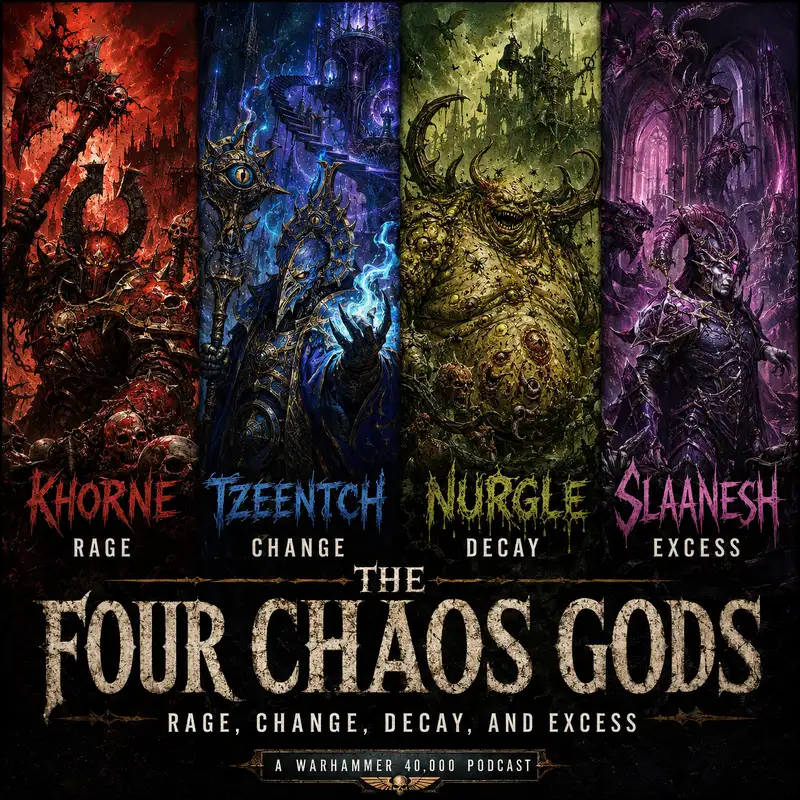
The Four Chaos Gods: Rage, Change, Decay, and Excess
On a battlefield somewhere beyond the reach of reliable maps, four survivors endure the same disaster in four different ways. One rises with a scream and attacks anything still moving. One begins calculating how the defeat might be reversed. One stops fearing the sickness spreading beneath his armour. One discovers that pain, terror, and triumph have become intoxicating. None of them needs to know the name of a god. The Warp already knows theirs.
The four great Gods of Chaos are often introduced as a simple set of labels. Khorne is rage. Tzeentch is change. Nurgle is decay. Slaanesh is excess. That is accurate in roughly the same way that calling a star hot is accurate. It identifies the general problem while leaving out the part that burns worlds.
These beings are not gods in the ordinary human sense. They were not elected by a divine council, and they do not govern tidy departments of reality. They are vast intelligences within the Warp, the psychic dimension shaped by the emotions, fears, desires, and beliefs of sentient life. Every act of hatred, ambition, despair, and obsession leaves an echo there. Across ages and civilisations, those echoes gathered into storms with appetites, personalities, servants, and purpose.
Whether the Chaos Gods created the worst impulses of mortals or merely grew from them is almost the wrong question. The relationship runs in both directions. Anger strengthens Khorne, and Khorne makes anger easier. Ambition nourishes Tzeentch, and Tzeentch turns ambition into conspiracy. Despair feeds Nurgle, and Nurgle offers despair the comfort of surrender. Desire empowers Slaanesh, and Slaanesh ensures that satisfaction never lasts.
The gods are therefore not distant patrons waiting for formal worship. A person can serve one of them without kneeling before an altar or learning a forbidden name. The officer who comes to love victory more than the people victory was meant to protect has taken a step. So has the scholar who values discovery above truth, the patient who would accept any cure at any price, and the artist who cannot allow a work to be merely excellent. Chaos begins with something recognisable. It becomes monstrous by refusing every limit.
Khorne is the easiest of the four to understand and perhaps the easiest to misunderstand. He is the Blood God, the Lord of Skulls, the embodiment of rage, violence, murder, and war. His realm is imagined as an endless battlefield beneath a red sky, dominated by a brass citadel and a throne raised upon the skulls of the slain. Such images should not be treated as ordinary geography. In the Warp, symbolism and landscape are often the same thing.
Khorne offers clarity. The galaxy is complicated, treacherous, and full of institutions that demand obedience while providing very little explanation. Rage cuts through all of that. There is the enemy. There is the weapon. There is the next blow. For the frightened, anger feels stronger than fear. For the humiliated, violence can resemble dignity. For the soldier abandoned by command, fury may be the last order that still makes sense.
This is why Khorne’s appeal is not limited to mindless killers. Warriors may approach him through pride, courage, discipline, or a desire for honourable combat. A champion tells himself that he seeks worthy opponents. He refuses sorcery because strength should be proved openly. He despises cowardice. At first, the code appears to restrain the violence.
It does not survive.
Khorne may favour martial prowess, but he is not a guardian of honour. The blood of the helpless serves him as surely as the blood of heroes. A skull taken in fair combat and a skull taken from a prisoner both reach the same throne. The code was never a wall against corruption. It was the road by which corruption entered while wearing armour.
The World Eaters show the process on a legionary scale. Even before their fall, they had been brutalised by the Butcher’s Nails, implants that punished calm thought and rewarded aggression. Their primarch, Angron, carried the same torment more deeply than any of his sons. Rage was not merely an emotion to them. It was relief from pain.
During the Horus Heresy, that relief became worship, whether every warrior understood the change or not. The legion’s old bonds fractured. Strategy narrowed into assault. Brotherhood became shared frenzy. Angron rose as a daemon primarch of Khorne, and many of his sons became Berzerkers who can still perform acts of battlefield skill, but increasingly struggle to imagine any purpose beyond the next killing.
Khorne’s gifts are real. His champions may receive unnatural strength, endurance, speed, and the favour of daemonic armies. The price is that every victory deepens the hunger that demanded it. There can be no final battle, because peace would be failure. There can be no lasting brotherhood, because eventually every living thing is another possible offering. Khorne promises freedom from fear by making fear’s opposite the only emotion left.
Tzeentch is more difficult, which is exactly how Tzeentch prefers matters. He is the Changer of Ways, the Architect of Fate, the god of ambition, sorcery, mutation, conspiracy, and hope. His domain is an impossible labyrinth of crystal, shifting paths, false destinations, and truths that alter while being understood. A straightforward map would be regarded as a personal insult.
Where Khorne says that problems can be destroyed, Tzeentch says they can be outwitted. He speaks to the prisoner studying the guard’s routine, the underling who knows the commander is a fool, the psyker desperate to master a dangerous gift, and the reformer who believes the world must become something better. Change is not inherently corrupt. Hope itself requires the belief that the future can differ from the present.
That is why Tzeentch is dangerous. He does not begin by asking a person to abandon hope. He offers more of it. He suggests that one compromise will provide the power needed to correct a greater injustice. One secret will prevent a war. One forbidden ritual will save a dying people. One betrayal will place a wiser hand on the lever of history.
Each step may be defensible. Together they build a maze.
Tzeentch’s followers become planners who cannot stop planning. Every ally may be a pawn, every enemy a tool, every apparent failure part of a deeper design. Some schemes succeed. Others collapse because Tzeentch empowered both sides, altered the objective, or simply valued the transformation more than the result. A final, stable victory would end possibility. For the god of change, that may be less attractive than an elegant catastrophe that produces ten thousand new plans.
The Thousand Sons are the great warning. Their legion was rich in psykers and knowledge, but it suffered from the flesh-change, a curse of uncontrolled mutation. Magnus the Red sought knowledge and power to preserve his sons. His choices were not driven by simple malice. They grew from pride, love, confidence, and the conviction that he could master forces others feared.
Those forces mastered him. When Prospero burned, Magnus accepted the power that carried his legion away from destruction, but deeper into Tzeentch’s grasp. Later, Ahzek Ahriman attempted to halt the flesh-change with the Rubric. The spell preserved many of the legion’s strongest psykers, while reducing most of their brothers to dust sealed inside their armour. The effort to prevent change produced one of the most terrible transformations in Imperial history.
That irony is pure Tzeentch. His gifts reveal futures, unlock sorcery, and make the impossible achievable. They also ensure that the recipient can no longer trust success. The greater the knowledge, the larger the unseen design may be. Tzeentch promises control over fate while teaching that control is merely another piece on the board.
Nurgle appears to be the opposite of Tzeentch. He is the Plague God, the Lord of Decay, the embodiment of disease, entropy, despair, and the slow collapse of all structures. His realm is a vast and rotting garden where every death feeds obscene new life. Flies swarm over cauldrons of contagion. Forests bloom from corruption. Nothing remains clean, but nothing is permitted the dignity of simply ending.
Nurgle’s horror is not only disease. It is the moment resistance feels pointless.
A city under siege can endure hunger, bombardment, and fear while its people believe relief is coming. Remove that belief, and the same hardships become unbearable. Nurgle enters through exhaustion. He speaks to those who have fought too long, suffered too much, or watched every remedy fail. He does not always promise victory. He promises that the pain of losing can stop mattering.
This is the source of his strange warmth. Followers call him Grandfather Nurgle. His daemons may laugh, count diseases like treasured possessions, and treat infection as generosity. Many of his mortal servants appear cheerful because they have been freed from pain, revulsion, and fear of death. The freedom is genuine. So is the chain attached to it.
Nurgle’s affection is the love of a captor who has removed every reason to leave. He embraces the sick by making sickness permanent. He relieves fear of decay by turning the victim into part of decay’s ecosystem. His followers endure wounds that should destroy them, but their resilience comes from accepting a condition no healthy mind would choose.
The Death Guard demonstrate the bargain. Their primarch, Mortarion, hated sorcery and prided himself on endurance. His legion was built to survive poison, attrition, and the worst battlefields of the Great Crusade. During the Horus Heresy, they became trapped in the Warp and afflicted by a plague that would not let them die. Their suffering had no end and no honour.
Mortarion surrendered to Nurgle to save his sons from torment. The plague ceased to be unbearable because the legion became its carrier. Their ruined bodies grew monstrously resilient. Mortarion became a daemon primarch. The Death Guard emerged as an army that could survive almost anything, provided survival was defined loosely enough.
Nurgle’s great enemy is not death. Death is part of his cycle. His enemy is the refusal to surrender, the belief that a cure can be found, a wall rebuilt, or a future changed. That places him naturally against Tzeentch. Hope and despair fight within every besieged world, every hospital ward, and every soldier who must decide whether to stand again.
Slaanesh is the youngest of the four great Chaos Gods in the history of the galaxy, but youth has not made the Dark Prince modest. Slaanesh is the god of excess, obsession, sensation, pride, and perfection pursued beyond sanity. The Aeldari call this power She Who Thirsts, because Slaanesh claims their souls and is never satisfied. Human titles often describe Slaanesh as male. Neither description contains a warp entity that regards mortal categories as binding.
Slaanesh is commonly reduced to pleasure, and pleasure is certainly part of the domain. It is not the whole of it. Slaanesh thrives whenever appetite becomes identity. The appetite may be for food, beauty, pain, speed, admiration, victory, purity, artistic achievement, or technical mastery. Even self-denial can become Slaaneshi if the denial itself is pursued as an intoxicating proof of superiority.
The first step is often excellence. A duellist wants a cleaner strike. A composer searches for a sound no audience has heard. A commander wants not merely to win, but to execute the perfect campaign. A physician refuses to accept an imperfect body. None of these desires begins as depravity. Slaanesh waits within the word perfect, because perfection has no natural stopping point.
Every achievement raises the threshold. The sensation that once satisfied becomes dull. The artist needs a more extreme medium. The warrior needs a more dangerous opponent. The ruler needs louder praise. Eventually, other people cease to be people. They become instruments, audiences, materials, or obstacles.
The birth of Slaanesh is the clearest demonstration of what collective excess can do to the Warp. The ancient Aeldari empire possessed wealth, knowledge, and power beyond most later civilisations. As restraint collapsed, vast portions of its society pursued increasingly extreme sensation and self-indulgence. Their psychic intensity gathered in the Warp until Slaanesh was born.
The birth cry tore across reality. Most of the Aeldari civilisation was destroyed. The Eye of Terror opened where the heart of their empire had been. Countless Aeldari souls were consumed, and those who survived inherited a spiritual predator bound to their species. The craftworld path system, the Drukhari’s predation, the Harlequins’ service to Cegorach, and the Ynnari’s desperate project all exist in the shadow of that catastrophe.
The Emperor’s Children followed a smaller version of the same road. Their legion valued refinement, discipline, beauty, and flawless performance. Fulgrim sought perfection as a primarch, and his sons measured themselves against impossible standards. During the Horus Heresy, those values were corrupted rather than discarded.
The pursuit of excellence became hunger for sensation and superiority. Music became weaponised noise. Art became violation. Martial skill became theatrical cruelty. The legion did not abandon its old identity. It exaggerated that identity until the virtues and the vices became impossible to separate.
Slaanesh’s gifts can grant speed, grace, heightened senses, charisma, and experiences beyond mortal capacity. The punishment is tolerance. What once overwhelmed the senses soon becomes ordinary. The worshipper must go further, then further again, chasing a satisfaction designed to retreat. Slaanesh promises fulfilment and survives by ensuring it never arrives.
The four gods hate one another because each seeks to interpret all existence in its own language. Khorne sees Tzeentch’s sorcery as manipulation without honest violence. Tzeentch sees Khorne’s fury as crude and predictable. Nurgle offers acceptance, while Tzeentch insists upon transformation. Khorne’s destructive rage clashes with Slaanesh’s self-absorbed pursuit of experience, while Slaanesh finds Khorne’s simplicity almost offensively dull.
Their rivalries form the Great Game, the endless struggle for dominance within the Warp. Daemonic legions fight across impossible realms. Mortal wars become moves in contests their participants barely understand. Alliances occur, especially when one god appears too strong or when a common enemy demands attention, but Chaos cooperation tends to last exactly as long as betrayal remains inconvenient.
The Horus Heresy was one of those rare moments when the powers aligned enough to threaten the material galaxy on a vast scale. Even then, unity was unstable. The traitor forces carried incompatible ambitions, rival patrons, old resentments, and private plans. Chaos can concentrate power with terrifying speed. Keeping that power pointed in one direction is another matter.
Some servants worship Chaos Undivided, honouring the pantheon as a whole or refusing exclusive devotion. Abaddon the Despoiler has accepted the favour of all four without surrendering himself entirely to one. That balance is extraordinarily difficult. Most mortals who believe they are using Chaos eventually discover that Chaos has a longer memory, greater patience, and fewer objections to irony.
The daemons serving the gods are not simply another alien species. They are expressions of warp power given identity and form. A Bloodthirster embodies Khorne’s violence. A Lord of Change carries Tzeentch’s sorcery and deception. A Great Unclean One reflects Nurgle’s diseased abundance. A Keeper of Secrets displays Slaanesh’s allure and lethal grace. They may possess personalities and pursue rivalries, but they remain tied to the power from which they came.
This also explains why defeating a daemon is rarely the same as killing a mortal. Its physical form can be destroyed, banishing it back to the Warp, yet the underlying entity may return when conditions allow. The battlefield victory matters. It simply does not settle the emotional forces that made the daemon possible. The Imperium responds by combining weapons, faith, secrecy, and severe penalties for curiosity. This has not produced a calm or well-informed population, but calm and information were never the Imperium’s leading products.
The most important truth about the four Chaos Gods is that they do not represent four foreign poisons poured into an otherwise pure galaxy. They are reflections made predatory. Rage can defend the innocent. Hope can resist tyranny. Acceptance can carry a person through grief. The desire for excellence can create beauty. Chaos takes each impulse, strips away proportion, and declares it the only truth that matters.
Khorne says anger will make you strong, then leaves you unable to protect anything without destroying it. Tzeentch says knowledge will make you free, then turns every certainty into another manipulation. Nurgle says surrender will end your pain, then preserves you forever inside the cause of it. Slaanesh says one more achievement will make you complete, then moves completion beyond the next horizon.
That is why the four gods remain distinct, and why none can permanently defeat the others. Mortal life keeps producing all four of their foundations. People rage. People hope. People despair. People desire. The gods compete not only for worshippers, but for the meaning of every choice made under pressure.
The danger is not that their promises are obvious lies. A lie can be rejected. Their promises contain enough truth to be useful at the worst possible moment. They offer strength, possibility, endurance, and fulfilment to people who desperately need those things. Then they remove every limit that allowed those virtues to remain human.
Four gods stand behind four doors, but the doors are not marked with evil. They are marked with what the person approaching them believes will save them. The trap is not that Chaos offers nothing. It offers exactly what is needed, and keeps collecting until nothing remains except the need itself.