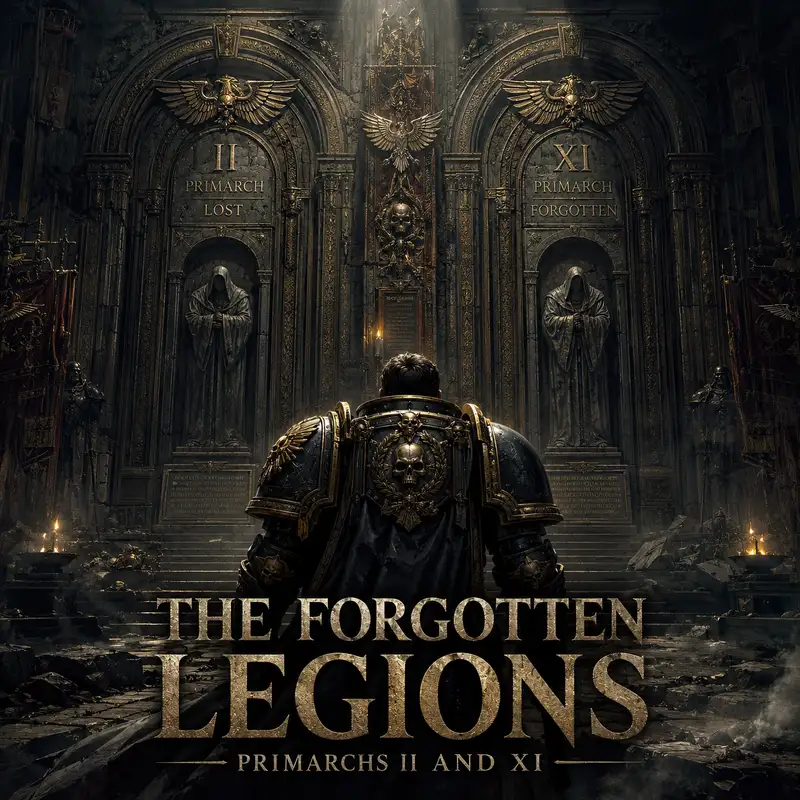
The Forgotten Legions: Primarchs II and XI
Deep within the Imperial Palace, there were once places prepared for twenty sons. Eighteen became associated with names that would shake the galaxy. Two became sealed chambers, empty plinths, and absences so carefully maintained that even their brothers could not hold the truth in their minds. The most unsettling thing about the Second and Eleventh Primarchs is not that they disappeared. Primarchs die. Legions break. Empires bury defeats. What makes these two different is that the Imperium attacked their memory as if memory itself were the enemy.
The Emperor created twenty primarchs, gene-forged warlords designed to lead twenty Legions of Space Marines during the Great Crusade. The primarchs were scattered across the galaxy before they could be raised on Terra, and the Emperor spent much of the Crusade recovering them. Each reunion transformed a Legion. A fatherless army gained the being whose genetic legacy it carried, along with his culture, ambitions, virtues, and usually several highly distinctive problems.
The Legion numbers did not show the order in which the primarchs were recovered. The Second Primarch appears to have been found very early, among the first few sons returned to the Emperor. The Eleventh was discovered much later, near the end of the search. This matters because neither was merely a missing infant who never took part in Imperial history. Both were found. Both were known to their brothers. Both had Legions. Both served within the Emperor’s expanding war machine long enough for their loss to become a wound shared by the primarch family.
Then, before Horus openly rebelled, both were gone.
Their names are not preserved. Their home worlds are not securely identified. Their heraldry, campaigns, beliefs, and physical appearances remain unknown. Surviving references call them lost, forgotten, or purged, but those words are not reliable labels that can be neatly assigned to one brother or the other. We do not know that the Second was the forgotten one and the Eleventh the purged one, or the reverse. The language tells us that catastrophe occurred. It does not tell us exactly what form that catastrophe took.
This is the first rule of the Lost Legions. The gaps are evidence, but they are not answers.
There are small fragments. Fulgrim remembered the Second as normally contemplative and quiet, a brother who rarely spoke but still accused Fulgrim of hubris when the occasion demanded it. Others spoke of both missing primarchs with grief, anger, contempt, or unease. The Emperor’s surviving sons did not react as though two administrative entries had been removed from a roster. They reacted as brothers who had experienced something terrible and had then been ordered not merely to remain silent, but to surrender part of their own past.
One of the clearest moments comes before the Horus Heresy, when Horus confronts Malcador over the removal of a lost brother’s monument. Horus is not yet the Warmaster of Chaos. He is still the Emperor’s favoured son, proud, politically powerful, and accustomed to being heard. He objects to the erasure and attempts to speak the forbidden name. Malcador stops him with psychic force, crushing the breath from a primarch who could tear armoured warriors apart with his hands.
It is a remarkable scene because the argument is not about whether the missing brother existed. Everyone present knows that he did. The argument is over whether he is still permitted to exist in memory. Horus believes deletion is an insult to their shared history. Malcador treats the name as a breach of state security. The Imperial solution to the disagreement is therefore measured, reasonable, and involves psychically strangling the Emperor’s most celebrated son.
The episode also reveals that the erasure was enforced while memories were still fresh. This was not the slow decay of ten thousand years. Statues were removed, records sealed, names forbidden, and recollections suppressed during the lives of people who had fought beside the missing Legions. The silence was constructed.
That immediately raises the central question. What could the Second and Eleventh have done that made deletion preferable to execution, public condemnation, or simple defeat? Horus would later kill the Emperor’s dream, turn half the Legions against Terra, and drown the galaxy in civil war. Yet Horus was remembered. His name became a curse, a warning, and the central villain of Imperial history. The two earlier failures received something more complete than damnation. They were denied even the dignity of being enemies.
Part of the answer may be practical. The Horus Heresy was too large to conceal. Billions witnessed its wars. Entire Legions declared for the Warmaster. Worlds burned from Isstvan to Terra. The Imperium could shape the account, bury inconvenient details, and convert history into scripture, but it could not plausibly pretend that the rebellion had never occurred. The earlier losses happened during the Great Crusade, when the Emperor and Malcador still controlled the central narrative and the machinery of expansion. A smaller disaster could be cut out before it spread.
Yet Malcador’s own explanation suggests something deeper. The loss of the two primarchs threatened the ideals at the heart of the Great Crusade. That phrase points beyond military embarrassment. The Crusade was built upon a claim of inevitability. Humanity was being reunited under rational leadership. The Emperor’s sons were living proofs of his mastery. The Legions were the disciplined instruments of a better age. If two primarchs exposed a fatal weakness in that claim, then their stories could become more dangerous than their armies.
A dead primarch could be mourned. A traitor could be condemned. A primarch whose existence disproved the entire project was another matter.
That leaves several possibilities, all tempting and none confirmed.
The first is simple rebellion. One or both primarchs may have rejected the Emperor before Horus did. Perhaps the disagreement concerned the Imperial Truth, the brutal methods of compliance, the treatment of human civilizations, or the demand that all independent power submit to Terra. Several known primarchs carried deep resentments. Angron hated the Emperor. Mortarion distrusted him. Corax recognized the hypocrisy of conquest in the name of liberation. Jaghatai Khan valued freedom more than Imperial ceremony. Lorgar needed faith in a regime that officially denied religion. The family was not exactly short of unresolved issues.
An earlier primarch may have crossed a line the others approached but did not yet pass. If he openly rejected the Great Crusade on moral or political grounds, his example could have shown that disobedience was possible. The Emperor did not merely need loyal generals. He needed the appearance that his sons, whatever their quarrels, remained parts of one design.
A second possibility is alliance with an alien power. The Great Crusade was not a diplomatic tour. Its governing assumption was human supremacy, and many alien civilizations were destroyed regardless of whether coexistence might have been possible. A primarch who adopted an alien culture, defended a mixed civilization, or refused an extermination order would have challenged more than military policy. He would have questioned the ideological boundary that defined the Imperium.
This idea fits the scale of the censorship, but fitting is not proving. No surviving source confirms that either lost primarch became a champion of aliens. It remains a theory built from what the Imperium would consider unforgivable.
A third possibility is corruption by Chaos. The Emperor concealed the true nature of the warp from most of his sons. If one of the lost primarchs encountered daemonic power and fell before the Heresy, the event could explain why the truth was sealed. It might also explain why dangerous knowledge had to be removed from witnesses rather than merely classified on paper.
The difficulty is that the lore never states this. Horus is still treated as the great arch-traitor, and the missing brothers are remembered differently from the later servants of Chaos. An early corruption is possible, but it is not established. The galaxy contains more than one road to ruin, and not every sealed door has a daemon behind it.
A fourth possibility is genetic or physical failure. The primarchs and their Legions were engineered beings, and the process was not flawless. The Thousand Sons suffered the Flesh Change. The Emperor’s Children nearly vanished because of a genetic crisis. The Blood Angels hid the Red Thirst. The Space Wolves carried their own unstable inheritance. Severe mutation alone, therefore, does not explain erasure. The Imperium tolerated dangerous flaws when the affected Legion remained useful and controllable.
For genetic failure to account for the Lost Legions, it would likely need to have been extreme, contagious, uncontrollable, or revealing of some deeper defect in the primarch project. That is possible. It is also an inference layered upon silence.
Then there are the Rangdan Xenocides, some of the most destructive wars of the Great Crusade. The Imperium fought a powerful and deeply alien enemy across campaigns so ruinous that the surviving accounts are themselves damaged, restricted, and contradictory. The First Legion suffered terrible losses. Entire military formations disappeared. Forbidden weapons were used, and the scale of the conflict was later pushed into shadow.
Because one of the missing primarchs was active during at least part of this broad period, the Rangdan wars have become a natural home for speculation. Perhaps a Lost Legion was destroyed there. Perhaps a primarch was captured, compromised, or disgraced. Perhaps the war required a sanction that could not be acknowledged. The timing makes a connection plausible, especially for the Second. It does not make it certain, and the Eleventh appears to have been found too late for some of the major Rangdan campaigns.
The Rangdan theory is attractive because it brings two mysteries together. Historians should be cautious when two locked cabinets stand beside each other. Sometimes they contain related files. Sometimes the archivist simply had a great many locks.
The Space Wolves are another popular answer. Leman Russ cultivated the role of the Emperor’s executioner, and several stories imply that the Wolves had fought other Space Marines before the burning of Prospero. Russ speaks with the weary confidence of someone who has carried out ugly orders against his own kind. This has led many to conclude that he killed one or both missing primarchs.
The conclusion is possible, but the evidence does not close the case. Russ also confronted Angron and the World Eaters during the Night of the Wolf, and his Legion’s reputation was partly political theatre. The Emperor used several forces for censure and extermination, including the Dark Angels. No official account clearly states that Russ executed the Second or Eleventh. The theory survives because it suits his role and because a silent axe is a satisfying answer. Satisfying answers are not always true.
The strongest evidence about the Lost Legions comes much later, during preparations for the Siege of Terra. Rogal Dorn is transforming the Imperial Palace into a fortress when workers breach a hidden structure. They die under the effects of old psychic protections. Dorn investigates and discovers chambers connected to the two missing primarchs. He recognizes their significance without being able to retrieve the memories that should explain it.
Malcador confronts him, and the conversation changes the mystery.
The Sigillite reveals that the suppression was not imposed upon an unwilling Dorn without consultation. Dorn and Roboute Guilliman had argued over what should happen after the two primarchs fell. Their surviving Legionaries, Malcador explains, had not shared the fate of their fathers. They were leaderless and forsaken, but still valuable warriors. Dorn and Guilliman argued that the sons should be spared.
Malcador accepted that argument. The Legionaries were given new circumstances and a second chance, while their memories were altered. The wording is deliberately broad. It does not tell us where they went, what names they took, or whether they were absorbed into existing Legions, reorganized into separate forces, or dispersed by some other method.
A long-standing rumour claims that the Ultramarines absorbed many of them, explaining a sudden increase in the strength of Guilliman’s Legion. That rumour appears within the setting itself, voiced by people who do not possess the full truth. It is not a confirmed solution. The Imperial Fists are sometimes added to the same theory because Dorn joined Guilliman in defending the surviving warriors. Again, advocacy is not proof of adoption.
What can be said is more interesting than the rumour. The Emperor’s regime distinguished between a primarch and his gene-sons. Whatever the fathers had done, at least some of their Space Marines were considered salvageable. Their guilt was not automatic. That is an unusual moment of mercy in the Great Crusade, although the mercy included the destruction or alteration of personal identity. The Imperium has always preferred gifts that cannot be returned.
Dorn then learns that he and Guilliman had supported an even more radical measure. They had agreed that knowledge of the lost brothers should be blocked within their own minds. Malcador had not simply censored archives. He had reshaped the memories of primarchs, beings renowned for extraordinary intellect and recall. The erasure reached into the family itself.
Dorn refuses to accept this on trust, so Malcador briefly releases the buried memory.
The story does not show the listener what Dorn sees. That omission is essential. He experiences the recovered truth, understands the scale of the old disaster, and then feels the knowledge fading again. What remains is not detail but certainty. The lost brothers are gone, and their absence is necessary. Dorn concludes that if they were present during the Horus Heresy, the war would already have been lost.
That judgment is the closest the lore comes to opening the sealed file, and even then it gives us consequence rather than cause. It does not say the two would have joined Horus. It does not say they were stronger than the other primarchs. It does not say they were daemons, pacifists, alien allies, mutants, or prisoners beneath the Palace. It tells us that their continued presence, or perhaps the unresolved forces surrounding them, would have made the current catastrophe worse.
Dorn is not easily frightened into agreement. He challenges Malcador, distrusts secrecy, and builds his identity around duty expressed through action. Yet after remembering, he orders the hidden place sealed and accepts that the truth must remain buried. Whatever he saw did not merely persuade him that the missing primarchs deserved punishment. It persuaded him that forgetting was part of the Imperium’s survival.
This also tells us something uncomfortable about the Emperor’s realm. The habit of rewriting history did not begin after the Horus Heresy, when frightened survivors built a theocratic state from ruins. It existed during the supposedly rational Great Crusade. The Emperor’s secular empire already possessed forbidden names, sealed wars, edited identities, and psychic censorship. The later Imperium did not invent these tools. It inherited them.
The Lost Legions therefore matter even without names or armour colours. They reveal that the primarch project had failed before Horus. Twice, the Emperor recovered a son, placed a Legion in his hands, and reached an outcome so damaging that the official story of the Crusade could not contain it. The mythology of eighteen known primarchs is built around two deliberate holes.
Those holes also shaped the surviving brothers. Horus remembered enough to rage against the erasure. Dorn and Guilliman remembered enough to request it. Russ carried a reputation that may or may not have been connected to their fate. Lorgar and Magnus spoke of the missing as warnings. The family entered the Horus Heresy already knowing, somewhere beneath altered memory and enforced silence, that a primarch could be removed from history.
Perhaps that is why the mystery feels larger than a pair of hidden character profiles. Revealing a name, home world, preferred weapon, and Legion specialty would satisfy curiosity, but it might reduce the scale of the absence. The Lost Legions are not merely two blank spaces waiting to be filled. They are evidence of an event powerful enough to make blankness a policy.
The honest account is narrow but significant. The Second and Eleventh Primarchs existed. They were found and reunited with their Legions. They served during the Great Crusade. They were lost before Horus began his rebellion. Their records and monuments were deliberately erased. Their surviving sons were spared their fathers’ fate and placed into new circumstances. At least some of their brothers consented to psychic suppression of the truth. When Dorn briefly remembered what had happened, he believed the Imperium was safer because the two were gone.
Everything beyond that must be handled as possibility rather than fact.
The Second and Eleventh are forgotten, but not because time was careless. They were made forgettable by the most powerful regime humanity had ever built, using law, fear, architecture, censorship, and control of memory itself. Beneath the Imperial Palace, two sealed doors remained as proof that the Emperor’s great family had suffered a disaster before the galaxy learned the name Horus. Even Rogal Dorn could stand before those doors, feel the shape of what had been taken from him, and lose it again before he reached the end of the corridor.