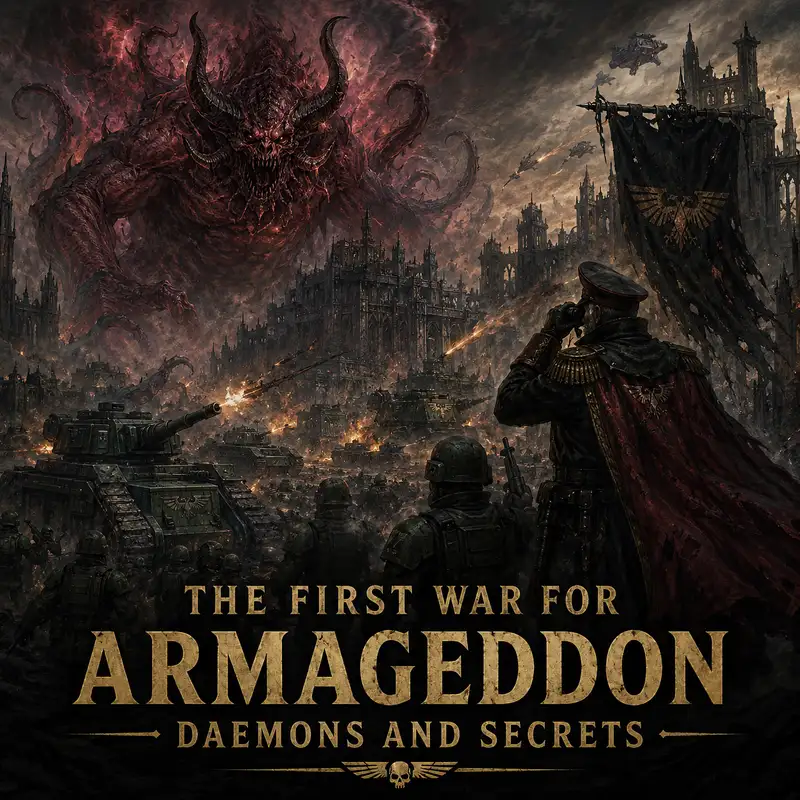
The First War for Armageddon: Daemons and Secrets
Armageddon’s first great war ended with a victory so dangerous that the Imperium tried to erase everyone who remembered it. A daemon primarch had been driven from the world. His armies had broken. The defenders had survived horrors that should have destroyed them. Then the soldiers who held the line were disarmed, separated from their families, and condemned by the government they had saved. The factories continued to burn beneath iron skies. The official records became quiet. That silence is the real shape of the First War for Armageddon, because the battle was about more than defeating daemons. It was about deciding whether knowledge itself could be treated as an enemy, and how much loyalty the Imperium was willing to murder to preserve a secret.
Armageddon was worth almost any price because it made war possible elsewhere. It was a vast hive world of crowded cities, poisoned skies, ash wastes, mines, refineries, and industrial districts without end. Its people lived inside a machine whose finished products were soldiers, vehicles, weapons, and ammunition. The planet was not beautiful, comfortable, or interested in the health of its inhabitants. It was useful. That distinction matters in the Imperium. A paradise world may inspire poetry, but an industrial world keeps armored columns moving. Armageddon supplied an entire region of space, and its position made it a strategic anchor. Losing it would have torn a hole in the military structure of the surrounding sector.
By the year four hundred and forty-four of the forty-first millennium, the machine was already shaking. Discontent had grown among workers packed into the northern continent known as Armageddon Prime. Labor unrest, sedition, cult activity, and open revolt spread through the hives. The planetary authorities treated the crisis as a domestic matter. They believed their own defense forces could restore order, so they did not call for Imperial assistance. This was not irrational. Rebellion was common, Imperial communication was slow, and requesting help could invite investigators who might execute the governor before assisting anyone else. The authorities chose quiet containment, one of the Imperium’s preferred solutions because it allows failure to mature undisturbed.
The rebellion was not merely political. Chaos had already found roots among the angry, the desperate, and the ambitious. Some wanted freedom from brutal working conditions. Some wanted power. Others served forces they did not understand, mistaking corruption for liberation. When invasion came, the distinction became fatal. Soldiers and workers who believed they were overthrowing distant tyrants discovered that their new patrons did not intend to build a fairer society. Khorne does not offer labor reform. He offers a simpler contract, written in blood and renewed continuously. The unrest did not cause the invasion, but it gave the invaders open doors, compromised units, and willing hands ready to destroy the world they claimed to be saving.
The invasion arrived aboard a space hulk called the Devourer of Stars, an impossible mass of wrecked ships fused by collision, decay, and the warp. Angron had gathered a host within it. The World Eaters had long since shattered into separate warbands, but their daemon primarch could draw them toward a common purpose. Around them came cultists, mutants, traitors, and daemons, a moving nation of violence held together by worship and appetite. System defense craft intercepted the hulk. They could not destroy it, but they damaged its engines and delayed its approach by roughly a month. Most of those defenders died. Their achievement was not victory, but time, often the only currency available to people facing something much larger than themselves.
Angron was more than a commander. He had once been one of the Emperor’s primarchs, a genetically engineered warlord created to lead armies during humanity’s ancient expansion. He rebelled during the Horus Heresy, served the Blood God Khorne, and became a daemon primarch. By the time he came to Armageddon, he was no longer simply a giant warrior with exceptional weapons. He was a creature sustained partly by the warp, a spiritual catastrophe wearing the outline of a general. Conventional firepower could wound his manifested body, but destroying that body would not destroy what he had become. His presence changed the nature of the campaign. Fear, rage, ritual slaughter, and weakening reality were not side effects of his army. They were part of its logistics.
When the Devourer of Stars reached the planet, the rebellion inside Armageddon Prime revealed its depth. Large sections of the planetary defense force turned against their comrades. Even elements of the Titan Legions joined the invaders. These were not frightened civilians with stolen rifles. Titans were walking war machines capable of breaking fortresses, and their betrayal made the collapse of the north brutally swift. World Eaters and daemons poured into the fighting. Hives fell. Loyal formations were crushed or forced south through the equatorial jungle, carrying whatever equipment and refugees they could save. Millions died in the opening violence. For the survivors, the war became a retreat through poisonous wilderness while the horizon burned with the light of their own cities.
Armageddon Prime should have been the beginning of an unstoppable advance. Instead, Angron paused. He raised monuments from wreckage and bodies and allowed his followers to indulge the instincts that had brought them there. This was not simply poor discipline. The weakening warp storms around Armageddon made it harder for the daemonic host to remain strong in material space. Angron needed an anchor. In the equatorial jungle, his forces built a great monolith designed to concentrate the power of Chaos. Prisoners were worked to death or sacrificed during its creation. The delay gave the Imperium time, but it also served the invasion’s deeper purpose. Angron was not trying to administer Armageddon. He was turning it into a place where the boundary between reality and nightmare could remain open.
South of the jungle, loyal commanders gathered what remained. The defenders of Armageddon Secundus had suppressed rebellion in their own formations with the directness expected of officers who knew hesitation might become possession. They established lines along the Styx and Chaeron rivers and prepared for the army coming through the jungle. Rivers restricted movement, armored vehicles needed crossings, and even a daemonic invasion had to move its mortal troops through terrain. The defenders were outnumbered and exhausted, but the pause in the north allowed them to build something resembling a front. Then the Space Wolves arrived under Logan Grimnar, the recently chosen Great Wolf, bringing not enough warriors to equal the enemy, but enough experience and authority to make resistance coherent.
The Space Wolves are remembered for ferocity, yet ferocity alone would have been useless. Grimnar understood that the World Eaters expected aggression and could be manipulated through it. Space Wolf forces struck across the Chaeron, inflicted damage, and withdrew. The enraged traitors pursued them into a prepared killing ground where Imperial armor and infantry waited. For hours, the defenders destroyed attackers who had mistaken pursuit for victory. It was a battle shaped by a simple military truth. An enemy’s greatest strength can become predictable, and predictability can be targeted. The plan did not make the war safe. It proved that mortal soldiers and conventional tactics still mattered, even while the sky and the laws of nature were becoming unreliable.
Along the western line, the war reached the limit of ordinary defense. Angron advanced with daemonic bodyguards and broke into the Imperial positions. Tanks, artillery, Space Marines, and massed infantry could slow the attack, but they could not provide a permanent answer. A daemon primarch did not need to preserve himself like a mortal commander. He could spend his manifested flesh as a weapon, knowing destruction might mean banishment rather than death. The defenders needed specialists who understood not only armor and firepower, but the rules governing daemons. Grimnar called for the Grey Knights, the secret Chapter created to fight the creatures of the warp. If they failed, the southern hives would fall and the monolith could make the invasion increasingly difficult to reverse.
The Grey Knights who answered were assembled from whatever brotherhoods could reach the battle in time. One hundred and nine Terminator-armored warriors formed a hastily gathered force under Brother-Captain Taremar Aurellian. They were not a conventional relief army. Their purpose was narrow and terrible. They would strike directly at Angron, surround him, and force a banishment before his host overwhelmed the planet. Every Grey Knight was a trained psychic warrior protected by ritual, discipline, and armor inscribed against the warp. That did not make them invulnerable. It made them capable of entering a fight that would kill almost anyone else before the first blow landed. Their secrecy was part protection and part weapon. Daemons use knowledge, names, fear, and temptation. The Grey Knights survived by controlling all four.
They teleported into battle around Angron and his daemonic retinue. Their formation was intended to contain the enemy long enough for combined psychic strength to matter. Lesser daemons were driven back or cast into the warp. Then Angron reached them. Terminator armor that could withstand heavy weapons was split beneath the daemon primarch’s blade. Squads vanished in moments. The Grey Knights did not defeat him by matching his physical strength. They attacked the conditions that allowed him to exist in realspace. Psychic assaults damaged the coherence of his form, while wards and weapons narrowed his choices. It was still a massacre. The difference was that the Grey Knights had entered it knowing exactly what their deaths were intended to purchase.
A surviving account places a warrior later known as Hyperion at the moment when Angron’s Black Blade was shattered. The broken weapon deprived the daemon primarch of part of his advantage, but it did not end the battle. Brother-Captain Aurellian confronted Angron as his force collapsed around him. Angron tore through his defenses and severed one of his arms. Aurellian continued the ritual, drawing upon the psychic strength and fury of the Grey Knights still standing. With his brothers holding a shrinking circle, he drove the broken blade of his halberd into the daemon primarch and completed the banishment. Angron was cast back into the warp for one hundred years and one day. Aurellian died. Of the one hundred and nine Grey Knights who entered the fight, only thirteen survived.
The effect on the wider battle was immediate. Daemons lost their hold on reality. World Eaters who had followed Angron’s presence found themselves without the center that drew the invasion together. Cultists and traitors discovered that confidence inspired by supernatural allies becomes less persuasive when those allies dissolve into smoke and screaming light. Imperial forces counterattacked. The remaining Chaos army broke apart, and the defenders pursued it through the wastes until organized resistance ended. By military standards, the First War for Armageddon was an Imperial victory. The planet remained in Imperial hands. Its industry, though damaged, could be rebuilt. Angron was gone. The survivors had done what the Imperium demanded of them. That should have ended the story.
The Inquisition saw a different battlefield. Millions of soldiers and civilians had witnessed daemons, traitor Titans, corrupted neighbors, and a primarch transformed into a servant of a Chaos god. To the Ordo Malleus, this knowledge was not neutral. Chaos could spread through memory, obsession, dreams, forbidden names, and the desire to understand what should remain unknown. A veteran who resisted corruption for months might still carry something home. A survivor’s testimony might become a cult’s scripture generations later. The fear was not invented. In the Warhammer universe, ideas can have claws. The Inquisition’s mistake was not believing exposure carried risk. It was deciding that every exposed human being was expendable.
The simplest method would have been to destroy Armageddon from orbit. Worlds touched by major daemonic incursions had suffered that fate before. Armageddon, however, was too valuable. Its mines, factories, transport networks, and military production were considered indispensable. The Imperium reached a characteristically efficient compromise. It would preserve the planet and remove the witnesses. Ordinary soldiers and civilians were rounded up. Many were sterilized and sent to labor camps in the remote south. Families disappeared into systems designed to ensure they left no descendants and no public testimony. New populations were brought in to refill the hives. The machinery survived. The people who defended it became classified waste.
Officials and selected elites could be sworn to silence, watched, or otherwise controlled. The mass of the population received no such consideration. This was partly security policy and partly class assumption. The Imperium trusted those with rank because it had mechanisms for threatening them, and distrusted common citizens because there were too many to supervise. Punishment was determined less by what a person had done than by whether the state considered that person administratively convenient. A worker who resisted Chaos was condemned beside a soldier who held the river line. Their courage did not reduce their risk rating. The policy had one considerable advantage. The people expected to object had already surrendered their weapons.
Logan Grimnar did object. The Space Wolves had fought beside the people of Armageddon. They had seen frightened soldiers remain at their posts and civilians endure a war that should have broken them. To Grimnar, loyalty created obligations in both directions. The defenders had served the Imperium, so the Imperium owed them protection. This was not a gentle humanitarian philosophy. The Space Wolves understood the danger of Chaos and were capable of brutality. Their objection came from a warrior culture in which oath, honor, and remembered deeds carried real weight. Killing loyal survivors after using their courage was not caution in Grimnar’s eyes. It was betrayal. Worse, it taught every future defender that service might be rewarded exactly like treason.
The Space Wolves began protecting evacuation ships and interfering with the purges. Some survivors escaped into the wider Imperium. The Inquisition argued that every escape increased the danger, because each refugee could expose another world. Its forces pursued ships, quarantined populations, and widened the circle of destruction. The confrontation became the Months of Shame, a bitter conflict between Imperial institutions that had just fought on the same side. Grey Knights were drawn into actions against Space Wolves they had bled beside on Armageddon. Inquisitorial commanders believed compromise would allow contamination to spread. Grimnar believed obedience would make him complicit in an unforgivable crime. Both sides claimed to defend humanity. Human beings caught between them continued to die.
The conflict did not become a full civil war, but it revealed how fragile Imperial unity could be. There was no neutral court capable of calmly settling the dispute. Authority depended on reputation, force, secrets, and the willingness of powerful organizations to stop before mutual destruction. The Grey Knights remembered the affair with shame, not because Angron defeated them, but because victory carried them into a war against other servants of the Emperor. The Inquisition preserved its principle of secrecy, while the Space Wolves preserved enough independence to remain openly resentful. No institution emerged clean. The Imperium survived the argument as it survives many things, by absorbing the dead and refusing to agree on what they meant.
The cover-up worked remarkably well. Records were expunged, sealed, or hidden. Armageddon was repopulated, its industry restored, and its official history simplified. Centuries later, the world became famous for wars against the Orks, while Angron’s earlier invasion remained unknown to most people living above its scars. Yet erasure was never complete. Names of dead defenders remained in places few thought to look. Suppressed memoirs and forbidden accounts survived. Mass graves were uncovered. Wrecked war engines lay buried beneath later battlefields. Fragments of Angron’s broken weapon remained connected to the spiritual wound left in the planet. The Imperium could destroy documents more easily than consequences.
The First War matters beyond the spectacle of Grey Knights surrounding a daemon primarch. It shows two kinds of defense operating at once. On the battlefield, the Imperium survived because different forces performed the tasks they understood best. Mortal soldiers held terrain. Space Wolves restored cohesion and turned enemy fury into weakness. Grey Knights attacked the supernatural center of the invasion. Victory depended on cooperation, sacrifice, and trust. Afterward, the system abandoned those virtues. Institutions concealed information from one another, reduced people to hazards, and nearly began another war over the meaning of loyalty.
The Inquisition’s fear was not foolish. Daemons are not merely foreign soldiers who can be counted, surrounded, and captured. They are ideas given hunger, and knowledge of them can open paths that artillery cannot close. Some secrets in the Imperium genuinely protect lives. The tragedy begins when secrecy becomes automatic, when preventing possible corruption justifies certain atrocity, and when the state can no longer distinguish a witness from an enemy. Armageddon was saved from Khorne by people who refused to break. It was then protected from memory by breaking those people deliberately.
Angron came to Armageddon to turn suffering into power. He built monuments from the dead, fed a monolith with sacrifice, and treated every life as material for a god of slaughter. The Imperial response condemned his purpose while adopting a colder version of his arithmetic. The motives were different. The methods were not identical. That distinction matters, but it does not make the resemblance comfortable. Both sides looked at the population and saw a resource to be consumed for a larger necessity. One called that necessity worship. The other called it security.
The First War for Armageddon was won in the narrowest possible sense. The invader was banished. The world remained productive. The secret was contained. Yet the victory damaged the idea that the Imperium’s defenders protected anything more than the continuation of the Imperial machine. Logan Grimnar understood that danger. An empire can compel obedience through fear, but it cannot endlessly demand sacrifice while treating sacrifice as evidence of guilt. Somewhere beneath Armageddon’s factories lie the graves, wreckage, and broken shards of a war the planet was ordered to forget. The furnaces kept burning above them. The secret did not disappear. It became part of the ground.