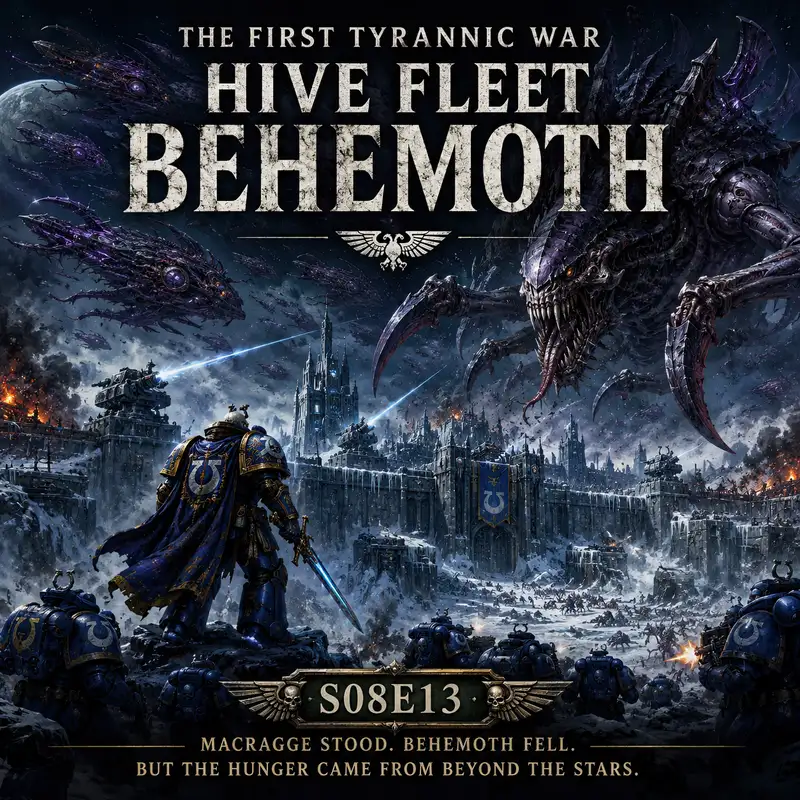
The First Tyrannic War: Hive Fleet Behemoth
The first proof of the Tyranids was not a living creature. It was an empty ocean. When Imperial investigators reached the world of Tyran, they found no cities in ruins, no occupying army, and no triumphant alien banners. They found a planet stripped to stone. Its seas were gone. Its atmosphere had been thinned. Even the smallest forms of life had vanished. Something had crossed the darkness beyond the Eastern Fringe, consumed an entire world, and moved on without leaving anyone behind to explain why. The Imperium had encountered many conquerors. This was the first warning that it had met a predator large enough to feed on planets.
The conflict later called the First Tyrannic War is usually remembered through the ice fields of Macragge, the dead of the Ultramarines First Company, and the destruction of Hive Fleet Behemoth. Yet the central question is larger than whether one famous world survived. How did the Imperium fight an enemy that had no capital to capture, no government to intimidate, and no soldiers in the ordinary sense? Behemoth was a fleet, an army, an ecosystem, and a single strategic appetite. The defenders of Ultramar did eventually stop it, but only after learning that almost every familiar assumption about warfare had become dangerous.
Imperial chronologies usually place the crisis in the later years of the forty-first millennium, although surviving accounts disagree over exact dates and the sequence of several battles. That uncertainty suits the opening of the war. Before Behemoth had a name, there were only reports from the frontier. Explorator vessels found worlds that should have supported life reduced to barren rock. The outpost on Tyran sent warnings of its own. Those warnings entered the Imperial bureaucracy, where urgent information can move with majestic ceremony and the practical speed of a glacier. No decisive aid arrived before the thing in the dark reached Tyran itself.
The Adeptus Mechanicus station on Tyran had little chance of defeating what came for it. The defenders did manage one act of resistance that mattered. They sealed a data codex deep beneath their command complex, preserving records of the invasion as the surface was overwhelmed. The world was then processed. Tyranid organisms killed resistance, consumed the dead, absorbed the living landscape, and fed the gathered material back into the fleet. What emerged was not merely a conquered planet. It was a planet converted into fuel, raw material, and new soldiers. The invading force grew by eating the battlefield, which is an alarming logistical advantage even by Imperial standards.
Inquisitor Kryptman followed the pattern of dead worlds and eventually recovered the buried record. From the name of Tyran came the Imperial designation Tyranids. The fleet itself received the name Behemoth, drawn from an ancient monster, because the Imperium often meets the incomprehensible by locating an older terror and updating the paperwork. Kryptman understood the essential danger. This was not a raid that would end when its holds were full. The hive fleet would continue until stopped, and every populated world in its path would make the next attack stronger. His task was to warn powers capable of mounting a defence before the evidence became another silent planet.
The Tyranids were alien even by the generous standards of the galaxy. Their ships were living organisms. Their weapons were grown rather than manufactured. Creatures that appeared to be separate species were specialised organs of a wider war machine. Small organisms could screen larger beasts, burrowing forms could break defensive lines, winged predators could hunt officers, and synapse creatures could impose direction on the swarm. Behind them all was the Hive Mind, a vast controlling intelligence expressed through countless bodies. Destroying a brood did not frighten the fleet. Killing thousands did not force a negotiation. The only useful question was whether enough of the whole organism could be destroyed before it replaced its losses.
Hive Fleet Behemoth advanced with a directness that later Tyranid invasions would not always share. It drove inward from the galactic southeast, crushing whatever happened to lie before it. Human outposts vanished. Alien forces were devoured or scattered. The fleet did not need to understand the politics of the Eastern Fringe because every political distinction ended in the same digestion pool. This apparent simplicity encouraged one of the first Imperial mistakes. Behemoth looked like a mindless flood. It was certainly ravenous, but ravenous did not mean stupid. Its organisms could adapt, its attacks could change, and the intelligence coordinating them was capable of identifying a defender's habits and using those habits against him.
The road to Macragge passed through Prandium, a fertile world celebrated as one of the treasures of Ultramar. Marneus Calgar, Chapter Master of the Ultramarines, led its defence. The Ultramarines were among the most disciplined military institutions in the Imperium. They possessed experienced commanders, powerful ships, armoured warriors, and a doctrine built from ten thousand years of recorded warfare. On Prandium, none of that was enough. Raids and mobile counterattacks wounded the swarm without stopping the invasion. Behemoth absorbed the world, its people, its fields, and according to some accounts even much of its atmosphere. Calgar escaped with a lesson severe enough to alter the defence of his home.
Prandium exposed the weakness in fighting Tyranids as though they were a conventional army. A human commander might withdraw after losing too many troops. A Tyranid swarm could recover part of its losses by consuming the corpses, including its own. A human supply line could be cut. A hive fleet carried the means of production within itself. A proud defence could become useful biomass if it died in the wrong place. Accounts describe Calgar withdrawing into meditation before admitting that the Ultramarines had underestimated their enemy. Whether every detail of that ritual is exact matters less than the decision that followed. He abandoned the idea that tradition alone would save Ultramar.
The next stand would be made at Macragge, the fortress world and spiritual centre of the Ultramarines. Calgar chose concentration over dispersal. The Chapter strengthened the planet's already formidable defences, gathered warships, armed merchant vessels, and prepared the polar fortresses whose great defence lasers could punish bio-ships in orbit. On the surface, fallback positions were established through the frozen regions. The plan was not elegant. It was designed to make the hive fleet spend more organisms than it could replace while keeping the orbital guns alive. For warriors trained to manoeuvre and counterattack, this meant accepting a brutal role. They would become the anvil and trust that a hammer would arrive.
Behemoth entered the Macragge system as a moving mass of living vessels. Imperial guns tore apart wave after wave, but the fleet could trade bodies for access. Mycetic spores plunged through the fire and burst across the surface, disgorging fresh organisms into snow, rock, fortification, and city. Each successful landing widened the invasion. The defenders could not simply count destroyed ships and declare progress, because the enemy's scale made arithmetic feel less like strategy and more like a clerical expression of despair. Calgar divided his forces, reinforcing the polar positions while leading delaying actions intended to slow the northern advance. Every hour gained on the ice might keep the defence lasers firing for another hour above it.
The records of the ground campaign do not agree on every movement, including Calgar's exact location during parts of the fighting. The best-known account places him at Cold Steel Ridge, an industrial position on Macragge's frozen seas. There, the Imperials believed they had begun to understand the swarm's methods. They had seen mass charges, monstrous shock creatures, and the pressure of numbers. Then the nature of the attack changed. Burrowing organisms struck one section of the line as a diversion. Flying creatures hunted command elements. Living artillery forced units apart. Larger beasts attacked the gaps. The Tyranids were not merely throwing bodies at a wall. They were taking the wall apart.
At the centre of this change was a creature later known as the Swarmlord. It was not simply a larger Hive Tyrant. It embodied experience gathered by the Hive Mind and applied with deliberate cruelty. At Cold Steel Ridge, the Swarmlord identified Calgar as the organising will of the defence. The attack isolated him. Even apparently dead organisms became part of the trap, rising to delay the Ultramarines trying to reach their Chapter Master. Calgar met the creature in close combat and was gravely wounded. His Honour Guard bought the time needed for a gunship extraction, paying for each moment with their lives. The defenders escaped. The ridge did not.
Cold Steel Ridge mattered because it destroyed the comforting fiction that the Tyranids were only animals. Animals can ambush, of course, and the galaxy contains animals capable of dismantling tanks. The deeper problem was coordination. The Swarmlord used different organisms as a commander would use infantry, artillery, aircraft, and reserves, except those forces shared a psychic purpose and showed no concern for survival. The Hive Mind had studied the defenders during the campaign. It recognised leadership, anticipated reinforcement, and turned corpses into concealment. The Ultramarines had adapted after Prandium. Behemoth was adapting in reply. The war had become a contest between two systems of learning, one of which could grow its next idea teeth.
With Calgar evacuated to orbit, the northern route opened toward the polar fortress. The Tyranid fleet had already battered Macragge's orbital defences and delivered enormous numbers of organisms to the surface. The polar guns remained crucial. As long as they fired, the bio-ships could not operate without cost. The Ultramarines First Company, the Chapter's veteran formation, held the fortresses with local troops and supporting war engines. These were warriors who had survived centuries of battle and earned the right to wear the Chapter's most honoured equipment. They were not placed there because the position was symbolic. They were placed there because failure would allow the invasion above and below to become one continuous victory.
Then the bio-ships broke away from Macragge. To an Imperial commander, a retreating enemy fleet offered a chance to end the campaign. It also threatened to escape, feed elsewhere, and return. Calgar took command of the surviving ships and pursued toward the ringed world of Circe. Accounts differ over whether the Tyranids were genuinely driven off or deliberately drawing the Imperial force away. Either version leads to the same danger. A second mass of bio-ships waited among the rings, and the pursuers found themselves facing an enemy that still possessed terrifying numerical strength. The battle for Macragge had become two battles separated by distance and joined by a single shrinking margin for error.
Reinforcements from Battlefleet Tempestus arrived and caught Behemoth between Imperial forces, but the numbers still favoured the hive fleet. The decisive act came from the Emperor-class battleship Dominus Astra. It drove into the heart of the Tyranid formation and detonated its warp drives. The resulting vortex consumed the battleship and tore the main mass of Behemoth into the immaterium. It was not a refined solution, but refinement had left the discussion some time earlier. The void battle ended through sacrifice on a scale the Tyranids could not immediately absorb. For the first time since Tyran, the great organism had been struck in a way that denied it the battlefield and the bodies.
The destruction of the fleet did not instantly save Macragge. On the surface, the Tyranid organisms already landed were still fighting. They did not disappear when their ships died. At the polar fortresses, the defenders had been forced from walls into chambers and from chambers into tunnels. Titans had walked the ice, guns had fired until barrels failed, and veteran Space Marines had yielded ground step by step. Communication with the fortresses ceased. Calgar's returning forces knew that Behemoth had been broken in space, but they did not know whether the world below still belonged to them. Victory in orbit had arrived before anyone could tell the men underground.
The southern fortress still contained survivors when relief forces reached it. The northern fortress offered something else. The Third Company fought through Tyranid organisms spilling from the passages, then advanced into tunnels choked with the dead of both sides. Deeper inside, they found the last position of the First Company. The veterans had fallen where they fought. Terminators lay in a circle, back to back, surrounded by the bodies of the creatures that had finally overwhelmed them. Captain Saul Invictus and the warriors under his command had held until there was no position left behind them and no living brother left to take it.
The image became one of the defining memories of the Ultramarines, but it should not be reduced to a simple tale of heroic last stands. The First Company had a military purpose. Its defence helped keep the polar weapons active, imposed losses on the swarm, and bought time for the void campaign to reach its terrible conclusion. Their deaths were not proof that courage defeats everything. Courage did not save them. Their sacrifice mattered because it was connected to a wider plan, and because others completed the work for which they died. The distinction is harsh, but military history is full of brave units destroyed for objectives that were never achieved. At Macragge, the objective was achieved elsewhere.
Hive Fleet Behemoth was shattered, and the First Tyrannic War became an Imperial victory. That phrase is true, but it conceals the condition of the victor. Macragge remained infested and required years of fighting to cleanse. Ultramar had lost worlds, ships, armies, and a generation of experienced warriors. The Ultramarines needed more than a century to regard the Chapter's losses as fully replaced. Calgar survived, but survival did not restore the dead or make the original assumptions less costly. The Imperium had saved one of its most important realms by feeding lives, vessels, and an irreplaceable battleship into the same furnace until the furnace finally broke.
The Chapter did learn. Ortan Cassius and other veterans carried the experience forward, eventually forming specialist Tyrannic War Veterans. The Codex Astartes, treated by many Ultramarines as the foundation of disciplined warfare, was amended to recognise methods developed against the new enemy. That detail matters. The Ultramarines are often mistaken for warriors who obey a book because they lack imagination. Their better tradition is more demanding. Doctrine is preserved so that experience does not have to be purchased twice, but doctrine that cannot respond to evidence becomes ceremony. Behemoth forced the Chapter to choose between the appearance of perfect orthodoxy and the practical duty to survive. They chose adaptation.
The Imperium learned less consistently. Information from Tyran helped later defenders understand the creatures, yet knowledge in the Imperium is fragmented, guarded, delayed, ritualised, and sometimes simply forgotten in an archive. Behemoth's surviving splinters remained dangerous. Given access to biomass, even a fragment could grow. Isolated organisms could persist on worlds long after the main fleet had gone. Every remnant demanded vigilance from institutions already fighting wars in every direction. The victory created expertise, but it did not create a coherent galactic response. The Imperium had discovered a predator from beyond the galaxy and answered in its usual fashion, with magnificent sacrifice followed by uneven filing.
Worse, Behemoth had also learned. The Hive Mind had consumed defenders from many species, tested its organisms against Imperial armour, studied Space Marine reactions, and measured the cost of attacking a fortified system. The fleet was destroyed, but the broader Tyranid threat was not a nation that could lose its capital and surrender. Later hive fleets would approach with different patterns. Kraken would divide into widespread tendrils. Leviathan would appear on a scale and from directions that undermined earlier assumptions. Macragge proved that a hive fleet could be stopped. It did not prove that the Tyranids could be defeated as a species, because no one yet knew how much of that species remained beyond the galactic edge.
This is the most important difference between Behemoth and the enemies the Imperium already understood. Orks can be scattered, even if they return. Rebellions can be decapitated. A rival empire can be contained by borders, treaties, or mutual exhaustion. Tyranids convert defeat, terrain, population, and corpses into the same resource. Their war aims require no occupation and produce no stable frontier. A world either remains alive or becomes part of the fleet. The First Tyrannic War therefore introduced a new kind of strategic terror. The enemy did not hate humanity, covet its throne, or seek to corrupt its faith. It regarded civilisation as stored nutrition protected by weapons.
There is also an irony in where Behemoth was stopped. The Ultramarines are associated with order, logistics, measured force, and the belief that war can be understood through disciplined study. The Tyranids appear to be the opposite, a chaos of claws and hunger. At Macragge, those appearances reversed. The swarm demonstrated coordination, deception, concentration, and adaptation. The Ultramarines survived through desperate improvisation, massed attrition, and a battleship turning its own warp engines into a bomb. Order defeated hunger only after accepting that the enemy possessed its own terrible order. The defenders won when they stopped insisting that the war should resemble anything they had fought before.
The First Tyrannic War did not end with a clean frontier or a conquered enemy capital. It ended with a dead fleet at Circe, living remnants across Ultramar, and a circle of veterans beneath the ice. The Imperium called that victory because Macragge still stood and Behemoth no longer advanced. It was a victory, but also a warning preserved in scars. The galaxy had not been invaded by the whole Tyranid species. It had been bitten by one hive fleet. The defenders survived the bite by learning faster than they died, and the cost of that lesson was written in empty oceans, stripped worlds, and the silence of the First Company.