The Fall of the Aeldari and the Birth of Slaanesh
Across the heart of Aeldari space, people died before they understood that a god had opened its eyes.
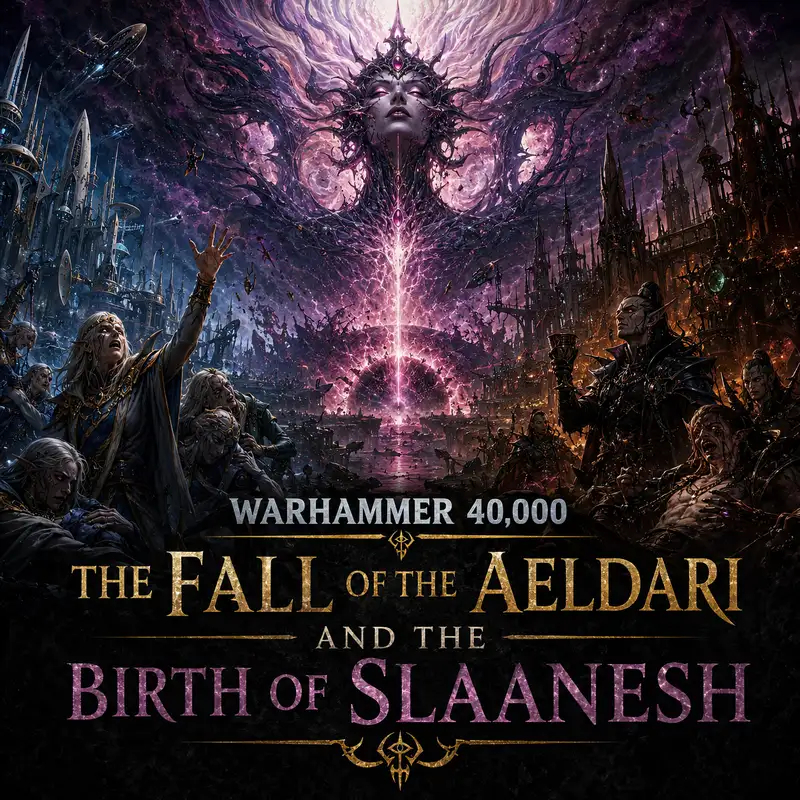
Cities that had endured for ages vanished beneath storms of impossible light. Towers folded into the sky. Seas boiled without heat. In the streets, Aeldari collapsed as their souls were torn from their bodies and dragged into the Warp. Ships fleeing the disaster found that distance was not always enough. Worlds separated by light years screamed together. At the centre of the empire, reality split open, and the wound would become known to later civilisations as the Eye of Terror.
The catastrophe is remembered as the Fall of the Aeldari. It was not the result of an enemy invasion, a failed military campaign, or a weapon turned against its makers. The most powerful civilisation in the galaxy destroyed itself so completely that its death created a new Chaos God.
That is the central horror of the Fall. The Aeldari did not merely lose an empire. They changed the structure of the universe, and the thing they created has hunted their souls ever since.
For millions of years, the Aeldari had stood near the summit of galactic power. Their oldest traditions reached back to the War in Heaven and the age of the Old Ones. Their mastery of psychic science, the Webway, and technologies that later species could scarcely understand allowed them to shape worlds and cross the stars with ease. Their armies could suppress rivals before those rivals became serious threats. Their machines performed labour, managed production, and protected the empire. Hunger, disease, and material want had largely ceased to govern Aeldari life.
This was not a civilisation struggling to survive. It was a civilisation that had won.
Some Aeldari traditions also remembered death differently. Before the Fall, an Aeldari soul could pass through the Warp and return to mortal life. Whether this was universal, or understood in the same way by every part of the empire, is not entirely clear. What matters is that death was not always imagined as a locked door. The psychic realm connected the living, the dead, and the gods of the pantheon.
That confidence made the coming disaster even more complete. The Aeldari had not only assumed that their civilisation would endure. Many had assumed that the soul itself belonged to an ancient cycle. Slaanesh broke that cycle and replaced it with predation. After the Fall, death no longer promised return. It promised capture.
Victory created a problem no weapon could solve. The Aeldari were extraordinarily long-lived, intensely emotional, and psychically sensitive. They experienced sensation with a depth that made human feeling seem muted by comparison. Their minds could devote centuries to an art, a discipline, or a single pursuit. In an earlier age, those qualities had produced magnificent works and formidable warriors. Once external necessity disappeared, the same qualities became dangerous.
There was always another experience to seek, another boundary to cross, another degree of perfection to demand. What began as freedom from hardship slowly became freedom from restraint.
The Fall is sometimes reduced to a simple warning about pleasure. That explanation is convenient, memorable, and incomplete. Pleasure was part of the descent, but Slaanesh is not merely the god of indulgence in its narrowest sense. Slaanesh embodies excess, obsession, perfection without limit, appetite without satisfaction, and the conviction that one more experience will finally be enough.
It never is.
A musician might pursue a note no instrument had ever produced. An artist might seek colours visible only through psychic manipulation. A duellist might become unable to tolerate opponents who offered anything less than genuine danger. Sensation cults explored ecstasy, terror, pain, domination, and sacrifice. Violence became performance. Murder became a form of self-expression. Those who had exhausted ordinary experience pursued increasingly extreme forms of it, because ordinary experience no longer reached them.
The problem was not that every Aeldari became equally corrupt. They did not. Many were appalled. Some warned that their civilisation was sick. Others withdrew from public life, gathered their families, or fled. The empire fell because the institutions capable of restraining the descent had weakened, while those who embraced it held the cultural centre.
A society can continue operating after it has lost the ability to correct itself. The streets remain lit. The machines continue their work. Officials still issue decrees. Festivals proceed on schedule. From a distance, everything appears stable. Then one notices that no one obeys the laws unless the laws are entertaining, that cruelty has become fashionable, and that warnings are dismissed as the complaints of frightened traditionalists.
The Aeldari empire had achieved a form of perfect administration. Unfortunately, administration is poor protection against collective madness.
Every thought and emotion leaves some trace in the Warp. For most beings, that trace is small. For the Aeldari, a psychic species numbering beyond easy calculation, the effect was immense. Their passions did not remain private. The accumulated force of their desires, fears, cruelties, and obsessions began to gather in the Immaterium.
No single cult created Slaanesh. There was no one ceremony at which the Aeldari gathered and voted, perhaps after a brief procedural debate, to manufacture a god. The birth was the result of generations of psychic pressure. The entire civilisation was feeding an emerging presence without understanding the full consequence.
The Warp does not experience time as material beings do, which makes the language of birth and growth imperfect. Slaanesh was forming, and in another sense had always existed once formed. For those living through the final centuries of the empire, the distinction was academic. Something hungry was taking shape behind reality.
The emerging presence also created a terrible feedback loop. The more unstable the empire became, the more fear, craving, and violence it poured into the Warp. The stronger the presence grew, the more those impulses intensified. It is impossible to draw a clean line between social corruption and daemonic influence, because each was feeding the other.
This helps explain why warning alone could not save the empire. A prophet might describe the danger accurately and still be heard by people whose judgement had already been reshaped by the danger itself. Those who called for restraint were not merely opposing popular habits. They were struggling against a psychic tide generated by their own species.
The warning signs grew harder to ignore. Strange dreams spread. Violence became less controlled and more ritualised. Psychic disturbances intensified. Daemonic manifestations appeared. The great Warp storms that isolated human worlds during the Age of Strife were connected to the convulsions surrounding this gestation. Across Aeldari space, the social collapse accelerated as though the approaching god were pulling its creators toward the conditions of its own birth.
Some Aeldari rejected the empire long before the final catastrophe. These became the Exodites. They abandoned the central worlds and travelled to distant maiden worlds, choosing lives of difficulty and discipline. Their decision was not technological ignorance. It was deliberate refusal.
The Exodites understood that comfort had become dangerous. On their new worlds, survival required labour, restraint, and attention. They lived among harsh landscapes and powerful creatures, often binding themselves closely to the world spirits of their adopted homes. Their society was austere because austerity gave desire a boundary.
To the sophisticated inhabitants of the empire, the Exodites appeared fearful, primitive, and embarrassingly earnest. History would later offer a severe correction to that assessment.
Other Aeldari escaped aboard craftworlds. These immense vessels had long travelled beyond the empire’s core, often serving as centres of trade, travel, and culture. As the crisis deepened, they became refuges. Families, artists, seers, warriors, and entire communities boarded them with whatever could be preserved.
Not every craftworld departed in time. Some remained too close to the centre of the disaster. Others were caught by the psychic shockwave despite desperate flight. The survivors were those that had travelled far enough, or possessed sufficient protection, to endure what followed.
There were also Aeldari domains within the Webway. The hidden city of Commorragh and its associated realms were protected from the immediate force of the birth scream by their separation from realspace. Protection, however, was not absolution. The inhabitants survived the instant of the Fall, but Slaanesh still claimed a connection to their souls.
These Webway survivors would become the Drukhari. Unlike the craftworld Aeldari, they did not respond by rejecting the old empire’s appetites. They preserved many of them, then built an entire civilisation around avoiding the price. They discovered that the suffering of others could replenish the essence slowly drained from them by She Who Thirsts.
Their cruelty is not random. It is an economy, a medicine, a social order, and a form of denial. The Drukhari continue the habits that helped create Slaanesh while using stolen agony to keep Slaanesh at bay. It is difficult to imagine a more faithful monument to the old empire.
The moment of birth came near the end of the thirtieth millennium. Accounts describe it as a psychic scream, an implosion, or an awakening. Language fails because the event occurred in both the Warp and material space.
Slaanesh emerged fully conscious and ravenous. The vast majority of Aeldari within the empire died almost at once. Their souls, brilliant in the Warp, were drawn into the newborn god. Bodies fell in palaces, streets, theatres, temples, and ships. Many victims had never joined a pleasure cult. Some had resisted the corruption. Others were children. Chaos does not conduct a careful inquiry into individual responsibility.
The Fall was not justice. It was consequence without fairness.
Aeldari mythology remembers another disaster unfolding in the Warp. Slaanesh fell upon the Aeldari pantheon. The precise nature of those gods remains debated even among the Aeldari. They may have been independent divine beings, psychic constructs shaped by worship, ancient powers formed around cultural memory, or some combination of these. Whatever their origin, the result was ruin.
Asuryan and many of the old gods were consumed. Cegorach, the Laughing God, escaped into the Webway according to the surviving myths. Khaela Mensha Khaine, the Bloody-Handed God of war, fought Slaanesh and was defeated, but not devoured. Khaine was shattered, and fragments of the war god came to rest within the surviving craftworlds. In later ages, those fragments would awaken as Avatars of Khaine, burning embodiments of a god who had survived only by being broken.
The destruction of the pantheon was more than a religious calamity. The Aeldari lost the divine structure through which they understood themselves. Their gods had represented war, life, fate, craft, laughter, death, and authority. Slaanesh did not simply kill their people. Slaanesh devoured their symbols, their myths, and much of the spiritual order that had connected past generations to the future.
In realspace, the centre of the Aeldari empire became the Eye of Terror. The ancient homeworlds were swallowed by overlapping reality and nightmare. Palaces, vaults, cities, and machines survived in distorted forms upon what became known as Crone Worlds. They remained filled with treasures beyond price and dangers beyond sensible calculation.
The Aeldari would return to these worlds in later ages, driven by prophecy, desperation, or the need to recover spirit stones. Such expeditions are journeys into the corpse of their civilisation. The ruins are not dead. They exist within a realm where memory can take shape, desire can become a predator, and the old empire’s sins have acquired claws.
Beyond Aeldari space, the effects were equally profound. The psychic eruption blew away many of the Warp storms that had divided human civilisation during Old Night. Routes that had been impassable reopened. Isolated systems could once again be reached.
The Emperor of Mankind began the Great Crusade soon afterward.
The timing carries a grim symmetry. Humanity’s attempt to reunite the galaxy became possible because the Aeldari empire had annihilated itself. One civilisation’s apocalypse created another civilisation’s strategic opportunity. The Imperium would later speak of human destiny, usually in tones loud enough to discourage questions. Yet that destiny advanced through a doorway opened by the birth of a Chaos God.
For the surviving Aeldari, there could be no return to ordinary life. Every community had to answer the same question. How do you continue living when your own emotions helped create the thing waiting to consume you?
Among the scattered survivors was an Aeldari named Iliathin, later remembered as Asurmen. He had not believed the warnings strongly enough to leave before the Fall. In the ruins, he saw his world become a hunting ground for daemons and was forced to kill his own brother after possession claimed him. The old civilisation had offered Iliathin almost limitless freedom. Its destruction left him with a simpler choice: find discipline, or die.
His later transformation into Asurmen would help shape the martial traditions of the craftworlds. He became the first Phoenix Lord and taught the Path of the Warrior. This did not reverse the Fall. Nothing could. It gave some survivors a way to carry violence without allowing violence to consume every other part of the self.
The craftworld Aeldari answered with the Path. Their lives became carefully structured around disciplined forms of experience. An individual might walk the Path of the Artisan, the Seer, the Warrior, or another calling, devoting intense concentration to one role before moving on. The purpose was not merely social organisation. It was psychic survival.
The Path gave Aeldari passion a channel. It allowed them to pursue excellence without letting pursuit become limitless appetite. Even so, there was danger. Some became trapped upon a Path, unable to leave the identity they had mastered. A warrior trapped in that way became an Exarch, permanently bound to the martial aspect of Khaine. Discipline saved the craftworlds, but discipline could become another form of obsession. The Aeldari had learned to build walls around fire. They had not learned how to extinguish it.
They also turned to spirit stones. Worn by the living, these stones capture an Aeldari soul at death before Slaanesh can claim it. The soul may then be placed within a craftworld’s Infinity Circuit, joining the psychic presence of generations.
This offers protection, but not peace in any simple sense. The dead remain part of the craftworld. In moments of great need, their souls may animate wraith constructs and return to battle. The armies of the Asuryani can therefore include their ancestors, called from the quiet of the Infinity Circuit because the living are too few.
The Exodites trusted their world spirits to shelter their dead. The Harlequins placed their faith in Cegorach and preserved the story of the Fall through ritual performance. Their great dances are not entertainment alone. They are history, warning, worship, and war conducted through movement.
The Drukhari chose predation. Corsairs accepted risk and freedom between more rigid ways of life. Later movements would seek other answers, including hope in Ynnead, the Aeldari god of death who might one day challenge Slaanesh. Every surviving branch of the species became an argument about how to live after the Fall.
That is why the Aeldari cannot be understood as one people with a few military variations. Their divisions are philosophical wounds. The craftworlder looks at the Drukhari and sees the old empire refusing to repent. The Drukhari looks at the craftworlder and sees a frightened ascetic hiding inside rules. The Exodite sees both as dangerously close to the civilisation that failed. The Harlequin turns all of them into characters within a tragedy whose final act has not yet been performed.
None of these answers is complete. The Paths can become prisons. The world spirits can be threatened. The Drukhari must constantly acquire new victims. The Harlequins serve a god whose plans are concealed behind laughter. Even the spirit stones that protect Aeldari souls must be gathered from worlds lying within the Eye of Terror.
Slaanesh transformed survival into a permanent logistical problem.
The deepest mistake is to treat the Fall as a single night of punishment following a long party. The physical catastrophe was sudden, but the civilisation had been falling for generations. It fell each time restraint was mistaken for cowardice, each time appetite became identity, each time warning was dismissed because the machines still worked, and each time private obsession was allowed to reshape public life.
The Aeldari had defeated enemies, scarcity, distance, and perhaps even ordinary death. They had not defeated the need for purpose. With no external limit, they discovered that desire can expand faster than any empire.
Slaanesh was born from that expansion. The new god was not an alien invader arriving from beyond the stars. It was a reflection made conscious, a psychic image of the civilisation that created it. Beautiful, terrible, insatiable, and incapable of accepting enough.
The Fall therefore answers its central question in a way more disturbing than simple decadence. The Aeldari were destroyed not because they felt too much, nor because pleasure itself was forbidden, but because an entire civilisation lost the ability to place limits on what feeling demanded. Their power magnified every appetite. Their psychic nature gave those appetites form. Their empire supplied the time and freedom for them to grow.
When Slaanesh opened its eyes, the Aeldari saw their own excess looking back at them.
The survivors still live beneath that gaze. Every Path chosen, every spirit stone carried, every raid launched from Commorragh, and every Harlequin dance performed in the darkness is an answer to the same ancient scream. The empire is gone, but its final creation remains, waiting beyond death with the patience of a god and the hunger of a civilisation that never learned to stop.