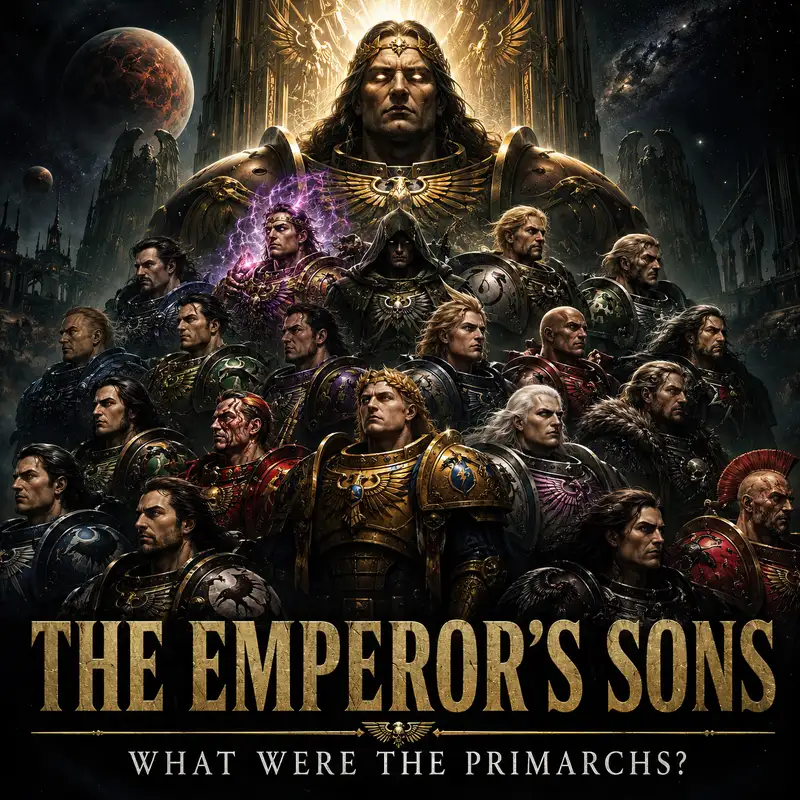
The Emperor’s Sons: What Were the Primarchs?
Beneath the Imperial Palace, before humanity had reclaimed the stars, twenty sealed chambers held the future of the species. Inside them were not infants in any ordinary sense. They had no ordinary childhoods prepared for them. They were designed lives, each shaped by sciences that had survived the collapse of human civilisation and by powers drawn from a realm the Emperor publicly insisted mankind should learn to master without worship. He called the beings within those chambers his sons. That single word would help build an empire, fracture it, and leave the survivors arguing for ten thousand years over whether he had meant it.
The Primarchs are often described as giant Space Marines. This is convenient, understandable, and wrong in almost every useful way. A Space Marine was created from a Primarch’s genetic legacy. The Primarch was the original pattern, the gene-sire, the commander, and the living standard around which an entire Legion could be organised. Space Marines were transformed human recruits. Primarchs were engineered from the beginning as something beyond human. They were not simply stronger soldiers. They were meant to think at impossible speed, command wars across star systems, and stand before ordinary people with the presence of figures from myth. The Emperor did not need twenty unusually large infantry officers. He needed beings capable of carrying pieces of his ambition across a galaxy.
That ambition had been born from disaster. Old Earth had survived the Age of Strife as a wasteland divided among tyrants, techno-barbarians, warlords, and isolated enclaves. The Emperor unified Terra through diplomacy where it worked, conquest where it did not, and methods that made the distinction rather academic. His Thunder Warriors broke the armies of Old Earth, but they were built for a brutal and temporary purpose. The Legiones Astartes were more stable, more adaptable, and suitable for the wars beyond Terra. Even they needed direction. A Legion might number tens of thousands of enhanced warriors, supported by fleets, armour, artillery, and the labour of entire worlds. Such a force could conquer kingdoms. The Primarchs were intended to make those Legions instruments of a single galactic design.
Their exact creation remains one of the great locked rooms of Imperial history. The Emperor possessed genetic knowledge far beyond that of most surviving human cultures, and he did not work entirely alone. Fragmentary accounts identify other scientists and architects around the project, although their roles and motives are not always presented consistently. The Primarchs do not appear to have been products of biology alone. Every one of them possessed a presence that exceeded muscle, bone, and engineered organs. Some, such as Magnus, displayed overwhelming psychic ability. Others seemed to bend attention, loyalty, fear, or probability around themselves without consciously trying. The evidence points toward the Warp as part of their making. What the Emperor took from it, learned from it, or risked within it is less certain. The available witnesses are unreliable. Several have horns.
Even the number of Primarchs requires care. The Imperium created twenty numbered Legions, each linked to a Primarch line. Eighteen Primarch lineages are remembered by name. The second and eleventh were deliberately erased from the record, their names, deeds, and fates buried beneath orders so severe that even their brothers learned not to speak openly of them. The twentieth lineage makes the count still less comfortable because the Alpha Legion concealed the twin Primarchs Alpharius and Omegon behind one identity. With the Alpha Legion, arithmetic is merely another opportunity for counterintelligence. The Emperor planned a family of twenty roles, while the surviving records refuse to stand neatly in formation.
Before the Emperor could raise them, train them, or explain what they were, the Primarchs were scattered. A catastrophe tore through the laboratories and cast the gestation capsules into the Warp. They emerged across the galaxy on distant human worlds. Imperial tradition presents this as the work of Chaos, intended to corrupt the Emperor’s design before it matured. Later accounts complicate the event and suggest that other hands may have played a part. The precise responsibility remains disputed. The result is not. Twenty engineered beings intended to grow under one teacher were instead delivered to different planets, different cultures, and very different forms of misery.
That scattering changed them as deeply as their construction had. Roboute Guilliman grew on Macragge among institutions, law, administration, and a family that taught him to govern. Leman Russ survived on Fenris, where civilisation clung to volcanic islands beneath a lethal sky and strength was measured against winter, monster, and rival clan. Konrad Curze emerged on Nostramo, a world of darkness and predation, and learned justice through terror because terror appeared to be the only language anyone obeyed. Angron was enslaved on Nuceria, mutilated with the Butcher’s Nails, and forced to kill for the amusement of an elite he despised. Vulkan grew among the people of Nocturne and learned craft, endurance, and attachment to ordinary human communities. Corvus Corax matured among prisoners and became a liberator. The Primarchs arrived with extraordinary capacities, but their worlds taught them what those capacities were for.
Their growth was unnaturally rapid. As youths, they absorbed languages, tactics, sciences, and political systems with frightening speed. Many conquered or transformed their home worlds before the Emperor found them. Some became kings. Some became rebels. Some became prophets, hunters, scholars, or weapons in the service of other rulers. This matters because the Emperor did not recover a collection of empty vessels. He found adult personalities with loyalties, grievances, cultures, and ideas of their own. He may have designed their potential, but strangers raised the men who would use it.
The Space Marine Legions had already been created from the Primarchs’ genetic material, even while their gene-sires were lost. Each Legion carried a distinct line of gene-seed derived from its Primarch. This did not make the Marines miniature copies, but it could influence appearance, temperament, abilities, and inherited flaws. When a Primarch was reunited with his Legion, the meeting was biological, political, and almost religious. The Primarch gained tens of thousands of warriors prepared to call him father. Names changed. Customs changed. Recruitment worlds shifted. Old officers found themselves judged by a commander who had never seen Terra but whose bloodline defined every warrior under him.
The effect could be restorative. A Legion damaged by instability might gain access to its Primarch’s genetic material and recover. It could also be disastrous. Angron’s Legion adopted versions of the Butcher’s Nails because it wanted to resemble a father who could barely tolerate its devotion. The Night Lords reflected Curze’s use of fear, then magnified it into a culture where terror became not merely a method but an appetite. The Word Bearers absorbed Lorgar’s hunger for belief. The Iron Hands took Ferrus Manus’s contempt for weakness and eventually remembered the contempt more clearly than the man. Gene-seed created kinship. Culture decided what that kinship meant.
Were the Primarchs designed for separate tasks? The answer is probably yes, though not in the simple manner of assigning one son to siege warfare and another to ride very quickly in the opposite direction. They were all capable strategists, warriors, diplomats, and rulers. Their abilities overlapped because the Great Crusade could not afford helpless specialists. Still, patterns are visible. Guilliman excelled at administration and building systems that survived victory. Rogal Dorn embodied discipline, defence, and uncompromising duty. Perturabo possessed a brutal genius for engineering, siegecraft, and the mathematics of destruction. Jaghatai Khan understood movement, distance, and the freedom found beyond rigid control. Corax mastered concealment and insurgent war. Magnus explored the psychic future of humanity. Sanguinius inspired love as readily as fear. Horus could bind rivals together and make obedience feel like partnership.
One later interpretation suggests that the Primarchs were intended as a balanced system, each compensating for qualities the others lacked. It is an attractive idea. It also reveals the central weakness of the project. A balanced system works only when its parts cooperate. The Primarchs did not grow together. They met as accomplished warlords, each accustomed to command, each carrying the habits of a different world, and each confronted by brothers who were both family and competition. They admired, resented, loved, and measured themselves against one another. Some friendships became genuine. Fulgrim and Ferrus Manus shared a bond built through craftsmanship and mutual respect. Horus and Sanguinius loved one another deeply. Other relationships hardened into rivalries whose military consequences would eventually be measured in burning planets.
Physically, a Primarch stood above even a Space Marine. Their size varied, as did their appearance, but all possessed strength, speed, endurance, and perception beyond the Legiones Astartes. They could read immediate violence while holding an entire campaign in mind. Their charisma was equally important. Ordinary humans often reacted to them with awe before a word was spoken. Space Marines felt a genetic pull toward their own gene-sire that could become fierce loyalty. None of this made the Primarchs invulnerable. They could be wounded, broken, corrupted, and killed. Their greatness made their failures more consequential, not less possible.
The claim that they were sons therefore cannot be dismissed as mere poetry. They shared the Emperor’s genetic legacy and, in some uncertain fashion, aspects of his greater power. They called one another brothers. They formed attachments, rivalries, and a family history that continued even when they tried to deny it. They wanted approval, trust, explanation, and proof that they were valued for more than victories. Horus treasured the years in which he alone fought beside the Emperor. Lorgar wanted his father to accept worship and meaning. Perturabo wanted his achievements to be seen rather than merely used. Mortarion wanted freedom from tyrants and never forgot that the Emperor’s intervention on Barbarus felt like rescue mixed with humiliation. Angron had good reason to believe that his father had saved his life while abandoning everything he considered worth living for.
The Emperor’s own conduct does not settle the question. Different accounts show different faces. At times he addressed the Primarchs with warmth, pride, and unmistakable concern. At other times he treated them as strategic assets whose emotional needs were irrelevant to the survival of humanity. Some records suggest that he saw them primarily as tools. Others show actions that are difficult to explain without attachment. The Emperor appeared differently to different observers, useful for inspiring an empire and less useful for historians seeking a straight answer. He may have loved them. He may have believed that love could not be allowed to interfere with necessity. He may also have assumed that engineered demigods would cope with poor communication better than ordinary families. On this matter, he demonstrated the confidence of a man who had never attended a family counselling session and had no intention of starting.
The Great Crusade proved that the Primarchs worked. Under their command, expeditionary fleets crossed the stars, reunited isolated human worlds, destroyed hostile empires, and expanded the Imperium at astonishing speed. Some worlds welcomed contact. Others were brought into compliance through invasion, bombardment, and the removal of governments that preferred independence. The Primarchs were not merely defenders of humanity. They were the leading generals of an imperial conquest. Their intelligence and charisma made that conquest more effective. Their presence also allowed the Emperor’s authority to travel far beyond his physical reach. Each son became a mobile centre of legitimacy, carrying the father’s command into regions the father might never see.
Success concealed structural danger. Each Primarch commanded a Legion whose warriors often felt more loyalty to their gene-sire than to distant Terra. Many Primarchs ruled home worlds or domains, controlled fleets, and possessed the personal authority to alter the culture of enormous military organisations. The Imperium had created twenty concentrations of power large enough to conquer sectors and personal enough to follow a grievance. So long as the Emperor remained present and the brothers shared a common purpose, the arrangement produced victory. Once trust weakened, the same design offered rebellion a ready-made command system.
The crisis sharpened when the Emperor named Horus Warmaster and withdrew to Terra to continue a secret project. Horus was the obvious choice in many respects. He was the first openly recovered Primarch, the most experienced beside the Emperor, and the brother most capable of coordinating other brothers without immediately making them reach for weapons. His promotion still created resentment. The Primarchs had been told they were equals in service, then one was placed above the rest. Horus had to continue the Crusade without the father whose authority had held it together. The Emperor offered responsibility but little explanation. Chaos did not create every wound in that family. It found wounds already present and applied pressure with professional interest.
When Horus fell, nine of the eighteen remembered Primarchs turned against the Emperor. Their reasons differed. Some were seduced by power or hidden knowledge. Some acted from bitterness, pride, fear, or loyalty to Horus. Some believed the Emperor had lied about the Warp, humanity’s future, or their place within it. Some made one catastrophic decision and found pride made retreat harder than damnation. The loyal Primarchs were not united by simple virtue either. They argued, concealed secrets, disobeyed orders, and carried their own dangerous flaws. The Horus Heresy was not a clean division between good sons and evil sons. It was a civil war among engineered rulers whose virtues and injuries had both been scaled to military proportions.
The battles that followed demonstrated what Primarchs truly were more clearly than any laboratory record. They were strategic multipliers capable of changing entire campaigns through command, personal combat, or symbolic presence. They were also emotional centres whose fall could shatter a Legion. Ferrus Manus died at Isstvan, and the Iron Hands spent millennia trying to amputate grief from their identity. Sanguinius died aboard the Warmaster’s flagship, and the psychic echo of that death still erupts through the Blood Angels and their successors as the Black Rage. Horus died by the Emperor’s hand, and the traitor war effort lost the figure who had held its rival powers together. A Primarch’s body could be killed. The consequences did not necessarily notice.
It is tempting to say the project failed because the Emperor made his sons too human. That is not quite right. Their humanity was part of what made them effective. A machine could calculate. A weapon could destroy a city. A Primarch could persuade that city to open its gates, then reorganise its government, recruit its children, and convince the survivors that history had always been moving toward this result. Their emotions gave them loyalty, creativity, courage, and the ability to understand the people they ruled. Those same emotions produced jealousy, shame, resentment, devotion, and despair. The flaw was not that they felt. The flaw was that the Imperium depended on those feelings while pretending they could be commanded like engines.
Nor is there firm evidence that each Primarch was fated to become exactly what he became. Their traits created tendencies, not completed destinies. Angron’s capacity for empathy can still be seen beneath what Nuceria did to him. Curze’s visions did not force every cruelty he chose. Perturabo’s brilliance did not require bitterness, though bitterness found abundant nourishment. Guilliman’s order could become humane government or cold calculation. Russ’s savagery could conceal discipline. The Lion’s loyalty could coexist with secrecy so profound that even his allies doubted him. Each Primarch was designed with possibilities, then shaped by upbringing, circumstance, the Emperor’s decisions, and his own choices. They were not pieces placed on a board with only one legal move.
After the Heresy, the loyal Legions were divided into smaller Chapters in part because no one wished to see such enormous military power concentrated again. The surviving Primarchs disappeared, died, or passed into legend. Several traitors became Daemon Primarchs, exchanging what remained of their freedom for immortality beneath the Chaos Gods. Ten thousand years later, the sons became religious figures in an Imperium that worshipped the father who had once condemned religion. Their names survive in Chapter rituals, battle cries, genetic flaws, relics, and political claims. Even absent, they remain embedded in the military body of the Imperium.
The return of Roboute Guilliman and Lion El’Jonson exposes the old contradiction with unusual cruelty. To the Imperium, they are demigods from a sacred age. To themselves, they are veterans waking inside the failure of their father’s dream. Guilliman commands institutions that quote his writings while often violating their purpose. The Lion walks through a divided realm where truth has been buried beneath ten thousand years of fear and ritual. Their traitor brothers have also returned to war in monstrous forms, still carrying ancient rivalries into a galaxy that barely understands their origins. The Primarchs were created to lead humanity out of darkness. They now stride through an age that turned their family disaster into scripture.
So what were the Primarchs? They were gene-forged warlords, psychic mysteries, templates for the Space Marine Legions, imperial governors, symbols of authority, and weapons powerful enough to threaten the civilisation they built. They were also sons, not because the Emperor used the word, but because they lived the consequences of being a family. They sought a father’s recognition, competed with brothers, and passed their wounds to generations who never met them. The Emperor designed beings capable of conquering the galaxy, then expected them to understand their place without ever giving all of them the same answer. The Imperium rose through their victories and broke through their grievances. In the end, the most dangerous thing about the Primarchs was not that they were too powerful to be human. It was that they were human enough to need love, and powerful enough to make the galaxy pay when they did not find it.