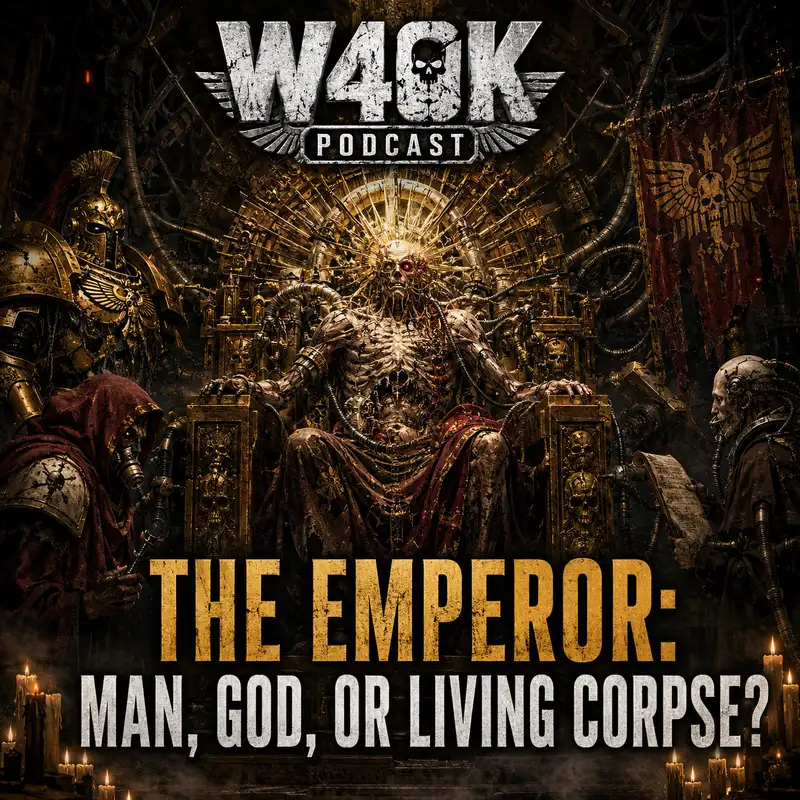
The Emperor: Man, God, or Living Corpse?
The most powerful human being in the galaxy cannot lift his head. He sits at the center of Terra inside a machine so vast that generations of priests can spend their lives tending one portion without understanding the whole. He does not walk, speak aloud, or issue orders as a living ruler would. Yet fleets cross the stars by his light, armies kill in his name, saints rise from death beneath his gaze, and an empire of uncounted worlds insists that his silence is the voice of God.
To the ordinary citizen of the Imperium, there is no question. He is the God-Emperor of Mankind, immortal father of the human race and shield against the alien, the daemon, and the darkness. To his enemies, he is a tyrant preserved by obscene machinery, a dead warlord whose followers have mistaken a prison for a throne. To those who knew him before the Imperium became a religion, he was something more troubling. He was a man who denied the existence of gods while wielding power that made disbelief increasingly difficult.
Even his beginning is uncertain. No reliable authority can provide his original name, and the oldest accounts disagree on how he came into the world. Some legends place his birth in prehistoric Anatolia. Others surround him with tales of ancient mystics and gathered souls. Later testimony presents him as one of the Perpetuals, rare humans who do not age normally and may return after death. The Emperor’s past is older than dependable history.
What can be said with greater confidence is that he lived among humanity for an immense span of time, sometimes acting openly and sometimes from concealment. That restraint ended during the Age of Strife, when warp storms isolated the stars, old empires collapsed, and Terra fractured into states ruled by techno-barbarians, gene-lords, tyrants, and warlords with functioning weapons and dramatic titles.
The Emperor emerged from that ruin not as a philosopher asking for consent, but as a conqueror. He created the Thunder Warriors, gathered armies, forged alliances when useful, and destroyed rivals when they would not submit. The wars of Unification ended Terra’s division, but they were not gentle. Entire cultures disappeared. Ancient faiths were suppressed. When the Thunder Warriors had served their purpose, they too were discarded. He could show patience across millennia, yet remain brutally economical with individual lives.
After Terra came the stars. The Emperor created the primarchs, twenty engineered sons intended to become generals, rulers, and foundations for his new order. When they were scattered across the galaxy, he used their genetic legacy to create the Space Marine Legions. The Great Crusade followed, carrying human armies outward to reunite lost colonies, destroy hostile powers, and impose one Imperium. Some worlds welcomed reunion. Others received the patient education of orbital bombardment and massed artillery.
This was not conquest for its own sake, at least not in the Emperor’s design. He believed humanity was approaching a dangerous psychic transformation. More people were being born with minds that touched the warp, and the warp contained predators, daemons, and the powers later called the Chaos Gods. Humanity had to be united and moved beyond its dependence on warp travel before those powers could consume it.
His intended solution was breathtakingly ambitious. He would unite the species, replace superstition with reason, guide human psychic development, and gain access to the webway, an ancient network of protected passages running through the immaterium. Humanity would no longer depend so completely on Navigators and unstable warp routes. It was a plan to save the species by placing nearly every part of its future under one will. His own.
The public creed of this order was the Imperial Truth. It declared that gods did not exist, religion was a relic of fear, and the universe could be understood through reason. Temples were destroyed. Priests were silenced. Worship was treated not merely as error, but as a danger to survival. The Emperor did not offer a mild secular philosophy. He enforced disbelief with armies.
There was an obvious difficulty. The man demanding an end to worship appeared as a towering figure in golden armour, surrounded by psychic radiance, commanding engineered sons and descending from the heavens at the head of crusading fleets. Witnesses did not always perceive him in the same way. Some saw a glorious giant. Others saw a more ordinary man. This may have been deliberate psychic projection, the expectations of the observer, or both. The visual argument was not entirely on the side of rational modesty.
The Emperor insisted that power did not make him divine. Within the world of Warhammer forty thousand, that position is reasonable. A psyker can perform acts that look miraculous without becoming a god. The Emperor could read minds, shape perception, confront daemons, and influence events across impossible distances. None of that proved he created the universe, knew everything, or deserved worship.
One of his sons disagreed. Lorgar, primarch of the Word Bearers, saw the divine made flesh. His Legion raised temples and taught conquered populations to worship the Emperor. Lorgar’s devotion was sincere, but it slowed his campaigns and violated the Imperial Truth. The Emperor responded by ordering the Ultramarines to destroy Monarchia, the perfect city Lorgar had raised in his honour, then forced the Word Bearers to confront their humiliation.
The lesson was intended to end Lorgar’s faith. It did not. Lorgar decided not that gods were unreal, but that the Emperor was unworthy of worship. He went searching for gods who would accept it, and Chaos was pleased to receive the application. The son punished for excessive devotion became an architect of the Horus Heresy, while the religious book he had written before his fall, the Lectitio Divinitatus, continued to circulate in secret.
That irony sits near the heart of the Imperium. An argument for the Emperor’s divinity came from a future traitor. The Emperor condemned it. Loyal soldiers and civilians preserved it. As the Heresy spread and rational certainty collapsed, belief offered frightened people a language for courage and sacrifice. Euphrati Keeler helped turn forbidden devotion into a movement among people who needed the Emperor to be more than an absent commander.
His secrecy helped create that need. The Emperor knew the powers of Chaos were real, but concealed much of their nature. He appears to have feared that knowledge and worship would strengthen them. The result was an empire ordered to reject religion without being told what religion was protecting it from. When the primarchs encountered the warp’s intelligences, many lacked the framework to understand the threat. The policy was rational in purpose and disastrous in execution.
The deepest secret lay beneath the Imperial Palace. There, the Emperor worked to open a human route into the webway. The Golden Throne was part of that project before it became his life-support system. He withdrew from the Great Crusade to concentrate upon the work and placed Horus in command as Warmaster. To several primarchs, his departure felt like abandonment. To Horus, already wounded by pride and manipulated by Chaos, it became evidence that his father had used him and moved on.
Then Magnus the Red tried to warn the Emperor of Horus’s betrayal. Magnus used forbidden sorcery to force his message into the Palace. The warning was genuine. The method was catastrophic. His intrusion shattered the protections around the human webway project, allowing daemons into the passages beneath Terra. The Emperor was forced onto the Golden Throne to hold the breach shut while Custodians, Sisters of Silence, Mechanicum forces, and others fought a hidden war below the Palace.
The webway war destroyed the future the Emperor intended. Humanity would remain dependent on warp travel. The Imperial Truth had failed to prevent Chaos from corrupting half the primarchs. The Great Crusade became civil war. The architect of a plan designed to control every major danger found himself trapped by consequences he had not controlled.
The Heresy ended above Terra aboard Horus’s flagship, the Vengeful Spirit. Malcador, the Emperor’s oldest and most trusted regent, took his place upon the Golden Throne so the Emperor could confront his fallen son. When the struggle ended, Sanguinius was dead, Horus was destroyed, and the Emperor bore wounds no ordinary body could survive. The loyalists had won in the narrow military sense. Their capital was ruined, their armies were broken, and their ruler could no longer rule.
The Emperor was carried back to the Palace and placed upon the Throne according to instructions given before the battle. Malcador died in the transfer. The machine preserved what remained of the Emperor, but preservation is generous. Over the millennia, his body became withered and skeletal, held between life and death by systems the Imperium can maintain only imperfectly and may no longer fully understand.
The Throne is not simply an elaborate medical chair. It sustains the Emperor’s remains, anchors his psychic presence, and keeps the ruined webway portal beneath the Palace sealed. If that barrier fails, Terra may face daemonic invasion from beneath its foundations. Ancient safeguards may destroy the Throneworld rather than allow it to fall. Turning the machine off would be less like ending treatment and more like opening a door into hell while standing on humanity’s capital.
The Emperor also remains essential to the Astronomican, the psychic beacon by which Navigators guide ships through the warp. The Astronomican has its own choir of trained psykers whose lives feed its radiance, while the Emperor’s will focuses and directs that light. The Golden Throne consumes a separate, terrible tithe of psykers to sustain its function and the being within it. Both systems turn human souls into infrastructure. This is considered normal administration on Terra.
Without the Astronomican, long-distance travel becomes slower, more dangerous, and often impossible. Worlds lose contact. Reinforcements vanish. Trade collapses. Armies starve while ammunition arrives three centuries late, assuming it arrives at all. The Emperor may not speak, but his presence makes the Imperium physically possible. A civilisation dependent upon one being has powerful reasons to declare that being eternal.
After the Heresy, forbidden faith grew around the silence of the Throne. The Emperor had denied that he was a god, but could no longer repeat the denial. His sacrifice resembled martyrdom. His continued psychic power resembled immortality. His light guided ships. His enemies were daemons. His servants performed deeds believers called miracles. The Imperial Truth did not survive contact with the image of a wounded saviour suffering eternally so humanity might endure.
Over the millennia, the Imperial Cult became humanity’s dominant religion. The Ecclesiarchy built its authority around the Emperor’s divinity, though worship varied wildly. On one world he might be a sun god. On another, an ancestral warrior, a machine spirit, or a judge hidden behind local names. Humanity must obey, the Emperor must be worshipped, and doubt should be expressed only in places with excellent soundproofing. So was he still a man?
The case for godhood begins with the fact that a god in Warhammer forty thousand need not be an all-powerful creator outside the universe. The Chaos Gods are vast intelligences of the warp, shaped and fed by emotions and souls. They are powerful beyond mortal comprehension, but not unlimited. They compete, deceive, suffer setbacks, and act through mortal servants. In such a universe, beginning life as a human does not prevent something from becoming divine.
The Emperor was already more than human before the Throne. Daemons feared him and called him the Anathema. His presence could burn creatures of the warp. He created beings of impossible complexity, defeated the powers that ruled Terra, and held a daemonic breach closed through psychic force. Those achievements establish power. They do not settle divinity, but they make the question reasonable.
The ten thousand years that followed made it harder. Believers report visions, answered prayers, prophetic dreams, and impossible deliverance. The Emperor’s Tarot is used to seek fragments of his will. Living Saints such as Celestine return from death and wield powers identified with him. The Sisters of Battle perform acts that seem to bend probability beneath the pressure of faith. Some events can be explained as psychic phenomena. Others resist neat explanation. In a universe where thought can shape reality, the difference between a miracle and a warp effect may depend largely on who survives to write the report.
Not every battlefield coincidence is the Emperor’s personal intervention. Imperial propaganda rarely allows uncertainty to interfere with a useful story. A soldier survives artillery fire, and the Emperor protected him. A regiment is destroyed, and the Emperor required its sacrifice. The belief system is impressively resistant to negative results. Yet dismissing every miracle as fraud becomes difficult when saints return, daemons recoil, and powers associated with the Emperor act with visible force.
Roboute Guilliman’s return sharpened the problem. Guilliman knew the Emperor before the Throne, when the Imperium proclaimed the Imperial Truth. After his resurrection, he entered the Throne room and encountered his father’s mind across ten thousand years of pain. His experience suggests not a silent corpse, but a vast and fractured intelligence powerful enough to overwhelm a primarch. Guilliman did not feel like a son being welcomed. He felt like an instrument being taken up for use.
That encounter may reveal what the Emperor has become. His consciousness could be divided by suffering, the strain of the Throne, or the immense faith directed toward him. Perhaps the man remains at the center but has expanded into something he would no longer recognise. Another possibility is that the body on Terra anchors a growing presence in the warp, shaped partly by his will and partly by humanity’s expectations. The evidence does not settle the matter.
Faith may have strengthened him. The Great Rift and the galaxy’s psychic upheaval appear to have increased the reach of powers associated with the Emperor. Yet it remains unclear whether worship created something new, empowered the original being, or simply gave his existing strength more paths into the material universe. The Imperium calls all three possibilities divine and burns people who request a more precise definition.
Then there is the corpse. Physically, the description is difficult to avoid. The Emperor’s body is ruined, immobile, and sustained by machinery. He does not live as a human lives. He cannot rise, eat, sleep, speak normally, or command in person. Living corpse is not merely an insult from Chaos. It is a bleakly accurate description of the figure hidden at the center of the Palace.
It is not the whole description. A corpse has no will. The Emperor appears to possess one. A corpse does not guide ships, hold shut a gateway, invade dreams, empower saints, or overwhelm a primarch with its attention. Whatever survives upon the Throne is active, though perhaps not sane in any human sense. His body may be dead in every way that matters to medicine while his mind is more alive in the warp than it ever was in flesh.
His nature as a Perpetual creates a darker possibility. Some believe that if allowed to die, he might regenerate or be reborn. Others fear his soul would be destroyed, consumed, fragmented, or transformed into something uncontrollable. No one can test the theory safely. If he dies, the Astronomican may fail, the webway breach may open, and Terra itself may be destroyed. The experiment has one subject, no reliable instructions, and a failure condition involving the collapse of human civilisation.
This is why the Imperium preserves him. It is not only devotion. It is terror. Every institution built around the Throne depends upon the present arrangement continuing, even as the machinery decays and the cost rises. The Emperor is the object of worship, source of political legitimacy, anchor of navigation, seal upon a daemonic wound, and final authority invoked by people who have no way to ask what he wants.
The tragedy is that his victory created the future he tried to prevent. He opposed religion and became the center of humanity’s largest faith. He sought to free mankind from the warp and now holds its empire together through a psychic beacon shining across that realm. He wanted a rational civilisation, and his name now justifies relic cults, holy wars, ritualised ignorance, and bureaucracies that consider human sacrifice a maintenance requirement.
Calling him only a tyrant misses what he still protects. Calling him only a saviour excuses the methods that helped create the disaster. Calling him only a god accepts Imperial doctrine too easily. Calling him only a corpse ignores the will still burning behind the dead face. Each answer is true from one angle, and false when treated as complete.
He was a man because he came from humanity, made choices, misjudged his creations, and paid for those failures in flesh. He is a god because uncounted lives are shaped by his worship, his power acts beyond his body, and the Imperium cannot distinguish its survival from his will. He is a living corpse because the human form at the center has been dying for ten thousand years without being permitted to finish.
The Emperor is not one of those three things. He is all of them at once. A man in origin, a god in consequence, and a corpse in form. The Imperium survives because all three remain trapped upon the same throne.