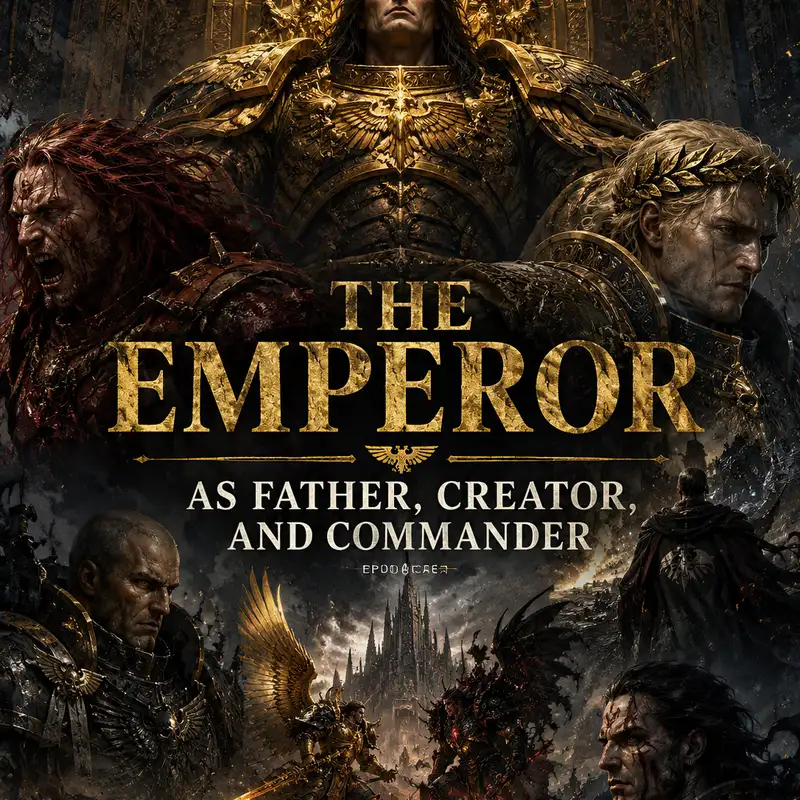
The Emperor as Father, Creator, and Commander
The Emperor found Angron on a mountainside, surrounded by the last survivors of a slave rebellion and an army closing in for the kill. The Master of Mankind had the power to intervene. Instead, he teleported Angron away and left the gladiators behind. In one decision, all three of the Emperor’s roles became visible. A creator had recovered his lost work. A commander had secured a valuable general. A father had abandoned everyone his son considered family.
That moment on Nuceria is difficult because it refuses to fit a simple picture of the Emperor. If he was merely a cold engineer, why did he call the primarchs his sons? If he was truly their father, why did he so often treat them as weapons? If he was only their commander, why build an empire around the language of blood, brotherhood, inheritance, and filial loyalty? The answer is not that one of these identities was false. The tragedy is that all three were real, and the Emperor moved between them whenever it suited the mission.
The primarchs began as a project beneath the Imperial Palace, created before the Great Crusade as humanity emerged from the ruin of Old Night. They were not born in any ordinary sense. They were designed through genetic science, cultivated in artificial chambers, and invested with powers that science alone does not fully explain. The Emperor directed the work, but he did not perform it in isolation. Gene-wrights, savants, and other extraordinary figures contributed to the project. Even so, its purpose was unmistakably his.
Each primarch was intended to become the genetic source and supreme commander of a Space Marine Legion. Their gene-seed would shape the Legiones Astartes, while their minds and bodies would make them generals capable of conquering worlds at a pace no ordinary human command structure could match. They were individuals, not interchangeable copies. Their talents differed, their temperaments differed, and many traditions describe them as embodying different qualities found within the Emperor himself. That interpretation is useful, provided it is not mistaken for a tidy chart. The primarchs have never been tidy.
They were also made for a deadline. The Emperor believed humanity had only a narrow chance to reunite before hostile empires, uncontrolled psychic evolution, and the powers of the warp made recovery impossible. The Great Crusade was not conceived as a leisurely project in enlightened diplomacy. It was a military emergency conducted across the galaxy. Compliance was demanded quickly. Resistance was usually answered by force. A commander facing that scale of war would naturally value reliable instruments. The problem was that his instruments could think, suffer, resent, hope, and remember.
Before the Emperor could raise them, the primarchs were scattered through the warp and cast onto distant worlds. Responsibility remains disputed. Chaos was involved, while later accounts also place Erda, a central figure in the project, at the heart of the act. Whatever the exact sequence, the result was the same. The Emperor lost the children he had designed before he could shape their upbringing, and each child was instead shaped by a different planet.
By the time the Great Crusade found them, the primarchs were not blank creations waiting for instructions. They were rulers, slaves, warriors, scholars, prophets, and monsters. Some had known genuine families. Roboute Guilliman had been raised by Konor and guided by Tarasha Euten. Rogal Dorn remembered the stern affection of his adoptive grandfather. Others had known only violence. Konrad Curze grew alone amid the predation of Nostramo. Angron was enslaved, mutilated, and forced to kill for entertainment. Mortarion was raised by the tyrant he would one day try to destroy.
The Emperor therefore met most of his sons for the first time when they were already adults with loyalties of their own. He had created their bodies, but other worlds had created their identities. That distinction matters. A maker may believe that authorship grants ownership. A father must accept that a child becomes a person. The Emperor repeatedly demanded the first relationship while invoking the emotional power of the second.
His arrival could feel like revelation, liberation, conquest, or all three at once. Some primarchs embraced him immediately. Some recognized a ruler whose vision was larger than their own. Some accepted because refusal was pointless. The reunion stories differ because the sons differed. The Emperor was capable of warmth, admiration, and personal attention, but he was also evaluating assets. He saw not only the person before him, but the Legion waiting for its gene-sire and the campaigns that Legion could now complete.
Horus received the longest period of direct companionship according to the traditional Imperial account. The Emperor taught him, campaigned beside him, and made him the most visible example of what a primarch could become. Later accounts complicate the order, especially wherever Alpharius is involved, which is the Alpha Legion’s usual contribution to a clear record. Yet Horus was unquestionably the favored son in the political imagination of the Great Crusade.
At Ullanor, after one of the Crusade’s greatest triumphs, the Emperor named Horus Warmaster and returned to Terra. As command policy, the decision made sense. The Crusade had grown too large for one leader to direct every fleet, and Horus possessed charisma, experience, and the respect of many brothers. As family policy, it was combustible. One son was elevated above the others, then left to carry their rivalries while the father withdrew without fully explaining why.
Horus did not fall merely because he felt neglected. Chaos deceived him, wounded him, tempted him, and fed his ambition. He made choices for which he remains responsible. Yet the corruption worked because it found existing fears. Horus had been taught to measure himself through the Emperor’s approval. When that approval became distant, he could interpret silence as replacement and delegation as abandonment. The Warmaster’s authority was enormous, but authority is not the same thing as certainty.
The Emperor’s return to Terra was driven by the secret Webway Project, an attempt to free humanity from dependence on warp travel and perhaps from some of the dangers that came with it. The goal was immense. The secrecy surrounding it was disastrous. The primarchs continued the Great Crusade knowing only that their father had left them. A commander may conceal operational details. A father who has built loyalty around personal trust pays a different price for the same silence.
Magnus illustrates that price more clearly than any other son. He shared the Emperor’s psychic nature in a way few others could. He was brilliant, curious, and certain that knowledge justified risk. The Emperor warned him about the warp, but never gave him a complete and honest education in its powers. At the Council of Nikaea, Magnus and the use of psychic arts within the Legions were publicly censured. The decision addressed a real danger, but left Magnus humiliated and convinced that lesser minds had condemned what they did not understand.
When Magnus later learned of Horus’s betrayal, he tried to warn Terra through sorcery. The act was intended as loyalty. It was also disobedient, reckless, and catastrophic. His psychic message shattered the wards protecting the Emperor’s Webway work and opened the way for daemonic assault. The Emperor lost the future he had been building and became bound to the Golden Throne to contain the breach. Magnus had been told not to act, but not fully told why. The son believed exceptional ability excused obedience. The father believed authority could replace explanation. Chaos required only the gap between them.
Lorgar suffered a different contradiction. He did not merely admire the Emperor. He worshipped him. The Emperor had rejected religion as part of the Imperial Truth, believing superstition and devotion made humanity vulnerable to manipulation. Lorgar’s slow conquests and religious empire therefore threatened both strategy and ideology. The Emperor ordered Monarchia destroyed and publicly humbled Lorgar and the Word Bearers. From a commander’s perspective, it was discipline. From a father’s perspective, it was humiliation administered on a civilizational scale.
The rebuke did not teach Lorgar to stop believing. It taught him to search for gods who wanted belief. He found them. This does not make the Emperor responsible for Lorgar’s treason, and it certainly does not make Lorgar an innocent victim. He chose to corrupt his brothers and helped prepare the galaxy for civil war. Still, the method of punishment revealed the Emperor’s weakness. He understood disobedience as a problem of command, even when its roots were spiritual and emotional.
Mortarion’s discovery on Barbarus followed the same pattern in another form. Mortarion had spent his life resisting the toxic world’s inhuman overlords and preparing to kill the foster father who had tormented him. The Emperor challenged him to complete that task alone. When Mortarion failed in the poisoned heights, the Emperor finished the kill. He saved Mortarion’s life and destroyed a tyrant, but also took the victory Mortarion believed should have been his. The gesture looked like rescue from above and felt like theft.
Perturabo’s grievance was less theatrical and more familiar. He was extraordinarily capable at siegecraft, logistics, engineering, and the reduction of fortified worlds. The Imperium repeatedly used him for brutal, thankless, and costly campaigns. He came to believe that his labor was exploited while more celebrated brothers received glory. That belief contained truth, but Perturabo also fed it, refused vulnerability, punished those around him, and turned resentment into identity. The Emperor saw a commander suited to hard wars. He failed to see, or failed to address, what those wars were making of his son.
Angron remains the clearest example because almost every excuse falls away. The Butcher’s Nails had been driven into his brain on Nuceria, replacing and damaging structures so deeply that removing them would kill him. The Emperor understood that Angron could not be repaired by any method available to him. He nevertheless placed Angron at the head of the World Eaters and sent him to conquer in the name of unity. The commander chose the remaining usefulness of a dying weapon. The father offered neither release nor peace.
It would be easy to build the entire case from the damaged sons, but that would distort the record. Several primarchs experienced real trust. Dorn was given responsibility for Terra’s defenses. The Lion received access to weapons and missions that demanded absolute confidence. Vulkan’s humanity was not treated as weakness. Sanguinius inspired affection across the Imperium, and the Emperor appears to have valued him as far more than a battlefield instrument. Malcador later suggested that the Emperor’s use of the word sons reflected an attachment deeper than the original plan required.
The Emperor was never perceived in a simple, consistent way. His psychic presence shaped how others saw and heard him. Witnesses could encounter a radiant monarch, a weary man, a remote scientist, or something closer to a force of nature. In one account, a Mechanicum savant hears him speak of a damaged primarch with the detachment of an engineer discussing a failing device. Elsewhere, his words and actions carry unmistakable paternal concern. Both may be true. The Emperor often presented the face the observer could understand, perhaps deliberately and perhaps as an unavoidable effect of what he had become.
A cold statement may reveal his true priorities, or merely the form in which one witness could receive them. A tender gesture may show love, or may be calculated leadership. The Emperor had spent millennia shaping identities, concealing intentions, and guiding humanity from behind masks. Expecting complete emotional transparency from him was rather like expecting the Administratum to locate a form after it had been filed correctly. The system was not designed for that outcome.
Even the language of fatherhood served several purposes. It described genetic descent. It created a dynasty. It gave the primarchs a shared identity as brothers. It also reinforced hierarchy. A son owes loyalty to a father in a way a general may not owe loyalty to an employer. The Emperor could speak the language of family while demanding the discipline of an army. The primarchs, in turn, often interpreted military favor as affection and strategic criticism as personal rejection.
Their rivalries grew inside that confusion. Who had been found first? Who was trusted most? Whose Legion received the hardest duty? Who stood closest to the Emperor at triumph? Who was permitted to break rules that bound another? These were military questions, political questions, and family questions at the same time. Horus’s appointment as Warmaster did not create the rivalries, but it gave them a throne to circle.
The Emperor also built sons powerful enough to exercise independent judgment, then reacted harshly when that judgment opposed his design. He needed generals who could conquer without waiting months or years for instructions from Terra. He needed them to improvise, govern, negotiate, and make decisions affecting entire systems. Yet the same independence made them capable of questioning his commands. He created minds fit to rule and expected them to behave like components.
The two lost primarchs sharpen the point even though almost nothing reliable is known about their fate. Their names were erased, their Legions removed from the accepted record, and even their brothers were constrained from speaking openly of them. Whatever crimes or disasters caused that silence, the Imperium demonstrated that sonship offered no immunity when the project judged a son unacceptable. Family memory itself could be subordinated to command.
None of this means the Horus Heresy can be reduced to poor parenting. The traitor primarchs were not children throwing a tantrum, despite the occasional behavior of grown demigods suggesting otherwise. They commanded armies, destroyed worlds, and made deliberate moral choices. Chaos offered power, vindication, revenge, and freedom from the Emperor’s authority. Some accepted eagerly. Others were cornered, deceived, or transformed by forces they had underestimated. Their father’s failures created weaknesses. Chaos weaponized them, but the sons chose how to respond.
The loyal primarchs also complicate any simple accusation. Jaghatai Khan distrusted the Imperium’s rigidity, yet chose to defend humanity against Chaos. Guilliman could recognize the Emperor’s failures without treating rebellion as liberation. Dorn’s loyalty endured unbearable pressure. Sanguinius faced the possibility of his own corruption and still went to Terra. Their fidelity was not always the obedience of loving sons. It could be duty, judgment, honor, or the recognition that the Emperor’s flawed order remained preferable to what the traitors offered.
That distinction reveals the Emperor at his strongest as a commander. He created a strategic system capable of reconquering much of the galaxy in roughly two centuries. He identified extraordinary talents and gave them forces proportionate to those talents. He inspired loyalty across cultures and species-wide distances. Even many who disliked him believed in the human future he promised. The Great Crusade was one of the most effective military enterprises humanity had ever attempted.
It also reveals him at his weakest as a father. He often treated emotional injury as inefficiency, spiritual hunger as insubordination, and trauma as damage to be managed. He could read the fate of civilizations yet misjudge what humiliation would do to one wounded son. He could design transhuman minds yet assume that purpose would satisfy them. He gave them armies before he gave them honest answers.
As creator, he may have believed he understood them because he had designed them. That is a common error among makers, kings, and parents, although most are fortunate enough not to make it with eighteen demigods and a host of genetically engineered soldiers. Design explains intention, not outcome. The worlds that raised the primarchs, the brothers they loved or hated, the wars they fought, and the choices they made all carried them beyond whatever plans had been written in the laboratories beneath Terra.
At the Siege of Terra, the contradiction reached its final form. The Emperor’s greatest creation and favored son returned as the champion of the powers he had tried to deny. Horus came not as a rebellious child seeking reconciliation, but as a rival sovereign saturated with the strength of Chaos. Accounts of their final confrontation are mythic, fractured, and shaped by ten thousand years of religion. Yet every version preserves the same essential horror. The father and son could no longer exist in the same future.
The Emperor defeated Horus, but victory destroyed the last shape of the family he had built. Sanguinius was dead. Ferrus Manus was dead. Others were broken, corrupted, missing, or soon to depart. The Emperor himself was placed upon the Golden Throne, unable to lead as he once had. The commander saved the Imperium but could no longer command it. The creator preserved his species but lost control of what it would become. The father survived his son only as a corpse-like god.
The Imperium then transformed every ambiguity into doctrine. The man who had rejected worship became the divine Father of Humanity. The primarchs became saints, devils, angels, and forbidden names. Their complicated relationships were simplified into loyalty and betrayal because religion prefers clean categories, especially when the archive has been purged. The family had been filled with affection, rivalry, manipulation, duty, and fear. The myth left only obedience.
So was the Emperor a father, a creator, or a commander? He was all three, but he behaved as though each role excused the obligations of the others. When his sons needed truth, the commander gave orders. When they needed mercy, the creator assessed their usefulness. When he needed loyalty, the father invoked blood. The Heresy grew in the space between those roles, widened by Chaos and filled by the choices of the primarchs themselves.
Ten thousand years later, humanity kneels before an Emperor who can no longer explain what he intended, while his surviving sons inherit the consequences of a relationship none of them understood in the same way. He made them to conquer the galaxy, called them his children, and commanded them as weapons. The tragedy was not that one of those claims was a lie. The tragedy was that every one of them was true.