The Emperor and Horus: The Final Confrontation
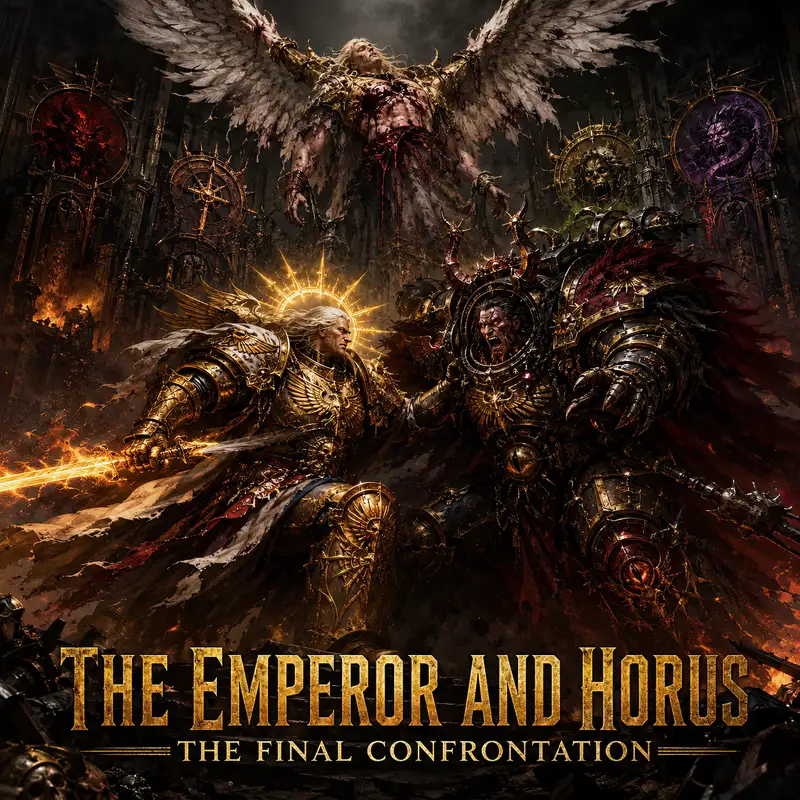
By the time the Emperor reached Lupercal’s Court, the battle had already escaped the rules of war. Sanguinius hung dead above the chamber, his wings broken and his blood dark against the metal. Around him stood thrones prepared for powers that had no need of furniture, though Chaos has always understood the value of ceremony. Horus waited beneath his murdered brother, swollen with the strength of the four great gods of the Warp. The Emperor entered wounded, diminished, and accompanied by only a handful of survivors. The final confrontation was not beginning on equal terms. It was beginning after almost every better choice had already failed.
Ten thousand years of Imperial memory would reduce the scene to a sacred image. A father confronted a fallen son. A loyal warrior stood between them. The Emperor finally abandoned mercy, destroyed Horus, and was carried to the Golden Throne. That account preserves the outline, but not the truth inside it. The Emperor did not defeat Horus simply because he was stronger. At that moment, he was not stronger. Horus did not fall because one heroic intervention revealed that he had become evil. The duel was decided by pride, sacrifice, deception, and two very different acts of refusing power.
Terra was already dying when Horus lowered the shields of the Vengeful Spirit. The Imperial Palace had been breached. Daemons walked openly beneath a poisoned sky. Space and time were beginning to fold together as the Warp consumed the battlefield. Guilliman and a vast loyalist fleet were approaching, but time itself had become unreliable. Horus had stretched the final hours of the Siege into something almost timeless. He needed to kill the Emperor before relief could break through, and the Emperor needed to end Horus before Terra slipped completely into the Warp. When the shields fell, no one mistook it for an accident. Horus had opened the door and placed a trap on the other side. The difficulty was that the trap was also the last available road to victory.
To leave the Palace, the Emperor first had to leave the Golden Throne. The ancient mechanism was holding shut the ruined human Webway and preventing a greater daemonic invasion beneath the Palace. Malcador the Sigillite took his master’s place, knowing the Throne would consume him. Vulkan remained behind with an even darker responsibility. If the Palace fell and the Webway breach became unstoppable, he was to activate a device that would deny Terra to Chaos at a catastrophic cost. Rogal Dorn, Constantin Valdor, Sanguinius, and chosen warriors joined the assault. The operation was named Anabasis. It was an optimistic title for an assault whose planners knew might have no return.
The teleport strike should have placed the assault groups at selected points aboard the Vengeful Spirit. Horus scattered them instead. The flagship was no longer merely a vessel. Its corridors merged with a nightmare realm known as the Inevitable City, while rooms opened into memories, deserts, battlefields, and impossible distances. Dorn was trapped in a wasteland where centuries seemed to pass and the rage of Khorne worked patiently against his discipline. Valdor fought through vaults and daemonic hordes. The Emperor’s own Custodians were seized by Horus and forced to attack the master they had been created to protect. Only Sanguinius reached something close to his intended destination.
Sanguinius had long foreseen that Horus would kill him. He went anyway, not because he believed prophecy was comforting, but because he believed resistance still mattered. Horus offered him a place at his side. The Warmaster wanted the Angel corrupted as proof that even the noblest of the Emperor’s sons could be remade. Sanguinius refused and attacked. For a time, martial skill and absolute determination allowed him to pressure Horus. Then Horus stopped pretending the contest was between primarchs. He drew fully upon the Warp, seized Sanguinius through dimensions ordinary warriors could not perceive, and beat him to death. The Blood Angels felt their father die and descended into the inherited madness later called the Black Rage. When the Emperor entered Lupercal’s Court, Sanguinius was not a fallen champion waiting to be avenged. He was evidence of the scale of the enemy.
Horus had spent part of the Siege appearing distracted, erratic, and even diminished. Much of that weakness had been a mask. Beneath it, he had become the chosen vessel of Khorne, Tzeentch, Nurgle, and Slaanesh. Their powers did not blend into harmony. Chaos rarely performs harmony unless screaming counts. They united because the Emperor threatened all of them, and Horus provided a will strong enough to contain their gifts without immediately dissolving into madness. He believed this made him their master. In reality, they had armed him, fed him, flattered him, and wrapped chains around every part of him that still mistook dependence for command.
The Emperor had already discovered that his own natural power was not enough. As he moved through the Warp-wracked ship, he began drawing greater and greater force into himself. The process promised victory over Horus, but it also carried him toward an apotheosis of his own. He was becoming the Dark King, a potential fifth god of Chaos associated with ruin, finality, and the destruction of all things. The name had been whispered across Terra before its meaning was understood. The more terrible possibility was that the Emperor would create the Dark King while trying to save humanity from Chaos. The gods could accept that result. If Horus won, the Emperor died. If the Emperor won by becoming a god of annihilation, humanity still belonged to the Warp. It was an admirably efficient trap.
Ollanius Persson reached the Emperor before that transformation was complete. Ollanius was an ancient Perpetual, a soldier and wanderer who had known the Emperor in ages before the Imperium. He had also opposed him and understood the danger of his certainty. Ollanius did what primarchs, generals, and entire governments had rarely managed. He told the Emperor that his solution was worse than the problem, and the Emperor listened. He released the power he had gathered rather than complete his ascent. The resulting psychic shock purged much of the Warp’s corruption from the immediate battlefield and freed loyalists from several of Horus’s traps. More importantly, the Dark King was denied birth.
That refusal left the Emperor able to confront Horus without becoming another form of catastrophe. It also left him weaker. Malcador perceived that the Emperor had cast away more than raw power. He had separated himself from a portion of his compassion, hope, and warmth, perhaps because those qualities might prevent him from killing the son he had once loved. The Emperor who continued toward Lupercal’s Court was neither an untouched father nor a newly born god. He was a wounded ruler who had deliberately reduced himself, carrying enough humanity to reject Chaos and perhaps not enough to escape the cost of doing so.
He entered the court with the Custodian Caecaltus Dusk, the ancient warrior Leetu, and Garviel Loken. Loken had once been one of Horus’s most trusted Luna Wolves, a member of the Mournival that advised the Warmaster during the Great Crusade. He had rejected the rebellion at Isstvan and spent the Heresy fighting the Legion he still regarded as his own. Horus faced not only his father, but one of the sons he had betrayed before the galaxy learned what betrayal would cost.
The Emperor looked upon Sanguinius and ordered that his body be taken down. He did not answer Horus’s boasts. Instead, he addressed the powers watching through him. He accused the gods of killing his son. Horus slowly understood that the Emperor meant both Sanguinius and Horus himself. The remark struck at the truth Horus had spent the entire war refusing to see. He had declared himself liberated from a tyrant, yet every step toward freedom had made him more dependent upon masters that regarded him as a weapon. Horus attacked, and the court ceased to be a single place.
Their duel unfolded through matter, memory, symbolism, and the Warp. Sword met maul. Psychic force became shields, fire, blades, and impossible geometries. They fought through echoes of Cthonia, Ullanor, ancient Terra, and battlefields that belonged to other times. They attacked each other through remembered choices and possible futures. At one point the struggle became a contest of the Imperial Tarot, with each card representing a move in a war of meaning as much as power. The Emperor played Death. Horus answered with the Despoiler. Both were trying to define the story in which the other could be defeated.
Horus won that contest. Empowered by all four gods, he could answer the Emperor’s strategies, survive wounds that should have ended any material being, and return violence on a greater scale. The Emperor stole a small measure of Horus’s power and used it to strike back, but he dared not take enough to risk corruption. Horus recovered. He tore into the Emperor with the Talon of Horus and the maul called Worldbreaker. He punctured his father’s throat, broke his body, and dragged him toward a fifth throne prepared beside the seats of the Chaos gods. Death was no longer sufficient. Horus wanted submission. He intended to enthrone the Emperor as a defeated servant and make the architect of the Imperium acknowledge him as the rightful master of mankind.
That desire revealed the flaw inside Horus’s apparent victory. He did not merely need the Emperor dead. He needed the Emperor to understand that Horus had been right. He needed the gods to be allies rather than owners. He needed the rebellion to prove that he was still the Warmaster who had conquered by strength, judgement, and command. The more power Chaos gave him, the more desperately he wanted credit for using it. He could bend time and overpower the Emperor, yet remained vulnerable to the suspicion that none of the victory truly belonged to him.
Caecaltus Dusk stepped between Horus and the wounded Emperor. Dusk could not defeat the being Horus had become, and he knew it. He stood anyway. Whether the defiance that followed came entirely from Dusk or was shaped by the Emperor’s will is not completely clear. Horus annihilated him, but the interruption allowed Leetu to pull the Emperor free. The Emperor struck Horus with the crown intended for his humiliation, driving it through the Warmaster’s skull. Horus regenerated and beat him down again. Dusk’s stand did not reverse the battle. It purchased a moment. At the end of the Siege, moments had become the most expensive currency in the Imperium.
Ollanius Persson arrived soon afterward with John Grammaticus. A word of impossible power briefly staggered Horus, giving Ollanius time to reach the Emperor and place an athame in his hand. The ritual blade had passed through a long chain of murders and betrayals before reaching this chamber. It looked absurd beside Worldbreaker and the Talon of Horus. So did Ollanius, carrying a soldier’s weapon against a demigod swollen with the strength of hell. He fired on Horus and was destroyed with a contemptuous sweep of the Warmaster’s claw. He could not harm Horus. He delivered the weapon and bought another moment.
Later Imperial tradition would remember Saint Ollanius Pius as an ordinary Guardsman who stood between Horus and the Emperor. The surviving account is stranger, but the core of the legend is sound. A soldier faced something he could not defeat because someone had to stand there. The myth compressed Ollanius, Dusk, Leetu, Loken, and countless others into one perfect figure of sacrifice. Imperial history is often inaccurate in detail and painfully accurate in what it needs people to believe.
Horus turned back toward the Emperor and saw Garviel Loken. The figure before him appealed to the identity Horus was still trying to preserve. If Horus truly commanded the gods, he should be able to dismiss their power. If he was genuinely superior to the Emperor, he should finish the battle as Horus Lupercal, not as a vessel carried by four unseen hands. The challenge was shaped for the man Horus had been. He had once valued the judgement of his inner circle and wanted loyalty freely given. Even after those virtues had curdled into vanity, their outlines remained.
Horus cast off the power of Chaos. The gods protested, but he believed the battle was already over. He struck down the Emperor and Loken before him, only to discover that both were illusions. The real Loken was elsewhere in the court. The real Emperor had used Horus’s pride to create the only conditions in which he could still be killed. It was not an honourable tactic. Honour had left the field some time before, probably after being issued contradictory orders.
Deprived of divine power, Horus remained a primarch of immense strength. The Emperor was already mutilated and near death. Their struggle became physical again, and Horus continued to inflict terrible wounds. He destroyed one of the Emperor’s eyes, ruined an arm, and crushed his spine. The Emperor answered by drawing upon the newly rekindled light of the Astronomican and driving it into Horus’s mind. That beacon had been restored through the sacrifice of defenders and civilians on Terra, people who had rallied around the desperate conviction that the Emperor must live. Even in the most personal duel in human history, neither combatant truly fought alone.
Horus reached for the gods and found them withholding what they had given. Perhaps they meant to punish him or make the nature of their arrangement clear. The result was clarity. For a brief interval, the old Horus saw the chains around him. He understood that he had never controlled the powers he welcomed into himself. They had encouraged every grievance, praised every ambition, and transformed each wound into an argument for surrender. Now they were returning, pressing back into him, and the moment in which he could choose was closing.
Horus asked the Emperor to kill him before the gods reclaimed him. The Emperor hesitated. That pause matters because it denies the simplest versions of both men. The Emperor had deceived Horus and sacrificed others to create the opportunity. Horus had murdered Sanguinius and brought Terra to ruin. Still, when the corrupted Warmaster briefly became his son again, the Emperor did not strike without feeling. He raised the athame Ollanius had delivered and told Horus, “I wait for you, and I forgive you.” Then he drove the blade into Horus’s heart and poured his remaining will through it until the Warmaster’s presence was extinguished.
Horus died not while proclaiming victory, but during the first honest choice he had made in years. He rejected Chaos only after learning that rejection would not save him. The Emperor granted mercy only by killing the son he had failed to save. The four gods lost their vessel and withdrew in fury. Their grip on the battlefield loosened. Time resumed. Daemons vanished from Terra. The Vengeful Spirit became a ship again rather than the centre of an approaching hell, though it remained an exceptionally unpleasant ship by any reasonable naval standard.
The Emperor collapsed beside Horus’s remains. Rogal Dorn and Constantin Valdor reached the court too late to take part in the duel. They found Sanguinius dead, Horus destroyed, and the Emperor unable to explain what must happen next. There was no clear final speech and no orderly transfer of command. Leetu noticed the image of the Throne among the scattered Tarot cards. Dorn and Valdor accepted it as the Emperor’s direction and carried him back to the Palace. Malcador had already spent his life holding the Golden Throne. The machine that might preserve the Emperor also required him to contain the Webway breach. He was installed upon it because there was no other surviving answer.
Garviel Loken remained aboard the Vengeful Spirit beside Horus. Ezekyle Abaddon arrived with the surviving Sons of Horus, and for a brief moment the killing stopped. Loken urged surrender. Abaddon refused, but he did not murder his former brother. Erebus did that later, stabbing Loken from behind and turning one more personal betrayal into nourishment for the Warp. The Heresy ended as it had begun, not with an honest challenge between warriors, but with someone trusted standing where the victim could not see him.
So who won the final confrontation? The Emperor defeated Horus, denied the Dark King, and prevented the immediate triumph of Chaos. Horus failed to kill his father, failed to master the gods, and lost the rebellion at the moment of apparent victory. Yet the Emperor’s Imperium also died in that chamber. The secular future he had pursued was replaced by a civilisation built around his worship. His sons were dead, broken, or scattered. His body became part of the machinery he had intended to escape. Chaos lost its champion and gained ten thousand years of war, fear, repression, and faith powerful enough to feed the Warp.
The duel was decided by more than the two figures at its centre. Malcador gave the Emperor time. Sanguinius refused corruption and forced Horus to reveal what he had become. Ollanius persuaded the Emperor to reject godhood, then delivered the weapon that could finish the battle. Dusk and Leetu bought seconds. Loken provided the shape of the deception. The defenders of Terra rekindled the Astronomican. Dorn carried the Emperor home. Imperial legend turned these actions into a simpler story because legends prefer one blade, one sacrifice, and one clear moment. History is usually less considerate.
The Emperor won because he refused the power that would have made victory meaningless. Horus lost because he accepted power to prove he was free, then surrendered it to prove he was still himself. In that brief return to himself, he made his defeat possible and his death necessary. The father destroyed the son. The son destroyed the father’s future. What left the Vengeful Spirit was not the ruler who had begun the Great Crusade, but a broken body carried toward a throne that would become an altar. Horus was dead, the Emperor lived, and the age of Warhammer forty thousand began in the narrow space between those two truths.