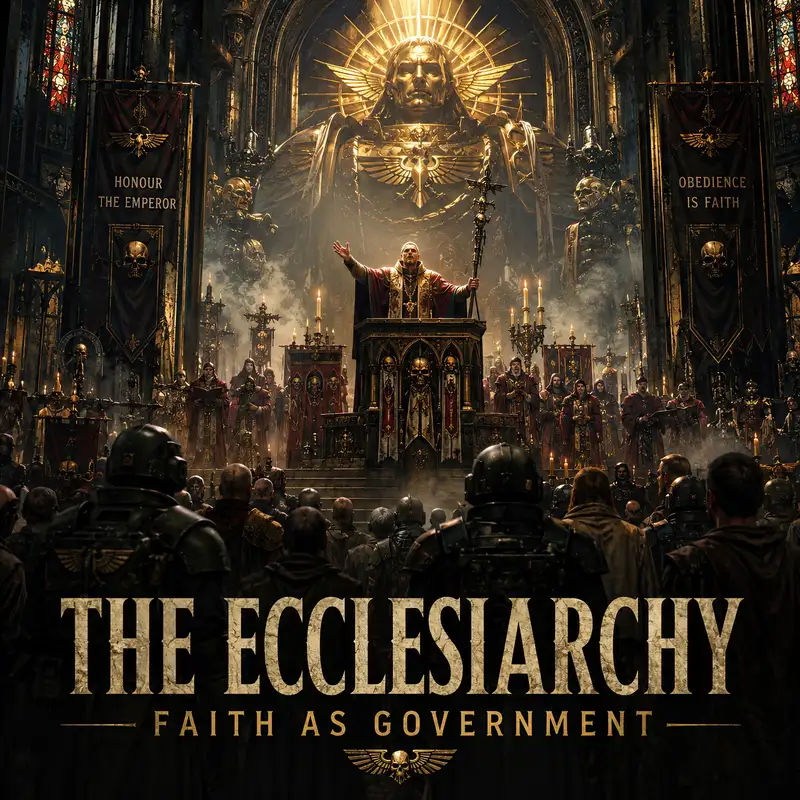
The Ecclesiarchy: Faith as Government
On an Imperial world, a governor may sign a decree in a palace no citizen will ever see. The Administratum may record it in ledgers thick enough to stop a las-round. The enforcers may carry it into the streets. Yet the order often becomes real only when a priest climbs the pulpit, the cathedral bells begin to toll, and the decree is spoken as the will of the Emperor. A new tax becomes an offering. A conscription becomes a sacred duty. A failed harvest becomes a trial of faith. A dead soldier becomes a martyr. The Ecclesiarchy does not merely tell people what to believe. It teaches them how to understand everything the Imperium demands of them.
Its formal name is the Adeptus Ministorum, though almost everyone calls it the Ecclesiarchy. It is the organised hierarchy of the Imperial Cult, the state religion that proclaims the Emperor of Mankind to be a god. Calling it a church is accurate, but incomplete. The Ecclesiarchy is a church with courts, estates, schools, hospitals, diplomats, propagandists, tax collectors, political officers, armed devotees, and a permanent voice among the rulers of Terra. It does not replace the Administratum, the planetary governor, the Arbites, or the military. Instead, it runs through all of them, supplying a language of duty that turns government into worship.
That arrangement begins with one of the great ironies of the Imperium. The Emperor did not want to be worshipped. During the Great Crusade, his official doctrine was the Imperial Truth, a vision of humanity united by reason, material knowledge, and rejection of superstition. Religion was treated as a dangerous relic. Temples were torn down. Gods were dismissed as inventions. The Emperor wanted obedience, certainly, but not prayer. Ten thousand years later, his subjects kneel before statues of him while priests condemn doubt as treason. The secular empire became a theocracy with its founder trapped at the centre as the unwilling object of devotion.
The transformation began before the Horus Heresy had even ended. Belief in the Emperor’s divinity spread through soldiers, civilians, and survivors who needed more than official doctrine could provide. The Lectitio Divinitatus, associated with the primarch Lorgar before his fall to Chaos, helped give that belief a written foundation. Figures such as Euphrati Keeler became important to the growing cult during the Heresy. The precise path from scattered wartime faiths to an Imperial state church was neither simple nor peaceful, but the emotional logic was powerful. The Emperor had been betrayed by his favoured son, maimed in the defence of humanity, and placed upon the Golden Throne. To many, this did not prove he was merely human. It proved he had sacrificed himself for mankind.
After the Heresy, the Imperium was traumatised, fragmented, and desperate for unity. One of the most successful new movements was the Temple of the Saviour Emperor, established on Terra and led in its early years by a veteran who took the name Fatidicus. Its followers included soldiers, officials, and ordinary citizens. That mattered. The Temple was not confined to isolated mystics whispering in cellars. It spread through the same fleets, regiments, offices, and transport routes that held the Imperium together. By the early thirty-second millennium, it had become dominant enough to be recognised as the official faith, and the Adeptus Ministorum emerged as an institution of the Imperial state. In time, the Ecclesiarch gained a permanent place among the High Lords of Terra.
The church succeeded because it solved a problem that no fleet or ledger could completely solve. The Imperium is too large, too slow, and too divided to govern through direct instruction alone. Astropathic messages can be delayed, distorted, or lost. Warp travel can turn a routine journey into a disappearance lasting generations. Planetary governors possess enormous local authority because Terra cannot supervise every decision. Under those conditions, a shared faith becomes a form of political infrastructure. A citizen on a mining world and a soldier on a distant frontier may speak different languages, live under different laws, and imagine the Emperor in very different ways, yet both are taught that service to him is the highest human duty.
The Ecclesiarchy does not achieve this unity by imposing one perfectly uniform form of worship. That would be impossible, and the Imperium generally prefers achievable oppression to idealistic administration. The Imperial Creed changes from world to world. On some planets, the Emperor is identified with the sun. On others, he is understood through the memory of an ancestral ruler, a divine protector, or a warrior who watches from beyond the stars. Rituals, feast days, sacred symbols, and stories may differ almost beyond recognition. A missionary often succeeds not by destroying every local tradition, but by declaring that the people have been worshipping the Emperor imperfectly all along.
There are limits to this flexibility. The Emperor must stand at the summit. Humanity must be obedient to the Imperium. The alien is feared or hated. Mutation is treated with suspicion, often with lethal results. The witch is dangerous. The heretic is not merely mistaken but corrupting. Local customs can survive if they are brought beneath those principles. A village may keep its ancient procession, provided the image carried at its head is reinterpreted as an aspect or servant of the God-Emperor. The Ecclesiarchy therefore governs through adaptation as much as standardisation. It permits a thousand languages of worship while controlling the conclusion they are allowed to reach.
At the top of the institution stands the Ecclesiarch. Beneath that office are cardinals, synods, arch-deacons, bishops, deacons, confessors, missionaries, preachers, abbots, and a host of other ranks whose precise authority can vary by place and period. The Imperium is divided into dioceses and parishes, though a diocese may encompass a world, several worlds, or a region shaped more by politics than sensible geography. The spiritual hierarchy preaches and defines doctrine. The temporal bureaucracy manages property, money, construction, transport, staffing, and the endless physical business required to maintain a galaxy-spanning religion. Even divine truth needs clerks.
A cathedral is therefore more than a place of prayer. It may be an archive, treasury, courthouse, recruiting station, charitable centre, school, political stage, and fortress. Its priests keep records of saints, relics, donations, oaths, and suspected deviations from doctrine. Its steps may be where a governor announces a campaign, where soldiers receive blessings before deployment, or where condemned heretics are displayed as a public lesson. The building dominates the city because the institution dominates the meaning of public life. A palace says that the governor is powerful. A cathedral says why obeying the governor may be righteous.
This is the heart of faith as government. The Ecclesiarchy translates practical demands into moral obligations. When the tithe rises, the priest can present sacrifice as proof of loyalty. When food is scarce, endurance becomes devotion. When troops are needed, enlistment becomes service beneath the Emperor’s gaze. When a rebellion begins, its economic or political grievances can be recast as spiritual corruption. This does not mean every priest is consciously lying. Many believe exactly what they preach. That sincerity often makes the system stronger, because genuine conviction can reach places where ordinary propaganda sounds hollow.
The same institution can also turn against a planetary ruler. A governor may possess legal authority, but a cardinal or popular preacher can question whether that authority remains faithful. A sermon can calm a city, or make it ungovernable by the following morning. A priest who declares a ruler corrupt may create a crisis before the Administratum has finished finding the correct form. This gives the Ecclesiarchy leverage over governors, generals, and nobles. They may not answer directly to every cleric, but few can afford to be seen as enemies of the Imperial Creed.
The relationship is rarely tidy. The Administratum wants tithes delivered and records maintained. The Ecclesiarchy wants orthodoxy, offerings, influence, and sacred projects. The Arbites enforce the Lex Imperialis. The Inquisition investigates threats that may include corrupt priests as readily as rebellious citizens. The Adeptus Mechanicus follows its own cult and guards its privileges with considerable determination. Space Marine Chapters may honour the Emperor without accepting the Ecclesiarchy’s claim that he is divine. These institutions cooperate because the Imperium needs them all, and quarrel because each believes its own duty outranks the others. Imperial government is less a machine than a collection of machines bolted together during a fire.
The Ecclesiarchy’s power is also material. Offerings and religious tithes fill its vaults. It owns estates, controls shrines, directs construction, and rules some shrine and cardinal worlds directly. Pilgrimage routes move populations and wealth across sectors. A saint’s tomb can transform an otherwise unremarkable planet into a destination for millions of travellers, merchants, mendicants, soldiers, thieves, and officials. Entire economies can form around relics, festivals, hospices, processions, and the sale of objects declared to be spiritually useful. Some are genuine antiquities. Others have the distinct advantage of being recently manufactured.
Pilgrimage is not merely devotional travel. It is mass mobilisation. A cardinal who declares a site holy can redirect ships, labour, food, and military protection. A preacher who announces that the faithful must defend a shrine may raise a militia without issuing anything that resembles a conventional mobilisation order. Wars of Faith can draw together Guard regiments, naval forces, Battle Sisters, pilgrims, zealots, and opportunists under a religious purpose. The Ecclesiarchy may not command every participant in a strict military sense, but it can create the political conditions in which refusing to participate looks like cowardice, disloyalty, or heresy.
Its influence begins long before adulthood. Ministorum clergy help operate the Schola Progenium, the severe institutions that raise the orphaned children of Imperial servants. These children are educated, disciplined, and shaped into future officers, commissars, priests, officials, and members of the Adepta Sororitas. The Schola provides opportunity, structure, and survival, but never without purpose. It does not simply care for the children of the dead. It turns grief into a new generation of loyal servants who regard service to the Emperor as both inheritance and debt.
Other arms of the faith provide forms of care that are entirely real. Missions establish schools and hospitals on newly contacted or troubled worlds. Sisters Hospitaller treat the wounded in conditions that would break less disciplined souls. Other Sororitas orders preserve relics, maintain records, teach doctrine, or serve in roles far removed from the famous image of a Battle Sister carrying a bolter through cathedral smoke. The Ecclesiarchy feeds, heals, educates, and shelters people. It also watches them, classifies them, and teaches them whom to fear. Mercy and control are not opposites in the Imperium. They are often administered by the same hand.
War reveals the institution at its most direct. Ministorum priests accompany Imperial armies, preaching beneath artillery fire and turning terror into zeal. A frightened soldier may hold the line because retreat would shame the regiment, doom comrades, and offend the Emperor. A dying soldier may endure because martyrdom gives suffering a place in a larger story. Faith can improve morale, sustain resistance, and bind units together. It can also encourage wasteful attacks, punish reasonable caution, and make commanders mistake fervour for planning. The battlefield has never lacked men willing to explain that courage will compensate for missing ammunition.
For centuries, the Ecclesiarchy possessed its own great military forces, including the Frateris Templar. Wealth, political authority, and armed power accumulated until the church became capable of challenging the other institutions of the Imperium. That danger reached its fullest expression during the Age of Apostasy. Goge Vandire, already Master of the Administratum, seized control of the Ecclesiarchy as well. In one man, bureaucratic and religious authority were joined. The result was the Reign of Blood, a period of purges, assassinations, paranoia, and violence so extreme that even the Imperium eventually noticed something had gone wrong.
Vandire secured the loyalty of a warrior sisterhood known as the Brides of the Emperor and used them as his bodyguards. His rule ended only after a broad uprising led by Sebastian Thor’s Confederation of Light and supported by forces from across the Imperium. According to the accepted account, the Custodes brought Alicia Dominica, leader of the Brides, into the presence of the Emperor. What occurred there remains unknown. What is known is that she emerged convinced of Vandire’s treachery and executed him. It was a concise theological dispute by Imperial standards.
The settlement that followed reshaped the Ecclesiarchy. Sebastian Thor became Ecclesiarch and accepted reforms intended to prevent another Vandire. Most famous was the Decree Passive, which barred the Ministorum from maintaining men under arms and forced the disbandment of its standing armies. The Adepta Sororitas survived as a closely allied but nominally independent sisterhood, their Orders Militant becoming the Ecclesiarchy’s most reliable defenders and instruments of war. Whether described as a legal loophole, a political compromise, or both, the arrangement allowed the church to remain formidable without openly rebuilding the same military structure that had helped produce the Reign of Blood.
The reform did not make the Ecclesiarchy harmless. It still possesses priests who can summon mobs, cardinals who can influence fleets and governors, wealth capable of sustaining campaigns, and the moral authority to declare a conflict sacred. The Frateris Militia can arise from the faithful when called, formally or otherwise. The Sisters of Battle defend holy sites, purge heresy, and wage wars of faith. The church may be forbidden from owning a conventional army of men, but Imperial law has always been most flexible where power and careful wording meet.
It would be easy to treat the entire institution as a cynical mechanism for controlling the population. That would miss an essential part of the setting. Many servants of the Ecclesiarchy are corrupt, vain, cruel, or ambitious. Others are brave, compassionate, self-denying, and entirely sincere. A missionary may exploit a primitive culture, or stand alone between that culture and annihilation. A cardinal may hoard wealth, while a preacher dies defending refugees. A Sister Hospitaller may save lives that the wider Imperium has already reduced to numbers. Institutions can be oppressive without every person inside them being a fraud.
There is also the uncomfortable question of miracles. The Imperium is a place where belief, psychic power, and the Warp can interact in ways that are not easily separated. Living Saints appear. Warriors survive wounds that should kill them. Daemons recoil before acts of faith. Some accounts are propaganda, some are misunderstood psychic phenomena, and some resist neat explanation. The Ecclesiarchy claims these events prove its doctrine. That claim may be self-serving, but it is not always empty. In a rational universe, a state religion can govern by controlling belief. In the forty-first millennium, belief may occasionally answer back.
The return of Roboute Guilliman made the old contradiction impossible to ignore. Guilliman remembers an Emperor who rejected worship, yet he awakened into an Imperium that depends upon it. The Ecclesiarchy venerates the primarch as the divine son of the God-Emperor, a role he does not welcome. He distrusts the church’s excesses and its theology, but he also understands its political value. Removing it would not restore the secular Imperium of the Great Crusade. It would tear away one of the few ideas still shared across humanity’s scattered domains. His uneasy cooperation with the Ministorum shows how thoroughly faith has become part of government. Even a primarch cannot simply issue a correction and expect ten thousand years of belief to stand down.
After the opening of the Great Rift, that role became even more important. Worlds cut off from reliable communication may receive no clear order from Terra, no relief fleet, and no confirmation that the wider Imperium still exists. The local shrine, the feast day, the saint’s legend, and the priest’s sermon can preserve a sense of belonging when every administrative connection has failed. They can also justify purges, ignite crusades, and transform fear into fanaticism. Faith keeps communities from collapsing. It can just as readily drive them into the fire in formation.
The Ecclesiarchy governs because it controls more than institutions. It controls interpretation. It tells the citizen what suffering means, what authority means, what humanity means, and what death might purchase. It turns the Emperor from a distant ruler on a hidden throne into a presence inside the factory shift, the military oath, the family shrine, the public execution, and the final prayer. A planetary governor can command obedience. The Ecclesiarchy can make obedience feel holy.
That is why faith functions as government across the Imperium. The cathedral does not replace the palace, the courthouse, or the barracks. It gives each of them a sacred purpose and condemns those who reject it. Records may burn, governors may die, and orders from Terra may never arrive, but the bells can still ring. When they do, the faithful know where to assemble, whom to obey, what to fear, and what they are expected to sacrifice. The Ecclesiarchy rules the meaning of Imperial life, and in a civilisation held together by duty, terror, and hope, meaning is one of the strongest forms of power.