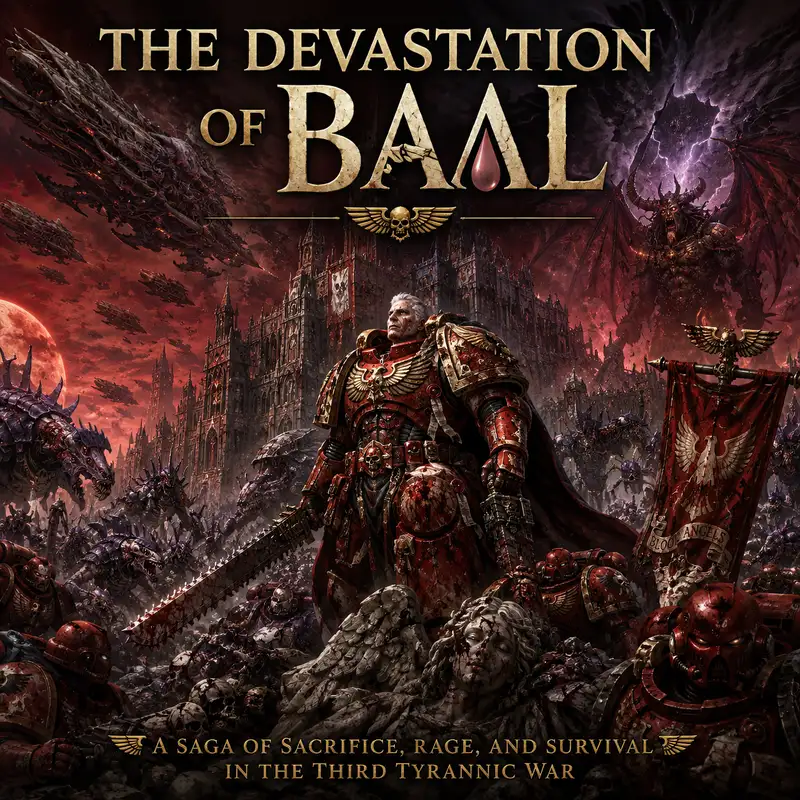
The Devastation of Baal
Baal did not lose its sun. It lost the stars. One by one, the lights above the red world vanished behind the living ships of Hive Fleet Leviathan, until the night sky looked less like space and more like the underside of an approaching ocean. Below, the fortress-monastery of the Blood Angels waited amid deserts poisoned long before the Imperium existed. Its guns were loaded. Its walls were manned. Its commanders had counted every warrior, every shell, and every hour they believed remained. None of those calculations produced victory. The question at Baal was no longer whether the defenders could destroy the enemy. It was whether they could remain alive long enough for something, anything, to alter the arithmetic. The Blood Angels had prepared for an apocalypse. The difficulty was that this apocalypse could think, learn, and take a personal interest in them.
The Devastation of Baal was the climax of the Blood Angels’ war against a major tendril of Hive Fleet Leviathan during the Third Tyrannic War. It was also more intimate than an ordinary campaign. Baal was the home of their bloodline, the world of their primarch Sanguinius, and the spiritual centre of every Chapter descended from him. Its loss would shatter the shared heart of a scattered family already burdened by inherited curses, old resentments, and different ideas about what the sons of Sanguinius ought to be. Leviathan threatened to consume their bodies and prove that their brotherhood had become an empty legend. Understanding how Baal survived means following both battles at once.
Baal and its two moons were unlikely sacred ground. Ancient war had reduced them to irradiated deserts, where human communities survived beneath a red sun through discipline, scavenging, and stubbornness. Sanguinius had grown among those people before the Emperor found him, and the Blood Angels still drew recruits from them ten thousand years later. Above the wasteland rose the Arx Angelicum, a fortress-monastery filled with reliquaries, armouries, chapels, laboratories, and the memory of a First Founding Chapter. The contrast defined the Blood Angels. They created extraordinary beauty while ruling a poisoned world. They cultivated restraint while carrying a hunger for blood. Their nobility was real, but so was the violence required to maintain it.
The Red Thirst was the immediate part of their flaw, a violent craving that could overwhelm a warrior in battle. The Black Rage was the deeper doom. A son of Sanguinius lost to it believed he was living the primarch’s final hours, seeing present enemies as traitors from the Horus Heresy. Those consumed were gathered into the Death Company and sent to one last battle under the guidance of Chaplains. Against most enemies, the curse could be hidden, managed, and sometimes used. At Baal, where almost the entire bloodline assembled beneath crushing psychic pressure and the threat of extinction, secrecy became a luxury. The defenders were preparing to face the Tyranids while carrying their own catastrophe inside them.
Leviathan had not reached Baal by accident. The Blood Angels and their allies had fought its advance through the Cryptus System, a shield protecting the approaches to their home. They delayed the swarm and burned worlds rather than let their biomass feed it, but they could not stop it. The surviving tendril entered the Red Scar and turned toward Baal with deliberate force. The Hive Mind is often described as instinctive because its thoughts are alien and distributed across uncountable organisms. This campaign makes that explanation difficult to sustain. Leviathan adapted to the Blood Angels, remembered the damage they had inflicted, and concentrated against their home. Hunger remained its purpose, but hunger and malice were not mutually exclusive. The sons of Sanguinius had hurt the predator. The predator had noticed.
Commander Dante understood that the Blood Angels alone could not hold. He had led the Chapter for more than a thousand years, long enough to see legends become administrative burdens and victories become names on memorial walls. He summoned every successor Chapter that could be reached. Nearly thirty thousand Space Marines gathered in the Baal system, the largest concentration of Sanguinius’s descendants since the Heresy. Some arrived in brilliant armour with carefully guarded traditions. Others brought reputations that made their cousins reach instinctively for weapons. The Flesh Tearers came under Gabriel Seth, fierce and tired of judgment from Chapters whose flaws were merely better concealed. The excommunicated Knights of Blood also came, condemned by the Imperium but unwilling to let Sanguinius’s home die without them. It was a family reunion in the Imperial manner, meaning old grievances, loaded guns, and a reasonable expectation that most guests would be dead by morning.
Dante’s first achievement was political. He persuaded independent Chapter Masters to accept one plan without pretending their differences had vanished. These were sovereign brotherhoods with separate histories, doctrines, and wounds. Some embodied the grace associated with Sanguinius. Others had leaned into his fury. Dante did not resolve those contradictions. He gave them a purpose larger than their suspicion. Baal belonged to all of them, and Leviathan would make no distinction between the polished angel and the blood-streaked outcast. The Hive Mind achieved what ten thousand years of tradition could not. It made cooperation unavoidable.
The defence covered Baal, both moons, orbital stations, and the void approaches. Tens of thousands of Space Marines sound overwhelming until placed beside a swarm measured in trillions. The defenders possessed capital ships, ancient weapons, layered fortifications, and warriors capable of killing scores of lesser organisms. The Tyranids possessed an entire military ecology. Their ammunition and landing craft were alive. Their command network was psychic, and dead creatures could become raw material for new ones. Imperial warfare usually depends upon breaking morale, supply, or command. Leviathan carried its supply system inside its bodies and could replace local command organisms as the battle changed. The defenders could kill at an extraordinary rate and still lose, because efficiency is less reassuring when the enemy treats casualties as an investment.
The first great clash came in space. Blood Angels warships and the vessels of their successors struck the approaching bioships with torpedoes, massed batteries, boarding attacks, and nuclear fire. The void burned with armour fragments, frozen organic matter, and wrecks large enough to possess their own weather. Hundreds of Tyranid ships were destroyed. It was magnificent by any normal standard and completely insufficient. The swarm absorbed the losses, divided the Imperial formations, and closed around isolated vessels. The Angels Excelsis were annihilated with their Chapter Master. Then another mass of Tyranid ships emerged, revealing that the defenders had spent ships and lives against only part of the threat. The surviving fleet could no longer prevent landings. It had purchased time, now the only currency that mattered.
On the ground, Dante’s forces built defensive belts around the Arx Angelicum. Mortal Baalites stood beside Space Marines and heavy guns, with Chaplains ensuring that courage remained compulsory. A moat filled with lethal Thirstwater guarded part of the approach, while void shields protected the fortress from bombardment. Wave after wave broke against the lines, and for a time the plan worked. Then Leviathan began solving the defences. Lesser creatures poured into the moat until their bodies formed a bridge for heavier beasts. The image explains Tyranid warfare better than a strategic lecture. A moat is an obstacle only to an enemy that considers the soldiers filling it to be losses.
The Hive Mind also searched for weaknesses firepower could not create. A Lictor slipped behind the lines and found traces of a forgotten tunnel beneath the fortress. It detected an irregularity and called the organisms suited to exploit it. Trygons burrowed through the earth. Genestealers followed into the Arx Angelicum, where young aspirants lay sealed inside sarcophagi, undergoing transformation into Blood Angels. Dante led warriors inward to save them. The decision was emotionally and strategically unavoidable. Without those recruits, even survival would leave the Chapter without a future. It was also the response the Hive Mind had anticipated. While the defenders fought below, the Lictor reached the void shield controls and brought the protection of the fortress down.
The result was the collapse of an entire defensive logic. Tyranid artillery and flying organisms could reach positions that had been protected. Swarms flooded ground the defenders had assumed secure. Commanders died holding chambers and halls whose names had carried meaning for millennia. Five Chapter Masters were killed during the wider battle. Whole Chapters were erased or reduced to handfuls. Relics survived while their bearers did not. In the Dome of Angels and across the fortress, Sanguinius’s descendants fought beneath statues of the dead, gradually becoming the next layer of memory. The Arx Angelicum had been designed as a monument that could fight. Leviathan forced it to become what all fortresses become when the walls fail: rooms in which people decide where they are willing to die.
The fighting on the moons was equally desperate. Gabriel Seth and the Flesh Tearers fought with the aggression for which they were feared, but their savagery was not mindlessness. Seth knew his Chapter was losing brothers to war and to the flaw faster than it could replace them. Baal was a struggle over whether their particular inheritance would continue at all. The Knights of Blood fought knowing victory would not erase their condemnation. They had not come to win forgiveness. They came because whatever the Imperium called them, they were still sons of Sanguinius. In a setting built upon titles and decrees, that choice mattered more than the paperwork.
As the battle tightened, the Black Rage spread. The psychic pressure of the Hive Mind was already crushing, and another presence pressed against reality. Ka’Bandha, a greater daemon of Khorne and ancient enemy of Sanguinius, sought entry into the Baal system. Its interest was possessive rather than protective. It did not wish to save the Blood Angels. It wished to preserve the right to destroy them itself. This is the sort of assistance the galaxy sometimes provides when conventional appeals fail. The sons of Sanguinius faced an alien intelligence outside their walls, inherited madness within their minds, and a daemon at the threshold claiming a prior appointment. Baal had become a point where their history, Tyranid hunger, and the violence of the warp converged.
The Swarmlord entered the battle as the Hive Mind’s supreme battlefield instrument, a creature remade whenever its experience was needed. Its presence drove the assault toward final collapse. Dante confronted it after the defences had been shredded and the surviving sons of Sanguinius were being pushed toward extinction. The duel was not proof that one hero could reverse a lost campaign. It was the last act available to a commander whose formations were broken and whose world was dying. Dante killed the Swarmlord, but it wounded him terribly. As he lay near death, he experienced a vision of Sanguinius and believed his service had finally ended. Instead, he was denied the release he wanted. The old commander had survived another victory, which may have seemed a particularly refined punishment.
Dante’s triumph did not restore the walls or make Leviathan vanish. Tyranid organisms were beginning to strip Baal and its moons. The remaining defenders were exhausted, scattered, and surrounded. The Sanguinor, the mysterious golden figure who appears in the bloodline’s darkest moments, fought among them, but even that intervention could not turn the larger situation. Courage no longer changed the outcome. Every defence was temporary. The sons of Sanguinius had proven their unity, and the proof seemed likely to become their epitaph. Then a disaster elsewhere in the galaxy reached Baal before any conventional relief force could.
Cadia fell, and the Great Rift tore across the galaxy. The psychic shock struck the Hive Mind’s synaptic web with a violence even Leviathan had not expected. Connections between fleets, broods, and command organisms failed. Some Tyranids became little more than animals. Parts of the swarm were scattered or isolated as the warp convulsed around Baal. The Shadow in the Warp, which had smothered communication and psychic action, was disrupted by a greater storm. This was not an Imperial weapon or a reward for virtue. The same catastrophe that divided the Imperium interrupted Baal’s consumption. The galaxy opened a wound so large that, for a moment, even the Great Devourer lost its grip.
The rupture also gave Ka’Bandha a path into reality. The Bloodthirster and its daemonic host fell upon the Tyranids, slaughtering them in numbers the defenders could not have achieved. On Baal Primus, the Knights of Blood made their final stand amid the collision of swarm and daemon. Consumed by the Black Rage, they fought until their Chapter effectively ceased to exist, allowing other sons of Sanguinius to withdraw. Ka’Bandha’s intervention saved lives, but no one sensible would call the daemon an ally. When the killing ended, Tyranid skulls had been arranged across the dead moon in its mark. The message was not rescue. It was ownership. Baal escaped one predator partly because another refused to surrender its claim.
Relief arrived with the Indomitus Crusade, led by the returned primarch Roboute Guilliman. To the defenders, his appearance seemed impossible. They had fought beneath the Shadow in the Warp while the wider Imperium broke apart. Guilliman brought fleets, armies, and new Primaris Space Marines to reinforce depleted Chapters. His forces cleared the immediate system and ended the siege, but it would be misleading to say they won the battle in the ordinary sense. The sons of Sanguinius had broken Leviathan’s momentum and survived until the Great Rift disrupted the swarm. Guilliman arrived to a battlefield already transformed by sacrifice, daemonic violence, and cosmic catastrophe. He did not find a saved world. He found ruins that had not yet stopped resisting.
The aftermath exposed the loss. Baal’s moons were ravaged, populations destroyed, fortifications wrecked, and several Chapters annihilated or reduced to remnants. Primaris reinforcements offered survival, but also uncertainty. The successors had developed distinct cultures across millennia. Rebuilding them with Guilliman’s new warriors raised an uncomfortable question. Would the bloodline be restored, or standardized? Gabriel Seth feared the Flesh Tearers might survive in name while becoming something else in character. For a Chapter defined by its struggle against the Red Thirst and Black Rage, identity was bound to the flaws threatening it. Reinforcement could resemble salvation from the outside and erasure from within.
Guilliman also challenged the way the Blood Angels had treated Baal. They had long regarded local suffering as a forge that produced strong recruits. The primarch saw people living in misery with little reason to believe the Imperium offered anything better than its enemies. The sons of Sanguinius possessed the power to improve Baal and had chosen tradition instead. After fighting to save their home, they had to ask what saving a home meant. Preserving a fortress was not the same as serving its people. Protecting Sanguinius’s memory did not automatically fulfil his ideals. The criticism cut because the ruins made denial difficult.
Guilliman appointed Dante to command the Imperium Nihilus, the vast region cut off from Terra by the Great Rift. It was another burden placed upon a warrior who had begged for rest. Baal changed from the endangered centre of one bloodline into a bastion for half a divided empire. The Blood Angels and their successors began rebuilding and carrying war back into the Red Scar, where Tyranid organisms still remained. Leviathan had been checked at Baal, not destroyed as a galactic threat. The victory resembled most Imperial victories. The world remained in Imperial hands, the casualties were catastrophic, the enemy was active, and the reward for survival was a larger assignment.
Baal survived because the sons of Sanguinius did enough without ever doing enough alone. Their fleet bled Leviathan. Their fortifications delayed it. Their unity denied it a quick victory. Dante killed the Swarmlord, the Knights of Blood spent their last lives, the Great Rift shattered the Hive Mind’s control, Ka’Bandha tore into the stranded swarm, and Guilliman secured what remained. Remove any one of those events, and Baal may have been consumed. That is the defining truth of the Devastation. It was not a clean triumph or simple miracle. It was a lost battle interrupted by a greater disaster, then converted into survival by warriors who continued fighting after victory had ceased to be reasonable.
The final image is not Dante standing untouched above a defeated enemy. It is an ancient commander rising when he wanted to die, surrounded by the remnants of a family that discovered its unity only at the edge of extinction. Behind him lay broken statues, empty armour, and moons marked by alien hunger and daemonic spite. Before him waited the darkness beyond the Great Rift and an empire requiring him to become more than a Chapter Master. Baal endured, but endurance changed its meaning. The sons of Sanguinius did not preserve the old world they had known. They survived long enough to inherit a harsher one, and the burden of proving that their father’s nobility was more than a beautiful mask worn over blood.