The Deep Warp: Where Canon Ends and Speculation Begins
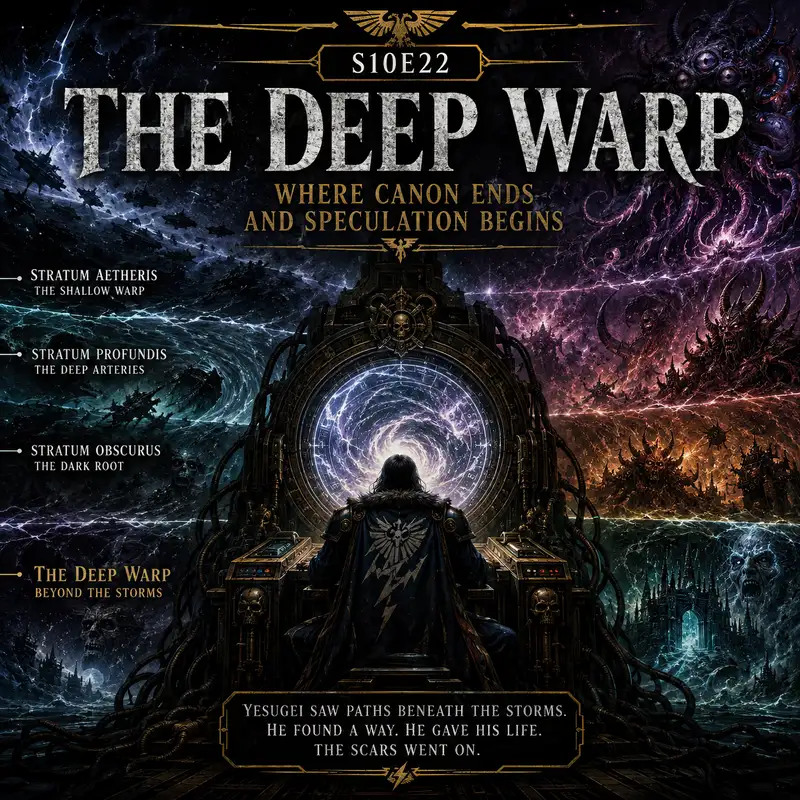
The White Scars had reached the end of every road. Traitor fleets closed around them, the routes to Terra were smothered by war, and the warp itself had become a barricade. Their last chance waited inside Dark Glass, an abandoned station built around a throne that resembled the machinery hidden beneath the Imperial Palace. When Stormseer Targutai Yesugei took that seat, he did not simply look into the warp. He saw beneath the routes that human ships believed were deep, and what he found was not a kingdom of secret monsters. It was a path.
Yesugei’s vision, described in The Path of Heaven, is the strongest canonical foundation for what fans now call the Deep Warp. He perceived layers within the immaterium, hidden ways beneath the storms, and channels connected to the Webway. The language used around Dark Glass names shallow regions, deeper arteries, and a darker obscure stratum associated with terror. At one point, the term Deep Warp appears plainly. That matters. The Deep Warp is not entirely a fan invention. The far larger mythology built around it, however, mostly is.
That distinction is the heart of the mystery. Canon supports the idea that the warp has depths, strata, and routes that ordinary human travel cannot reach. It does not provide a clean map of those depths. It does not identify a border where the familiar warp ends and a second, older realm begins. It does not catalogue creatures that make the Chaos Gods afraid. It certainly does not issue a helpful warning sign reading, beyond this point, even daemons reconsider their career choices.
The warp is already difficult to describe because it is not space in the ordinary sense. It is an extradimensional ocean of psychic energy that underlies reality, responds to thought and emotion, and refuses to obey the reassuring habits of distance, sequence, and time. A ship can cross light-years through it, yet emerge centuries late, years early, or distressingly close to somewhere the Navigator did not select. People call it an ocean because it has currents, tides, shoals, storms, and becalmed regions. None of that means it contains a literal seabed.
Human beings need metaphors to survive contact with the immaterium. Navigators speak of routes and lights. Sailors speak of weather. Psykers speak of pressure, voices, hunger, or flame. Daemonologists describe courts, gardens, fortresses, and battlefields. These images may be operationally useful, spiritually true, physically real for a time, and still not describe the warp as an objective landscape. In the immaterium, a metaphor is not merely a comparison. Given enough power, belief, and attention, it can become the nearest thing available to geography.
Imperial warp travel therefore tells us less about the full structure of the warp than it first appears. A voidship tears open reality, raises its Gellar field, and enters currents that a Navigator attempts to read by reference to the Astronomican. Even a successful voyage is an armed intrusion into an environment where the crew does not belong. The ship is protected by a bubble of imposed reality, guided by a mutant who sees what others cannot, and accompanied by enough prayer to suggest that confidence has already left the bridge.
The language of depth appears because some routes are more accessible than others. In The Path of Heaven, the Navigator agent Veil describes a shallow stratum, a deeper network of great arteries, and a darker root beneath them. He calls these regions stratum aetheris, stratum profundis, and stratum obscurus. He also insists that living humans cannot truly navigate the deeper ways. This is important evidence, but it remains one character’s technical model inside one story. It is a window, not a complete cosmology.
Veil’s explanation makes ordinary warp travel sound almost modest. Imperial vessels boast of crossing the immaterium, but by his account they mostly skim its upper reaches. Go deeper and familiar protections fail. Navigational lights vanish. The Navigator’s Eye loses its usefulness. Energy requirements become impossible. The deeper warp is not presented as a secret country waiting for a sufficiently brave expedition. It is presented as an environment in which the methods that define human warp travel stop working.
Dark Glass changes the problem because it is not simply a better warp engine. It is connected to the Emperor’s abandoned effort to gain access to the Webway, the ancient labyrinth used by the Aeldari and built upon technologies older than their surviving civilisation. The Webway allows movement across enormous distances without exposing travellers to the ordinary violence of the warp. It is not perfectly safe, as ten thousand years of breaches, invasions, and Drukhari urban planning have demonstrated, but it is safer than steering a cathedral through hell and hoping the walls remain theological.
When Yesugei activates the throne, he sees the deeper routes as part of the machinery connecting reality, unreality, and the Webway. He perceives pathways hidden beneath the storms, along with the fading echoes of slain alien powers. He understands that Dark Glass and the Golden Throne were intended to reach into those concealed ways. Then the throne consumes him. His sacrifice opens a route through which the White Scars escape their hunters and continue toward Terra. The Deep Warp enters the story as infrastructure, revelation, and cost.
That scene establishes several things with reasonable confidence. The warp can be described in layers. Some sources treat those layers as meaningfully different. The phrase Deep Warp has appeared in published fiction. Deeper routes may connect with, surround, or provide access toward the Webway. Those regions are extraordinarily dangerous and largely beyond human navigation. Ancient psychic remnants may linger there. This is already strange enough. The setting did not really need an additional warehouse full of bigger daemons, but fandom is an industrious institution.
The scene does not establish that the Deep Warp is a separate universe. It does not say the Chaos Gods are barred from it. It does not say they hide from the things living there. It does not identify the deepest stratum as the birthplace of pre-Chaos predators. It does not connect every unexplained psychic creature to a single abyss. Most importantly, it does not connect the Deep Warp to the story that usually supplies the theory with its most dramatic evidence: the Well of Eternity.
The Well of Eternity belongs to the mythology of Tzeentch and Kairos Fateweaver. Tzeentch, the Chaos God of change, ambition, sorcery, and schemes within schemes, is said to have confronted one mystery he could not solve. At the heart of the Impossible Fortress lay a well where space and time began and ended. Tzeentch would not enter it, so he cast servants into its depths. None returned until Kairos, one of his greatest Lords of Change, was hurled into the currents.
Kairos eventually emerged, altered beyond recognition. He was aged, twisted, and given two heads. His awareness reached into past and future while leaving him unable to grasp the present in any normal fashion. One head speaks truth and the other offers a lie so convincing that the distinction may be useless. Tzeentch gained an oracle who knew what even the Architect of Fate could not reliably know, which is exactly the sort of solution Tzeentch would devise: brilliant, self-contradictory, and administratively dreadful.
This tale is canonical as a story told about Tzeentch. The connection between the Well and the Deep Warp is not. The relevant daemon lore describes the Well as a mystery at the centre of reality, but it does not label it an entrance to deeper warp strata. The Path of Heaven describes the Deep Warp, but it does not mention Kairos or the Well. The popular theory takes two separate mysteries, places one beneath the other, and treats the resulting stack as a confirmed diagram.
A later essay by writer John French made the metaphorical reading of the Well unusually clear. Daemons are not independent biological creatures in the mortal sense. They are expressions, fragments, and masks of the greater powers from which they emerge. If Kairos is part of Tzeentch, then Tzeentch casting Kairos into a literal hole to learn something Tzeentch does not know produces a paradox. French’s point was not that the story is worthless. It was that the paradox is the point.
The Impossible Fortress, the Well, the act of casting Kairos into it, and the Oracle’s return are mortal-shaped images laid over something that cannot be observed directly. They describe Tzeentch knowing and not knowing, controlling and being surprised, containing the future while remaining addicted to change. The story may be experienced as an event within the warp, but it is also an explanation of a god whose nature cannot fit inside ordinary logic. Turning it into a mining shaft leading to stronger monsters makes it easier to picture and less interesting to understand.
This is where discussions of warp canon often go wrong. A description can be true without being literal in the same way a battlefield report is literal. Nurgle’s Garden is portrayed as a place through which beings can move, fight, suffer, and even cause damage. It is also an expression of Nurgle himself, a landscape made from decay, despair, endurance, and diseased affection. The Brass Citadel of Khorne, the Palace of Slaanesh, and Tzeentch’s crystal domains operate in the same unstable territory between place, symbol, and divine anatomy.
The warp does not force us to choose between saying these realms exist and saying they are metaphors. It permits the less comfortable answer that they are both. A mortal may walk through a god’s garden because, in the warp, walking through an idea can be a physical experience. A daemon can rebel against the god from whom it is formed because Chaos contains division within itself. A fortress can have halls without possessing a fixed floor plan. Anyone demanding tidy zoning regulations has selected the wrong dimension.
The same caution applies to the Webway. It is often described as existing between or within reality and the warp, protected by psychically engineered walls. The Path of Heaven suggests that reaching it requires access to deeper ways beneath ordinary warp travel. That supports a relationship between the Webway and deep strata. It does not prove that the Webway rests on the bottom of the warp, because bottom is precisely the kind of reassuring word the immaterium enjoys punishing.
Other strange dimensions make the temptation stronger. The Necron Ghostwind, encountered in The Twice-Dead King, is described as a realm of cold, singular nothingness adjacent to reality and used especially by the Flayed Ones. Its imagery feels like a basement beneath the universe. That does not make it the Deep Warp. Necron dimensional technology, the Webway, the immaterium, and other hidden states of reality may touch, overlap, or defy each other, but similarity is not identity. A mysterious cellar is not automatically connected to every other basement.
The same rule should be applied to unexplained beings. Enslavers are warp-associated predators with a history reaching back toward the War in Heaven. Umbra are shadowy entities linked in surviving accounts to the shattered god Qah. Daemons can exist outside the familiar hierarchies of the four great powers, and the warp may contain intelligences that do not fit Imperial categories. None of these facts establishes a Deep Warp origin. Unknown provenance is an invitation to investigate, not permission to write the answer in ink.
Then there is the most popular claim of all: the Chaos Gods fear what waits below them. No canonical passage clearly establishes this. Tzeentch’s reluctance to enter the Well concerns Tzeentch and the Well. It does not become proof that Khorne, Nurgle, Slaanesh, and Tzeentch share a terror of deeper entities. The Path of Heaven describes lethal depth and ancient echoes, not a pantheon of predators feeding upon gods. The theory is possible in the broad sense that the warp permits many possibilities. Possible is not confirmed.
The Chaos Gods are not necessarily omnipotent, omniscient, or free from danger. They struggle against one another, lose servants, suffer reversals, and encounter powers that resist them. Their daemons can fail, their designs can contradict themselves, and their influence depends upon conditions in both the warp and material reality. Yet limitations do not automatically imply a larger animal waiting above them in a food chain. The Great Game does not need to become a food chain with a larger predator on every rung.
There may be beings or forces in the warp that are older, stranger, or less comprehensible than the familiar gods. Canon leaves room for forgotten divinities, dead psychic empires, alien afterlives, unformed powers, and phenomena that cannot be separated into creature and environment. The deeper strata described around Dark Glass may preserve remnants from the War in Heaven or from civilisations erased before humanity named the stars. Those are reasonable areas for speculation, provided the word speculation remains attached.
One disciplined way to discuss the Deep Warp is to separate four levels of certainty. First comes what a text directly depicts or states. Second comes what an in-universe character believes, which may be informed, mistaken, or manipulated. Third comes inference, where several details support a possibility without settling it. Last comes invention, where a compelling idea fills a deliberate silence. Warhammer uses all four levels constantly. Confusion begins when the fourth is repeated with the tone of the first.
By that standard, Yesugei’s experience and Veil’s terminology belong close to the firm end. There are deeper warp strata in at least one serious model of the immaterium, and the term Deep Warp is used for them. The exact structure of those strata is less certain because the vision is filtered through human minds, unique machinery, and a moment of lethal psychic overload. The claim that the Well opens into those strata is inference at best. The claim that god-eating super-entities live there is imaginative invention.
That invention remains attractive because the four Chaos Gods have become familiar. Their symbols are known. Their daemons can be named. Their motives, however vast, can be reduced to recognizable hungers. The idea of a darkness beyond them restores the shock of the unknown. It turns the warp back into an ocean at night, with the ship’s lamps illuminating only a few metres of water and something large moving where the light fails. Cosmic horror has always understood the value of an unhelpful depth gauge.
There is nothing wrong with using that idea in a theory, campaign, or story. A hidden current that even daemons avoid is excellent material. So is an ancient intelligence that does not feed upon mortal emotion, or a route beneath the Great Game where the names of the gods have no authority. The error begins only when creative possibility is presented as recovered fact. Fan speculation is not a lesser form of engagement. It simply deserves an honest label, especially in a setting where dishonest labels are already an Imperial administrative tradition.
A more unsettling interpretation does not require stronger monsters. Perhaps the Deep Warp is dangerous because individuality, sequence, and meaning dissolve there. Perhaps the shallow warp is the region most shaped by mortal minds, while deeper strata are less responsive to familiar emotion and therefore harder to perceive. Perhaps the ghosts Yesugei sensed were not residents of a lower kingdom, but impressions left where ancient psychic structures had collapsed. These ideas fit the evidence more closely, but they remain interpretations, not revelations.
Depth itself may not describe distance. It may describe how far a traveller has moved from the assumptions of material existence. The deeper one goes, the less useful become time, direction, identity, causation, and the boundary between observer and environment. A ship cannot navigate such a place because navigation requires a ship, a destination, a before, and an after. At sufficient depth, those may be temporary opinions. The horror is not necessarily that something waits at the bottom. The horror may be that there is no bottom and no unchanged traveller to reach it.
This reading also explains why the Webway matters. Its passages impose form upon unreality. They create a route where route should not exist, walls where distance has no obligation to behave, and continuity through a medium that rejects sequence. The Emperor’s project was not merely an attempt to find a quieter road. It was an attempt to build human destiny inside protected structure, beyond dependence on Navigators and beyond exposure to the predatory sea. Dark Glass showed both the promise and the price.
Yesugei did not return from that revelation carrying a catalogue of hidden gods. He found the path his Legion needed, held it open, and died so others could cross. The scene gives the Deep Warp narrative purpose without explaining it away. Its depths are not a new army waiting beyond the known map. They are the forbidden pressure beneath the setting’s roads, glimpsed when ancient technology, psychic sacrifice, and impossible necessity briefly align.
So where does canon end? It ends after confirming that the warp has deeper ways, that at least one source calls them the Deep Warp, that those ways are nearly inaccessible to humanity, and that they touch mysteries associated with the Webway and the ruins of ancient psychic powers. Speculation begins when the Well of Eternity is declared their gateway, when every obscure entity is assigned a home there, and when the Chaos Gods are said to fear an unseen hierarchy beneath them.
The most faithful answer is neither that the Deep Warp is fake nor that every alarming theory about it is true. The phrase is canonical. The elaborate realm built around it is largely fan-made. Between those two statements lies something better than a power ranking: a genuine unknown. At Dark Glass, Yesugei looked beneath the routes of gods and mortals and saw enough to save a fleet. The canon opened a door, showed a path descending into darkness, and wisely refused to tell us what waits beyond the light.