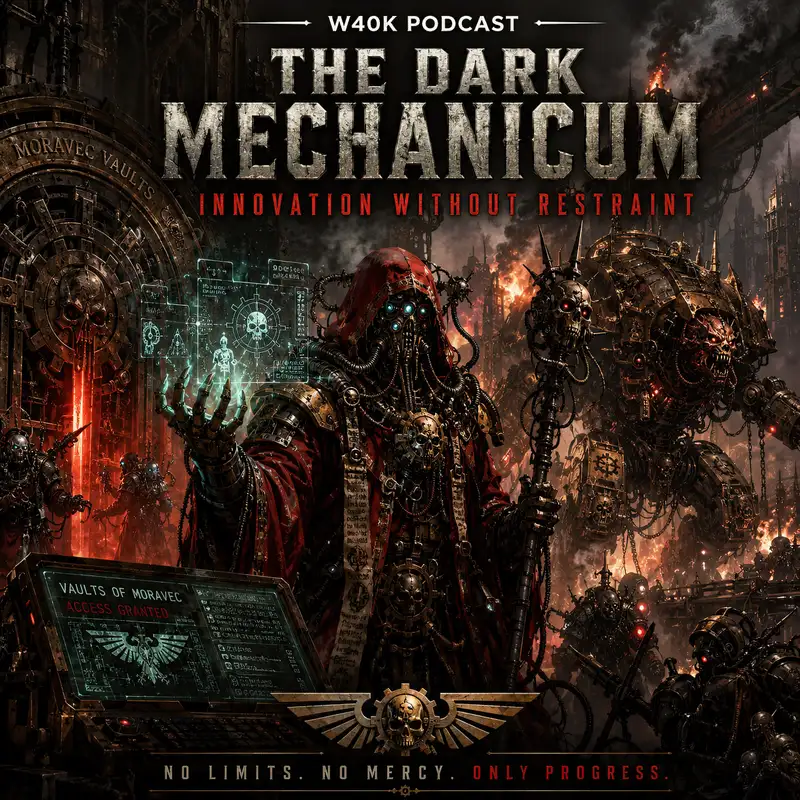
The Dark Mechanicum: Innovation Without Restraint
The first weapon fired in the civil war on Mars made no sound. It crossed no battlefield, left no muzzle flash, and gave its victims no warning. It moved through data lines, command networks, reactor controls, shield systems, and life-support machinery. Furnaces lost their restraints. Power grids turned upon the cities they sustained. Sealed habitats opened themselves to poison and vacuum. Across the red planet, machines that had served faithfully for centuries began to fail with murderous precision. This was the Death of Innocence, and it announced the birth of the Dark Mechanicum in the most appropriate way possible. Not with a new machine, but with knowledge released from its cage.
Before the Horus Heresy, the Mechanicum of Mars was already a civilisation built around a contradiction. Its priests commanded technology beyond the understanding of almost any ordinary human, yet they treated that technology as sacred inheritance rather than an open field of study. A reactor was not merely repaired. It was placated. A weapon was not simply calibrated. Its machine spirit was honoured through rite, sequence, incense, and precisely preserved instruction. To outsiders, this could look like superstition wearing a metal mask. Sometimes it was. Yet the rituals also preserved procedures whose original explanations had been lost. In a galaxy where pressing the wrong ancient control might awaken an artificial intelligence, rupture a containment field, or invite something hungry from the warp, caution was not entirely irrational.
The Mechanicum searched endlessly for fragments of humanity’s lost technological past, especially the patterns associated with the Standard Template Construct systems of the Dark Age of Technology. It valued recovery more than invention, continuity more than novelty, and approved knowledge more than personal curiosity. Certain fields were forbidden or heavily restricted. The creation of true artificial intelligence carried the shadow of the ancient revolt of the thinking machines. Uncontrolled experimentation with the warp threatened corruption on a scale no laboratory wall could contain. Alien technology was suspect. Some weapons were sealed away because even the rulers of Mars judged them too dangerous to use. The priesthood had turned survival into doctrine, and doctrine into monopoly.
That monopoly created its own resentment. Many magi did not believe the boundaries placed around them were wise protections. They saw chains. They resented the Emperor’s authority, the restrictions imposed upon their research, and the political compromise that bound Mars to Terra. Some desired independence. Others wanted access to sealed knowledge. A few simply believed that no mind, human or machine, had the right to tell them which questions could be asked. This sounds almost admirable until one remembers that the questions often involved weaponised nightmares, living test subjects, and power sources capable of developing opinions.
At the centre of the coming schism stood Kelbor-Hal, Fabricator-General of Mars. Horus did not win his allegiance merely by appealing to pride or offering a place in a new order. His agents offered access. The Warmaster’s emissary, Regulus, brought Kelbor-Hal the means to open the Vaults of Moravec, repositories of forbidden knowledge that had been sealed by the Emperor’s command. Within them waited ancient data, proscribed technologies, and intelligences that were not simply machines. Kelbor-Hal accepted the bargain. Whatever political calculation accompanied that decision, the act itself crossed a boundary from which Mars could not retreat.
When the vaults were opened, the scrap-code escaped. It was more than malicious programming in the ordinary sense. It spread like a digital plague and carried the touch of the warp. It infected systems, corrupted safeguards, and turned the infrastructure of Mars into an executioner. Loyalist forge-fanes were struck by cascading failures. Reactors overloaded. Defences collapsed. Essential systems became traps. Millions died while the traitors prepared to destroy those magi who remained loyal to the Emperor. The first great achievement of unrestricted innovation was therefore not a marvellous engine. It was sabotage so comprehensive that an entire technological civilisation discovered it had built its own gallows.
The name Dark Mechanicum can suggest a single organisation, a shadow version of the red-robed priesthood with matching ranks, shared doctrine, and perhaps a very sinister filing system. The reality is far less tidy. During the Heresy, the term covered the magi, forge worlds, cybernetic cohorts, Titan Legions, and industrial powers that joined Horus or embraced forbidden technologies. In later millennia, their descendants and imitators became even more fragmented. Some serve individual Chaos Gods. Some bargain with traitor legions. Some rule isolated forge worlds inside warp storms. Some still claim to represent the true spirit of the ancient Mechanicum. They are united less by obedience to one authority than by their rejection of the old limits.
Those limits are what make the Dark Mechanicum so dangerous. A loyal tech-priest may refuse to create a thinking machine, bind a daemon, graft alien organs into a weapon, or feed human minds into an experimental control system. A dark magos sees four unexplored research programmes. The forbidden becomes attractive precisely because it is forbidden. Warp energy can replace conventional power. Daemons can provide instinct, aggression, and intelligence. Flesh can be reshaped into circuitry. Captives can become processors, fuel, or components. Alien devices can be dismantled without concern for contamination. Failure ceases to be a reason to stop. It becomes evidence that more subjects are required.
The restrictions of the Mechanicum were often cruel, political, and self-serving, but they were not meaningless. Humanity’s history contained genuine reasons to fear autonomous intelligence. The warp did contain predatory beings eager to enter realspace. Ancient weapons did sometimes destroy their makers. Technologies recovered from dead civilisations could carry dangers invisible to their new owners. The Dark Mechanicum’s mistake was not curiosity. Curiosity is one of the few forces in the setting that might have improved human existence. Its mistake was treating every warning as cowardice, every safeguard as oppression, and every surviving subject as proof that the procedure was safe.
Daemon engines are the clearest expression of this philosophy. They combine machinery with a bound warp entity, creating a weapon that can think, hunt, hate, and sometimes repair itself through means that no honest engineer would care to explain. Early examples appeared during the Horus Heresy, and the concept endured because it solved several problems at once. A daemon does not require a conventional artificial mind. It provides motive power beyond ordinary engineering, reacts with supernatural speed, and brings its own appetite for violence. The experiment is efficient, provided one excludes the binding rituals, the sacrifices, the risk of possession, the tendency of the machine to turn on its handlers, and the possibility that the prisoner inside the engine is merely waiting.
Some daemon engines resemble armoured beasts. Others crawl on brass limbs, drag gun platforms through the ruins, or stride above infantry like industrial nightmares that have learned to stalk. Brass Scorpions, Blood Slaughterers, Decimators, and Kytans differ in form and origin, but they share a central obscenity. The machine is no longer merely a tool, and the daemon is not merely a pilot. Each has been forced into the other until the distinction becomes difficult to maintain. The result can be enormously powerful. It can also be furious, unstable, and intelligent enough to resent every hand that tightened its chains.
The same principle was applied to the battle-automata of the Mechanicum. Malignant scrap-code could burn through the sanctified patterns within a cybernetica cortex, destroying or displacing what the priesthood understood as the machine spirit. A malefic presence could then inhabit the emptied shell. The automaton would continue to move, but discipline gave way to hunger. Ranks of these corrupted constructs formed ruinous hosts under fallen magi, no longer governed solely by command routines but driven by an urge to kill. The process produced a more aggressive war machine. It also replaced reliable obedience with supernatural compulsion, which is an unusual definition of improved control.
The Dark Mechanicum did create genuinely new designs. During the war on Mars, strange stalker constructs emerged from traitor forges in vast numbers. Multi-legged engines crossed broken industrial terrain, carried weapons that conventional platforms could not easily mount, and reflected design principles freed from the need to resemble human vehicles. Forge worlds such as Cyclothrathe embraced profane automata and dangerous enhancements. Sarum became associated with savage engines made for close slaughter. Xana developed its own feared traditions under masters such as Anacharis Scoria. These were not merely old machines with spikes added. The traitor magi could be imaginative, technically brilliant, and terrifyingly productive.
That fact matters because the Adeptus Mechanicus is sometimes described as incapable of invention, while the Dark Mechanicum is cast as the side that still understands science. The distinction is too simple. Loyal magi adapt, experiment, and occasionally produce innovations, even if they conceal the process beneath claims of rediscovery or divine revelation. Their institutions make innovation slow, dangerous to the inventor’s career, and vulnerable to accusations of heresy. The Dark Mechanicum moves faster because it has removed many of those barriers. Yet speed alone does not make its work wiser. A forge can produce a revolutionary weapon in a month when it is permitted to consume a city in the attempt.
Nor did the traitors create a culture of open inquiry. Knowledge remained power, and power was guarded. A dark magos might hide a discovery from rivals, sabotage a competitor, encrypt a design so thoroughly that it died with its creator, or bind the entire production process to a personal pact with a daemon. Forge lords became tyrants over private industrial kingdoms. Their laboratories were not universities exchanging results for the common good. They were fortresses, temples, slaughterhouses, and arsenals. Peer review existed mainly in the form of surviving an assassination attempt by someone who believed the conclusions were insufficiently respectful.
Chaos made this isolation worse. A magos dedicated to Tzeentch might pursue endless transformation, secrets, and devices whose purpose shifted as they were built. A servant of Khorne might reduce engineering to the production of ever more efficient slaughter. Nurgle’s influence could fuse decay with endurance, creating machines that continued functioning because failure itself had become part of their design. Slaanesh could turn precision into obsession and refinement into a hunger that no final model could satisfy. Others served Chaos Undivided, worshipped the Omnissiah in altered forms, or treated daemons as resources rather than gods. There is no single Dark Mechanicum creed, only many roads leading away from restraint.
The magi often believed they were the masters of those roads. They possessed binding circles, command ciphers, true names, sacrificial formulae, and engines designed to imprison beings of the warp. They could point to successful creations as evidence that will and intellect had conquered superstition. Yet a daemon is not an inert battery. It lies, bargains, waits, and learns the weaknesses of its captor. Scrap-code can change the mind using it. Warp exposure can turn ambition into obsession so gradually that the victim experiences corruption as clarity. The dark magos may remain convinced that every decision is rational, even while building the altar upon which that rationality will be sacrificed.
This is why the phrase innovation without restraint is both accurate and incomplete. The Dark Mechanicum removes external restraints, but it does not become free. The laws of consequence remain. So do the appetites of Chaos. A researcher who rejects every ethical boundary may become dependent on victims. One who rejects every technical safeguard may become dependent on daemonic intervention. One who refuses every authority may end as the servant of a warlord, a traitor legion, or a god. The chain is still present. It has merely been heated, sharpened, and inserted beneath the skin.
The relationship between the Dark Mechanicum and the forces of Chaos is therefore one of mutual need and mutual contempt. Traitor Space Marines require ammunition, armour, starships, repairs, siege engines, and the maintenance of technologies their warriors cannot reproduce alone. Dark forge lords require protection, raw materials, slaves, captured relics, and access to battlefields where their creations can be tested. Warpsmiths occupy some of the same territory, combining the traditions of the Space Marines with forbidden engineering and daemonic craft. Cooperation is common. Trust is not. The contract usually lasts until one side discovers it can convert the other into spare parts.
In the later age of the Imperium, Vashtorr the Arkifane gives this world of corrupted invention a daemonic face. He is associated with forges, weapons, engines, and the ruthless urge to create without moral limit. That makes him a natural patron, ally, or object of fascination for some hereteks and warpsmiths. It does not make him the universal ruler of the Dark Mechanicum. The faction is too old, too divided, and too jealous for such a simple hierarchy. Vashtorr represents the principle they embody: invention stripped of conscience, where the worth of a creation is measured by what it can accomplish and never by what it costs.
The cost is rarely borne by the inventor alone. Dark forge worlds consume populations. Workers become thralls, their bodies altered for specialised labour until the distinction between person and equipment disappears. Prisoners may be wired into guidance systems or used to feed rituals. Entire landscapes are poisoned by production that acknowledges no duty beyond output. A weapon may be brilliant while the society that creates it becomes incapable of producing anything except weapons. This is one of the Dark Mechanicum’s deepest failures. It can manufacture wonders, but it cannot build a humane civilisation, because humanity has been reclassified as material.
Even its greatest successes are difficult to preserve. Real progress depends on more than novelty. A discovery must be understood, reproduced, taught, maintained, and used without destroying the system that supports it. Dark Mechanicum creations are often personal, unstable, or bound to unique warp conditions. A daemon engine may function only while its captive remains contained. A weapon may require sacrifices that cannot be sustained. A design may be so corrupted by scrap-code that copying it spreads the infection. A magos may jealously retain the only complete set of instructions. The machine works. The method does not become a dependable foundation for the future.
This is where the Dark Mechanicum and the Adeptus Mechanicus become distorted reflections of one another. The loyal priesthood protects knowledge so fiercely that it often prevents understanding. The renegades pursue understanding so ruthlessly that they destroy the conditions in which knowledge can endure. One turns caution into paralysis. The other turns curiosity into predation. One may preserve a machine for ten thousand years while forgetting why it works. The other may create something entirely new and discover, somewhat late in the proceedings, that it has been creating itself through them.
The tragedy is that the original desire was not entirely wrong. Humanity does need invention. It cannot survive forever by repairing the relics of a better age. The Imperium’s fear of new knowledge leaves it brittle, dependent, and vulnerable. A magos who looks upon that stagnation and demands the freedom to experiment has identified a real problem. The Dark Mechanicum’s answer is monstrous because it takes a necessary virtue and removes every companion virtue that gives it purpose. Curiosity without humility becomes arrogance. Courage without caution becomes recklessness. Intelligence without conscience becomes merely a more efficient form of cruelty.
So the Dark Mechanicum is not frightening because it proves that innovation is evil. It is frightening because it proves that innovation alone is not good. Its forges can produce weapons the orthodox priesthood would never dare imagine. Its masters can combine machinery, flesh, alien science, and the warp in ways that break ancient limits. They can make engines that hunt, fortresses that think, and soldiers that continue fighting after death should have ended the argument. Yet every triumph carries the same question: who is controlling whom?
On Mars, the answer first appeared in the systems infected by scrap-code. Kelbor-Hal and his allies believed they had opened a prison and seized its treasures. In doing so, they released forces that killed millions, corrupted their followers, and transformed a political rebellion into something far darker. The pattern has repeated ever since. A seal is broken. A safeguard is dismissed. A new engine rises from the forge. Its creator calls this freedom, right up to the moment the machine begins to call him a component.